

Radio Control: Helicopters
Dave Chesney
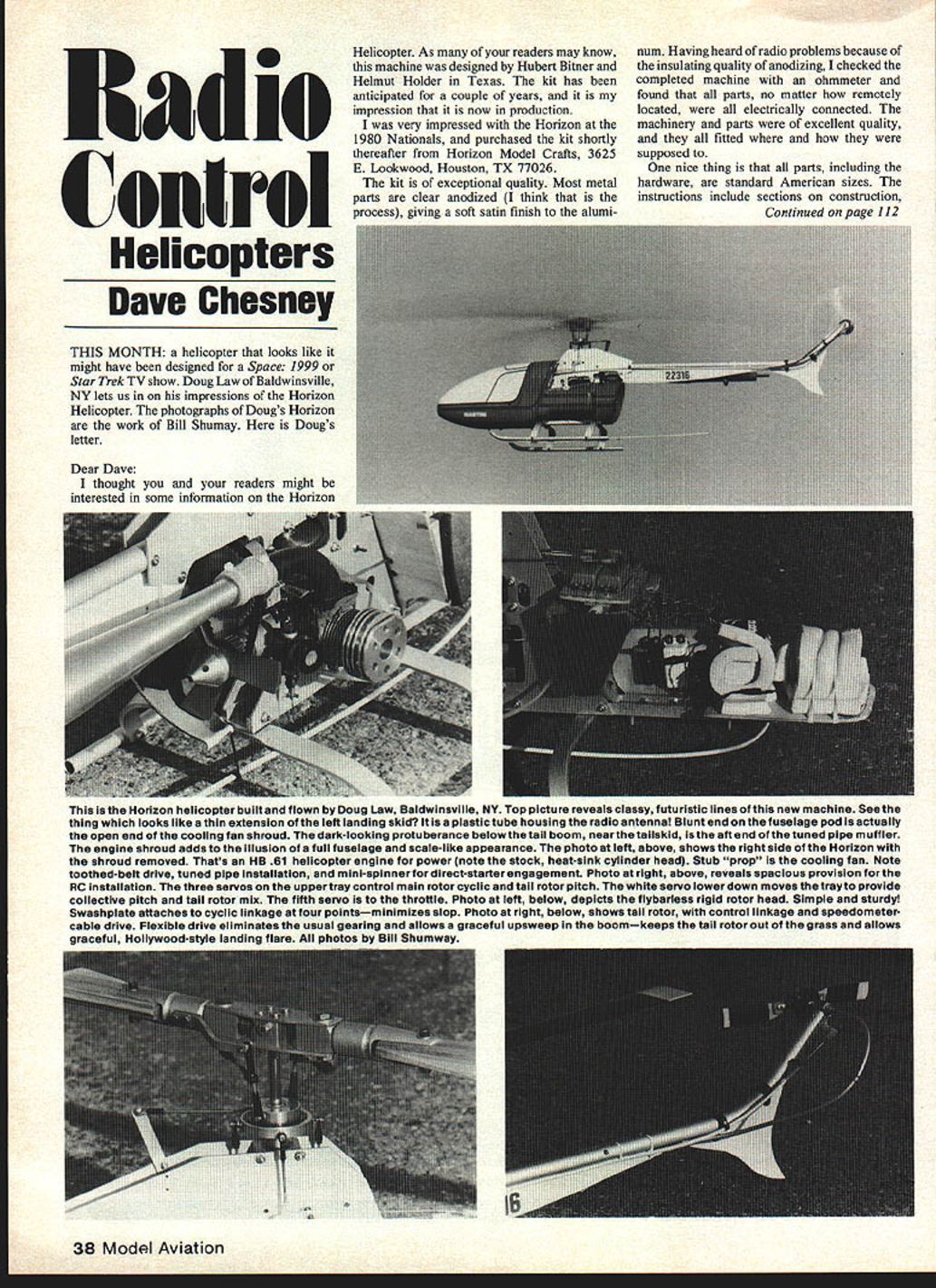
This month: a helicopter that looks like it might have been designed for a Space: 1999 or Star Trek TV show. Doug Law of Baldwinsville, NY lets us in on his impressions of the Horizon Helicopter. The photographs of Doug's Horizon are the work of Bill Shumway. Here is Doug's letter.
Letter from Doug Law
Dear Dave:
I thought you and your readers might be interested in some information on the Horizon Helicopter. As many of your readers may know, this machine was designed by Hubert Bitner and Helmut Holder in Texas. The kit has been anticipated for a couple of years, and it is my impression that it is now in production.
I was very impressed with the Horizon at the 1980 Nationals and purchased the kit shortly thereafter from Horizon Model Crafts, 3625 E. Lockwood, Houston, TX 77026.
The kit is of exceptional quality. Most metal parts are clear anodized (I think that is the process), giving a soft satin finish to the aluminum. Having heard of radio problems because of the insulating quality of anodizing, I checked the completed machine with an ohmmeter and found that all parts, no matter how remotely located, were electrically connected. The machinery and parts were of excellent quality, and they all fitted where and how they were supposed to.
One nice thing is that all parts, including the hardware, are standard American sizes. The instructions include sections on construction, setup, preflight checking, and problem solving. In fact, even a "What to check for after a crash" section is included. For a 60-sized collective-pitch machine, the Horizon is amazingly simple. Several clever construction and setup procedures are employed, including a pitch gauge that made me say, "I wish I thought of that!" Total time spent in construction and setup was about 20 hours.
Although the Horizon is a frame-and-tube machine, the inclusion of side cowling, a pleasing front body, a sub-fin, and a main fin make the machine stand out as very stylish and even a bit futuristic-looking.
Design and components
- Flybarless main rotor diameter: 53 in., operating at approximately 1,575 rpm.
- Main blades require approximately one and a half ounces of weight in each tip to compensate for the lack of a flybar. These weights fit into a slot milled into the back side of the hardwood leading edge; when the balsa trailing edge is in place the weights are entirely enclosed. Properly installed, this method ensures there is no chance of the weights coming out.
- Tail rotor blades are made of wood rather than plastic, probably to provide lower rotor inertia.
- All ball bearings used in the Horizon are double-shielded. Thrust bearings as well as double ball bearings are used in the blade holders.
- Engine mounts horizontally, facing rearward, and is connected to the clutch through a drive belt. A three-blade fan is used to pull air through the side cowling for engine cooling; this method has proven to be very effective.
- The fuel tank is mounted in the cowling opposite the engine and is located on the center of gravity as well as at the center of the carburetor.
- The tail rotor is driven by a speedometer-type cable in such a way as not to require any gears; this eliminates considerable friction and parts. With this system, it is not necessary to disengage the tail rotor system for autorotations.
- Collective control is produced by a sliding swashplate, which is held at four points. The linkages go to both sides of the cyclic servos, producing a very firm swashplate with a minimum of feedback to the servos. Only two linkages are required from the swashplate to the head for direct blade control. The head itself is extremely simple, rugged, and easy to set up.
- Materials: heavy plastic is used for the side cowling and front body; the canopy is Lexan; the sub-fin and fin are made of balsa and plywood. The front body is designed to break away on impact for minimum damage—it works!
Engine, radio, and weights
I used an HB .61 PDP helicopter engine with a tuned pipe in my Horizon. This engine runs well, is easy to adjust, and provides excellent power. I am not sure if the pipe actually adds much power, but it is neat-looking and gets rid of most of the oil. My machine weighs 11 pounds ready to fly, without fuel. This could probably be reduced to about 10 pounds without the tuned pipe, as considerable nose weight is required when the pipe is used.
Radio equipment includes a World Engines seven-channel receiver with EMS 1511H servos. I use an Ace Silver Seven transmitter which I have modified for concurrent use of both exponential and mixing (throttle and tail/rotor), as well as external reversing and two functions on the throttle stick for inverted flight.
Flight impressions
When it came time to fly my Horizon, I was a bit apprehensive. I have been flying helicopters for only a year, and I had heard mixed stories about flybarless machines. Having learned on and only flown a Heliboy, I was also concerned about how the Horizon would compare in performance.
How sweet it is! After only minor trimming adjustments, the Horizon lifted into a very steady hover. One thing I was immediately impressed with was the complete lack of vibration. Cyclic control inputs responded immediately, giving a very solid feeling. Tail rotor control was very positive in both directions, and the tail rotor mix was very close to being correct. The collective response made me wonder if this machine really weighs 11 pounds. An engine flameout at 25 feet proved the durability of this machine. After rearranging the skids, I fired up the engine and put in several more flights.
One noticeable difference between a flybarless machine and a good flybar machine, like the Heliboy, is an accentuated upward pitching in forward flight. It took me a number of flights to become accustomed to—and compensate for—this characteristic.
The Horizon is capable of very precise flying as well as full aerobatic capabilities. The control setup is very easy and can be anywhere from mild to wild.
In the last few weeks I have modified my Horizon for inverted flight. Yes, while it is inverted I have my hands full, but I have managed several extended periods of inverted flight. I need to work out a couple of minor details and then practice, practice, practice.
Summary
To sum up my opinion of the Horizon, the combination of simplicity, durability, styling, and precision of control makes it well suited for the flier who desires quality and performance. I thoroughly enjoy my Horizon and feel that it will take a prominent position in the helicopter community. If anyone is thinking about a high-performance collective machine, I certainly recommend that he investigate the Horizon.
Sincerely, Doug Law
Transcribed from original scans by AI. Minor OCR errors may remain.

