
Radio Control: Helicopters
Dave Chesney
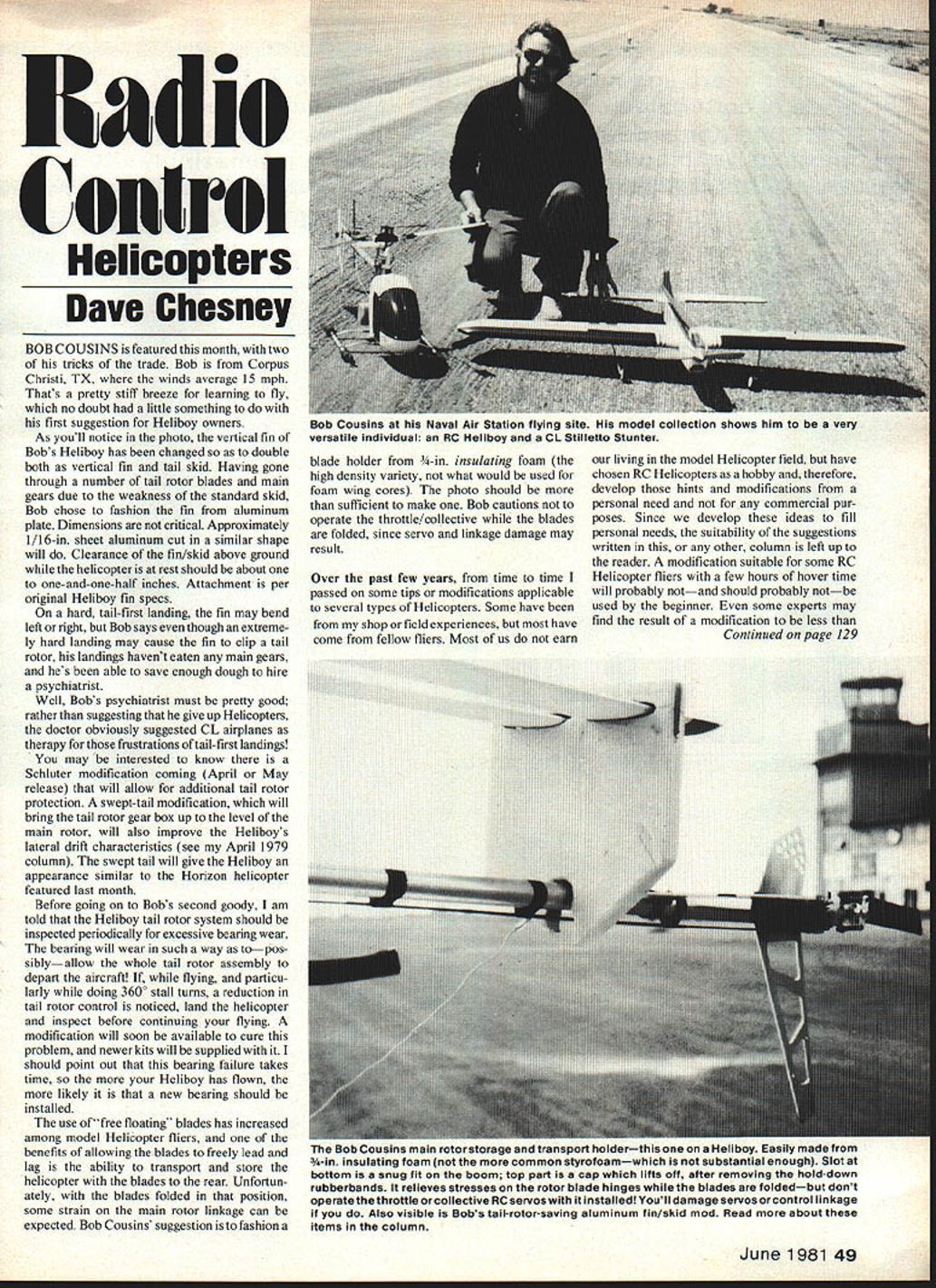
Bob Cousins is featured this month with two of his tricks of the trade. Bob is from Corpus Christi, TX, where the winds average about 15 mph. That's a pretty stiff breeze for learning to fly, which no doubt influenced his first suggestion for Heliboy owners.
1. Reinforced Vertical Fin / Tail Skid
Bob has modified the vertical fin of his Heliboy so it doubles as both the vertical fin and a tail skid. After going through a number of tail rotor blades and main gears due to the weakness of the standard skid, he fashioned the fin from aluminum plate. Dimensions are not critical; approximately 1/16-inch sheet aluminum cut to a similar shape will do. Clearance of the fin/skid above the ground while the helicopter is at rest should be about one to one-and-a-half inches. Attachment follows the original Heliboy fin specifications.
On a hard, tail-first landing the fin may bend left or right, but Bob reports that although an extremely hard landing may cause the fin to clip a tail rotor, his landings haven't eaten any main gears. He says the modification has saved him enough money to afford a psychiatrist (a lighthearted note on perseverance—he continues with RC rather than giving up).
A Schluter modification is expected (April or May release) that will allow for additional tail rotor protection. A swept-tail modification, which raises the tail rotor gearbox to the level of the main rotor, will also improve the Heliboy's lateral drift characteristics (see my April 1979 column). The swept tail will give the Heliboy an appearance similar to the Horizon helicopter featured last month.
Maintenance: Tail Rotor Bearing
The Heliboy tail rotor system should be inspected periodically for excessive bearing wear. The bearing can wear in such a way that the entire tail rotor assembly might separate from the aircraft. If, while flying—particularly during 360° stall turns—you notice a reduction in tail rotor control, land immediately and inspect the assembly before continuing. A modification to cure this problem will soon be available, and newer kits will include it. Bearing failure takes time, so the more your Heliboy has flown, the more likely it is that a new bearing should be installed.
2. Blade Holder for Free-Floating Blades
The use of "free-floating" blades has increased among model helicopter fliers. One benefit of allowing the blades to freely lead and lag is the ability to transport and store the helicopter with the blades folded to the rear. However, with the blades folded in that position, some strain on the main rotor linkage can be expected.
Bob's suggestion is to fashion a blade holder from 3/4-inch insulating foam (the high-density variety—not the foam used for wing cores). A photo (not reproduced here) should be sufficient to make one. Bob cautions not to operate the throttle or collective while the blades are folded, since servo and linkage damage may result.
- Inspect the tail rotor bearing regularly.
- Do not operate throttle/collective with blades folded in the holder.
About Modifications and Advice to Readers
Over the past few years I've passed along tips and modifications applicable to several types of helicopters. Some have come from my shop or field experiences, but most have come from fellow fliers. Most of us do not earn our living in the model helicopter field; we pursue RC helicopters as a hobby and develop hints and modifications to fill personal needs, not for commercial purposes.
Because these ideas are developed to meet personal needs, suitability is left up to the reader. A modification suitable for pilots with a few hours of hover time will probably not—and should probably not—be used by a beginner. Even experts may find the result of a modification to be less than expected, even when highly recommended by another expert flier.
As a hobbyist I cannot test every modification or design and must rely on the designer's tests or impressions from fellow fliers. To those beginning in RC helicopters, I still recommend—as I did in my first column three years ago—avoiding modifications unless recommended by the manufacturer or a local flier willing to help you with the new machine. For those of you who have flown RC for years and enjoy experimenting, I'll continue to pass on modifications as I hear from you.
I'm looking forward to some great flying weather. See you at the field!
Dave Chesney Rt. 9, Box 621-A Greensboro, NC 27409
Transcribed from original scans by AI. Minor OCR errors may remain.

