
Radio Control: Helicopters
Dave Chesney
This month, let's talk safety again. I received a memo from Geoffrey Styles, Flying Site Programs Director and AMA HQ coordinator of the Safety Committee, as follows:
"A question raised by one AMA member during the Toledo Show related to helicopters and other fixed-wing aircraft (powered) sharing the same field. Operational characteristics are different especially for the helicopter pilots who are beginners.
"Attention was drawn to the parking of cars/vans close to the helicopter flight line as a matter of convenience. The constant noise and smoke from helicopters was mentioned as a distraction for fixed-wing beginners.
"Perhaps we should consider this area of model flight and come up with some suggestions. I would be pleased to hear from both of you prior to any Safety Committee discussions. Many thanks."
Although I have answered Geoff's memo, I thought I'd share some safety tips and opinions, and invite you helicopter fliers out there to respond as well.
Field layouts and parking
Field layouts for most fixed-wing model events and sport flying vary greatly. Depending upon the available space at a local club field, or school lot for that matter, spectator separation from the flight activities can be a problem. Clubs with heavy activity in RC pylon racing may be the only clubs with clearly defined spectator/flight line separation, and even they may bend the rules (350' from pylon number 3) for weekend practice and sport flying. I would say most clubs take what they can get, due to available space.
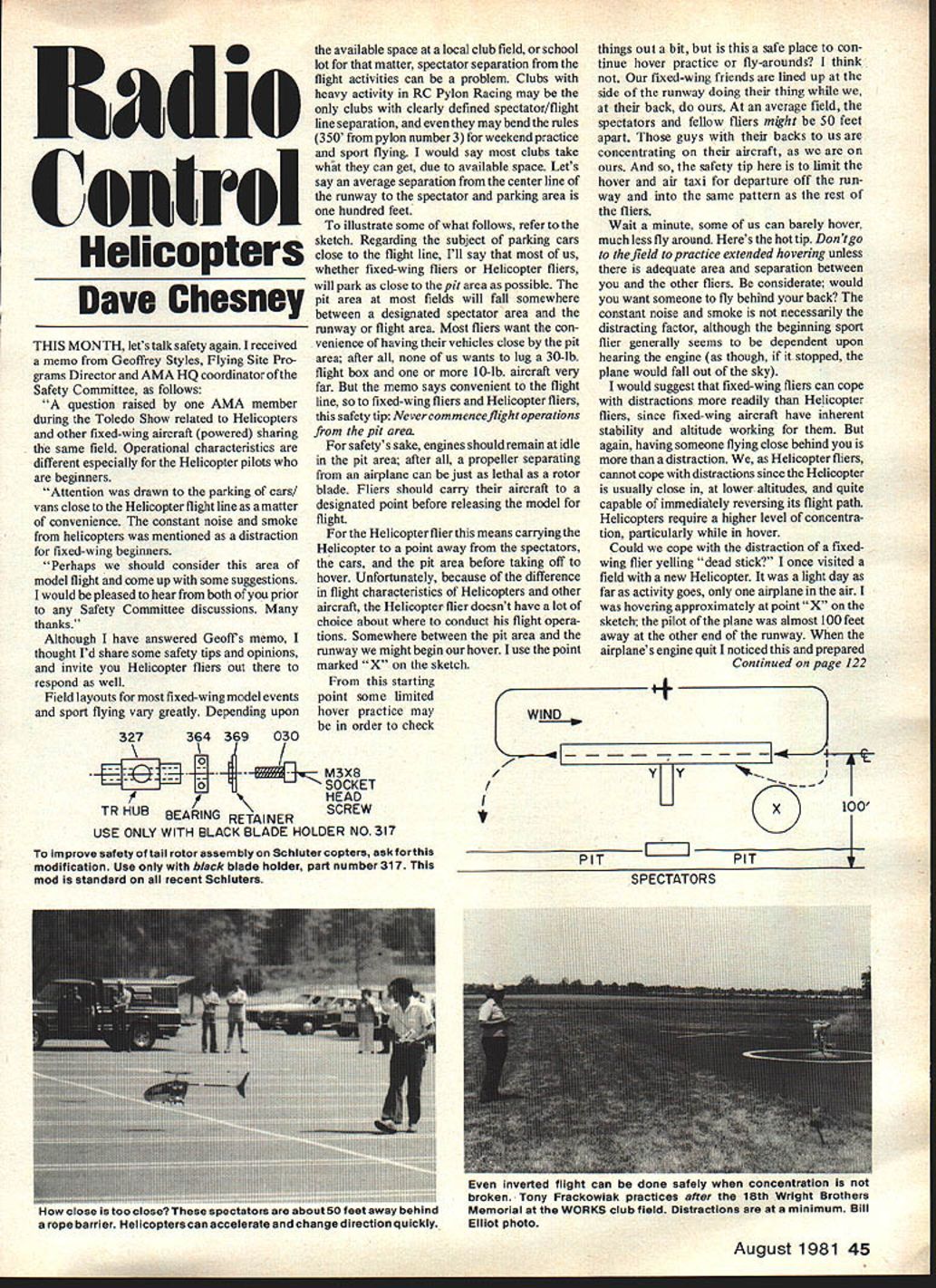
Let's say an average separation from the center line of the runway to the spectator and parking area is one hundred feet. To illustrate some of what follows, refer to the sketch. Regarding the subject of parking cars close to the flight line, I'll say that most of us, whether fixed-wing fliers or helicopter fliers, will park as close to the pit area as possible.
The pit area at most fields will fall somewhere between a designated spectator area and the runway or flight area. Most fliers want the convenience of having their vehicles close by the pit area; after all, none of us wants to lug a 30-lb flight box and one or more 10-lb aircraft very far. But the memo says convenient to the flight line, so to fixed-wing fliers and helicopter fliers, this safety tip:
Pit area and starting procedures
- Never commence flight operations from the pit area.
- For safety's sake, engines should remain at idle in the pit area; a propeller separating from an airplane can be just as lethal as a rotor blade.
- Fliers should carry their aircraft to a designated point before releasing the model for flight.
For the helicopter flier this means carrying the helicopter to a point away from the spectators, the cars, and the pit area before taking off to hover. Unfortunately, because of the difference in flight characteristics of helicopters and other aircraft, the helicopter flier doesn't have a lot of choice about where to conduct his flight operations. Somewhere between the pit area and the runway we might begin our hover. I use the point marked "X" on the sketch.
From this starting point some limited hover practice may be in order to check things out a bit, but is this a safe place to continue hover practice or fly-arounds? I think not. Our fixed-wing friends are lined up at the side of the runway doing their thing while we, at their back, do ours. At an average field, the spectators and fellow fliers might be 50 feet apart. Those guys with their backs to us are concentrating on their aircraft, as we are on ours.
Hovering, distractions, and pattern use
- Limit the hover and air taxi to departure off the runway and into the same pattern as the rest of the fliers.
- Don't go to the field to practice extended hovering unless there is adequate area and separation between you and the other fliers.
- Be considerate. Would you want someone to fly behind your back?
The constant noise and smoke is not necessarily the distracting factor, although the beginning sport flier generally seems to be dependent upon hearing the engine (as though, if it stopped, the plane would fall out of the sky). I would suggest that fixed-wing fliers can cope with distractions more readily than helicopter fliers, since fixed-wing aircraft have inherent stability and altitude working for them. But again, having someone flying close behind you is more than a distraction. We, as helicopter fliers, cannot cope with distractions since the helicopter is usually close in, at lower altitudes, and quite capable of immediately reversing its flight path. Helicopters require a higher level of concentration, particularly while in hover.
Could we cope with the distraction of a fixed-wing flier yelling "dead stick?" I once visited a field with a new helicopter. It was a light day as far as activity goes, only one airplane in the air. I was hovering approximately at point "X" on the sketch; the pilot of the plane was almost 100 feet away at the other end of the runway. When the airplane's engine quit I noticed this and prepared to clear the runway area by turning the helicopter toward the pit. I did not notice someone from the pit running up from behind me to tell me the airplane was "dead stick." That's a distraction — I crashed the helicopter to avoid hitting that person.
Assistant and crowd control
- Keep an assistant with you while you fly. He can be your eyes and ears while you concentrate on flying.
- Use ropes or other barriers to control spectator proximity during demonstrations.
A similar happening at a shopping mall flying exhibition occurred when the crowd at my back pushed in for a closer look. The helicopter was 30 feet up over my head, the crowd to my front and sides was at least 70 feet away; but as I did a tail-rotor turn towards me and flew over my head, I turned and found myself face-to-face with the crowd. The exhibition was cleared for hover demonstrations, but that distraction led to the helicopter accelerating to fast forward flight over the heads of the spectators. The crowd seemed pleased. It scared me to death! An assistant would have been handy. The security handling three sides of the crowd didn't control the fourth. We use ropes now.
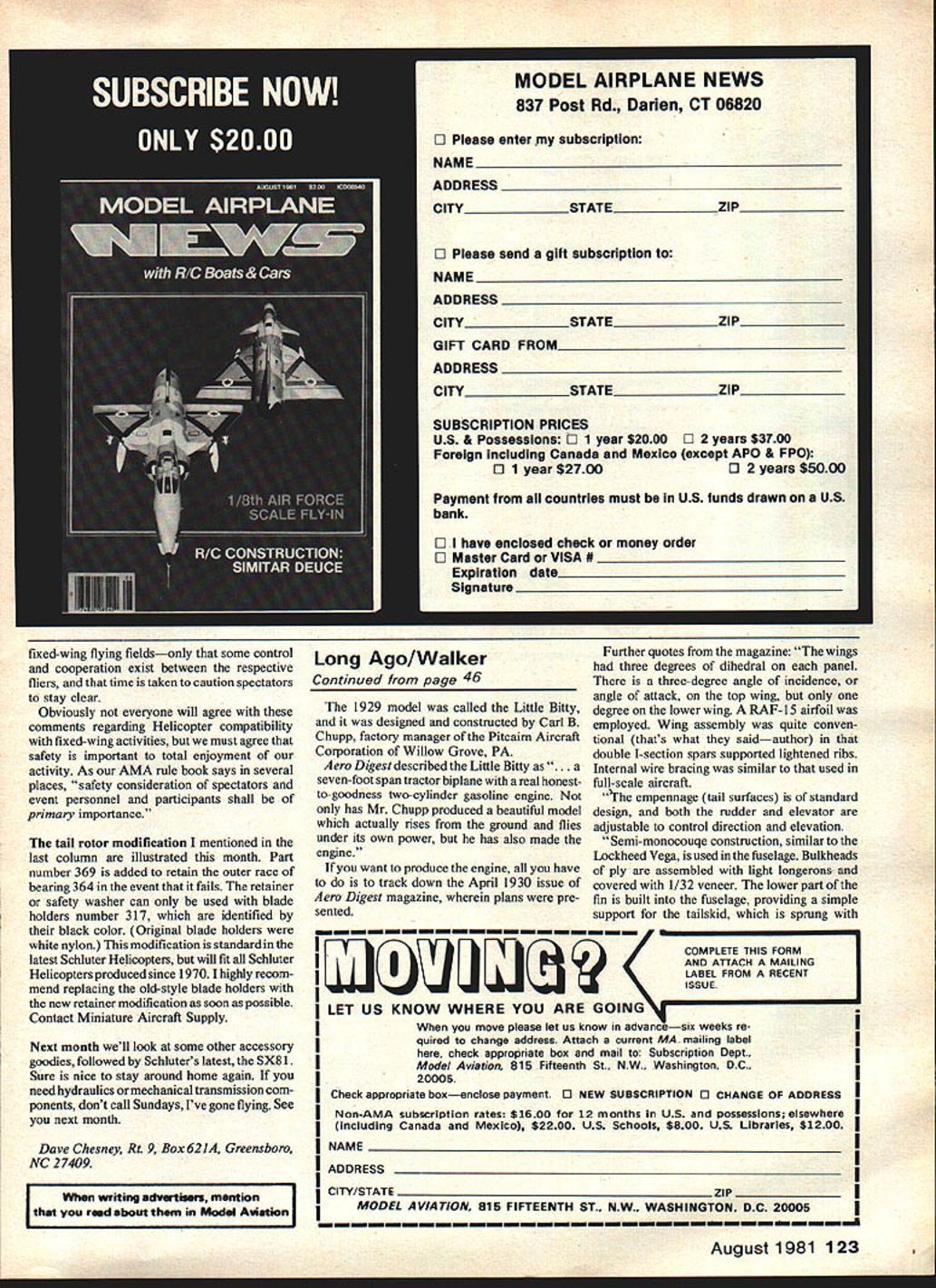
Although I suspect helicopters bore and aggravate some fixed-wing fliers, uninitiated spectators are hypnotized by RC helicopters, and will often come as close as possible to a helicopter in flight. This is particularly true when the helicopter is hovered for long periods of time; after all, the pilot is so close — it must be safe, they think.
RC helicopters are potentially more dangerous to the pilot, to spectators, and to surrounding obstacles than most other sport aircraft. (I won't tell you the story about the five cars I hit while learning to fly. Just call me "Ace.")
Compatibility with fixed-wing activities
I do not consider helicopters generally compatible with other RC activities. No, I do not suggest that helicopters be banned from RC fixed-wing flying fields—only that some control and cooperation exist between the respective fliers, and that time is taken to caution spectators to stay clear.
Obviously not everyone will agree with these comments regarding helicopter compatibility with fixed-wing activities, but we must agree that safety is important to total enjoyment of our activity. As our AMA rule book says in several places, "safety consideration of spectators and event personnel and participants shall be of primary importance."
Tail rotor modifications
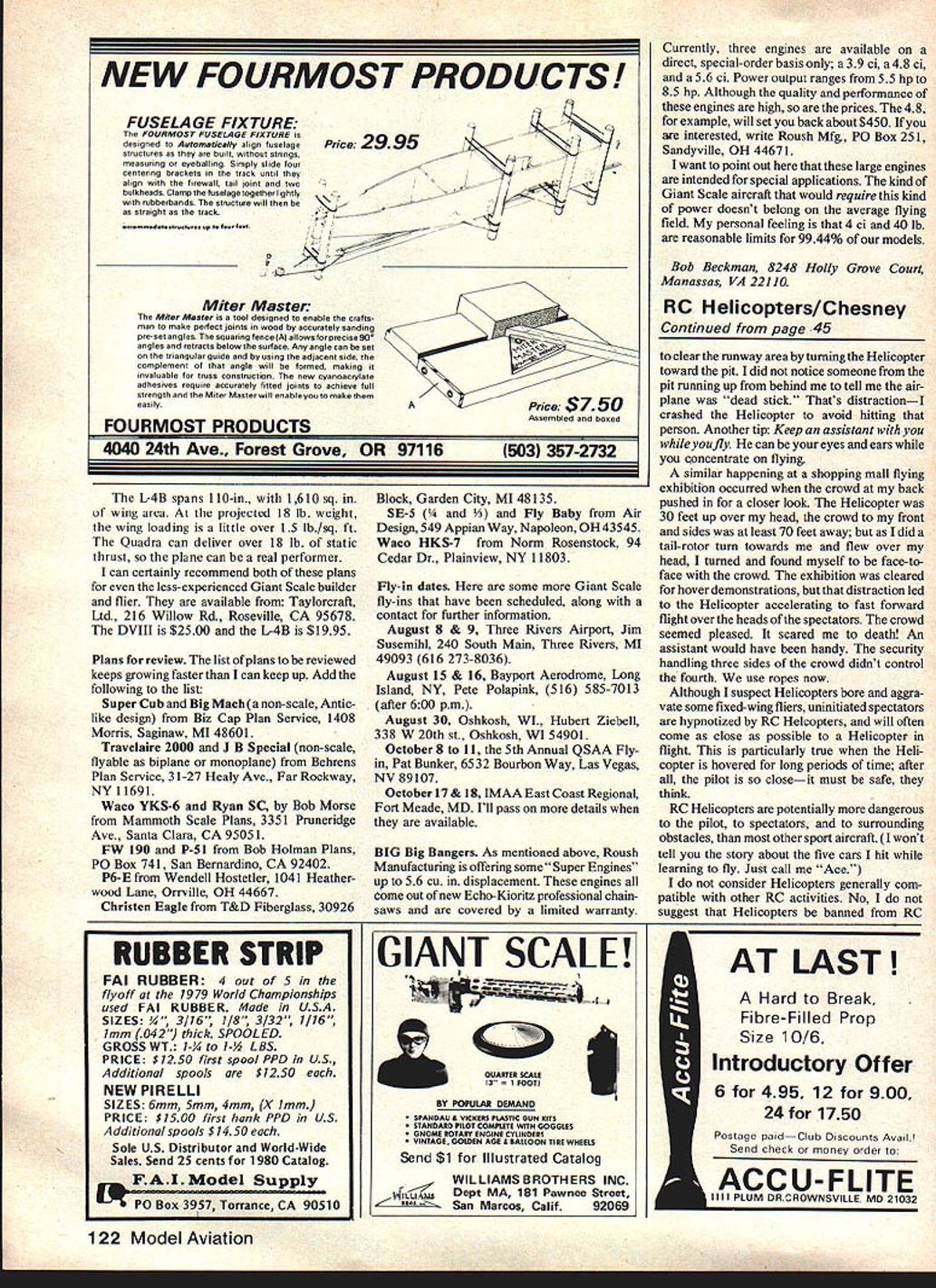
To improve safety of the tail rotor assembly on Schluter helicopters, ask for this modification. Use only with the black blade holder, part number 317. This modification is standard on all recent Schluters.
Part number 369 is added to retain the outer race of bearing 364 in the event that it fails. The retainer or safety washer can only be used with blade holder number 317, which are identified by their black color. (Original blade holders were white nylon.) This modification is standard in the latest Schluter helicopters, but will fit all Schluter helicopters produced since 1970. I highly recommend replacing the old-style blade holders with the new retainer modification as soon as possible. Contact Miniature Aircraft Supply.
Closing
Next month we'll look at some other accessory goodies, followed by Schluter's latest, the SK81. Sure is nice to stay around home again. If you need hydraulics or mechanical transmission components, don't call Sundays — I've gone flying.
See you next month.
Dave Chesney Rt. 9, Box 621A, Greensboro, NC 27409.
Transcribed from original scans by AI. Minor OCR errors may remain.

