


Radio Control: Helicopters
Dave Chesney
Reprint note
Thought I'd share this reprint from the May 1981 newsletter of the CORKS (Central Ohio Radio Kontrol Society). Dean Poeth edits The Cork and printed the following article by Ron Cottrill.
Thoughts of a Helicopter Pilot
Over the past few years that I have been reading the CORKS newsletters, I have never seen any articles concerning the fun of flying helicopters. After being the proud owner of a Cricket helicopter, purchased from the resident "expert," for a period of three months, I now know why! The darned things are not meant to fly. In case any of you innocent members out there are contemplating purchasing one of these contraptions in the hopes of flying it in the near future, please read on.
I first got the Cricket in November; however, since it was a Christmas present, I had to wait until that glorious date, December 25th, before I could proceed with this adventure. I must have flown it a hundred times in my mind in that period, figuring out every control and how I had to use both sticks together in order to maintain a smooth, easy flight. Easy, right? Read on.
Three weeks later I got the helicopter assembled and was ready for the trim flight. After reading several articles in the various model magazines, I determined that if I got the helicopter properly trimmed, it would fly itself. So, off to Ron Kumer's I went. Ron and I spent all day on a Saturday getting the balance, control throws, pitch and blade tracking set. It was a beautiful sight seeing Ron fly the Cricket for the first time.
He made it look so easy; and now finally it was my turn to show my stuff. I grabbed the control box with a great deal of confidence, wiggled the stick, and yep, everything was working. Gave it more throttle—starting to get light on the skids, fed in some tail rotor, kept the nose straight, more throttle, it was off the ground! Wait a minute! It was spinning like a top! Cut the throttle and down it came. Whew! That was close. Maybe I just made a mistake with the control, easy to do the first time, won't happen again.
I turned the helicopter around, wiggled the sticks, gave it throttle, and it started to lift off. Wait a minute! It was going forward—faster and faster. Chopped the throttle, down it came. Whew! Another close call. More practice, that's what it would take. I'd be flying in a month or two.
I took the Cricket home, fully confident that with a little more practice I would have it in a smooth, stable hover in no time. I practiced in my garage, out on the driveway and even spent an evening in Ron Eisner's basement with the same results! Either it spun like a top or it would take off in any one of four directions, with no resemblance of being in control.
I must admit, though, at one point I had it in a controlled hover approximately four feet off the ground; but what did I do next? Chopped the throttle! Did you know that the glide ratio on a helicopter is zero? I just found out! (I kept remembering through all of this that if properly trimmed, it would fly itself.)
I felt that after I hit the ground hard on several occasions and busted a rotor blade, the helicopter might possibly be out of trim. Back to Ron Kumer's I went. It was a beautiful day, no wind, sun shining—what more could you ask for? We took the Cricket out of the car, started it up, made a few trim adjustments, and it was flying beautifully. Kumer was really doing a nice job; but wait a minute! There's a clothesline! Surely he's going to miss it—or is he? Have you ever seen a bird with a broken wing flop around on the ground? That's what a clothesline will do to a helicopter.
I went through two gallons of fuel (an O.S. Max .25), three sets of main rotor blades, two sets of tail rotor blades and a canopy. My basement looks like a helicopter junk yard with all of the spare parts, and I need lots—lots more practice. But when I finally learn to fly this helicopter, I will have achieved one of the greatest personal satisfactions of accomplishment since I have been in this hobby. To me, that is what it is all about.
So, to any of you that accept the challenge—good luck!
Tools, accessories, and trimming tips
Well, Ron's thoughts bring back some memories of frustrations and broken rotor blades. And while my local "expert" couldn't fully help helicopters (we learned together), he was a whiz at trimming them out. If helicopters don't fly themselves, they sure do fly better when they're trimmed.
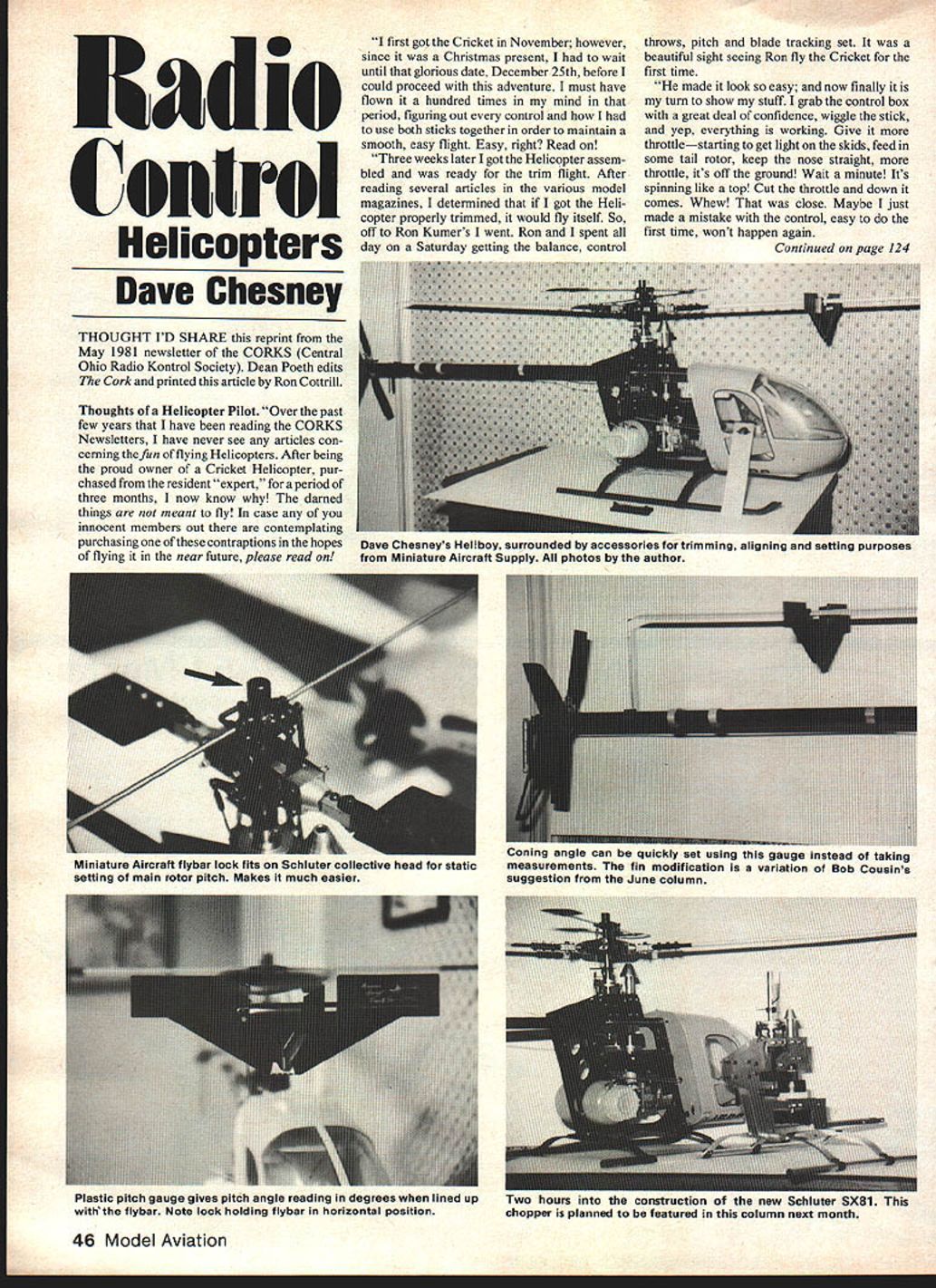
Miniature Aircraft Supply has several accessory items available to ease the trimming chores and assembly of Schlueter System 80 helicopters; some of the accessories may be adapted to other machines as well. If you check the photo of my Heliboy, you will notice the Miniature Aircraft Supply fan installation tool against the canopy. While I haven't yet had the opportunity to use this simple tool, its advantage over the routine method of installing the fan is obvious. Additional torque may be applied to the engine shaft nut without the discomfort of gripping the fan bare-handed or with a rag. The tool is simply attached temporarily in place of the clutch, and a nut driver is inserted through the machined hole to fit the prop nut. While the price for this tool (Part S1050) seems a bit steep at $5.95 for a one-time use, it should make a nice addition to the shop, and of course may be shared with friends. To produce a similar quality tool in the shop from scrap would take a little time, since this fan installation tool is free of sharp edges and is made from aircraft-grade aluminum.
Tools that will see continued service are those used for setup and trimming chores. A pitch gauge, coning angle tool, and flybar lock will round out the shop and flight-box tools for the helicopter builder and flier.
- Coning angle tool (S1060): clips to the tail boom of the Heliboy (or other machines with a similar-size boom) and its length is adjusted to represent the appropriate rotor blade-to-boom height. Once one blade is adjusted, the other is turned to the tool, adjusted to the same height, and locked down. Coning angle may be set very quickly using this tool as a guide.
- Flybar lock (S1020): complements the use of a pitch gauge by locking the flybar in a horizontal position. As far as I know, the lock is appropriate only for Schlueter helicopters using the System 80 collective pitch head (Helibaby, Heliboy, SX81, etc.). The lock fits over the screw which retains the flybar within the gimbal and down into the gimbal so that the flybar is held from teetering. A screw on the lock is tightened to secure it in place by spreading the lower portion of the lock against the gimbal body. With the flybar locked in place, a pitch gauge may easily be sighted to line up with the flybar.
- Pitch gauge (Walt Schoonard's gauge): may be used with any RC helicopter whether symmetrical, semisymmetrical, or flat-bottom rotor blades are used (up to 3-in. blade chord for symmetrical or semisymmetrical sections). When using flat-bottom sections, an adapter and rubber band are used; the adapter fits within the jaws which would normally be used to attach the gauge to the other types of blade sections. The attachment of the gauge automatically aligns the jaws to the chord line of the blade. The gauge is made of what appears to be fiber-filled plastic and should give years of service. The upper surface is aligned parallel with the flybar (the lock really helps), and the pitch angle is read directly from the bottom. Each mark is one degree—two degrees of negative pitch are shown in the picture. The gauge may be used to read other positive or negative pitch of rotor systems with either clockwise or counterclockwise rotation.
All of the items shown in the photos are available from Miniature Aircraft Supply, 2594 North Orange Blossom Trail, Orlando, Florida.
Other items that caught my eye
While we're on accessory items and new goodies, I ran across several things this past month that caught my eye.
- Cricket helicopter (available from Gorham Model Products): The little machine is even cuter in person than represented in Ken Keil's article in the January issue. I had a chance to look over the instructions and several newsletters meant to keep buyers of the Cricket up to date with modifications, problem areas and their corrections, and helpful tips. The newsletter is a nice touch, particularly for beginners.
- American RC Mantis parts: A local flier called for some help with his Cricket; while visiting a friend out of town, UPS arrived with a package from American RC containing new plastic side frames and modifications for my friend's Mantis (the Mantis was not available, since it was on loan in South Carolina). The plastic parts look good and are probably superior to the plywood construction, at least with regard to building time. The modification is available for under $20.00, so if your Mantis needs a face lift, this could be the ticket.
- Watson Industries "gyro": Watson Industries has developed an electronic device which duplicates the function of the old electromechanical rate gyro. I'm looking forward to trying one soon. If I can, I'll try one out in my new Schlueter SX81 helicopter.
A photo of the beginnings of the SX81 next to the Heliboy might lead one to wonder why Dieter didn't name the latter Lowboy. The center of gravity is higher on the SX81 than that of the Heliboy, which promises better rolling characteristics. The fuselage is very scale-like; in fact, someone not familiar with full-scale helicopters might think the SX81 is a scaled-down version of the latest attack helicopter. If time permits, I hope to have the SX81 completed and featured next month.
Meanwhile, since my Heliboy doesn't fly itself, I think I'll try my hand at it. Good flying! See you next month.
Dave Chesney Rt. 9, Box 621A, Greensboro, NC 27409.
Transcribed from original scans by AI. Minor OCR errors may remain.

