
Radio Control: Helicopters
Dave Chesney
Learning to Fly
Having experienced a few frustrations of my own lately, I thought about the September issue and my description of the frustrations of Ron Cotrill's first attempts at flying RC helicopters.
Perhaps we helicopter fliers do come across negatively at times. But then, part of the excitement of learning to fly helicopters may be that for some of us it doesn't come easily. We often have few fliers in the immediate area with which to share frustrations, and (more importantly) with which to reflect on those opportunities to learn. Yes, the first frustration of a beginning RC helicopter flier is often the lack of immediate success.
Beginning fliers should understand that the learning process is largely a result of insights gained by trial and error. When an experienced helicopter flier is available, the number of errors can be significantly reduced—but rarely eliminated. If an experienced flier is not available, the beginner must analyze each attempt to fly and avoid making the same mistake twice—the Wright Brothers approach. The important thing is not to become discouraged to the point of quitting.
In Ron's case, I believe we see a positive statement: "But, when I finally learn to fly this helicopter..." I'm sure Ron will learn to fly his Cricket.
Letter from Tom Gibbons
Tom Gibbons sent along some photos and this letter:
"I enjoy your column in Model Aviation and wanted to pass on to you and your readers a brief recounting of my experiences as a beginning heli pilot. My previous RC experience was limited to sailplanes. In April of this year, Fred Peters, owner of the local hobby shop, agreed to 'front' me with a GMP Cricket if I would build it and learn to fly it to demonstrate to our local club, Charleston RC Society, that helicopters can fly! We have over 80 members, and no helicopters. I am happy to report that the experiment worked.
"It took me about a month to put the thing together, paint the canopy, adjust, tinker, etc., trying to make sure everything was set up as John Gorham would have wanted it. At first, I went through rotor blades (and my patience) at an alarming rate. There were many tip-overs and lots of boom strikes as I tried to unlearn my habit of full-back stick flares at touchdown. The Cricket took all this abuse with hardly a chip. After about another month, things started falling into place, and I was able to maintain a fair hover and move it about my back yard a bit. I came out of the 'closet' long enough to prove that helicopters can fly, turned the Cricket back over to Fred, and bought and built my own. I am at the point now where I can do 360° hover-arounds, tail-in and left side, and a bit of slow forward flight around my back yard. I am just beginning to feel like I am (sometimes) in the cockpit. Maybe after another gallon of fuel...
"In reliving my learning experiences, there are a few things I would like to pass on to other neophytes while they are fresh in my mind:
- Get experienced help if you can—I had none available.
- Practice short sessions—three or four half-tanks every day if possible.
- Mind your tail rotor, and stay low—until you can point the chopper where you want it, and know where it's pointing, it's a crash or tip-over waiting to happen.
- Stay close, but not too close—eight to ten feet is nice; 20 feet is too far. You've got to eyeball it, and monitor its altitude constantly.
- Fly it, don't let it fly you. It's better to give it small, bum inputs that you can correct than to just hang onto the sticks as it wraps its rotor around your ankles.
- Persevere. One day, like magic, your hands will decide what to do from what your eyes are telling them, without interference. Things start to come together and you wonder why it took you so long.
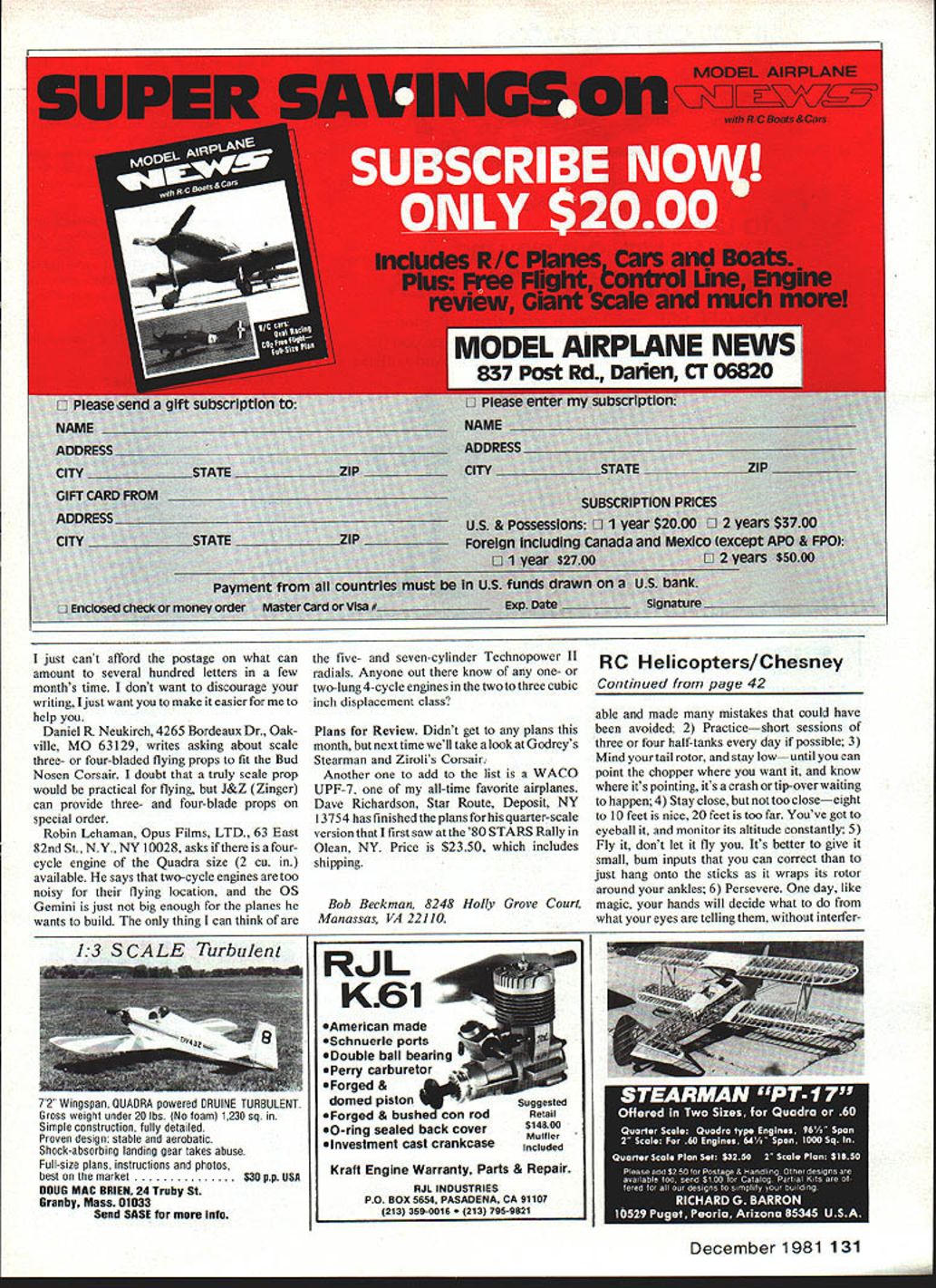
"Another tack on the same subject (helicopters), this about training gear. I pondered training gear for a long time. The Cricket has a nice, wide stance, but I wanted something longer, and skids that looked like they belong to a helicopter instead of a plumber's junk pile.
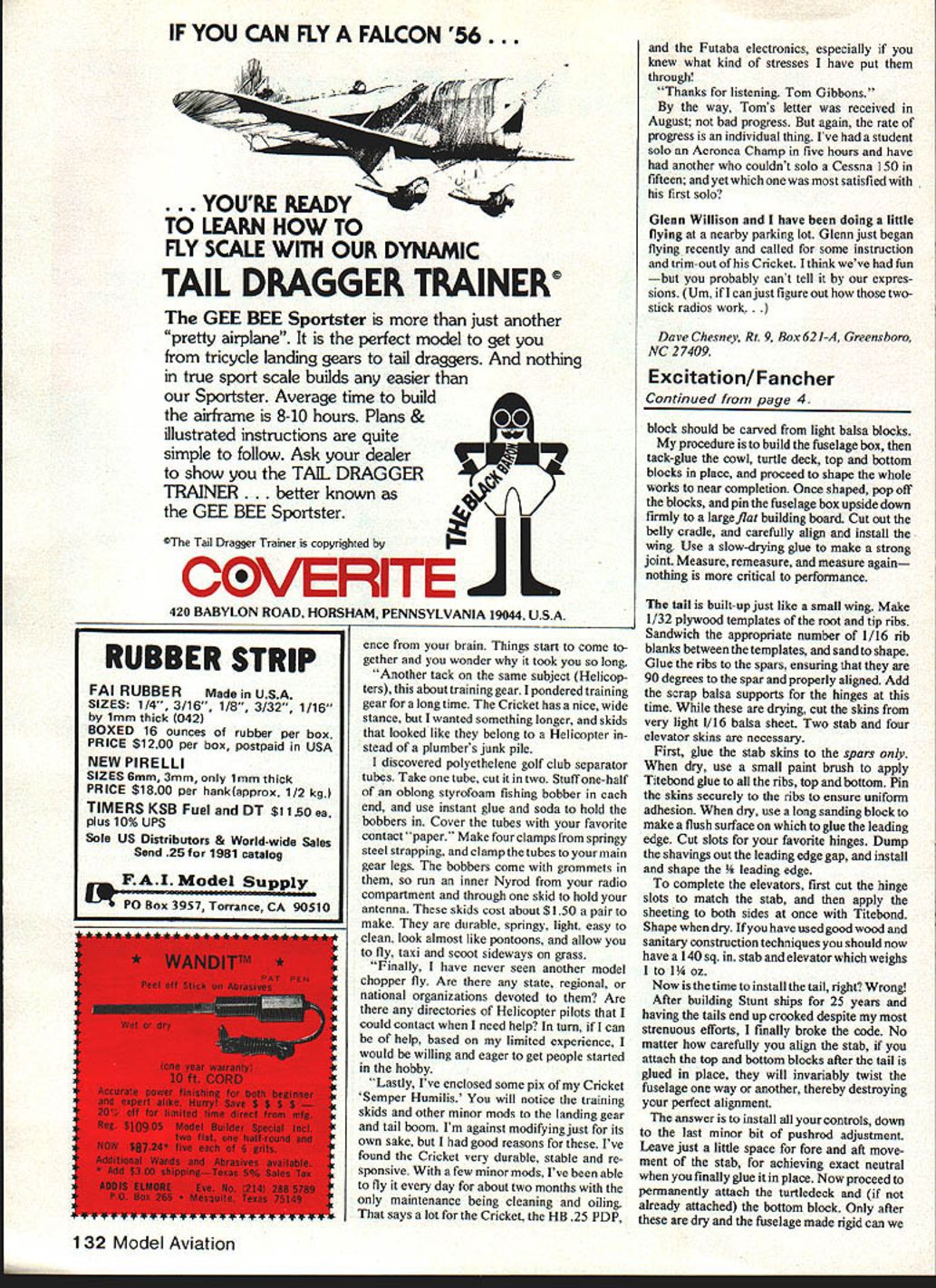
"I discovered polyethylene golf club separator tubes. Take one tube, cut it in two. Stuff one half of an oblong styrofoam fishing bobber in each end, and use instant glue and soda to hold the bobbers in. Cover the tubes with the white contact 'paper.' Make four clamps from springy steel strapping, and clamp the tubes to your main gear legs. Tie wooden dowels through two holes to hold the bobbers. The bobbers, with grommets in them, are foam and shrink-wrapped with grommet, so run an inner Nyrod from your radio compartment and through one skid to hold your antenna. These skids cost about $1.50 a pair to make. They are durable, springy, light, easy to clean, look almost like pontoons, and allow you to fly, taxi and scoot sideways on grass.
"Finally, I have never seen another model chopper fly. Are there any state, regional, or national organizations devoted to them? Are there any directories of helicopter pilots that I could contact when I need help? In turn, if I can be of help, based on my limited experience, I would be willing and eager to get people started in the hobby.
"Lastly, I've enclosed some pix of my Cricket 'Semper Humilis.' You will notice the training skids and other minor mods to the landing gear and tail boom. I'm against modifying just for its own sake, but I had good reasons for these. I found the Cricket very durable, stable and responsive. With a few minor mods, I've been able to fly it every day for about two months with the only maintenance being cleaning and oiling. That says a lot for the Cricket, the HB .25 PDP, and the Futaba electronics, especially if you knew what kind of stresses I have put them through!
"Thanks for listening. Tom Gibbons."
Tom's letter was received in August; not bad progress. But again, the rate of progress is an individual thing. I've had a student solo an Aeronca Champ in five hours and have had another who couldn't solo a Cessna 150 in fifteen; and yet which one was most satisfied with his first solo?
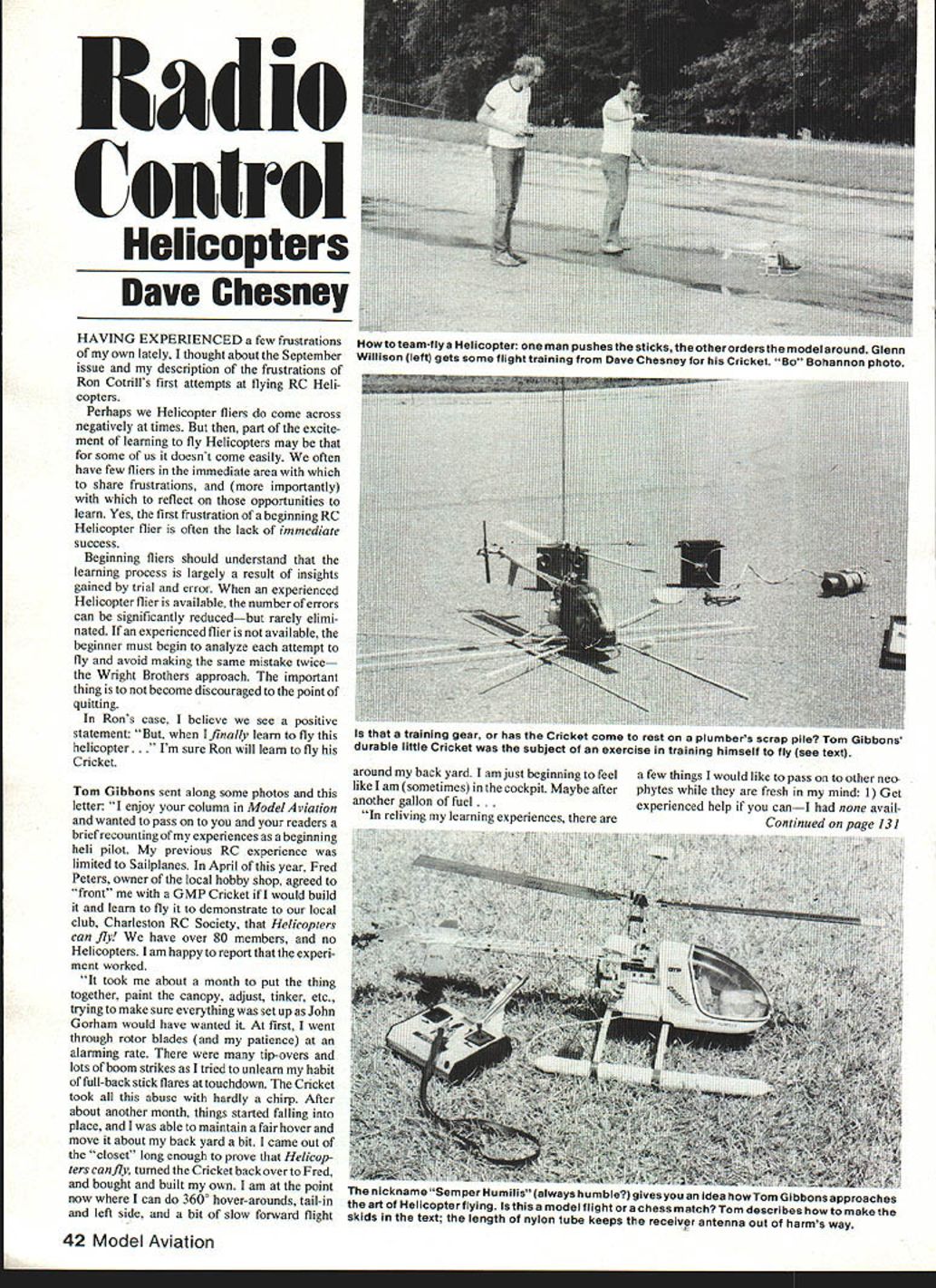
Glenn Willison and I have been doing a little flying at a nearby parking lot. Glenn just began flying recently and called for some instruction and trim-out of his Cricket. I think we've had fun — but you probably can't tell it by our expressions. (Um, if I can just figure out how those two-stick radios work...)
Dave Chesney Rt. 9, Box 621-A Greensboro, NC 27409
Transcribed from original scans by AI. Minor OCR errors may remain.

