



Radio Control: Helicopters
Dave Chesney
The Cricket and I have been flying a little since the last column, even though the weather has not cooperated fully. Cold, wind, snow or rain has been the rule here in the Carolinas the past few weeks, but three days of reasonable temperatures allowed three afternoons of flying fun.
By request, the flying site for the first forward flights was in a friend's neighborhood. My friend lives in a country subdivision with two- and three-acre lots and plenty of separation between houses and such, so don't get me wrong; I do not recommend playing tag with neighborhood houses. Cricket is suited to small areas, not so much because it is small, but because the engine noise is not so great. In fact, one spectator familiar with model aircraft activities commented on how quiet the little helicopter ran. The OS Max .25 FSR and companion muffler do make a powerful but relatively low-noise power plant.
After a few minutes of hovering in the road, slight forward stick pressure resulted in Cricket translating to a pretty departure into the wind. The first banked turn to the right was a little rough, as I had neglected to give the necessary tail rotor to keep the tail flying behind it, and the same to the left. Cricket likes attention on the tail in those turns, but the tail rotor control is as positive in forward flight as it is in the hover. By the next banked turn we were in harmony. I found Cricket to respond beautifully to my commands even when called upon to enter and exit some fairly steep-banked turns.
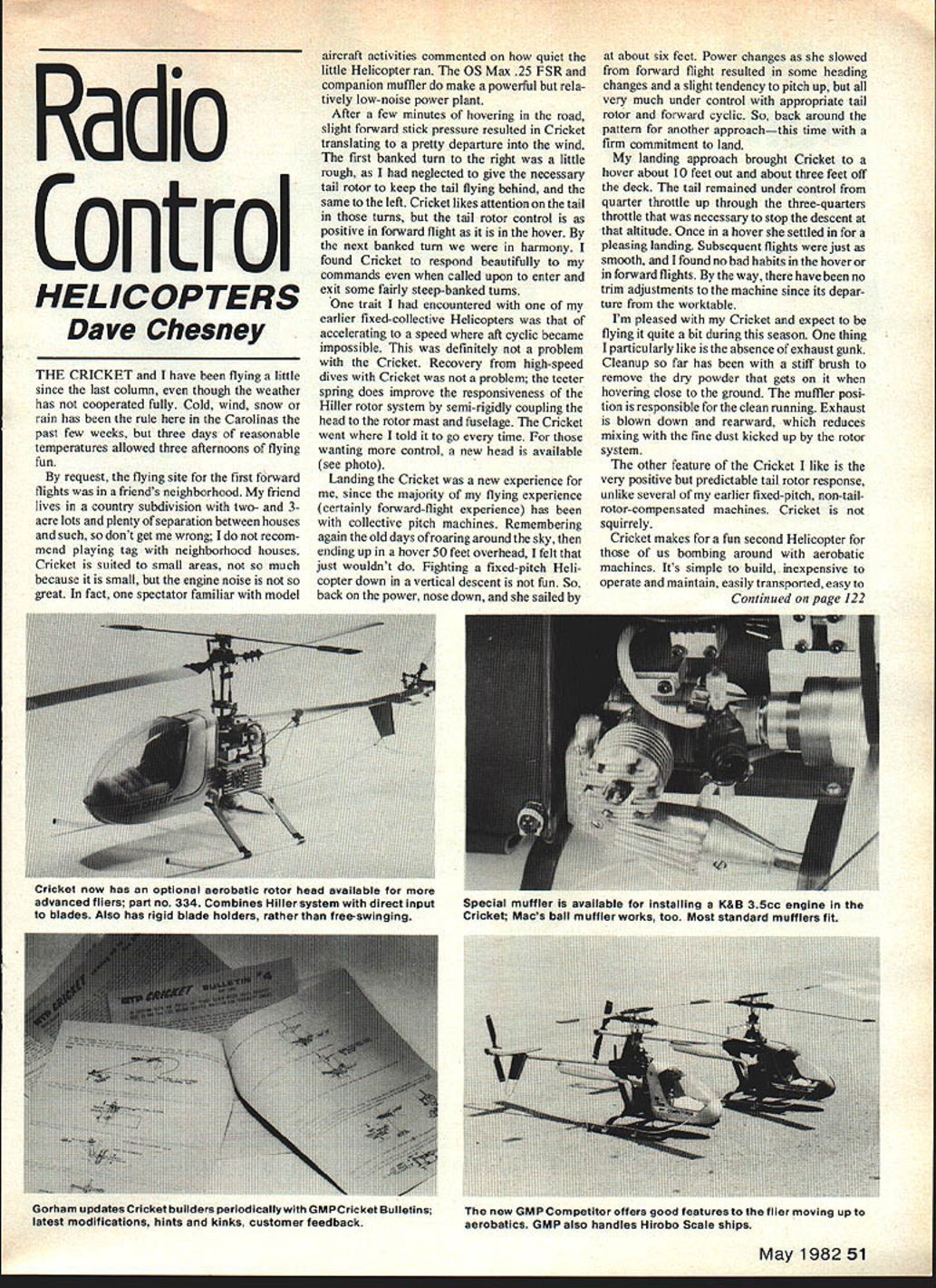
One trait I had encountered with one of my earlier fixed-collective helicopters was that of accelerating to a speed where aft cyclic became impossible. This was definitely not a problem with the Cricket. Recovery from high-speed dives with Cricket was not a problem; the teeter spring does improve the responsiveness of the Hiller rotor system by semi-rigidly coupling the head to the rotor mast and fuselage. The Cricket went where I told it to go every time. For those wanting more control, a new head is available (see photo).
Landing the Cricket was a new experience for me, since the majority of my flying experience (certainly forward-flight experience) has been with collective-pitch machines. Remembering again the old days of roaring around the sky, then ending up in a hover 50 feet overhead, I felt that just wouldn't do. Fighting a fixed-pitch helicopter down in a vertical descent is not fun. So, back on the power, nose down, and she sailed by at about six feet. Power changes as she slowed from forward flight resulted in some heading changes and a slight tendency to pitch up, but all very much under control with appropriate tail rotor and forward cyclic. So, back around the pattern for another approach—this time with a firm commitment to land.
My landing approach brought Cricket to a hover about 10 feet out and about three feet off the deck. The tail remained under control from quarter throttle up through the three-quarters throttle that was necessary to stop the descent at that altitude. Once in a hover she settled in for a pleasing landing. Subsequent flights were just as smooth, and I found no bad habits in the hover or in forward flights. By the way, there have been no trim adjustments to the machine since its departure from the worktable.
I'm pleased with my Cricket and expect to be flying it quite a bit during this season. One thing I particularly like is the absence of exhaust gunk. Cleanup so far has been with a stiff brush to remove the dry powder that gets on it when hovering close to the ground. The muffler position is responsible for the clean running. Exhaust is blown down and rearward, which reduces mixing with the fine dust kicked up by the rotor system.
The other feature of the Cricket I like is the very positive but predictable tail rotor response, unlike several of my earlier fixed-pitch, non-tail-rotor-compensated machines. Cricket is not squirrely.
Cricket makes for a fun second helicopter for those of us bombing around with aerobatic machines. It's simple to build, inexpensive to operate and maintain, easily transported, easy to clean up, and doesn't take up much space on the shop floor between flying sessions. Beginners will enjoy the little machine for about the same reasons and, as mentioned last month, for the excellent instructions and follow-up newsletters.
Cricket is available from Gorham Model Products, 23961 Craftsman Rd., Calabasas, CA 91302. GMP also handles the Hirobo line of scale RC helicopters. The fellow who hatched the Cricket writes every month in R/C Modeler magazine. John thinks everyone should "Give it a Whirl."
Vibration
Last month I mentioned vibration as a timely topic. I've had a few bouts with vibration, myself, but the following letter really opened my eyes to the significance of a vibration problem to the beginner.
Dear Dave,
I have been in RC for about seven years and am currently treasurer of the West Tennessee RC Fliers Club located in Jackson, TN. I have always been interested in helicopters but was too afraid to try them. Last November I made my fatal mistake. I got a second-hand Heliboy from a model store in Memphis. Since February of this year I have been trying to learn to trim and fly this thing. There are none around here who can help me, so I have done it all myself with some written instructions from Mike Mas. Since I have been working with this machine, there has been nothing but problems.
I just read your article in the September Model Aviation, and I have to agree with you that the thing just doesn't want to fly. I have learned to hover and fly forward after many hours of practice. In July I went to Arkansas, where I managed to pull off first place in the Beginner category by defying gravity for three minutes at a time. Walt Schoolard was there and gave me some great advice. My flying has improved very much since then. The problem is that this machine is not very reliable. It is constantly having radio failures. I never knew what the word "glitch" meant until I got a chopper. Damage from vibration is unbelievable! I installed a new radio in August, and the servos have gone to pieces already. Dave, what is it going to take to keep this machine in the air? If I don't have some better luck soon, I may have it bronzed to hang in my study.
The thing seems bent on destroying itself. So far I have had three major crashes and uncounted minor accidents, including getting caught in a whirlwind. Damage is never minor. I feel all alone in my problems, because there is no one else in the club to discuss it with. They are too busy to be bothered. Can you help? Is it smart to get involved in these things? Are there radios built for choppers, special equipment, or anything else I should know about? If there is any advice you can give me, it will be greatly appreciated.
Yours truly, Terry Sweat
P.S. If it were not for your articles and others like yours, I would never have made it this far. Thank you for that!
Well, I answered Terry's letter but needed some additional information from him and so suggested that he call me. He did call, and we discussed his problem at length. I made several suggestions, and the following letter resulted.
Dave:
I know it has been some time since we had our phone conversation about that Heliboy of mine. The weather has been rotten here, and test flying is at a premium. I appreciate your advice and will let you know how it worked. I changed all the linkages as you prescribed and set it up as you said. I made all the changes in the setup, and so far they have worked fine. The main rotor now goes from 11 1/2 degrees negative to 4 1/2 degrees positive.
The best thing I did was to change the blade coning angle. The blades were tilted up quite a bit before, but now they are almost flat. I found that this works much better. The vibration has stopped, and the blades are much easier to cone. This is the first time the chopper has been up without all that vibration. It flies more stably and hovers better now. I think this is the best flying I have ever done for it. I have not flown it forward yet as you described in our conversation, but it sure wants to go. The radio is doing fine. I seem to have a lot more rotor speed than before during hover exercises, which makes it much more stable than before.
Dave, there is one thing I would like to tell you about the chopper. In case you don't remember, I told you that I had to add a lot of extra weight to the nose to balance it: 13 oz., to be exact. When I got the machine (second-hand) I didn't take notice of how, or should I say what it was built out of. Instead of the original tail fin, the machine was fitted with a fin made from 1/8-in. plywood. Now this doesn't sound like much, but to offset the extra weight, all that lead had to be added to the nose. Yesterday, I made a new fin from a piece of cardboard and removed the lead from the nose. When I tried it out, I couldn't believe my eyes. It flew much better with more stability and less power to become airborne. That little extra weight on the tail so far away from the CG had to be offset with a lot of lead. You might caution your readers that if they break the original fin to replace it with something just as light as the original, or they may run into trouble as I did.
Thank you so much for all your help. The chopper is doing better now than it ever has before.
Terry Sweat
Terry's problems were not unique to his Heliboy, and in fact I'm sure most of us have had vibration problems of one sort or another. With helicopters it is not whether the machine vibrates but how much. How much is determined by the care with which we balance and align the rotating components.
Next month, we discuss some of the things to watch for when vibration gets out of hand.
Dave Chesney Rt. 9 Box 621A Greensboro, NC 27409
Transcribed from original scans by AI. Minor OCR errors may remain.

