
Radio Control: Helicopters
Dave Chesney
I was beginning to wonder if I would make Toledo this year. Just before departure my diesel Oldsmobile went in for a major overhaul, friends who thought they could go with me backed out, and other things went wrong. Undaunted, I departed Greensboro on schedule and drove the 11 hours solo in the Toyota.
Toledo is worth the adversity. I was sure plenty of new goodies would be on display, but I had forgotten one of the reasons for going—renewing friendships. Early Friday I ran into Horace Hagen and Gary and Russ Sherer and spent many of the non-show hours with this trio. By the end of the show we had almost convinced Russ to get into RC helicopters.
This is the year to go to Helicopters if you haven't already. If you've been flying, what a year to get something new. There were new helicopters, new radios, new accessories—you name it.
Notable aircraft and displays
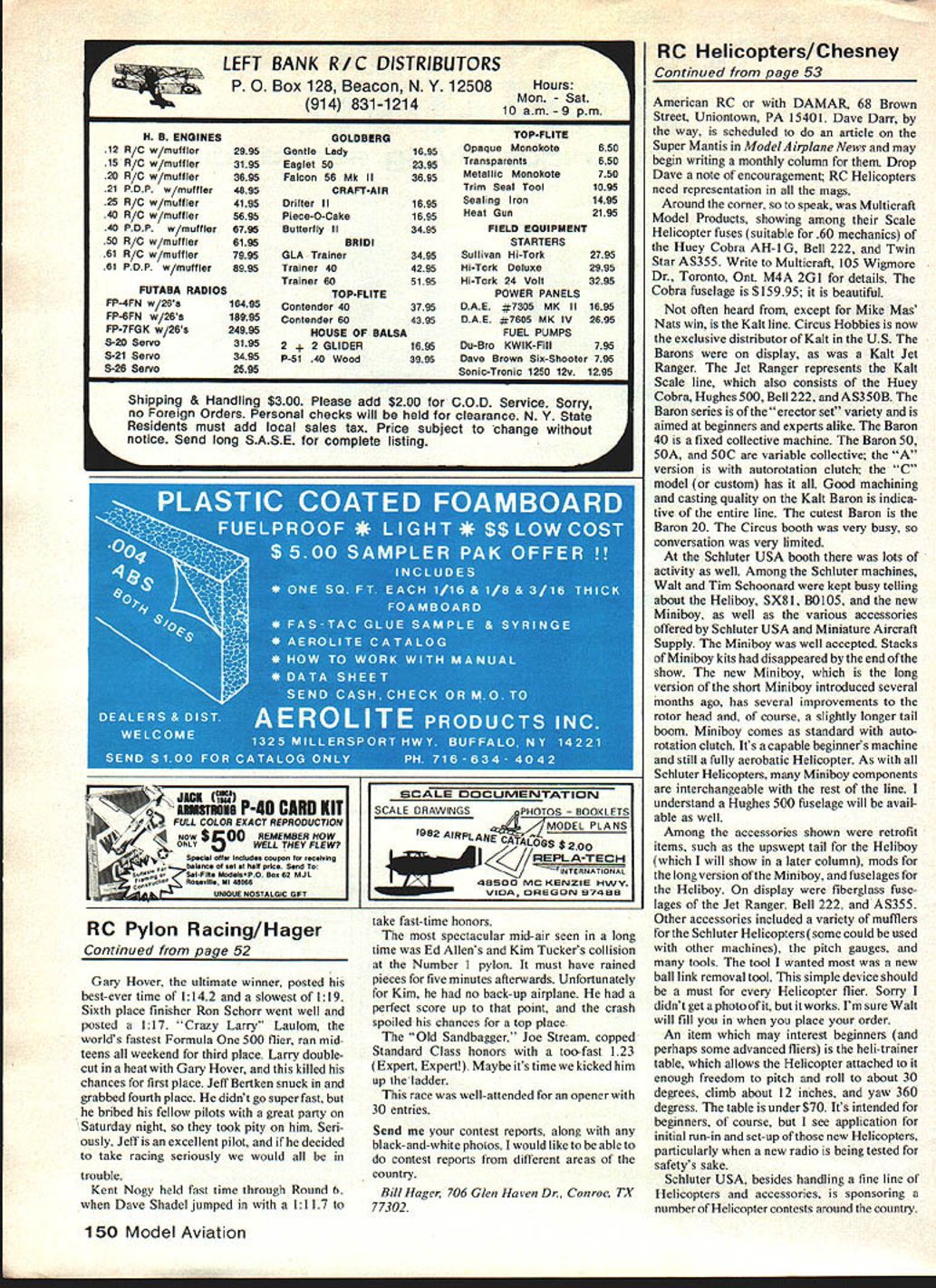
One of the most interesting aircraft (even if it's not technically a helicopter) was displayed at the Futurflite booth. The Turboplane is a unique aircraft capable of some wild flying with a .60 or .90 engine. The machine will even hover as well as fly forward on a three-channel radio. No, it's not a helicopter trainer; in fact, I'm not quite sure what it is, but it does fly, as proven by videotape presentations. The vertical rate of climb is fantastic. Could this machine account for some UFO sightings?
American RC / DAMAR
Since I hadn't heard much from American RC in two years, one of the first stops on my quick round of the show was the American booth. A return trip rewarded me with conversation with John Simone. John, as well as being a manufacturer of RC helicopters, is currently involved in movie-making and is doing some of those wild special effects. Next time you see a "real" helicopter blow up on the screen, watch for John in the credits.
American's booth was manned by DAMAR, Dave Darr's distributorship for the American RC Mantis and Super Mantis. These .40-size machines, fixed- and variable-collective respectively, feature a unique blend of fiber-filled plastic and metal parts to produce a simple but rugged helicopter. The tail rotor drive of the Mantis remains a belt-drive system, adding to the overall simplicity of the machine.
I was pleased to see the prototype of American's new spinner-starter system. The starter belt is one belt I've never particularly cared for on my helicopters. The American spinner-starter system is a simple retrofit for the existing Mantis. I didn't get the pricing on this, but it will be offered both as a retrofit for the older Mantis and as an option on the new Mantis and Super Mantis. Check with American RC or with DAMAR at:
- DAMAR, 68 Brown Street, Uniontown, PA 15401.
Dave Darr is scheduled to do an article on the Super Mantis in Model Airplane News and may begin writing a monthly column for them. Drop Dave a note of encouragement; RC helicopters need representation in all the mags.
Multicraft Model Products
Around the corner was Multicraft Model Products, showing among their scale helicopter fuselages (suitable for .60 mechanisms) the Huey Cobra AH-1G, Bell 222, and Twin Star AS355. Write to Multicraft, 105 Wigmore Dr., Toronto, Ont. M4A 2G1 for details. The Cobra fuselage is $159.95; it is beautiful.
Kalt (Circus Hobbies)
Not often heard from except for Mike Mas' Nats wins is the Kalt line. Circus Hobbies is now the exclusive distributor of Kalt in the U.S. The Barons were on display, as was a Kalt Jet Ranger. The Jet Ranger represents the Kalt scale line, which also consists of the Huey Cobra, Hughes 500, Bell 222, and AS350B.
The Baron series is of the "electro servo" variety and is aimed at beginners and experts alike. The Kalt Barons are a fixed-collective machine. The Baron 50A and 50C are variable-collective; the "A" version has an autorotation clutch; the "C" model (custom) has it all. Good machining and casting quality on the Kalt Barons is indicative of the entire line. The cutest Baron is the Baron 20. The Circus booth was very busy, so conversation was limited.
Schuler USA
At the Schuler USA booth there was lots of activity. Walt and Tim Schoonard were kept busy telling about the Heliboy, SX81, B0105, and the new Miniboy, as well as the various accessories offered by Schuler USA and Miniature Aircraft Supply. The Miniboy was well received; stacks of Miniboy kits had disappeared by the end of the show.
The new Miniboy, which is the long version of the short Miniboy introduced several months ago, has several improvements to the rotor head and a slightly longer tail boom. Miniboy comes standard with an autorotation clutch. It's a capable beginner's machine and still a fully aerobatic helicopter. As with all Schuler helicopters, many Miniboy components are interchangeable with the rest of the line. I understand a Hughes 500 fuselage will be available as well.
Accessories shown included retrofit items such as:
- Up-swept tail for the Heliboy (I'll show this in a later column).
- Mods for the long version of the Miniboy.
- Fuselages for the Heliboy (fiberglass Jet Ranger, Bell 222, and AS355 fuselages on display).
- A variety of mufflers for Schuler helicopters.
- Pitch gauges and various tools.
The tool I wanted most was a new ball-link removal tool. This simple device should be a must for every helicopter flier. I'm sure Walt will fill you in when you place your order.
An item that may interest beginners (and some advanced fliers) is the heli-trainer, which allows the helicopter attached to it enough freedom to pitch and roll to about 30 degrees, climb about 12 inches, and yaw 360 degrees. The basic unit sells for about $70. It's intended for beginners but is also useful for initial run-in and setup of new helicopters, particularly when testing a new radio for safety.
Schuler USA, besides handling a fine line of helicopters and accessories, is sponsoring a number of helicopter contests around the country. These contests are for everybody flying or interested in learning to fly, regardless of the type of machine you choose to participate with.
Schuler Cup contest dates and locations:
- Burbank, CA: May 1–2
- Atlanta, GA: May 15–16
- Orlando, FL: June 12–13
- Little Rock, AR: June 26–27
- Casey, IL: July 10–11
- Washington, DC: September 11–12
- Statesville, NC: October 16–17
- The Tangerine Internationals (date/location TBA)
Gorham Model Products (G.M.P.)
On to the Gorham Model Products booth, where Crickets like to fly—as do Hirobo scale machines. The booth was busy with lots of goodies. The Cricket was there in both Custom and Super Custom versions. The Super Custom is a gold-and-black anodized kit with the new fully assembled Gold Head featuring hardened bearings and rigid blade holders (the standard head has a single-point blade holder attachment, and blades are free to lead/lag).
To go with the Custom or Super Custom Cricket, consider floats for training or water operation. The floats are lightweight foam and may be used as is, painted, or epoxy-glassed.
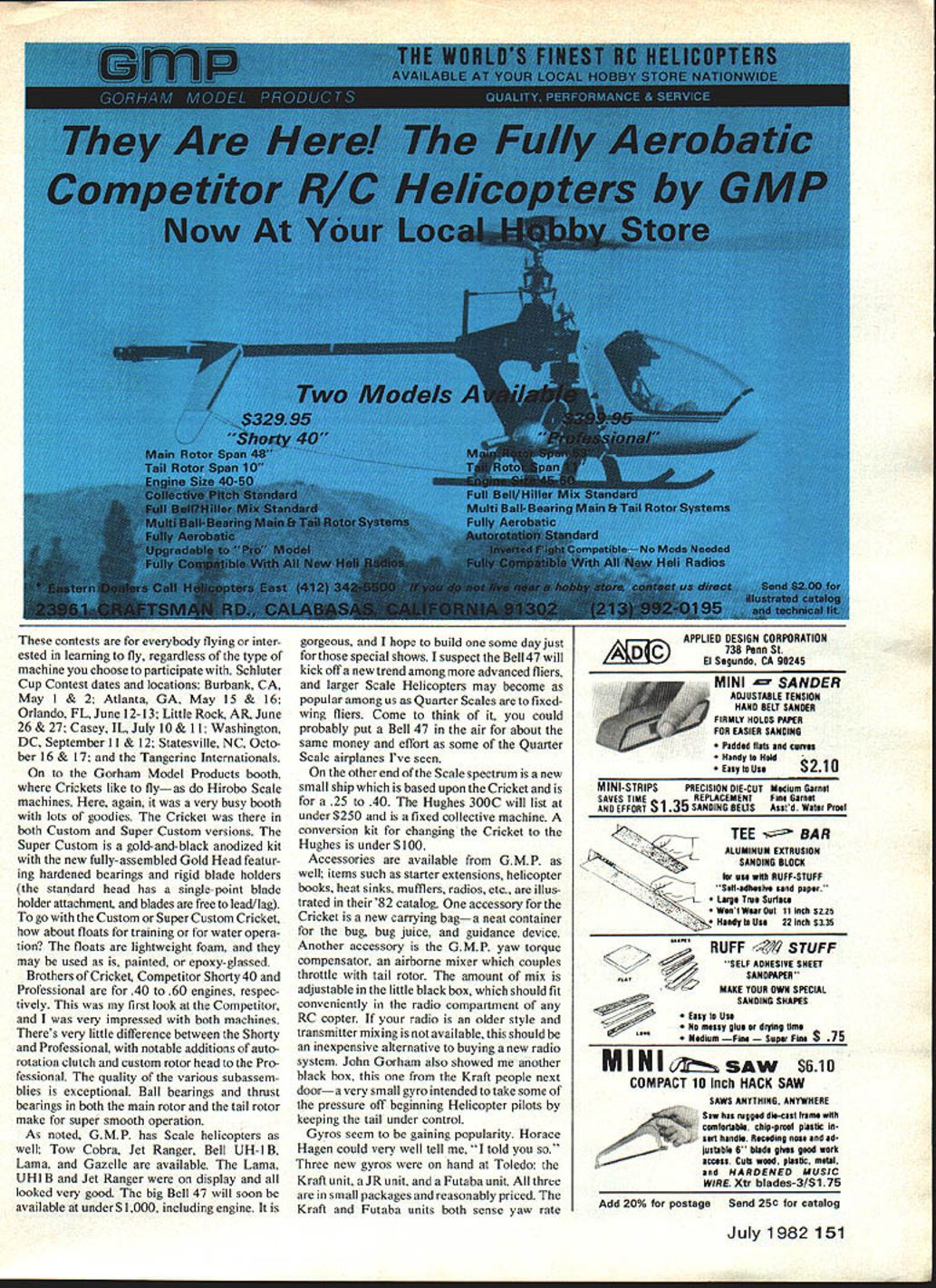
Brothers of the Cricket, the Competitor Shorty 40 and Professional are for .40 to .60 engines, respectively. This was my first look at the Competitor, and I was very impressed with both machines. There's very little difference between the Shorty and Professional, with notable additions of an autorotation clutch and custom rotor head to the Professional. The quality of the various subassemblies is exceptional. Ball bearings and thrust bearings in both the main rotor and the tail rotor make for super-smooth operation.
G.M.P. also has scale helicopters: Tow Cobra, Jet Ranger, Bell UH-1B, Lama, and Gazelle are available. The Lama, UH-1B and Jet Ranger were on display and all looked very good. The big Bell 47 will soon be available at under $1,000 including engine; it's gorgeous, and I hope to build one some day just for special shows. I suspect the Bell 47 will kick off a new trend among more advanced fliers, and larger scale helicopters may become as popular among us as quarter-scales are to fixed-wing fliers.
On the other end of the scale spectrum is a new small ship based on the Cricket for .25 to .40 engines. The Hughes 300C will list at under $250 and is a fixed-collective machine. A conversion kit for changing the Cricket to the Hughes is under $100.
Accessories from G.M.P. include starter extensions, helicopter books, heat sinks, mufflers, radios, and more (see their '82 catalog). One accessory for the Cricket is a new carrying bag—a neat container for the bug, bug juice, and odd bits of hardware. Another accessory is the G.M.P. yaw-torque compensator, an airborne mixer which couples throttle with a tail rotor. The amount of mix is adjustable in a little black box that should fit conveniently in the radio compartment of any RC copter. If your radio is older and transmitter mixing is not available, this is an inexpensive alternative to buying a new radio system.
John Gorham also showed me another small black box from the Kraft people next door—a very small gyro intended to take some of the pressure off beginning helicopter pilots by helping keep the tail under control.
Gyros
Gyros seem to be gaining popularity. Horace Hagen could very well tell me, "I told you so." Three new gyros were on hand at Toledo: the Kraft unit, a JR unit, and a Futaba unit. All three are small and reasonably priced. The Kraft and Futaba units both sense yaw rate (using magnetic sensors) and will likely find favor among owners of small and medium helicopters. The JR unit is a conventional heading-hold gyro and is quite sophisticated for its size and price; it uses an LED-type rate sensor. For beginners a gyro is an excellent purchase since it can take a lot of pressure off the pilot.
Radios
If gyros take care of the tail, will radios handle the rest? Radios aren't exactly my area, but I have to share a few I found impressive. Radio manufacturers are producing units with specific options for heli-pilots.
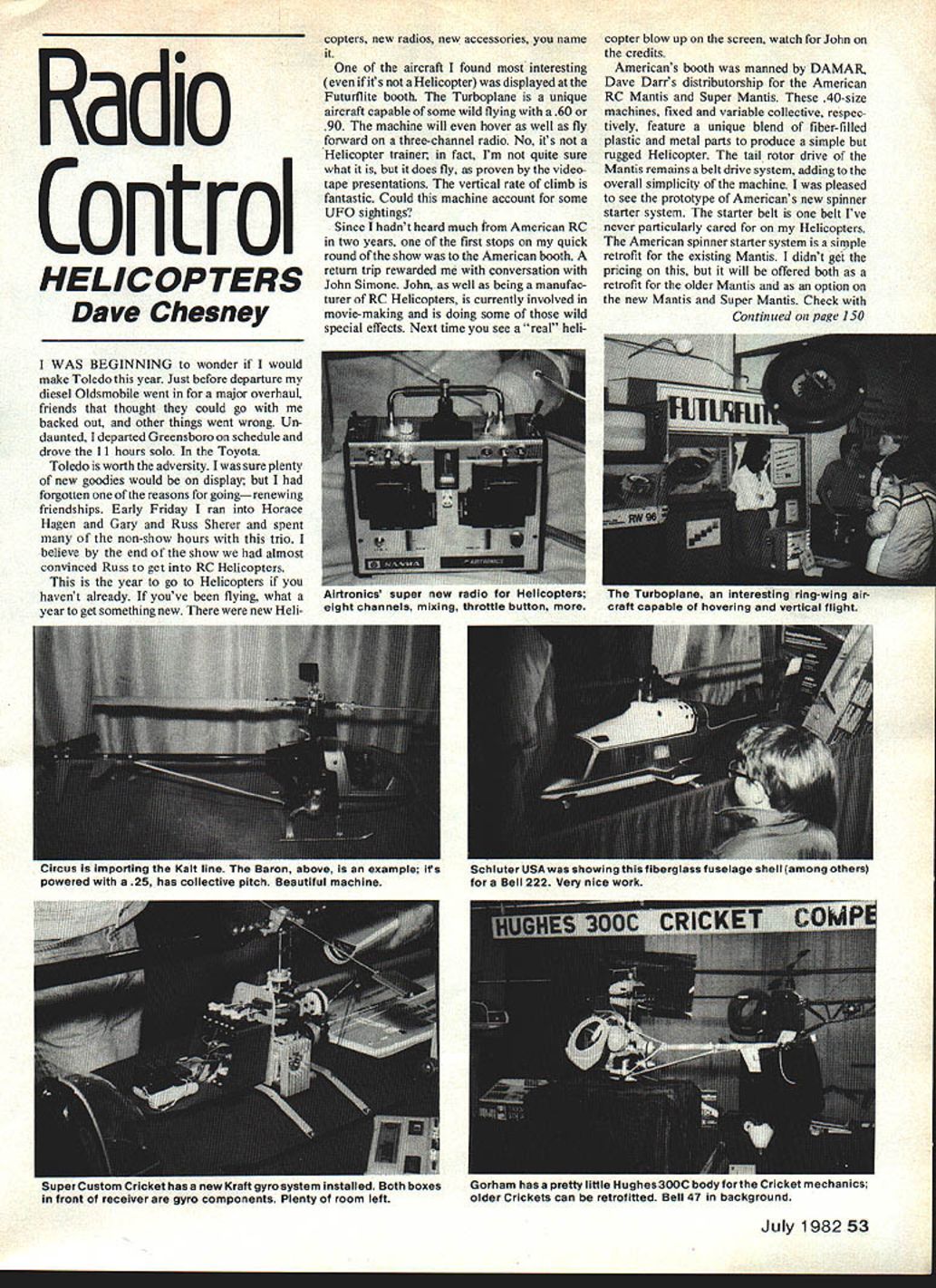
- Airtronics' new helicopter radio had so many features that they asked Mike Mas to tell about them. Features include mixers for tail rotor and throttle, throttle and collective mixing with collective trim, throttle cut to bring the engine to preset idle for autorotations, an inertial switch for flying inverted, a switch to flip trims from hover to forward flight, dual rates, servo reversing, servo travel limits, and more. Eight channels for under $730.
- The Futaba FP5JH is a radio offering special features for heli-pilots for under $580. The Futaba has five channels, servo reversing, mixers for throttle and tail rotor, and dual rates.
- JR Radios has the JSC-4SH at under $400 from Circus Hobbies. It is an eight-channel system with plenty of bells and whistles, including a direct servo controller (D.S.C.) which allows operation of all eight channels without transmitting—useful at the field when you're adjusting setups. Circus also offers the D6C-4SHM Apollo series (helicopter version) with many features at a small price.
Note that the above are two-stick radios. I'm building a single-stick unit around the Ace Silver Seven. Ace was at Toledo with their many radios and accessories. I'm convinced the Silver Seven is flexible enough to get all the features I could use, and it's fun building my dream radio.
If you want a radio with the word "Helicopter" in the name, they are available. Keep in mind, though, that a simple four-channel unit will get you in the air. Helicopters are not inherently expensive. Repairing diesel cars is expensive!
See you next month.
Dave Chesney Rt. 9, Box 621A, Greensboro, NC 27409.
Transcribed from original scans by AI. Minor OCR errors may remain.

