
Radio Control: Helicopters
Dave Chesney
TRUE TO FORM. I missed the Atlanta, GA Schluter Cup Helicopter Meet, having made a previous commitment to help with a soccer tournament. It looks like I'll have to start checking my calendar more carefully in the future, especially now that helicopter fun‑flies are becoming so popular. From all reports I've heard, helicopter fun‑fly meets and related activities are really taking off. Local activity is up as well — at least four new fliers in the Greensboro area have completed machines and a few have logged hover flights. It's good to see the surge of interest.
My flying has been somewhat limited for several weeks due to a major crash and a major move of shop equipment. Several projects have been put aside temporarily, so apologies to those expecting replies to letters. I'll be back on track soon.
The major crash involved my SX81. Due to failure of the tail rotor drive (when Walt Schoonard says to check the set screws on the flex shaft, do it — often!), I inverted the SX81 from about 150 ft. The wreckage looked like a total loss, and I wish I had taken photographs, but I was pleasantly surprised that repairs required less than $80 in parts. I was amazed at how rugged even the plastic fuselage casing was. Helicopters are not as fragile as many beginners might think — pass the word.
So, while the SX81 heads back onto the project list, things could have been worse — I might have crashed an airplane. Boy, have I developed a dislike for balsa dust!
I received some calls and letters from John Burleson of Washington, D.C., regarding several of his projects. I’d like to share them with you.
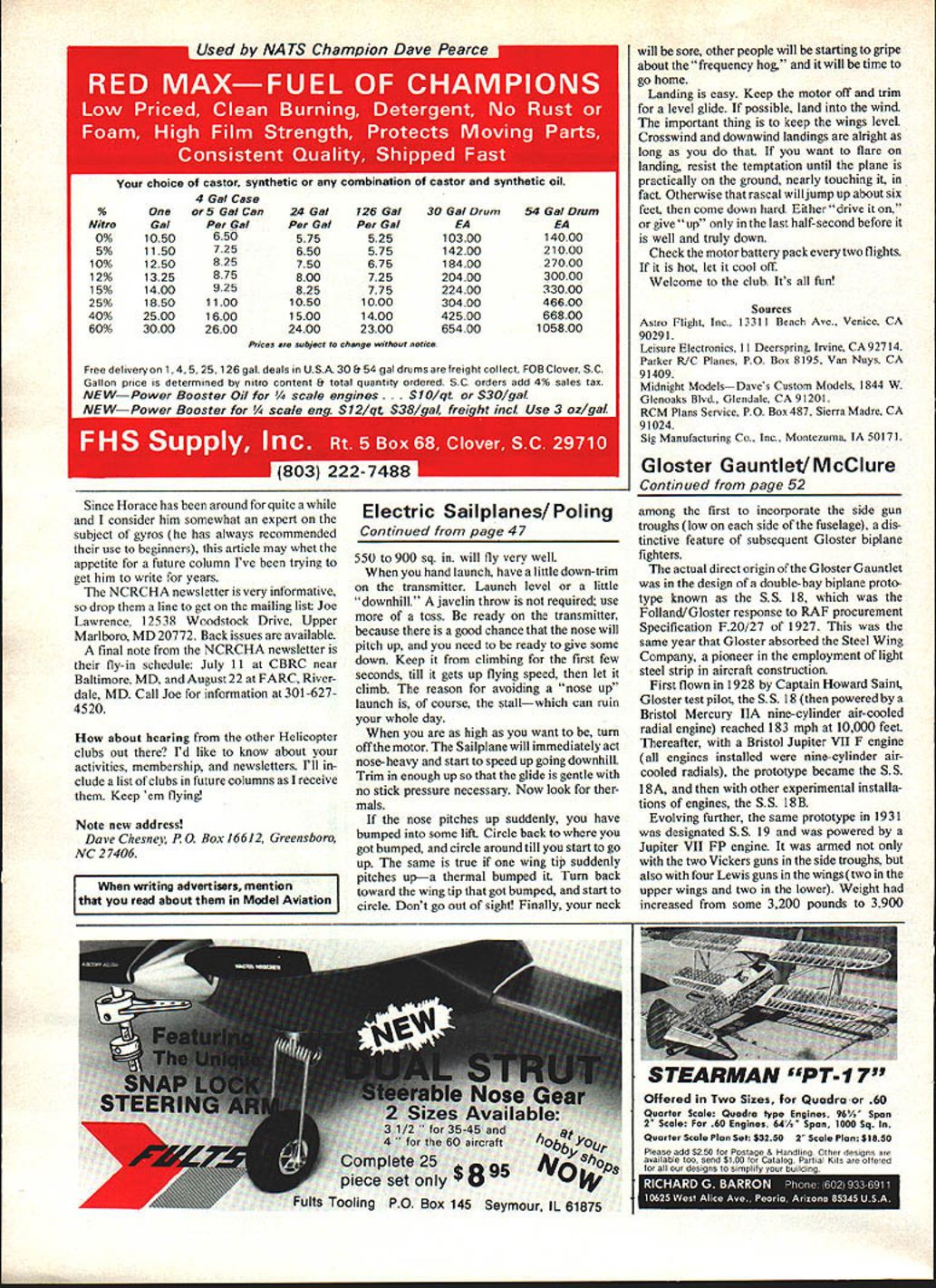
John Burleson — Heliboy pitch axle modification John writes that the thrust bearings he installed on the shafts will handle over 2,000 lb of longitudinal loading. The thrust bearings are intended to relieve the rotor‑head radial bearing from thrust loading. John reports that fellow flier Bob Harris has been flying the thrust‑bearing‑modified SX81 for over a month with good results.
John described a test setup: he installed two new blade pitch axles and fitted a thrust bearing on only one axle. After running more than six gallons of fuel through the engine, the axle using the thrust bearing showed no wear, while the unmodified axle was badly worn and needed replacement.
The thrust bearing used is Andrews Bearing part no. 03Y14 (Andrews Bearing, Spartanburg, SC). Note: the additional thrust bearing has one race with a tight‑fit bore and one race with a loose‑fit bore — always make sure the loose‑fit bore goes first so it seats against the existing radial bearing's inner race.
Two installation methods
- Machined bearing block (requires relief)
- Relieve the inside face of the bearing block (Schluter part no. 555) by .085" to accommodate the Andrews bearing.
- When reinstalling the axle and bearings, hold the radial bearing off its fully seated position by about .005"–.020" so the new thrust bearing carries the longitudinal load caused by centrifugal forces on the main rotor axle.
- No‑machining alternative (may require filing the pitch‑arm slots)
- Install the thrust bearing without machining the block and reinstall the shaft into the bearing block.
- Because the block is not machined, the pitch arm will be approximately .005"–.020" closer to the main rotor shaft; you may need to open the pitch‑arm slots in the main rotor side plates by filing to accommodate this change.
John highly recommends the thrust‑bearing modification — it should be well worth the effort.
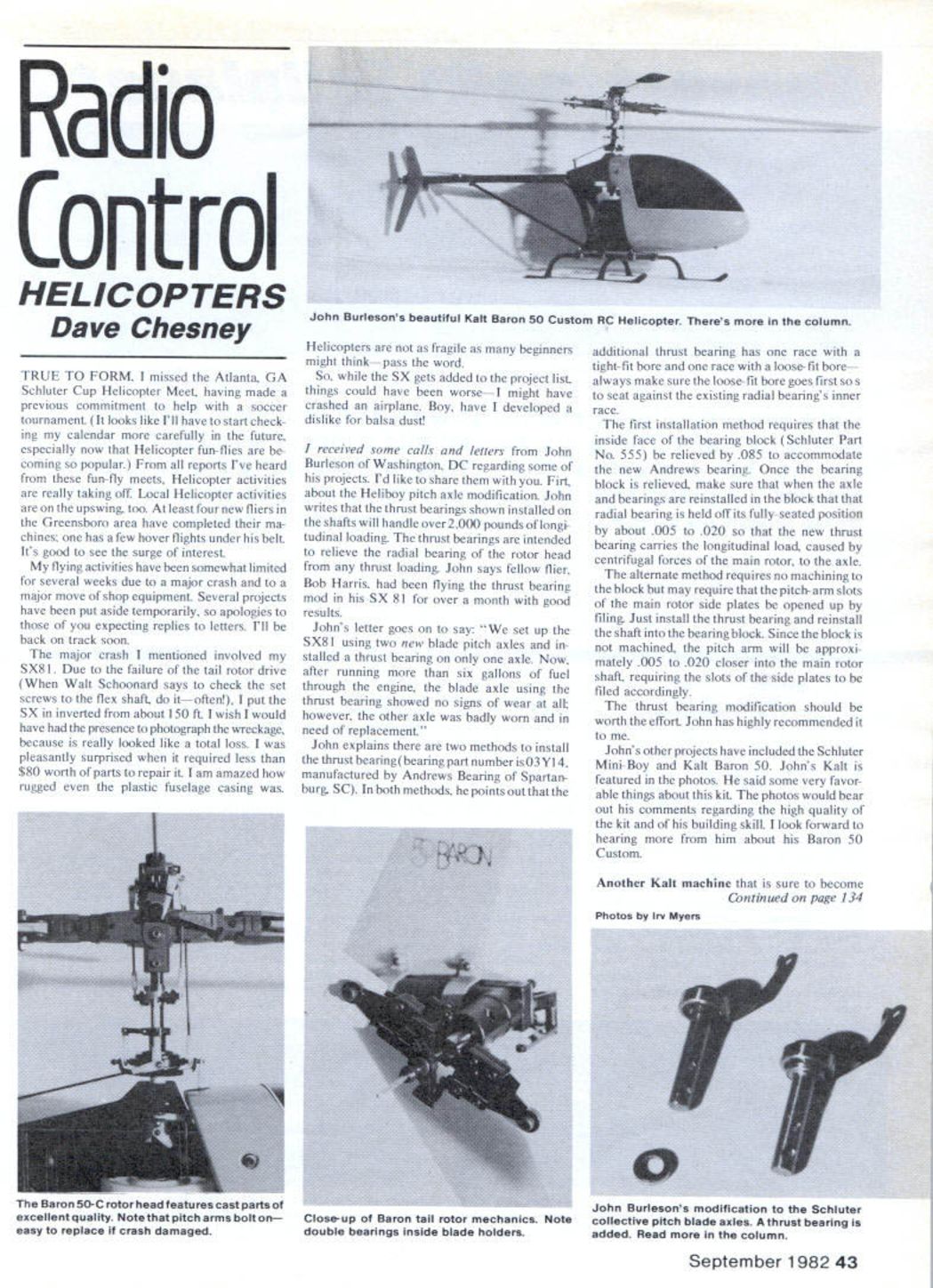
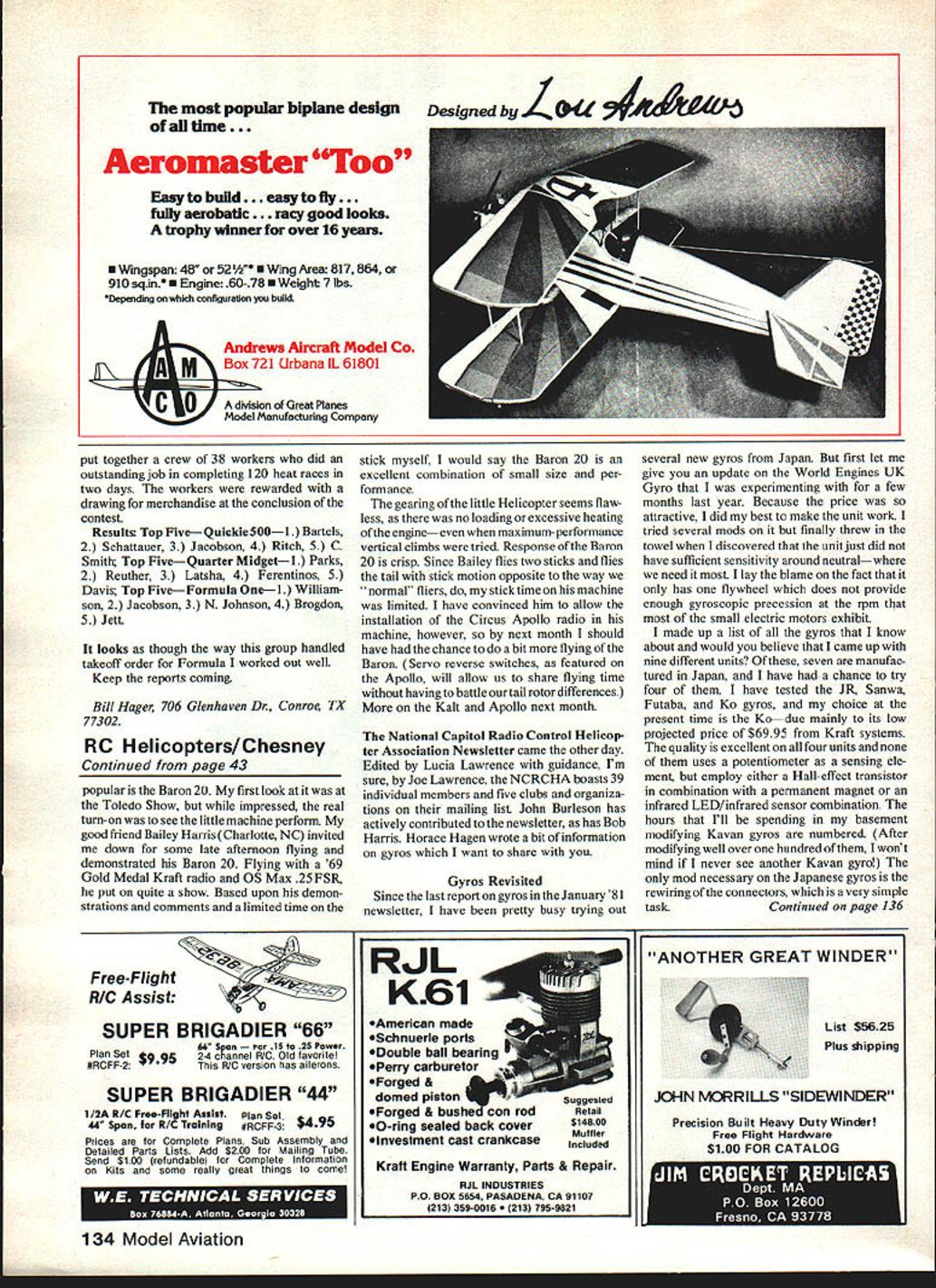
Other projects John has also been working on a Schluter Mini‑Boy and a Kalt Baron 50. His Kalt is featured in photos and he had very favorable comments about the kit quality and his workmanship. I look forward to hearing more about his Baron 50 custom.
The Baron 20 The Baron 20 is proving popular. My first look was at the Toledo show, but seeing it fly was the real selling point. My friend Bailey Harris (Charlotte, NC) demonstrated his Baron 20 using a '69 Gold Medal Kraft radio and an OS Max .25FSR. He put on quite a show. Based on his demonstrations and a bit of time on the sticks myself, the Baron 20 is an excellent combination of small size and performance.
The gearing of the little helicopter seems flawless — no loading or excessive engine heating even during maximum vertical climbs. Response is crisp. Bailey flies two sticks and uses opposite stick motion for the tail compared with many "normal" fliers, so my stick time was limited. I’ve convinced him to allow installation of the Circus Apollo radio in his machine; the Apollo’s servo reverse switches should let us share flying time without fighting tail‑rotor differences. More on the Kalt and Apollo next month.
NCRCHA newsletter The National Capitol Radio Control Helicopter Association newsletter arrived recently. Edited by Lou Lawrence with guidance (I’m sure) from Joe Lawrence, the NCRCHA mailing list includes 39 individual members and five clubs/organizations. John Burleson and Bob Harris have actively contributed to the newsletter.
Gyros Revisited
Since the last report on gyros in the January 1981 newsletter, I’ve been busy trying several new gyros from Japan. First, an update on the World Engines UK gyro I tested last year: despite the attractive price, the unit simply lacked sufficient sensitivity around neutral — where we need it most. I suspect the problem is that it uses only one flywheel, which doesn’t provide enough gyroscopic precession at the RPMs typical of small electric motors.
I compiled a list of gyros I’d read about and found nine different units; seven are manufactured in Japan. I’ve had a chance to try four: JR, Sanwa, Futaba, and Ko. My current choice is the Ko gyro, mainly due to its projected price of $69.95 from Kraft Systems. The quality is excellent on all four units tested.
None of these new units uses a potentiometer as the sensing element. They employ either a Hall‑effect transistor with a permanent magnet or an infrared LED/infrared sensor combination. The only modification typically needed on the Japanese gyros is rewiring the connectors — a very simple task.
After modifying well over one hundred Kavan gyros, I won’t mind if I never see another Kavan gyro! My days of modding Kavan units are numbered.
Transcribed from original scans by AI. Minor OCR errors may remain.

