
Radio Control: Helicopters
By Dave Chesney
Until recently, radio systems designed specifically for specialized forms of RC modeling—such as for our helicopter needs—were not available. Advances in electronic circuitry began to change that a few years ago, and now radios can be purchased tailored to the needs of pattern pilots, sailplane pilots, quarter-scalers, and other RC specialists. For our interest, Futaba got the ball rolling a few years back with their FP-5JH/Helicopter system. At that time the 5JH was slightly more expensive than the high-end five-channel sets, but less expensive than the thousand-dollar systems also being marketed.
Perhaps one of the best pieces of news was that the 5JH options were apparently popular enough that several other manufacturers followed with similar offerings. Now, helicopter options are available at what I'll call sport-series prices in the Circus Apollo D6C-4SHM system. The Circus Apollo system, at well under $250, features servo-reversal switches on four flight channels, dual rates, and mixing. The Circus Apollo/Kalt Baron 20 combo can be made airborne for under $500. (More about the Baron 20 later.)
Unpacking and Bench Time
I had plenty of opportunity to play with the Apollo on the bench since, at the time, only one of my machines was flyable. I had second thoughts about installing a two-stick system in my only chopper (remember, I fly single-stick mode most of the time), but I did so intending to give it a whirl.
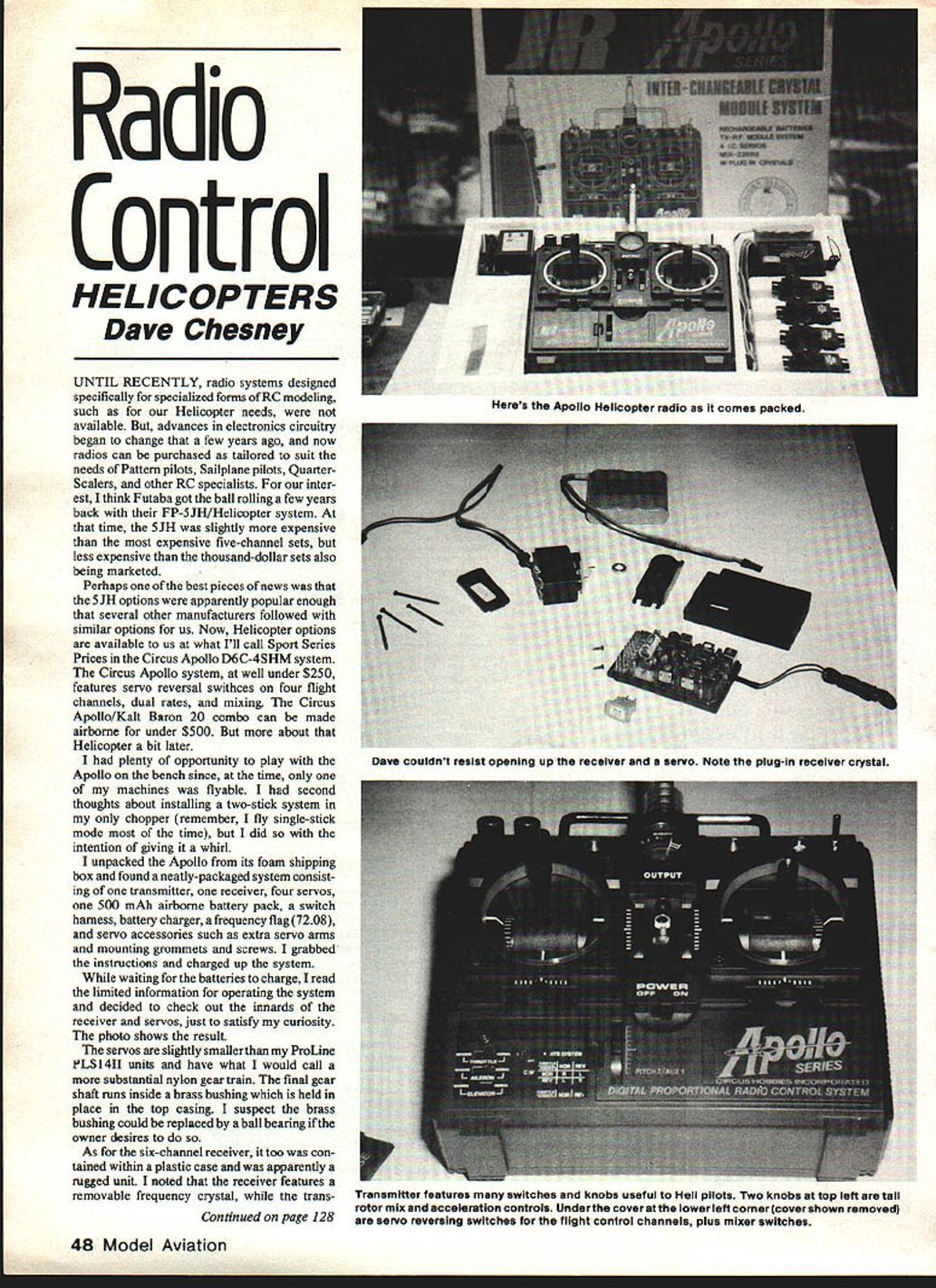
I unpacked the Apollo from its foam shipping box and found a neatly packaged system consisting of:
- one transmitter
- one receiver
- four servos
- one 500 mAh airborne battery pack
- a switch harness
- a battery charger
- a frequency flag (72.08)
- servo accessories (extra servo arms, mounting grommets, screws)
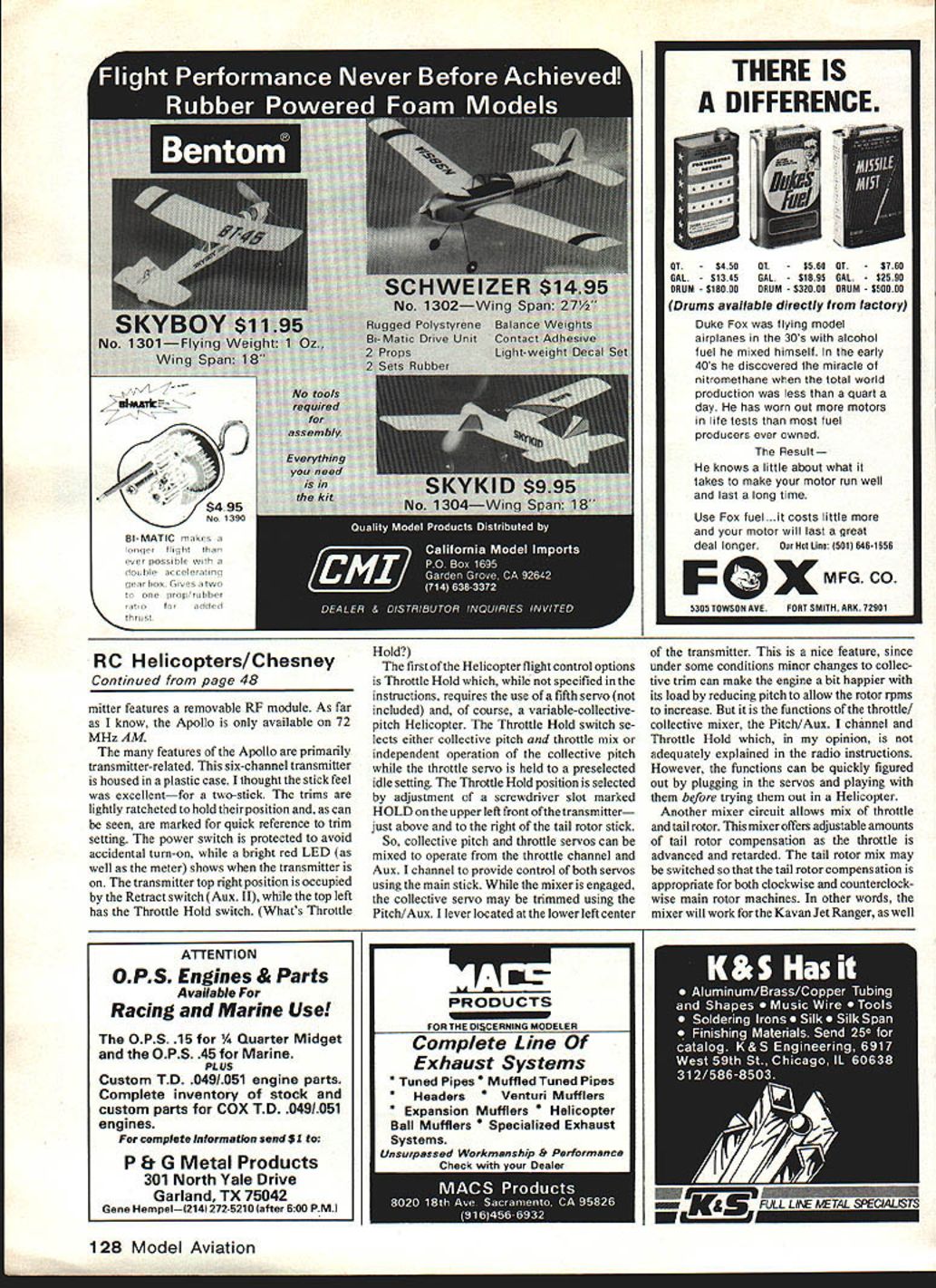
I grabbed the instructions and charged up the system. While waiting for the batteries to charge, I read the limited operating information and decided to check out the innards of the receiver and servos, just to satisfy my curiosity.
Bench Inspection: Servos and Receiver
The servos are slightly smaller than my ProLine PLS1411 units and have what I would call a more substantial nylon gear train. The final gear shaft runs inside a brass bushing which is held in place in the top casing. I suspect the brass bushing could be replaced by a ball bearing if the owner desires to do so.
The six-channel receiver is contained within a plastic case and appears to be a rugged unit. I noted that the receiver features a removable frequency crystal, while the transmitter features a removable RF module. As far as I know, the Apollo is only available on 72 MHz AM.
Apollo Transmitter Features
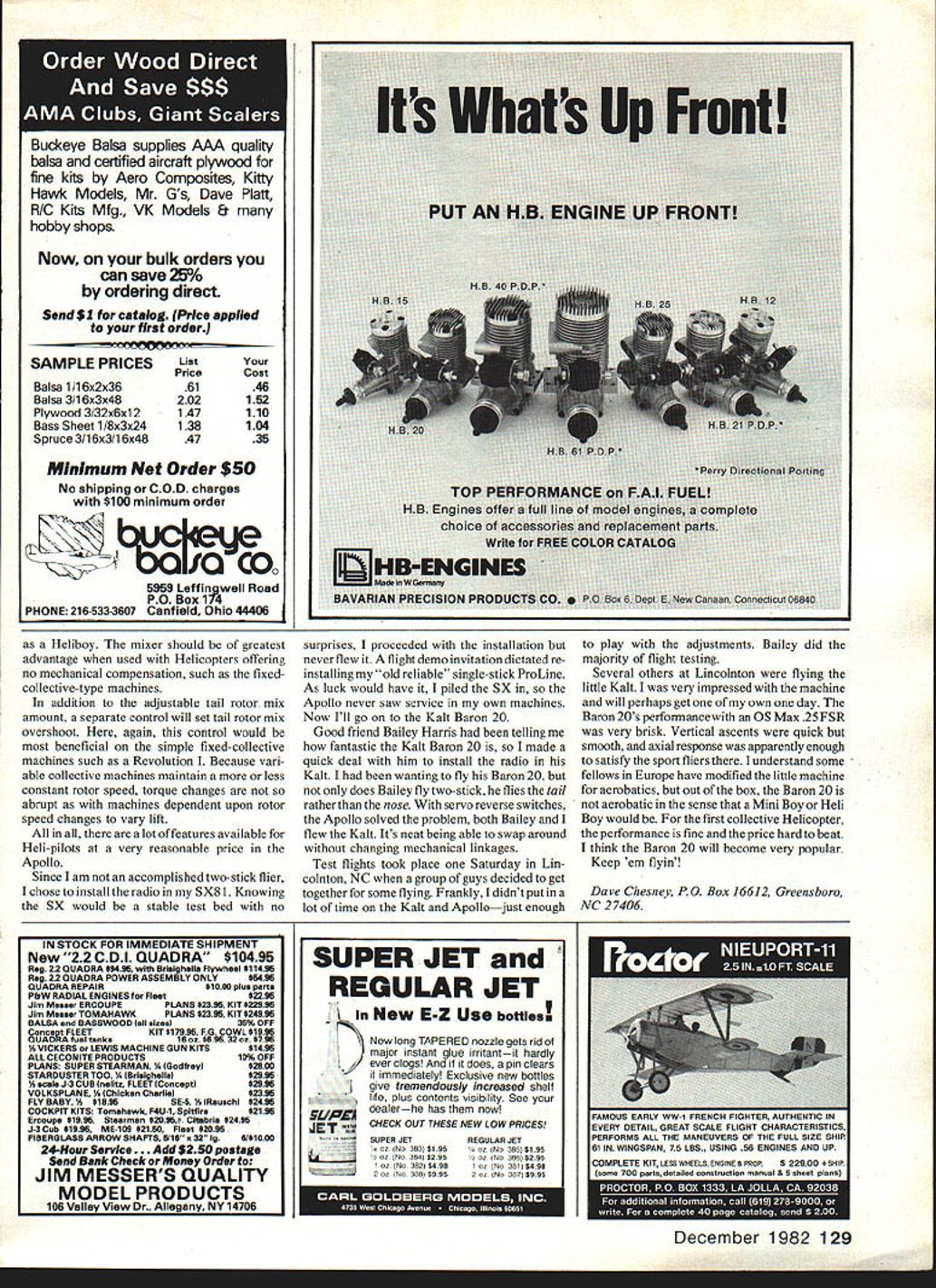
Many of the Apollo’s features are transmitter-related. This six-channel transmitter is housed in a plastic case. I thought the stick feel was excellent for a two-stick radio. The trims are lightly ratcheted to hold their position and are marked for quick reference to trim setting. The power switch is protected to avoid accidental turn-on, while a bright red LED (and the meter) shows when the transmitter is on. The transmitter top-right position is occupied by the Retract switch (Aux II), while the top-left has the Throttle Hold switch. (What's Throttle Hold? See below.)
Throttle Hold
The first of the helicopter flight-control options is Throttle Hold. While not specified clearly in the instructions, Throttle Hold requires the use of a fifth servo (not included) and, of course, a variable-collective-pitch helicopter. The Throttle Hold switch selects either collective-pitch-and-throttle mix or independent operation of the collective pitch while the throttle servo is held to a preselected idle setting. The Throttle Hold position is selected by adjustment of a screwdriver slot marked HOLD on the upper-left front of the transmitter—just above and to the right of the tail-rotor stick.
With this arrangement, collective-pitch and throttle servos can be mixed to operate from the throttle channel and Aux I channel to provide control of both servos using the main stick. While the mixer is engaged, the collective servo may be trimmed using the Pitch/Aux I lever located at the lower-left center of the transmitter. This is a useful feature: under some conditions, minor collective-trim changes can make the engine happier with its load by reducing pitch to allow rotor RPM to increase. The functions of the throttle/collective mixer, the Pitch/Aux I channel, and Throttle Hold are not, in my opinion, adequately explained in the radio instructions. However, the functions can be quickly figured out by plugging in the servos and experimenting before trying them on a helicopter.
Throttle/Tail Mixing
Another mixer circuit allows mixing of throttle and tail rotor. This mixer offers adjustable amounts of tail-rotor compensation as the throttle is advanced and retarded. The tail-rotor mix can be switched so that compensation is appropriate for both clockwise and counterclockwise main-rotor machines. In other words, the mixer will work for the Kavan Jet Ranger as well as a Heli Boy. The mixer should be of greatest advantage when used with helicopters offering no mechanical compensation, such as fixed-collective-type machines.
In addition to the adjustable tail-rotor mix amount, a separate control sets tail-rotor mix overshoot. This control is most beneficial on simple fixed-collective machines such as a Revolution I. Because variable-collective machines maintain a more or less constant rotor speed, torque changes are not as abrupt as with machines that depend on rotor-speed changes to vary lift.
All in all, there are a lot of features available for heli pilots at a very reasonable price in the Apollo.
Installation and Flight Testing
Since I am not an accomplished two-stick flier, I chose to install the radio in my SX81. Knowing the SX would be a stable test bed with no surprises, I proceeded with the installation but never flew it. A flight-demo invitation dictated reinstalling my "old reliable" single-stick ProLine. As luck would have it, I piled the SX in, so the Apollo never saw service in my own machines.
Good friend Bailey Harris had been telling me how fantastic the Kalt Baron 20 is, so I made a quick deal with him to install the radio in his Kalt. I had been wanting to fly his Baron 20, but Bailey flies two-stick and prefers tail-stick control rather than nose-stick. With servo-reverse switches, the Apollo solved the problem: both Bailey and I flew the Kalt. It's neat being able to swap around without changing mechanical linkages.
Test flights took place one Saturday in Lincolnton, NC, when a group of guys decided to get together for some flying. Frankly, I didn't put in a lot of time on the Kalt and Apollo—just enough to play with the adjustments. Bailey did the majority of flight testing.
Several others at Lincolnton were flying the little Kalt. I was very impressed with the machine and will perhaps get one of my own one day. The Baron 20's performance with an OS Max .25FSR was very brisk. Vertical ascents were quick but smooth, and axial response seemed sufficient to satisfy the sport fliers there. I understand some fellows in Europe have modified the little machine for aerobatics, but out of the box the Baron 20 is not acrobatic in the sense that a Mini Boy or Heli Boy would be. For the first collective helicopter, the performance is fine and the price hard to beat. I think the Baron 20 will become very popular.
Keep 'em flyin'!
Dave Chesney P.O. Box 16612, Greensboro, NC 27406.
Transcribed from original scans by AI. Minor OCR errors may remain.

