
Radio Control: Helicopters
Dave Chesney
SMALL HELICOPTERS have advantages. This year I've returned to basics because of another round of business travel. Fortunately I've been able to get in a lot of flying and haven't been home enough to repair the servo that caused its untimely crash. So the Cricket and the Kalt Baron 20 have been doing more flying than usual. As a result, this column covers some further impressions of those machines.
Baron 20 — clutch and starter problems
You may recall my articles a few months back about the Baron 20 and the Apollo radio system. Rather than remove the Apollo radio from Bailey Harris' Baron 20, I bought the Baron hoping to really learn two-stick flying instead of settling for periodic hover flights. The Baron/Apollo combo has been a good choice for my transition to two-stick flying.
However, downtime on the Baron 20 has been frustrating. My biggest gripe is the clutch/starter pulley/fan assembly and the problems getting the machine started. After a few successful starts and beautiful flights, the clutch begins to grab whenever enough strain is put on the starter belt to turn over the engine.
At Nitro, W.V., two of the best heli pilots there showed me that the two screws holding the clutch and pulley to the fan were not long enough. We replaced the plastic fan and screws and reassembled the helicopter. The new assembly worked for three flights before clutch-to-clutch-bell friction again prevented starting; ultimately the starter belt broke. I haven't flown the Baron since.
I did not build the Baron originally, but I have rebuilt the engine/clutch assemblies several times while trying to solve this. My recommendations if you build or rebuild a Baron 20:
- Replace the fan, clutch, and clutch housing if you experience similar problems.
- Pay careful attention to assembly sequence and alignment.
- Use longer screws to secure the clutch/pulley to the fan.
- Recheck fit and clearance during initial test runs.
Any effort you put into this little machine will be worth it — it does fly nicely once the starting issue is resolved. I credit the Baron/Apollo combo for helping me become a two-stick pilot.
Cricket — single-stick fun and upgrades
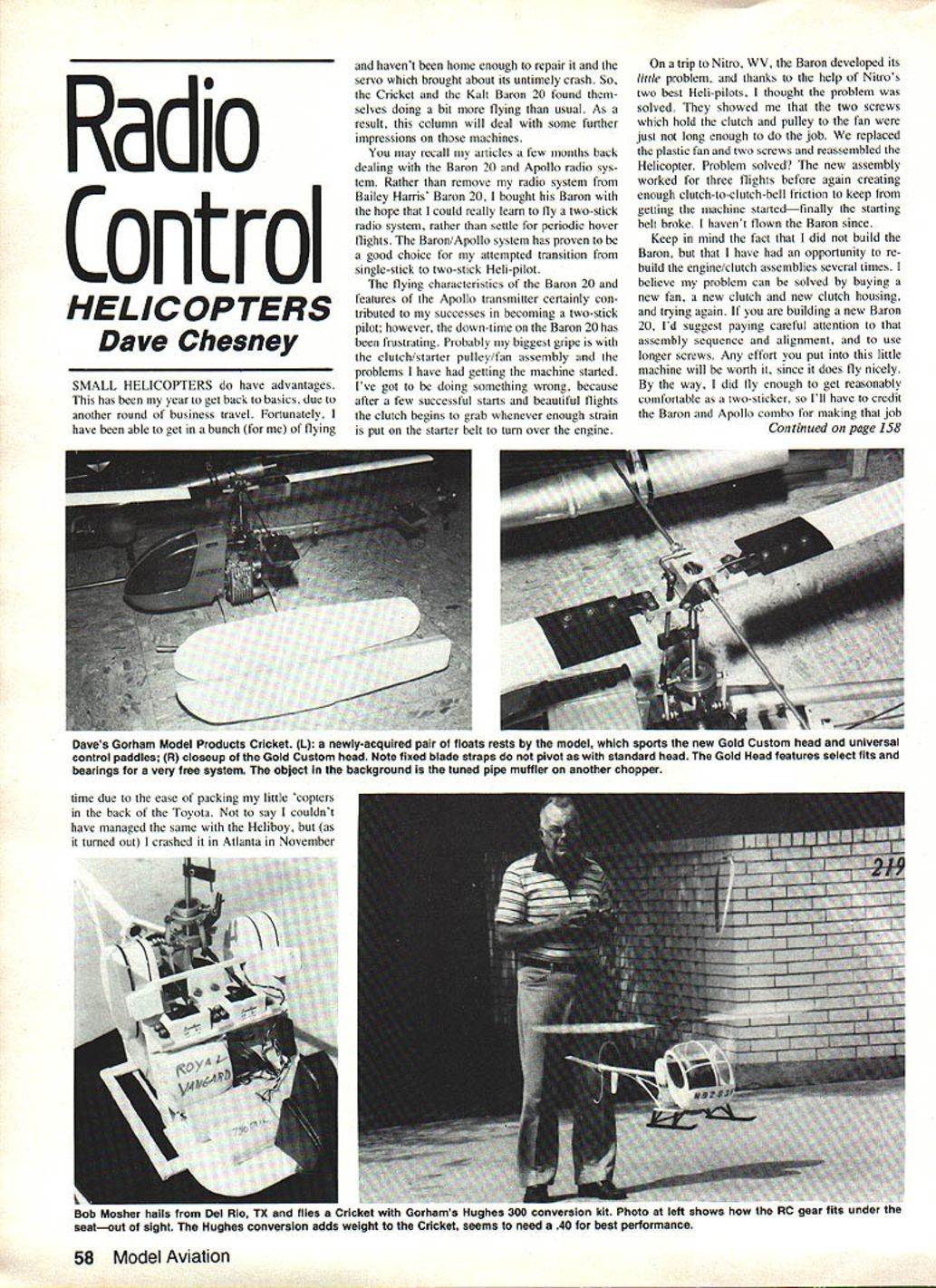
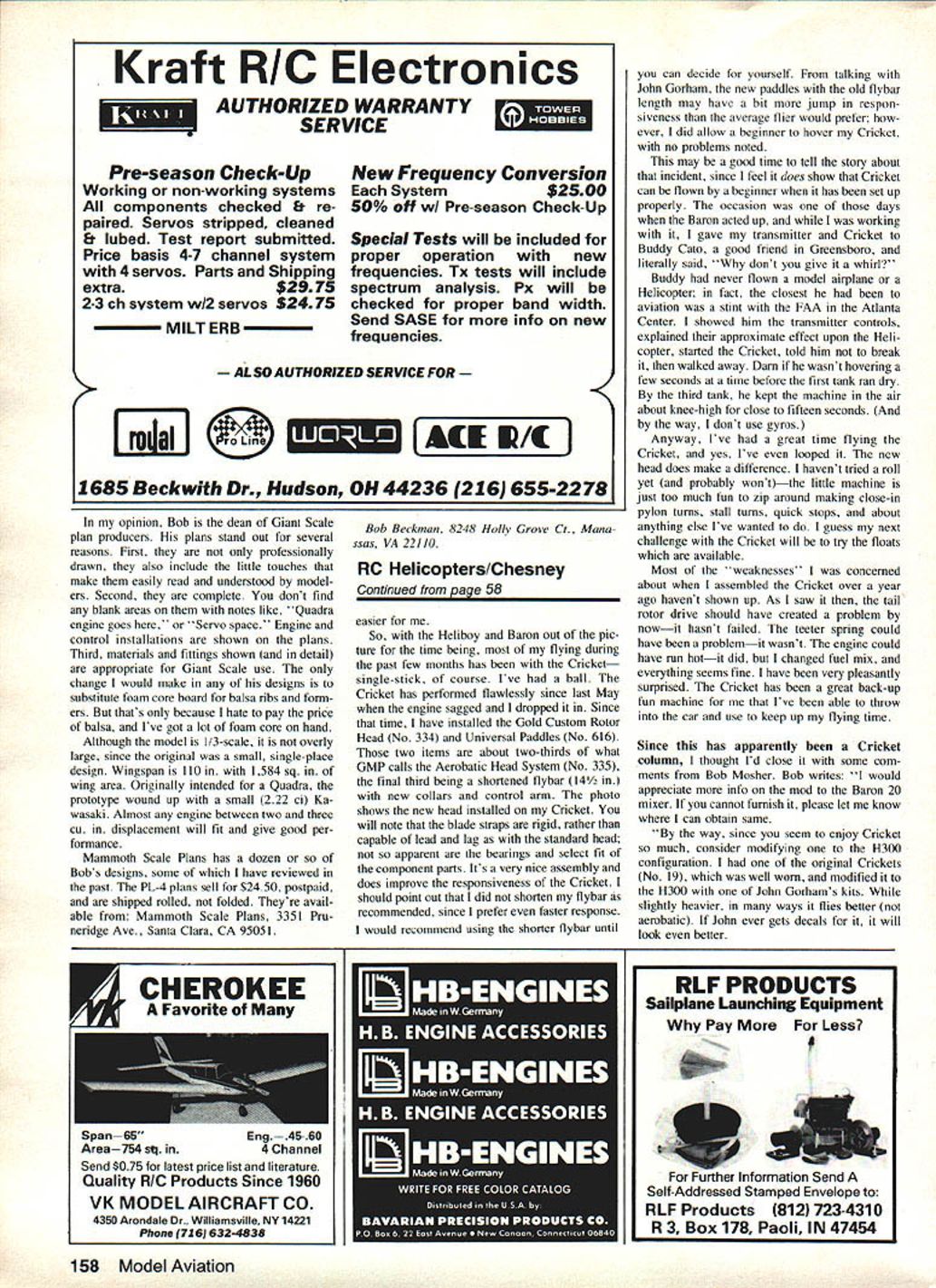
With the Heliboy and Baron out of commission for the time being, most of my flying over the past few months has been with the Cricket — single-stick, of course. I've had a ball. The Cricket has performed flawlessly since last May when the engine sagged and I crashed it. Since then I installed the Gold Custom Rotor Head (No. 334) and Universal Paddles (No. 616). Those two items are roughly two-thirds of GMP's Aerobatic Head System (No. 335); the remaining third is a shortened flybar (1/4 in.) with new collars and a new control arm.
The new head uses rigid blade straps instead of the stock flexible ones and the assembly does not appear to require the close bearing/select fit of the original parts. It's a very nice assembly and does improve responsiveness. I did not shorten my flybar as recommended because I prefer even faster response, but I would recommend using the shorter flybar until you can decide for yourself. John Gorham mentioned that the new paddles with the old flybar length may produce more jump in responsiveness than the average flier prefers; however, I did let a beginner hover my Cricket with no problems.
A short story that illustrates how flyable the Cricket can be: one day when the Baron was acting up I handed my transmitter and Cricket to Buddy Cato, a friend who had never flown a model airplane or helicopter (his only aviation experience was a stint with the FAA). I explained the controls, started the Cricket, told him not to break it, and walked away. He was hovering a few seconds at a time before the first tank ran dry, and by the third tank he was keeping the machine about knee-high for close to fifteen seconds. (I don't use gyros.)
I've had a great time flying the Cricket — I've even looped it. I haven't tried a roll yet (and probably won't) — the little machine is too much fun to zip around doing close-in pylon turns, stall turns, quick stops, and other maneuvers. My next challenge with the Cricket will be to try the available floats.
Most of the weaknesses I worried about when I assembled the Cricket over a year ago haven't shown up. The tail rotor drive hasn't failed. The teeter spring hasn't been a problem. The engine did run hot at one point, but I changed the fuel mix and everything seems fine. The Cricket has been a great backup fun machine I can throw in the car to keep up my flying time.
Reader comments
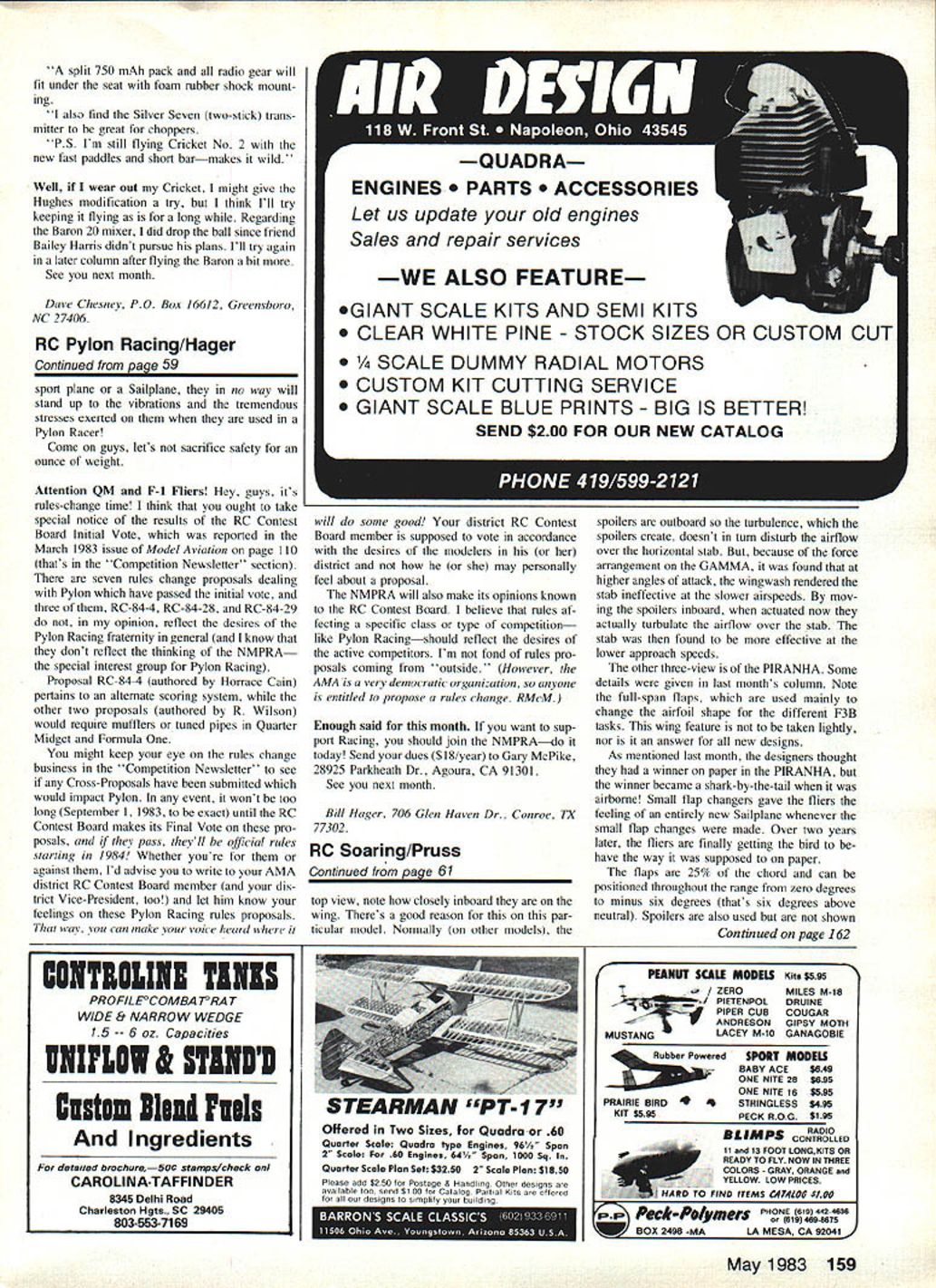
Bob Mosher writes requesting more information on how to modify the Baron 20's mixer and asks where he can obtain such information. He also suggests modifying a Cricket to the H300 configuration: he had one of the original Crickets (No. 19), modified it to H300 with one of John Gorham's kits, and found that while slightly heavier it often flies better (not aerobatic). If John ever supplies decals for it, it will look even better.
Transcribed from original scans by AI. Minor OCR errors may remain.

