
Radio Control
PYLON RACING Bill Hager
Winning. A common question a person interested in pylon racing will ask is: "What does a person have to do to win a pylon race?"
It doesn't matter what type of pylon racing you want to do—there are some simple, basic things you can do to improve your chances of winning.
First, start with yourself. In any sport, I don't know anyone who has become competitive or a winner without a lot of practice and training.
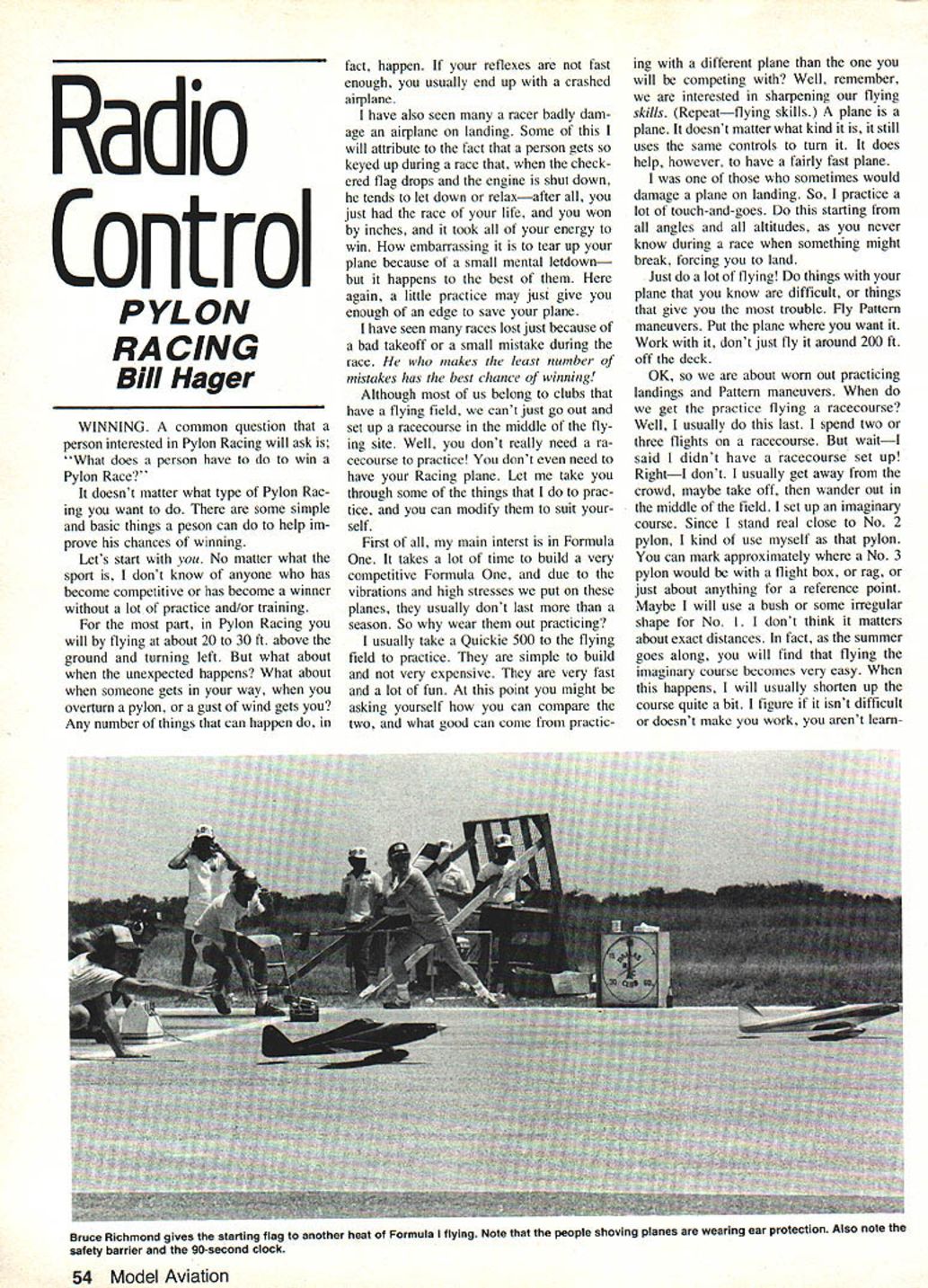
In pylon racing you'll typically be flying about 20 to 30 ft above the ground and turning left. But what about when the unexpected happens—when someone gets in your way, when you overturn a pylon, or when a gust of wind hits you? Any number of things can and do happen. If your reflexes aren't fast enough, you usually end up with a crashed airplane.
I've also seen many racers badly damage a plane on landing. Partly this comes from getting so keyed up during a race that, when the checkered flag drops and the engine is shut down, the pilot relaxes. After all, you just had the race of your life, you won by inches, and it took all your energy. It's embarrassing to tear up your plane because of a small mental letdown—but it happens to the best of them. A little practice may give you enough of an edge to save your plane.
Many races are lost because of a bad takeoff or a small mistake during the race. He who makes the fewest mistakes has the best chance of winning.
Although most of us belong to clubs with flying fields, we can't always set up a racecourse in the middle of the flying site. The good news is: you don't need a racecourse to practice, and you don't even need your racing plane. Here are some of the things I do to practice; modify them to suit yourself.
- I primarily race Formula One. Competitive Formula One models take a lot of time to build and, because of the vibrations and high stresses, usually don't last more than a season. So I avoid wearing them out practicing.
- I take a Quickie 500 to the field to practice. They're simple, inexpensive, fast, and a lot of fun. You might ask how practicing with a different plane helps—remember, we're sharpening flying skills. A plane is a plane; they all use the same controls to turn. It helps, however, to use a fairly fast plane.
- I practice touch-and-goes a lot, since I used to damage planes on landing. Do touch-and-goes from all angles and altitudes—you never know when something might break during a race and force you to land.
- Just fly a lot. Do things with your plane that are difficult for you. Fly pattern maneuvers. Put the plane where you want it. Work with it—don't just fly around 200 ft off the deck.
When it comes to practicing a racecourse, I usually do that last and spend two or three flights on it. I don't set up a formal course. I get away from the crowd, take off, and wander out into the middle of the field to set up an imaginary course. Since I stand close to the No. 2 pylon, I use myself as that pylon. I mark where No. 3 would be with a flight box, rag, or anything for a reference point. Maybe I use a bush or some irregular shape for No. 1. Exact distances don't matter. As the summer goes along, flying the imaginary course becomes very easy; when that happens I shorten the course quite a bit. I figure if it isn't difficult or doesn't make you work, you aren't learning.
Practice consistently, focus on eliminating small mistakes, and train for unexpected events—those are the keys to improving your chances of winning.
Bill Hager
Transcribed from original scans by AI. Minor OCR errors may remain.

