
Radio Control: Helicopters
Larry Jolly
I hope you all had a great summer and at least some of you were able to take in the AMA Nationals up in Massachusetts. Apparently, this was the biggest Helicopter Nationals ever, with over 80 entrants. That's fantastic; a few years back we couldn't even boast half that many proficient fliers in the whole U.S. Now we have a competition that tends to be somewhat regional in its "drawing" capabilities, and we get nearly 100 fliers! Congratulations to everyone who attended, whether you trophied or not, and let's look forward to an even bigger Nationals at Reno in 1984.
I wasn't able to attend the Nationals, as my busy summer schedule wouldn't allow it. However, I was lucky enough to wind up visiting the Grand Canyon on the way back from the L.S.F. tournament. As we were leaving the South Rim of the Canyon, I saw a full-scale Aerospatiale AS350 fly overhead at quite a low level and followed it to its helipad at Grand Canyon Helicopters. I had my wife and daughter with me, neither of whom had been up in a helicopter before. After much encouragement from my daughter and me, Charlotte consented to joining us for a chopper ride down into the canyon. If you have never flown in a full-size helicopter or visited the Grand Canyon by air, taking one of GCH's sightseeing tours is the best way possible to enjoy these two sensations at one time. Flying in a full-size machine is different from any other form of air transportation. It's not unlike being in an elevator that traverses horizontally as well as vertically. If you ever visit the Grand Canyon, take along a few extra dollars and look up Grand Canyon Helicopters. I guarantee those few dollars will buy a lifetime of memories.
Comments from the audience
I received a short letter from a reader in New Jersey who was perplexed by the reactions of the local power fliers when he attempted to fly his chopper at the club field. It seems they weren't very happy to have him there with his choppers and invited him to fly somewhere else. Our reader was confused by their response and couldn't understand their attitude. "After all, helicopter pilots are the safest fliers around."
I have had the same situation arise and will help by explaining the power fliers' rationale. If you are learning to fly, don't go to the local field and tie up the frequency while you practice hovering! You can practice in any small area. If you tie up the frequency hovering just a few inches off the ground, the chances are the locals are not only not going to encourage you, but may in fact end up distracting you as they make caustic comments about your abilities. Remember, in their eyes it looks as though you are accomplishing little while learning to hover, except of course, wasting their flying time.
Once you have mastered helicopter flying and are proficient, you will be in a better bargaining position at the club field. Before flying at any new field, find out what the operating procedures are for that particular club and follow them to the letter. If they don't allow helicopter flying, there is probably a reason. Perhaps some incident in the past caused this measure to be enacted. If there is no chopper flying allowed, bring it up at the next club meeting, invite the officers to a demonstration flight, and volunteer to serve on a committee to establish guidelines for helicopter activities at the field. Work from the inside through recognized channels and I'm sure you will get satisfaction.
Helicopter Safety
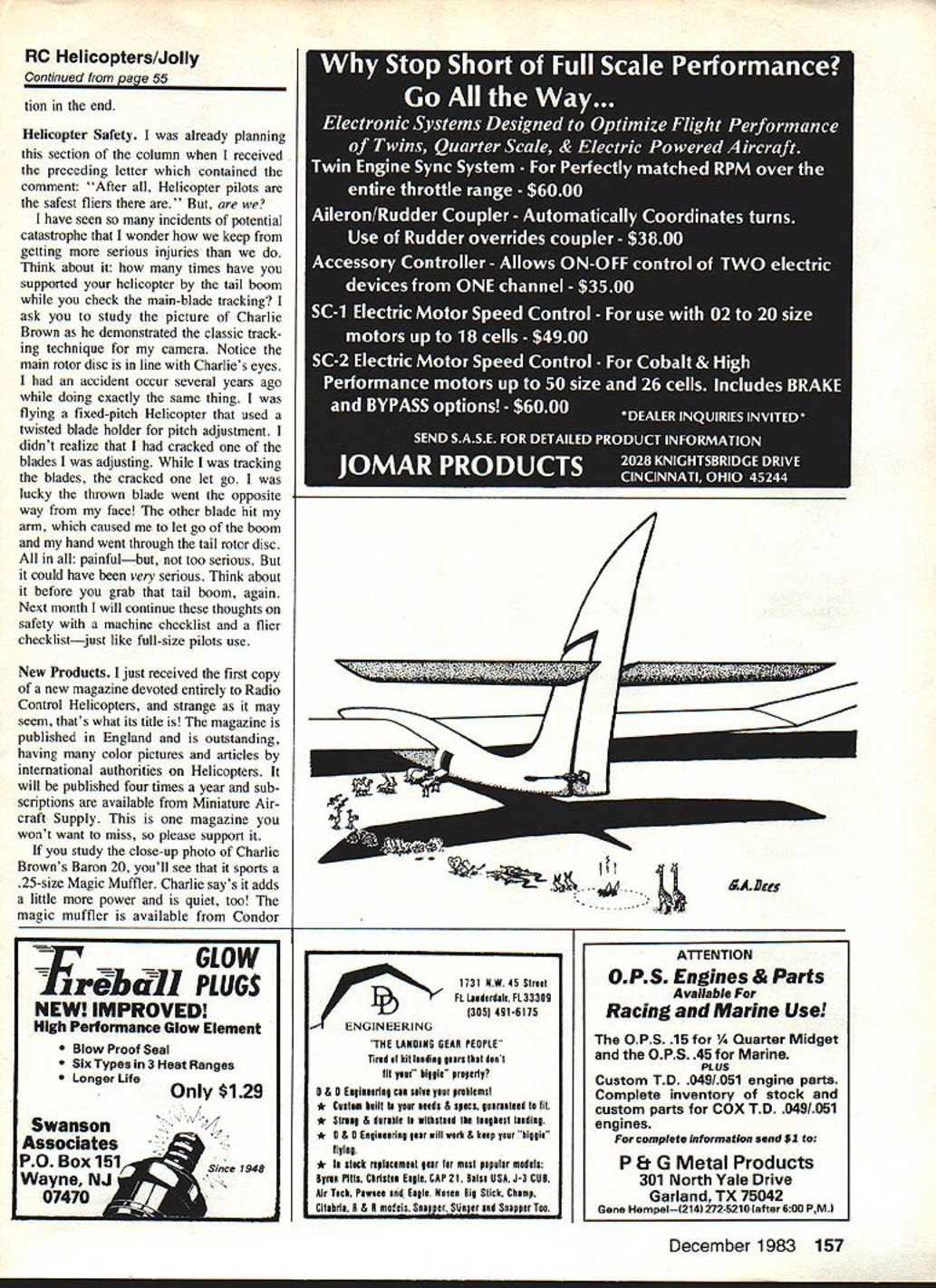
I am already planning a safety section for this column. The letter I received contained the comment, "After all, helicopter pilots are the safest fliers around," yet we have seen incidents with the potential for catastrophe and I wonder why we keep getting serious injuries. Think about times you have supported a helicopter tail boom to check main-blade tracking; study the picture: Charlie Brown demonstrated the classic tracking technique for the camera. Notice the main rotor disc line and Charlie's eyes. An accident occurred several years ago doing exactly the same thing.
Flying a fixed-pitch helicopter, I used a twist-type blade holder for pitch adjustment and didn't realize the blades were cracked. While adjusting tracking, the blades cracked and let go. Luckily the thrown blade went the opposite way and the other blade hit my arm, causing me to let go; my hand went through the tail rotor disc — painful, but not too serious. It could have been very serious. Think about it before you grab the tail boom again.
Next month I will continue thoughts on safety, machine checklist, flier checklist — just like full-size pilots use.
New Products
I just received the first copy of a new magazine devoted entirely to radio control helicopters, and strange as it may seem, that's what its title is! The magazine is published in England and is outstanding, having many color pictures and articles by international authorities on helicopters. It will be published four times a year and subscriptions are available from Miniature Aircraft Supply. This is one magazine you won't want to miss, so please support it.
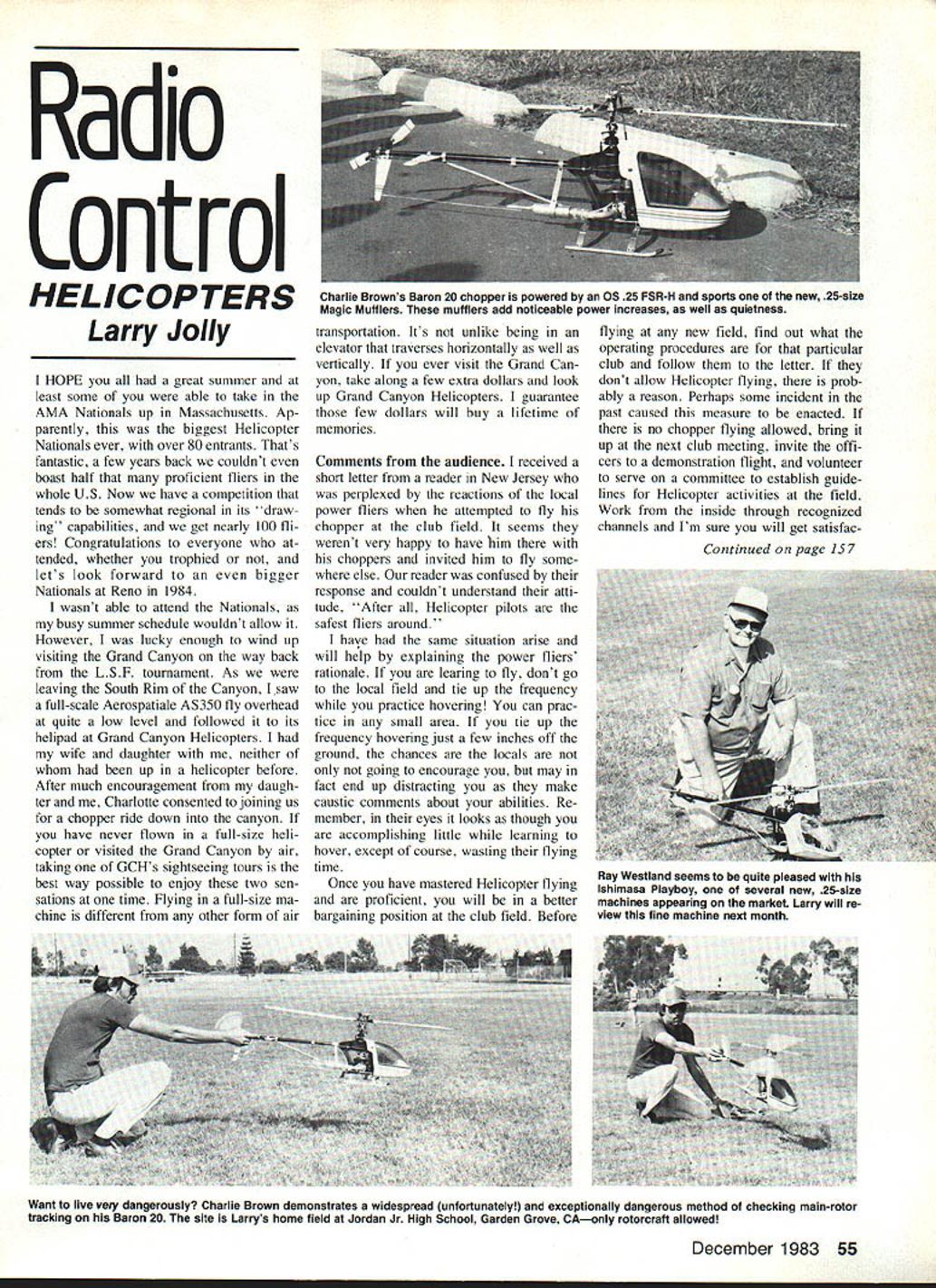
If you study the close-up photo of Charlie Brown's Baron 20, you'll see that it sports a .25-size Magic Muffler. Charlie says it adds a little more power and is quiet, too! The Magic Muffler is available from Condor.
Hobbies
Upcoming Reviews
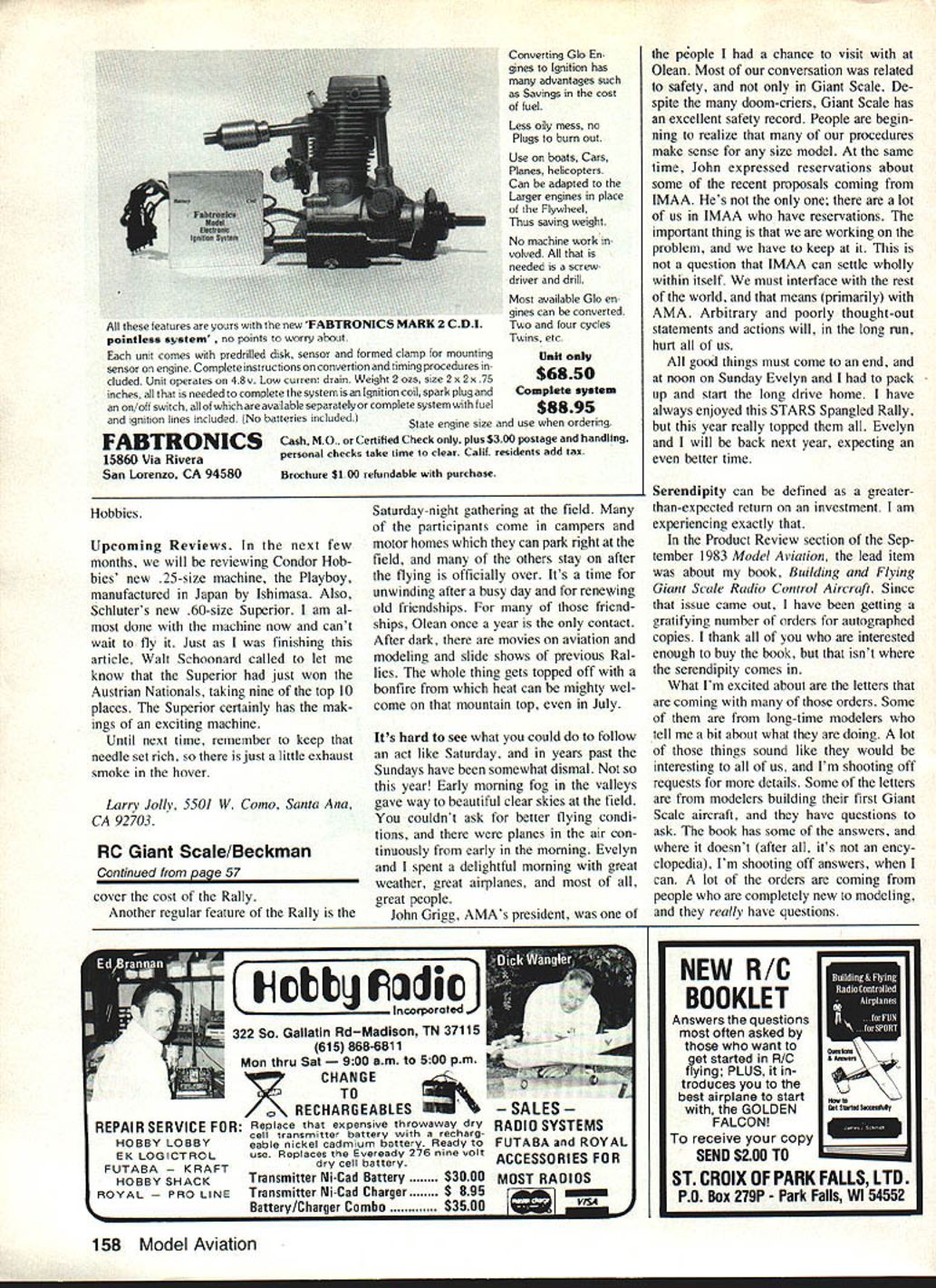
- In the next few months, we will be reviewing Condor Hobbies' new .25-size machine, the Playboy, manufactured in Japan by Ishimasa.
- Also, Schluter's new .60-size Superior. I am almost done with the machine now and can't wait to fly it. Just as I was finishing this article, Walt Schoonard called to let me know that the Superior had just won the Austrian Nationals, taking nine of the top 10 places. The Superior certainly has the makings of an exciting machine.
Until next time, remember to keep that needle set rich, so there is just a little exhaust smoke in the hover.
Larry Jolly 5501 W. Como, Santa Ana, CA 92703.
Transcribed from original scans by AI. Minor OCR errors may remain.

