

Radio Control: Helicopters
Larry Jolly
Safety
In the shop
- Check your helicopter for loose screws or nuts.
- Always use locknuts that don't have nylon seals. On nuts that do have nylon seals, make sure the screw threads extend past the seal by at least two threads.
- Periodically check ball links for wear.
- Inspect radio equipment for loose wiring, sloppy gears, or worn output arms.
- Make sure the receiver battery is in good condition. Four or five servos under load can drain a pack very quickly.
- Check the fuel system for leaks or a detached clunk in the fuel tank.
- Always use a fuel filter and check that it is not plugged with debris.
At the field
- Prior to flight, check that the controls move in the correct direction. This is especially important with radios that have servo-reversing and inverted-flight switches.
- Make certain all control rods are attached. On some machines it is necessary to remove links to fold the rotor blades for transportation.
- Before starting the engine, make sure the radio is switched on and the fuel tank is full.
- Hold the rotor head securely while starting the engine.
- Be certain you can kill the engine using full-aft throttle trim.
During flight
Always carry the helicopter from the starting area to the flight area.
Prior to liftoff, accelerate the rotor to a speed that will not allow the machine to lift off, yet will still give you some control in the event of a wind gust. Allow the machine to spin up for at least one minute. This warm-up period will:
- Give you time to check that all rate switches and trims are in their proper positions.
- Allow you to detect any noticeable vibration.
- Let the engine reach operating temperature and let you verify the carburetor is adjusted for a good idle as you open the throttle for liftoff.
When everything is checked and normal, liftoff into a low hover just out of ground effect. Check that the machine is trimmed for hover. Look for plenty of exhaust smoke — having the needle set just a little rich gives a safety margin against engine burn-down. If everything looks good, fly and enjoy yourself. By following these steps you reduce the chance of accidents due to haste or neglect.
Pilot and spectator safety
The following rules should be adhered to rigidly. Never break them. If you see someone violating them, remind the person of the dire consequences of being hit by a flying rotor.
- Never hold or touch a helicopter that has the rotors turning.
- Never fly over the pits or over another pilot.
- Never fly a helicopter that is shaking or vibrating.
- Never fly a helicopter that is glitching — land immediately before something bad happens.
- Never attempt more than 80% of your abilities while demonstrating your machine. If you are uncomfortable executing a maneuver, you are probably beyond your proficiency. Go home and practice until you are confident.
- When learning a new maneuver, be prepared with an "out" for that maneuver. For example, when I learned nose-in flight, I decided the emergency "out" would be hard tail rotor (either direction) and, as the tail came around toward me, full forward cyclic. Once in forward flight I could regain composure and sort things out.
- Never fly by yourself. If you were struck by a flying machine you might be unable to go for help.
- Always follow field rules and procedures. Never put yourself or a bystander in danger — think before you fly.
All of these rules come from observation and experience. I have crashed and witnessed many crashes that could have been prevented, and some of these could have caused catastrophic bodily damage. Few would consider touching a spinning rotor blade if they had seen the bloody damage it can cause.
A recent incident at our club field illustrates the danger. Two friends were tuning the engine of a Baron 20. Each had a hand on a skid and had the machine elevated above their heads. They ran the engine to full throttle and adjusted the needle valve. As they throttled back, a hot globule of oil struck one man in the face. He immediately released the machine, which rolled over; the rotor blades struck the other fellow in the forehead. They were very lucky — the rotor was spinning down and did not have enough energy to cause a fatal injury, but the gash across the forehead was a stark reminder of the risk. We can have a lot of fun flying RC helicopters, but it’s not enjoyable if you end up doing your flying from a hospital bed. Think before you push the throttle forward, and fly safely!
Helicopter review
Playboy (.25-size)
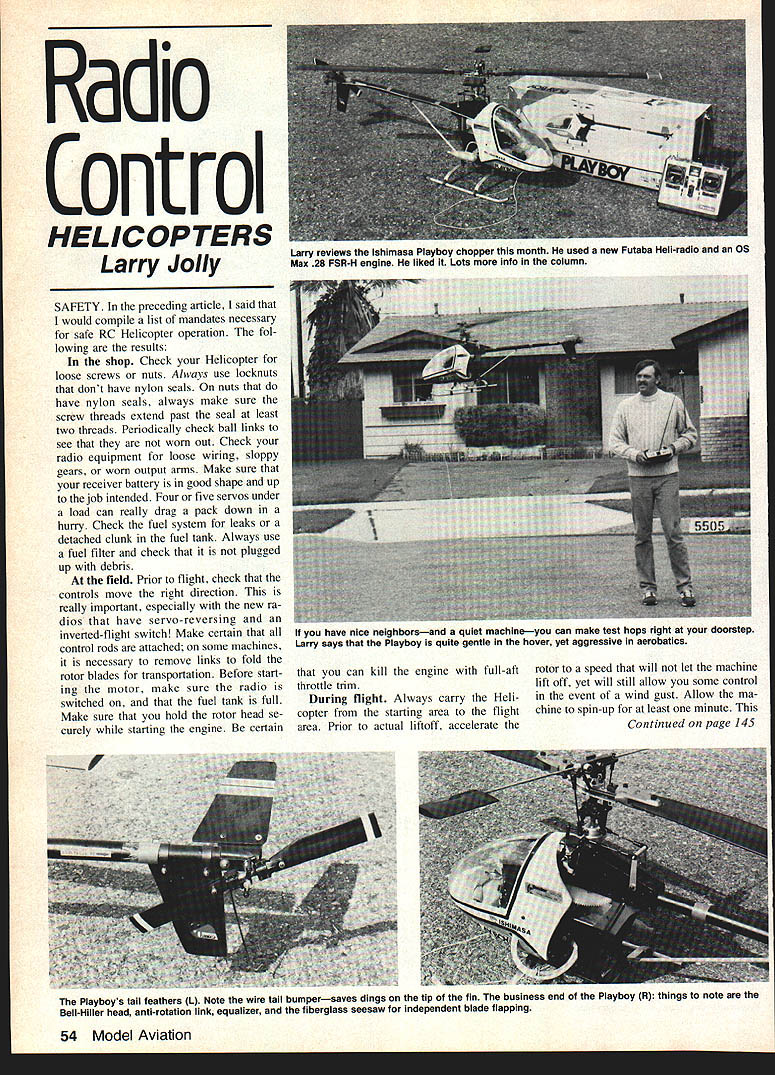
The Playboy is a new .25-size machine manufactured by Ishimasa of Japan and marketed in the U.S. by Condor Hobbies. This inexpensive chopper is impressive. It features collective pitch, a Bell-Hiller rotor control, a fiberglass seesaw with damper limits, and a toothed tail-rotor drive belt. An optional auto-rotation clutch will apparently be offered soon.
Specifications:
- Rotor diameter: 40.5 in.
- Length (minus rotor head): 38.5 in.
- Servos required: 4 or 5
- Recommended power: .25–.30 Schnuerle engine or a .40-size sport engine
Building and flight impressions
The Playboy arrived in a multi-hued box with illustrations showing the helicopter to best advantage. The kit was well packaged and up to high standards, with nothing damaged or missing. Before starting assembly I checked the instruction manuals and the plan sheet. The documentation can be a little confusing at first, but with patience it becomes clear.
There are two Japanese manuals: one for the basic helicopter construction and one for the collective-pitch version. There are also two English manuals that are translations of the Japanese ones (minus some pictures). All necessary instructions are included — just keep an open mind.
Originally, the Playboy was marketed as a fixed-pitch machine; a full-size drawing of that variant is included.
The Playboy is logically constructed and can be built by anyone with average mechanical skills. We built ours according to the manuals and powered it with an OS MAX .28 FSR-H helicopter glow engine. For control we installed a Futaba FG-H helicopter radio with S-28 servos. The entire package functions superbly — the Playboy is great fun to fly. The Bell-Hiller head allows smooth hovering, and with high rate selected on the transmitter it is very aerobatic. The feel of the Playboy is not unlike that of a small Heliboy — it really grooves.
If you are considering a small helicopter, try the Playboy. I think you'll be very satisfied.
Until next month, remember: if the tail boom shakes, it's the rotor head that is out. If the landing gear shakes, it is the engine-fan combination that is out. BCNU.
Larry Jolly 5501 W. Como, Santa Ana, CA 92703
Transcribed from original scans by AI. Minor OCR errors may remain.

