
Radio Control HELICOPTERS
Larry Jolly
Star‑Ranger
Let's talk about Star‑Ranger, the new kid on the block. If you have never read foreign publications or have little interest in RC helicopters on the international front, you may not have heard of the machine called Star‑Ranger or its creator, Ewald Heim. I remember the first time I heard mention of this dynamic duo, back in 1978. I was in Dave Nieman's shop outside London and happened to see the name Star‑Ranger in an English model magazine. A fellow in the shop informed me that the Star‑Ranger was a specially modified Kavan Jet Ranger and that its builder, Heim, was a talented German flier. As time passed, I read more passages referring to Heim and his machine, usually in the results section of European contests.
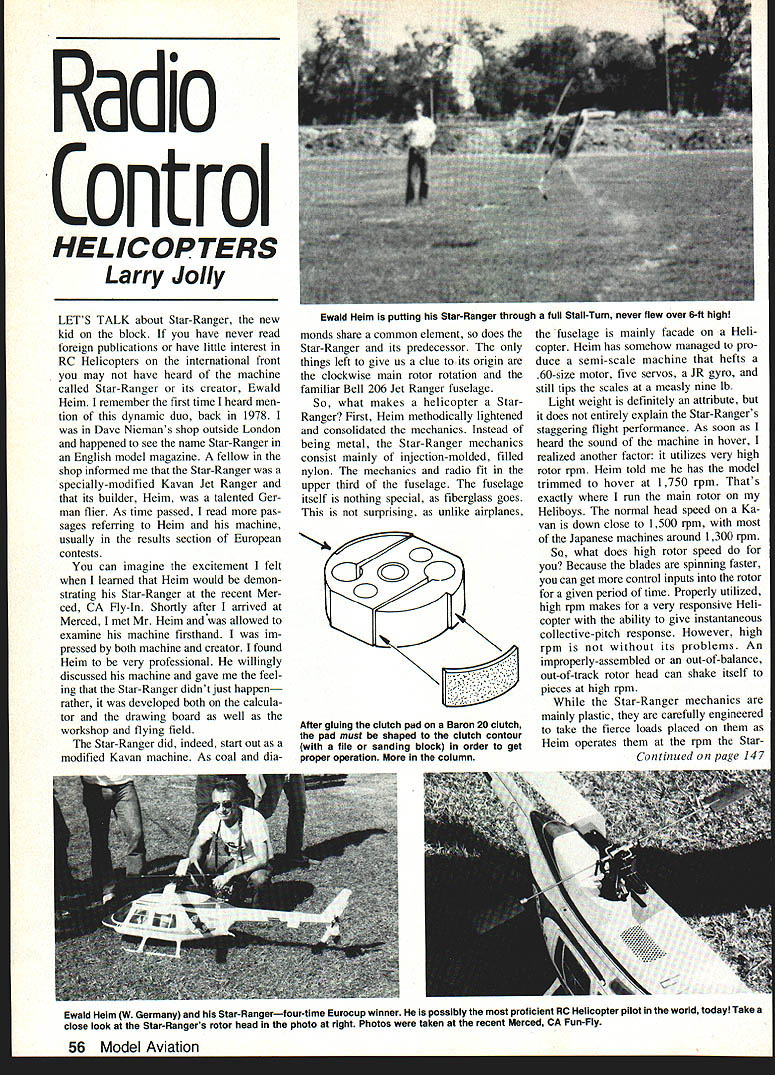
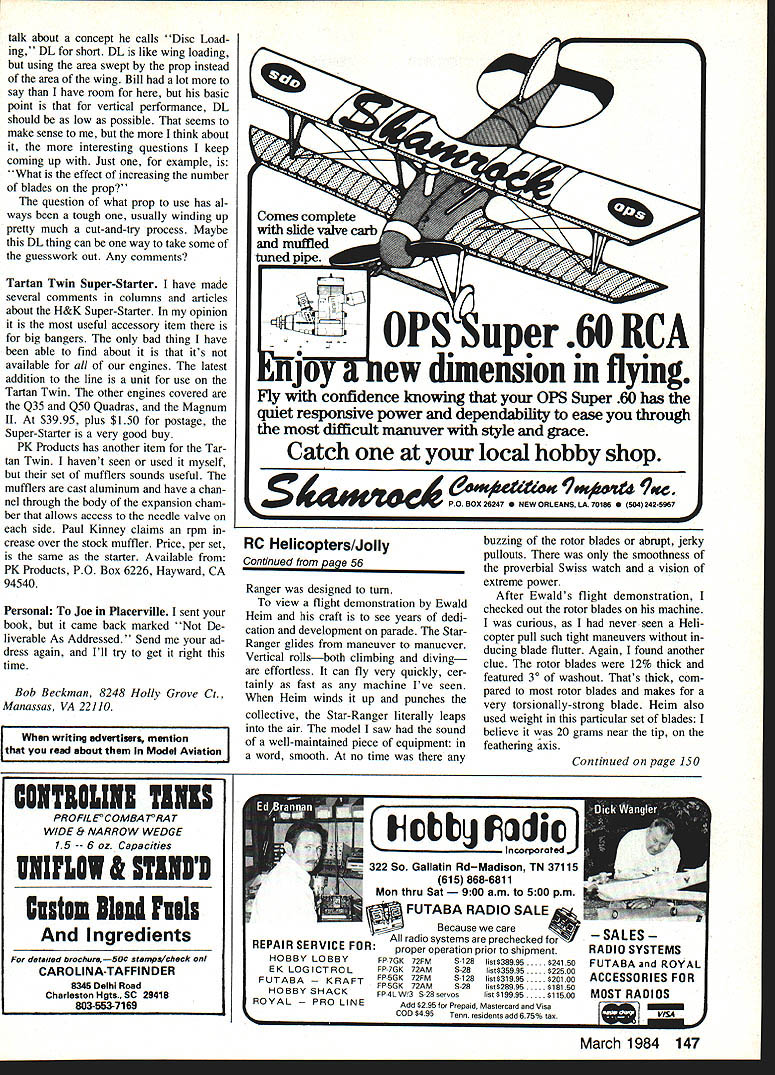
You can imagine the excitement I felt when I learned that Heim would be demonstrating his Star‑Ranger at the recent Merced, CA fly‑in. Shortly after I arrived at Merced, I met Mr. Heim and was allowed to examine his machine firsthand. I was impressed by both the machine and its creator. I found Heim to be very professional. He willingly discussed his machine and gave me the feeling that the Star‑Ranger didn't just happen—rather, it was developed both on the calculator and the drawing board as well as in the workshop and at the flying field.
The Star‑Ranger did, indeed, start out as a modified Kavan machine. As coal and diamonds share a common element, so do the Star‑Ranger and its predecessor. The only things left to give us a clue to its origin are the clockwise main rotor rotation and the familiar Bell 206 Jet Ranger fuselage.
Design and construction
So, what makes a helicopter a Star‑Ranger?
- Heim methodically lightened and consolidated the mechanics. Instead of being metal, the Star‑Ranger mechanics consist mainly of injection‑molded, filled nylon.
- The mechanics and radio fit in the upper third of the fuselage.
- The fuselage itself is a straightforward fiberglass job. This is not surprising, as unlike airplanes, the fuselage is mainly facade on a helicopter.
- Heim has managed to produce a semi‑scale machine that carries a 60‑size motor, five servos, a JR gyro, and still tips the scales at a measly nine pounds.
Light weight is definitely an attribute, but it does not entirely explain the Star‑Ranger's staggering flight performance.
Rotor speed and handling
As soon as I heard the sound of the machine in hover, I realized another factor: it utilizes very high rotor rpm. Heim told me he has the model trimmed to hover at 1,750 rpm. The normal head speed on a Kavan is down close to 1,500 rpm, with most of the Japanese machines around 1,300 rpm.
So, what does high rotor speed do for you? Because the blades are spinning faster, you can get more control inputs into the rotor in a given period of time. Properly utilized, high rpm makes for a very responsive helicopter with the ability to give instantaneous collective‑pitch response. However, high rpm is not without its problems. An improperly assembled or an out‑of‑balance, out‑of‑track rotor head can shake itself to pieces at high rpm.
While the Star‑Ranger mechanics are mainly plastic, they are carefully engineered to take the fierce loads placed on them when Heim operates them at the rpm the Star‑Ranger was designed to turn.
Flight characteristics
To view a flight demonstration by Ewald Heim and his craft is to see years of dedication and development on parade. The Star‑Ranger glides from maneuver to maneuver. Vertical rolls—both climbing and diving—are effortless. It can fly very quickly, certainly as fast as any machine I've seen. When Heim winds it up and punches the collective, the Star‑Ranger literally leaps into the air.
The model I saw had the sound of a well‑maintained piece of equipment: in a word, smooth. At no time was there any buzzing of the rotor blades or abrupt, jerky pullouts. There was only the smoothness of the proverbial Swiss watch and a vision of extreme power.
Rotor blades
After Ewald's flight demonstration, I checked out the rotor blades on his machine. I was curious, as I had never seen a helicopter pull such tight maneuvers without inducing blade flutter. Again, I found another clue. The rotor blades were 12% thick and featured 3° of washout. That's thick compared to most rotor blades and makes for a very torsionally strong blade. Heim also used weight in this particular set of blades: I believe it was 20 grams near the tip, on the feathering axis.
Availability
Apparently, negotiations between Heim and Gorham Model Products are complete, and you should be able to get a Star‑Ranger from GMP as you read this. John Gorham told me that the Star‑Ranger will be available either as a complete kit or as a mechanics set to go with a cowl or fuselage.
Advice for prospective owners
For those of you reading this and considering acquiring a Star‑Ranger, remember: the Star‑Ranger could well be the best FAI helicopter in the world today, as flown by Ewald Heim, four‑time European champion. You should also remember that the Star‑Ranger's performance comes from years of practice and determination on Heim's part. If you have trouble with your Star‑Ranger, it might be that it is a more advanced machine than you are capable of handling at your current skill level. You need not be ashamed, though; we must all learn to walk before we can run, and practice solves a great many dilemmas.
A reader problem: Baron 20 clutch
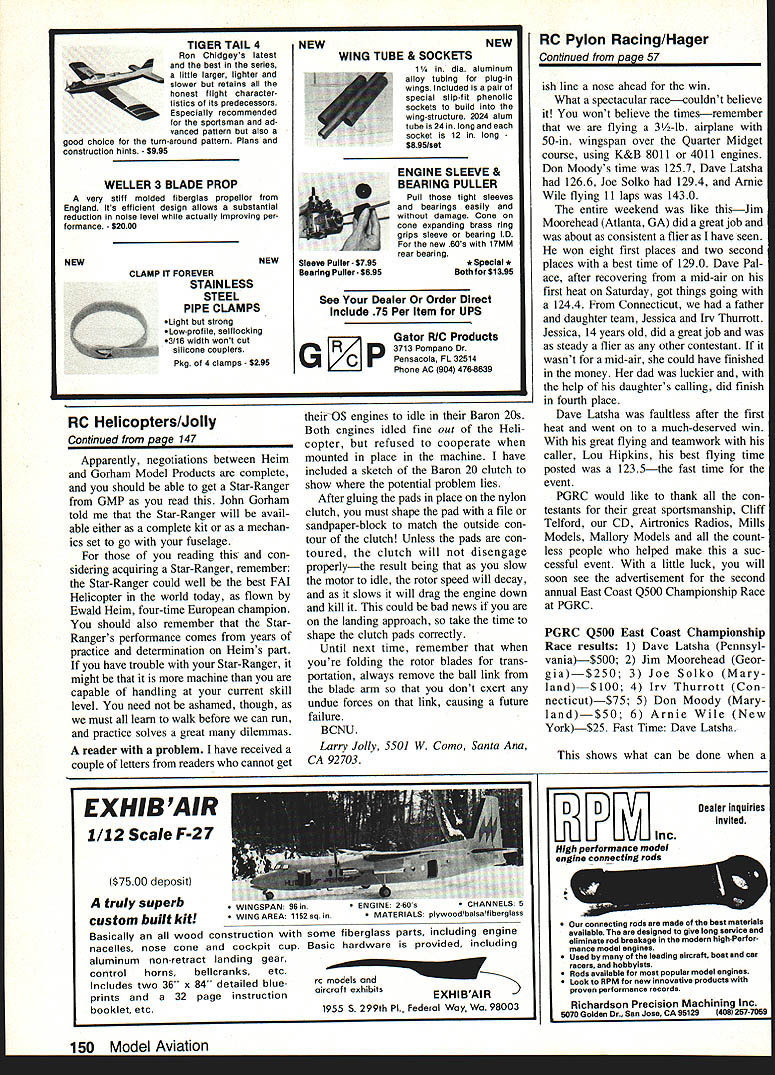
I have received a couple of letters from readers who cannot get their OS engines to idle in their Baron 20s. Both engines idled fine out of the helicopter, but refused to cooperate when mounted in place in the machine. I have included a sketch of the Baron 20 clutch to show where the potential problem lies.
After gluing the pads in place on the nylon clutch, you must shape the pad with a file or sandpaper block to match the outside contour of the clutch. Unless the pads are contoured, the clutch will not disengage properly—the result being that as you slow the motor to idle, the rotor speed will decay, and as it slows it will drag the engine down and kill it. This could be bad news if you are on the landing approach, so take the time to shape the clutch pads correctly.
Final tips
- When you're folding the rotor blades for transportation, always remove the ball link from the blade arm so that you don't exert any undue forces on that link, causing a future failure.
BCNU, Larry Jolly 5501 W. Como, Santa Ana, CA 92703.
Transcribed from original scans by AI. Minor OCR errors may remain.

