
Radio Control: Helicopters
Larry Jolly
SURPRISE! Part of the fun of being a monthly columnist is reading each new issue of Model Aviation and discovering the various mistakes that show up in your column! You must understand that when you get your copy of the magazine, nearly three months have passed since the initial writing of the material. (Sometimes I have trouble remembering what happened last week, let alone three months ago!) Anyway, in my column on safety, the first line reads something like: "Never use locknuts that have nylon seals." What I thought I wrote was: "Always use Loctite on nuts that don't have nylon seals."
Also, pertaining to that same issue, there were some photos of the Ishimasa Playboy. In one of them, I am shown hovering the machine in front of my neighbor's house. For those of you wondering how safe that is, I have to confess that flying in a residential area is not a good idea. There are certain risks involved in flying at any site; however the number of risks goes up proportionately to the number of people in the area.
Assessing the Gorham Model Products Cricket Helicopter
In a previous column, I commented that all of you go out and buy subscriptions to England's new Radio Controlled Helicopters magazine. I was very surprised at the negative criticism of the GMP Cricket written by Editor Colin Cameron in the Fall 1983 issue. Based on his comments, one would think that the Cricket had no redeeming virtues at all.
Although I think the Cricket really has enough merit to stand on its own two feet (as it were), perhaps a few words in its behalf would be in order. As most of you know, the GMP Cricket was designed as an inexpensive, easy-to-assemble, uncomplicated primary helicopter trainer. As far as I know, more people have learned to fly on the Cricket than on any other RC chopper.
After I read Colin Cameron's article, I called John Gorham for an update on the progress of the Cricket. Apparently, three years after its inception, GMP has sold nearly 10,000 Crickets! That's more than any other RC helicopter. John also told me that of the people entered in the 1983 Nationals, over half told him that they had learned to fly on the Cricket.
For those of you who haven't read Colin Cameron's review, his basic dislike of the Cricket is that it does not have collective pitch. I have found that, in a machine in the .25-size class, collective pitch is not necessary—or, for that matter, desirable. These lightweight machines have plenty of response when powered with the modern engines available in the .25- to .28-size class.
The only reason I could think of for incorporating collective pitch into the machine would be to allow the possibility of autorotations. However, I believe that the number of .25-size helicopters that will successfully autorotate is on a direct par with the number of novices capable of executing this precise maneuver.
I know that there are "better" machines (that is, they have more capability) out there than the Cricket. I also realize that most of them are more expensive and/or complicated. But, let's give credit where credit is due. The Cricket is one darn nice-flying small helicopter. (I figure I'll get some mail on this one, but that's good; it helps to keep the column going.)
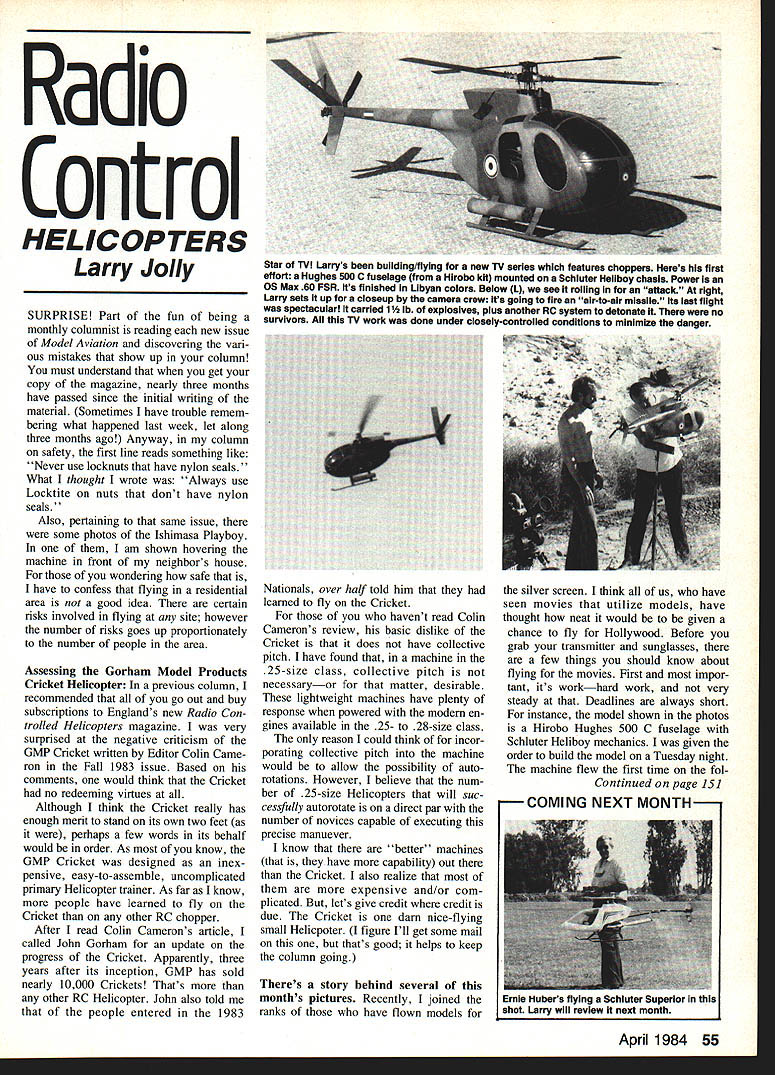
There's a story behind several of this month's pictures. Recently, I joined the ranks of those who have flown models for the silver screen. I think all of us who have seen movies that utilize models have thought how neat it would be to be given a chance to fly for Hollywood. Before you grab your transmitter and sunglasses, there are a few things you should know about flying for the movies. First and most important, it's work—hard work, and not very steady at that. Deadlines are always short. For instance, the model shown in the photos is a Hirobo Hughes 500 C fuselage with Schluter Heliboy mechanics. I was given the order to build the model on a Tuesday night. The machine flew the first time the following Friday night and was delivered, painted, Monday morning. It wouldn't have been so bad, but this took place over Christmas weekend, and I have to confess that Charlotte was not too crazy about me sanding primer on Christmas Eve.
Anyway, the story line called for the Hughes 500 to be blown up by an air-to-air missile. So, into the machine goes another radio for detonating the explosives, and a pound-and-a-half of excitement. Not having blown up anything before, I was both apprehensive and excited about the possibilities. As I knelt over the machine to start it on that last flight, I prayed that both of the safeties would work—and that if they didn't, that the crew could at least take me to the closest hospital in one trip!
The flight turned out to be somewhat anticlimactic, although there are millions of people out there who will love the resultant explosion, fireball, and debris. I feel kind of a loss. That Hughes was one great flying machine, and that was the first time I have crashed and had nothing I could salvage for another helicopter.
Anyway, the next time you see a helicopter blow up on the screen, think about the dedicated modelers who spent their time and effort to bring you that brief thrill. By the way, I can't tell you who I was flying for. Producers don't like viewers knowing that they use miniatures for the hairy scenes. However, I can tell you that there is a new series on the air featuring helicopters as its main theme. In our show, the good guy flies an American-made machine that flies real fast. Enough clues? Anyway, if you see a machine blow up, crash, or get into a tight
Transcribed from original scans by AI. Minor OCR errors may remain.

