
Radio Control: Helicopters
Larry Jolly
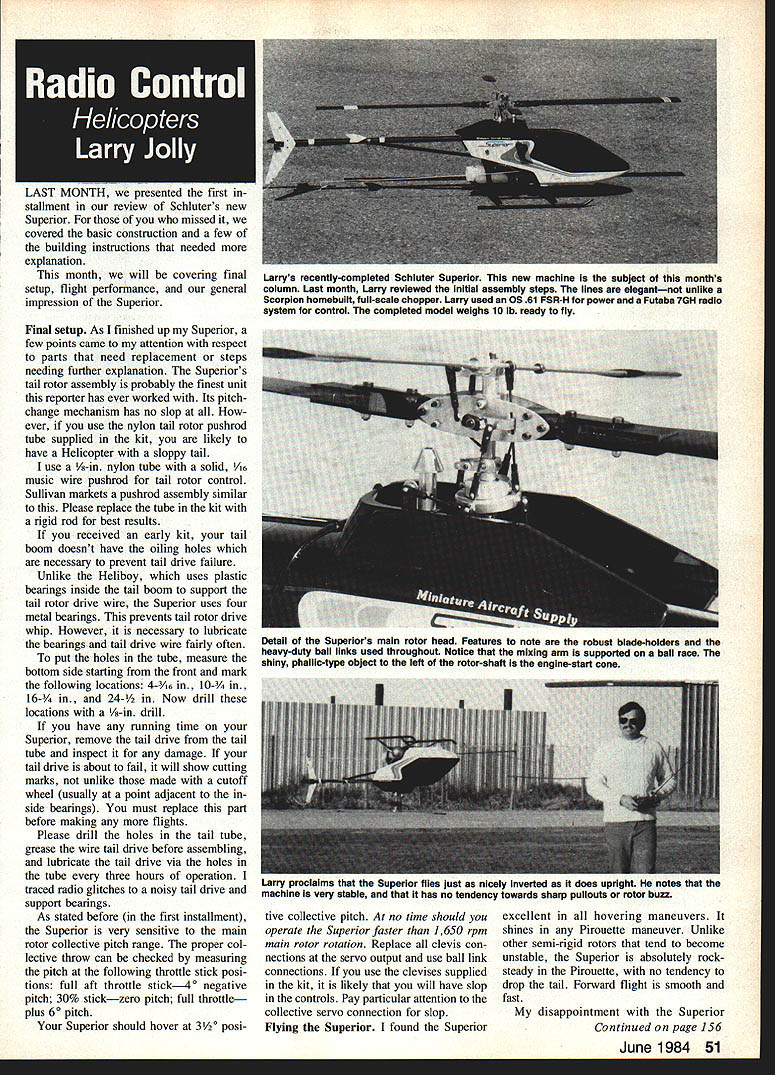
LAST MONTH, we presented the first installment in our review of Schluter's new Superior. For those of you who missed it, we covered the basic construction and a few of the building instructions that needed more explanation.
This month, we will be covering final setup, flight performance, and our general impression of the Superior.
Final setup
As I finished up my Superior, a few points came to my attention with respect to parts that need replacement or steps needing further explanation. The Superior's tail rotor assembly is probably the finest unit this reporter has ever worked with. Its pitch-change mechanism has no slop at all. However, if you use the nylon tail rotor pushrod tube supplied in the kit, you are likely to have a helicopter with a sloppy tail.
- Replace the kit tube with a rigid rod: I use a 5/32-in. nylon tube with a solid 1/16-in. music wire pushrod for tail rotor control. Sullivan markets a pushrod assembly similar to this. Please replace the tube in the kit with a rigid rod for best results.
If you received an early kit, your tail boom doesn't have the oiling holes which are necessary to prevent tail drive failure.
Unlike the Heliboy, which uses plastic bearings inside the tail boom to support the tail rotor drive wire, the Superior uses four metal bearings. This prevents tail rotor drive whip. However, it is necessary to lubricate the bearings and tail drive wire fairly often.
To add the oiling holes in the tail tube, measure the bottom side starting from the front and mark the following locations, then drill with a 1/8-in. drill bit:
- 4-3/16 in.
- 10-3/16 in.
- 16-3/4 in.
- 24-1/2 in.
If you have any running time on your Superior, remove the tail drive from the tail tube and inspect it for any damage. If your tail drive is about to fail, it will show cutting marks, not unlike those made with a cutoff wheel (usually at a point adjacent to the inside bearings). You must replace this part before making any more flights.
Please:
- drill the holes in the tail tube,
- grease the wire tail drive before assembling, and
- lubricate the tail drive via the holes in the tube every three hours of operation.
I traced radio glitches to a noisy tail drive and support bearings.
As stated before (in the first installment), the Superior is very sensitive to the main rotor collective pitch range. The proper collective throw can be checked by measuring the pitch at the following throttle stick positions:
- Full aft throttle stick — 4° negative pitch
- 30% stick — zero pitch
- Full throttle — plus 6° pitch
Your Superior should hover at 3-1/2° positive collective pitch. At no time should you operate the Superior faster than 1,650 rpm main rotor rotation.
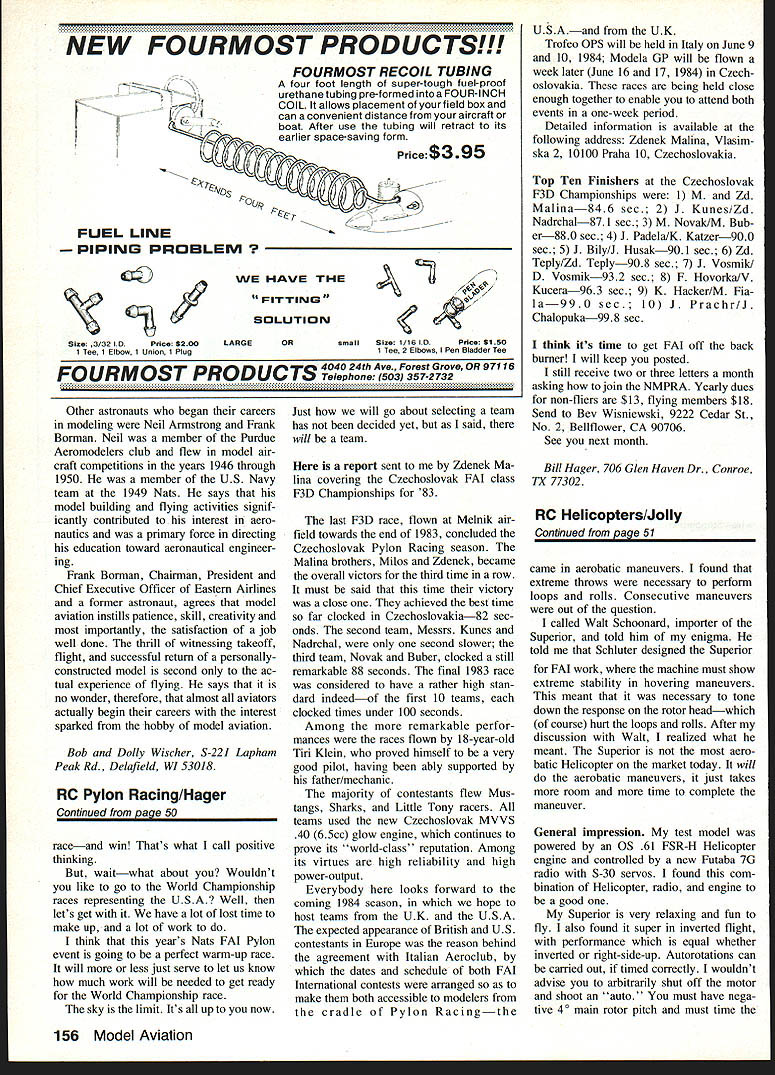
Replace all clevis connections at the servo output and use ball link connections. If you use the clevises supplied in the kit, it is likely that you will have slop in the controls. Pay particular attention to the collective servo connection for slop.
Flying the Superior
I found the Superior excellent in all hovering maneuvers. It shines in any pirouette maneuver. Unlike other semi-rigid rotors that tend to become unstable, the Superior is absolutely rocksteady in the pirouette, with no tendency to drop the tail. Forward flight is smooth and fast.
My disappointment with the Superior was that it is not the most aerobatic helicopter on the market today. It will do acrobatic maneuvers; it just takes more room and more time to complete the maneuver.
General impression
My test model was powered by an OS .61 FSR-H helicopter engine and controlled by a new Futaba 7G radio with S-30 servos. I found this combination to be a good one.
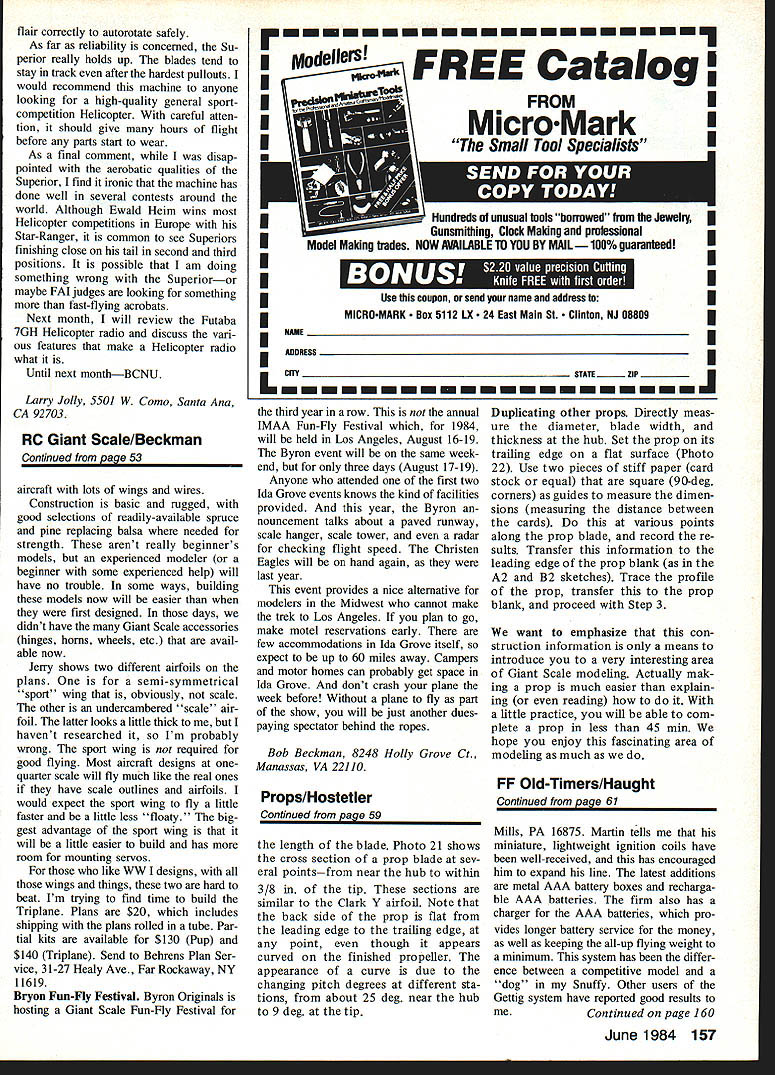
My Superior is very relaxing and fun to fly. I also found it superb in inverted flight, with performance equal whether inverted or right-side-up. Autorotations can be carried out, if timed correctly. I wouldn't advise you to arbitrarily shut off the motor and shoot an "auto." You must have negative 4° main rotor pitch and must time the flare correctly to autorotate safely.
As far as reliability is concerned, the Superior really holds up. The blades tend to stay in track even after the hardest pullouts. I would recommend this machine to anyone looking for a high-quality general sport-competition helicopter. With careful attention, it should give many hours of flight before any parts start to wear.
As a final comment, while I was disappointed with the aerobatic qualities of the Superior, I find it ironic that the machine has done well in several contests around the world. Although Ewald Heim wins most helicopter competitions in Europe with his Star-Ranger, it is common to see Superiors finishing close on his tail in second and third positions. It is possible that I am doing something wrong with the Superior—or maybe FAI judges are looking for something more than fast-flying acrobats.
Next month, I will review the Futaba 7GH helicopter radio and discuss the various features that make a helicopter radio what it is.
Until next month—BCNU.
Larry Jolly 5501 W. Como, Santa Ana, CA 92703.
Transcribed from original scans by AI. Minor OCR errors may remain.

