
Radio Control: Helicopters
Larry Jolly
Last month, I finished my review of the Schluter Superior. Even though I named Walt Schoonard as the model's importer, I failed to mention that the Superior is distributed in the United States by Miniature Aircraft Supply of Orlando, Florida, and that Walt and his family run that operation. Miniature Aircraft Supply was the source of the Superior built for the review, and I apologize for not mentioning them in the June column.
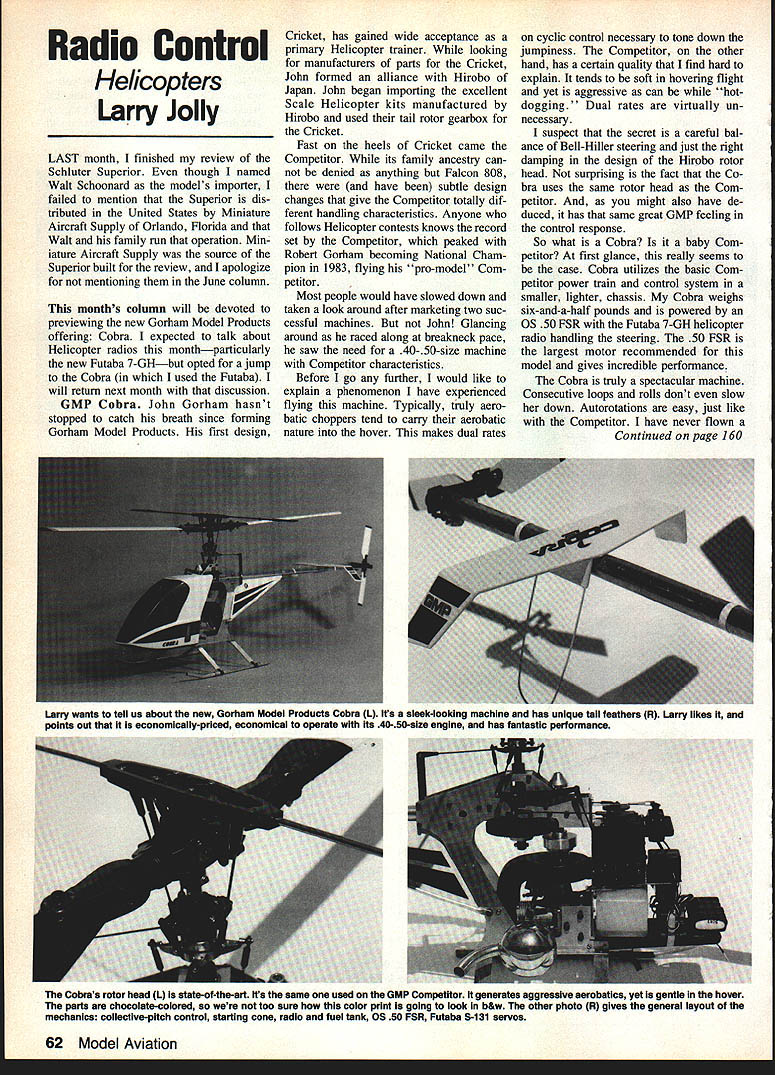
This month's column will be devoted to previewing the new Gorham Model Products offering: Cobra. I expected to talk about helicopter radios this month—particularly the new Futaba 7-GH—but opted for a jump to the Cobra (in which I used the Futaba). I will return next month with that discussion.
GMP Cobra
John Gorham hasn't stopped to catch his breath since forming Gorham Model Products. His first design, the Cricket, has gained wide acceptance as a primary helicopter trainer. While looking for manufacturers of parts for the Cricket, John formed an alliance with Hirobo of Japan. John began importing the excellent scale helicopter kits manufactured by Hirobo and used their tail-rotor gearbox in the Cricket.
Fast on the heels of the Cricket came the Competitor. While its family ancestry cannot be denied as anything but Falcon 808, there were (and have been) subtle design changes that give the Competitor totally different handling characteristics. Anyone who follows helicopter contests knows the record set by the Competitor, which peaked with Robert Gorham becoming National Champion in 1983, flying his "pro-model" Competitor.
Most people would have slowed down and taken a look around after marketing two successful machines. But not John! Glancing around as he raced along at breakneck pace, he saw the need for a .40–.50-size machine with Competitor characteristics.
Before I go any further, I would like to explain a phenomenon I have experienced flying this machine. Typically, truly aerobatic choppers tend to carry their aerobatic nature into the hover. This makes dual rates on cyclic control necessary to tone down the jumpiness. The Competitor, on the other hand, has a certain quality that I find hard to explain. It tends to be soft in hovering flight and yet is aggressive and can be "hot-dogging." Dual rates are virtually unnecessary.
I suspect that the secret is a careful balance, a Bell-Hiller steering system, and just the right damping in the design of the Hirobo rotor head. Not surprising is the fact that the Cobra uses the same rotor head as the Competitor. And, as you might also have deduced, it has the same great GMP feeling in the control response.
So what is a Cobra? Is it a baby Competitor? At first glance, this really seems to be the case. The Cobra utilizes the basic Competitor power train and control system in a smaller, lighter chassis. My Cobra weighs six-and-a-half pounds and is powered by an OS .50 FSR with the Futaba 7-GH helicopter radio handling the steering. The .50 FSR is the largest motor recommended for this model and gives incredible performance.
The Cobra is truly a spectacular machine. Consecutive loops and rolls don't even slow her down. Autorotations are easy, just like with the Competitor. I have never flown a more aerobatic machine. The power-to-weight ratio has got to be the best I've ever seen. After completing my Cobra, John let me fly one of his prototypes using a .40-size engine for comparison. The aerobatic performance, while good, was not as sparkling as with the larger engine. This was to be expected.
The .40 machine did fly very well and made me realize that the Cobra can (and will) cover the entire spectrum of performance in this class. Powered with a .40 and set up with normal control throws, the Cobra is a perfect medium-size collective trainer. With a .50 and extreme throws, the Cobra is capable of the entire FAI pattern, and any other helicopter pattern, for that matter. Set up in between, the Cobra is a super sport-ship which has that certain feel exhibited by the GMP line.
The Cobra is extremely easy to assemble. The instructions are organized in a series of subassemblies which soon leave you with a finished machine. I like the quick-release canopy mount and the tank-viewing window thoughtfully molded into the canopy.
I understand that GMP intends to market several scale fuselages to go along with Cobra mechanics. That would be great. The Cobra has enough lifting power to be a good-performing scale ship.
Congratulations, GMP — I can find no fault with the Cobra. It is an extremely versatile helicopter which will be popular for a long time to come.
Larry Jolly 5501 W. Como Santa Ana, CA 92703
When writing advertisers, mention that you read about them in Model Aviation.
Transcribed from original scans by AI. Minor OCR errors may remain.

