
Radio Control: Helicopters
Larry Jolly
Heli-Radios
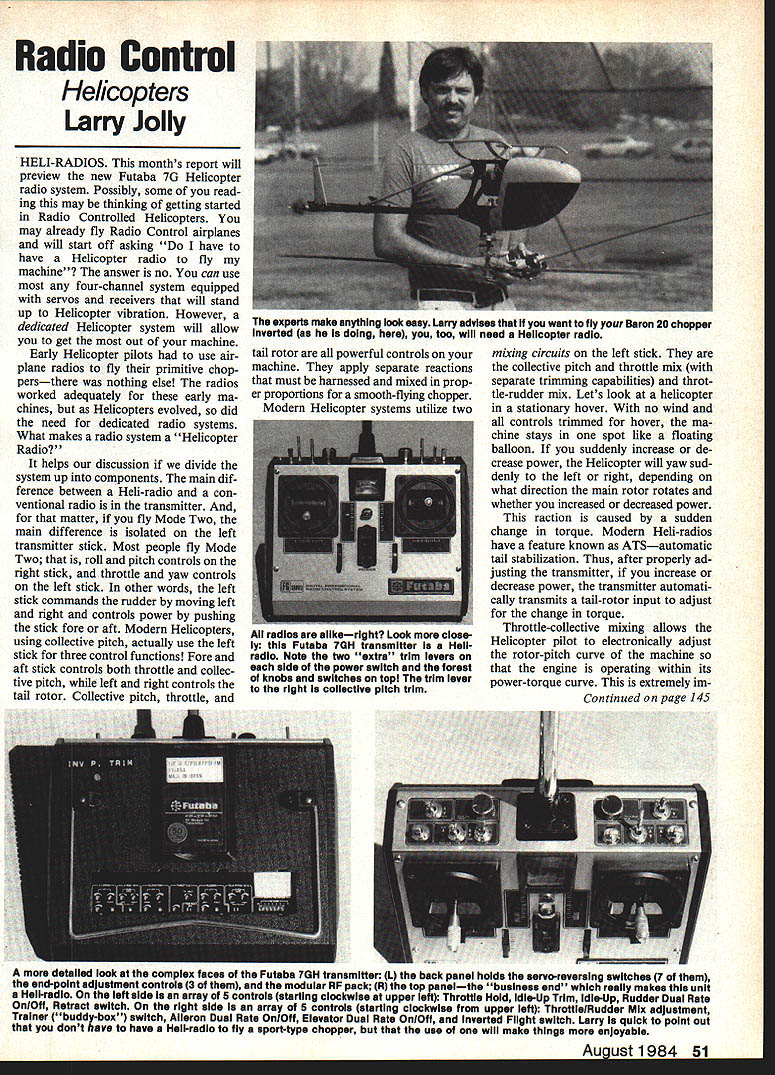
HELI-RADIOS. This month's report will preview the new Futaba 7GH helicopter radio system. If you are thinking of getting started in radio-controlled helicopters — or you already fly RC airplanes — you may ask, "Do I have to have a helicopter radio to fly my machine?" The answer is no. You can use most any four-channel system equipped with servos and a receiver that will stand up to helicopter vibration. However, a dedicated helicopter system will allow you to get the most out of your machine.
Early helicopter pilots had to use airplane radios to fly their primitive choppers—there was nothing else. Those radios worked adequately for early machines, but as helicopters evolved so did the need for dedicated radio systems.
What makes a helicopter radio different?
It helps our discussion if we divide the system into components. The main difference between a heli-radio and a conventional radio is the transmitter. If you fly Mode Two (roll and pitch on the right stick; throttle and yaw on the left stick), the main difference is isolated on the left transmitter stick. Most people fly Mode Two: roll and pitch controls on the right stick, and throttle and yaw (rudder) controls on the left stick.
Modern collective-pitch helicopters actually use the left stick for three control functions: fore and aft controls throttle and collective pitch, while left and right controls the tail rotor. Collective pitch, throttle, and tail rotor are all powerful controls that apply separate reactions and must be mixed correctly for smooth flight.
Modern helicopter systems utilize two mixing circuits on the left stick:
- collective-pitch and throttle mix (with separate trimming capability)
- throttle-rudder mix (throttle-to-tail-rotor mixing)
Mixing, torque, and ATS
Consider a helicopter in a stationary hover with all controls trimmed for neutral. If you suddenly increase or decrease power, the helicopter will yaw suddenly left or right depending on main rotor rotation and whether torque increased or decreased. This reaction is caused by a sudden change in torque.
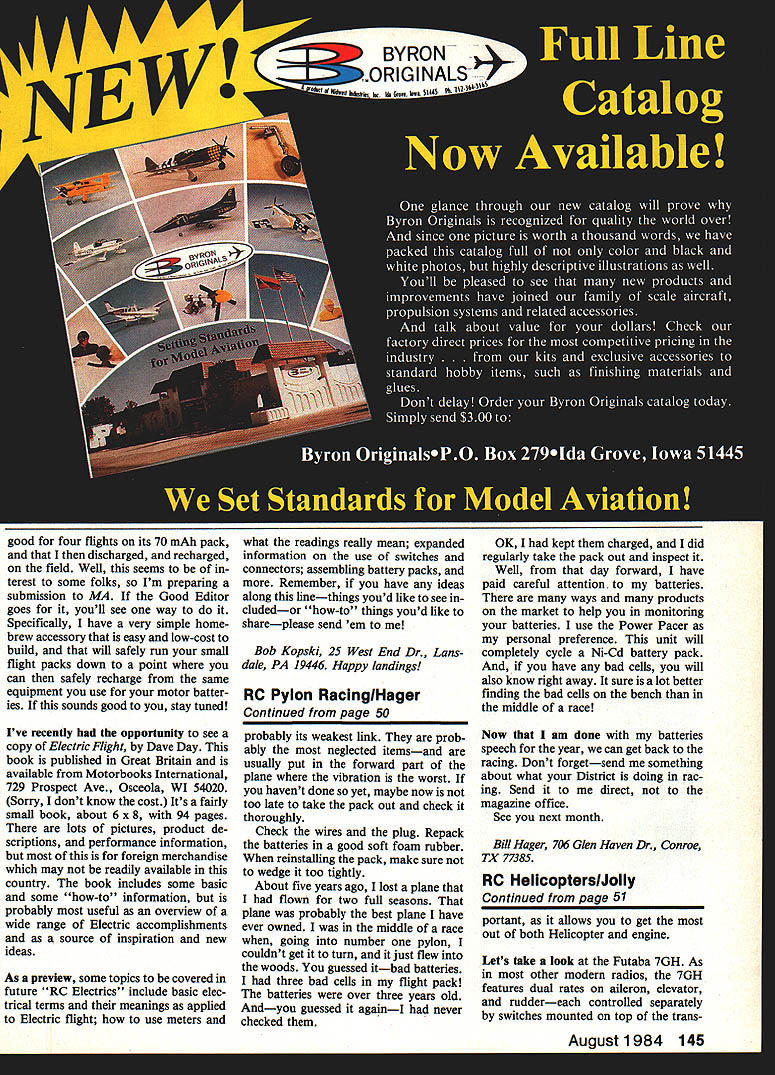
Modern heli-radios have a feature known as ATS — automatic tail stabilization. After proper adjustment, when you increase or decrease power the transmitter automatically transmits a tail-rotor input to compensate for the change in torque.
Throttle-collective mixing allows the pilot to electronically adjust the rotor-pitch curve so the engine operates within its power-torque curve. This is extremely important for consistent performance across the throttle range.
Futaba 7GH overview
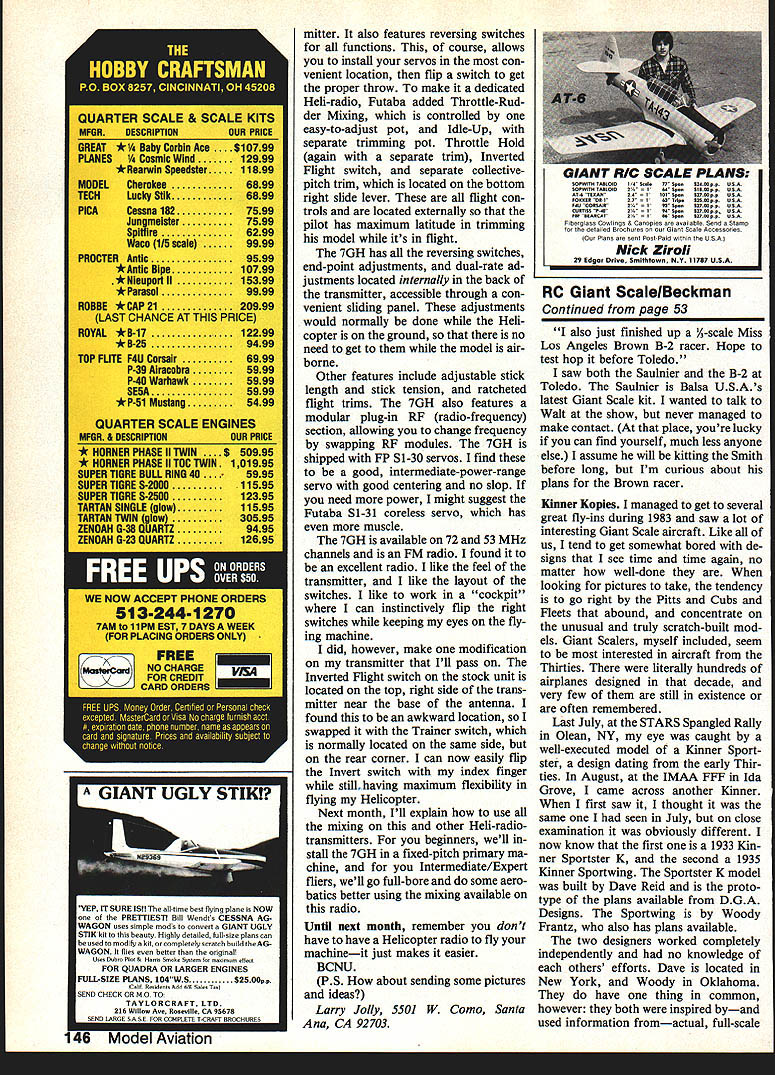
Let's take a look at the Futaba 7GH. As in most modern radios, the 7GH features dual rates on aileron, elevator, and rudder — each controlled separately by switches mounted on top of the transmitter. The 7GH also provides end-point adjustments for the servos, servo-reversing switches on the back panel, and accepts a modular battery pack.
The top panel — the business end — is what really makes this unit a heli-radio. The transmitter includes external flight controls so the pilot has maximum latitude in trimming the model while in flight.
Top-panel controls
Left-side array (starting clockwise from the upper left):
- Throttle Hold
- Idle-Up Trim
- Idle-Up
- Rudder Dual Rate On/Off
- Retract switch
Right-side array (starting clockwise from the upper left):
- Throttle/Rudder Mix adjustment
- Trainer (buddy-box) switch
- Aileron Dual Rate On/Off
- Elevator Dual Rate On/Off
- Inverted Flight switch
Also notable on the transmitter:
- Two extra trim levers on the side (the right trim lever is the collective-pitch trim)
- Power switch
- Four knobs/switches on top
In field use, the 70 mAh pack gave good power for several flights before needing recharge.
Other features
- Reversing switches for all functions, allowing convenient servo installation and easy reversal via switches.
- Throttle-Rudder mixing, controlled by an easy-to-adjust pot.
- Idle-Up with a separate trimming pot.
- Throttle Hold with a separate trim.
- Separate collective-pitch trim located on the bottom right slide lever.
- Reversing switches, end-point adjustments, and dual-rate adjustments are located internally in the back of the transmitter, accessible through a convenient sliding panel (these are normally set on the ground).
- Adjustable stick length and stick tension.
- Ratcheted flight trims.
- Modular plug-in RF section for changing frequency by swapping RF modules.
The 7GH is shipped with S1-30 servos, which are good intermediate-power-range servos with good centering and no slop. If you need more power, consider the Futaba S1-31 coreless servo.
The 7GH is available on 72 and 53 MHz channels and is an FM radio. I found it to be an excellent radio: good transmitter feel, intuitive switch layout, and a cockpit-style arrangement that lets me flip the right switches while keeping my eyes on the helicopter.
My modification
I made one modification I’ll pass on. The Inverted Flight switch on the stock unit is located on the top right side near the base of the antenna — an awkward location. I swapped it with the Trainer switch, which is normally on the rear corner of the same side. I can now easily flip the Invert switch with my index finger while maintaining flexibility in flying.
Next month / Closing
Next month I'll explain how to use all the mixing on this and other heli-radio transmitters. For beginners, we'll install the 7GH in a fixed-pitch primary machine. For intermediate and expert fliers, we'll go full-bore and do some aerobatics using the mixing available on this radio.
Until next month, remember you don't have to have a helicopter radio to fly your machine — it just makes it easier.
BCNU.
P.S. How about sending some pictures and ideas?
Larry Jolly 5501 W. Como, Santa Ana, CA 92703.
Transcribed from original scans by AI. Minor OCR errors may remain.

