
Radio Control: Helicopters
Larry Jolly
Emergency Rule Proposed
HOLD IT! A new Emergency Rule has been proposed by Horace Hagen (Chairman of the RC Helicopter Contest Board) and approved by John Grigg (AMA President). It calls for the elimination of any metal weights added to tail or main rotors and also prohibits metal or knife-edged main or tail rotor blades.
Under standard Contest Board procedures, this Emergency Rule action must be validated by a Contest Board vote, which must occur no earlier than four weeks after the ruling is published in an AMA publication. (In this case it appeared in the August 1984 "Competition Newsletter" under the heading "Safety Rule: RC Helicopters at the Nats" on page 112.) Then, not later than six weeks after publication, the Contest Board receives a 10-day turnaround ballot whereby they may approve or disapprove the Emergency action. (Editor's note: See this month's "Competition Newsletter" for more action on this ruling.)
This issue of Model Aviation will reach modelers before the voting period begins — so you can contact your AMA District RC Helicopter Contest Board member (his name and address appear in the "Competition Directory" section of the "Competition Newsletter" portion of this issue). You can also contact the RC Helicopter Contest Board Chairman and AMA President John Grigg, if you wish.
Please bear with me while I explain my thoughts on this new rule — and why I think you should tell the RC Helicopter Contest Board to defeat its adoption.
The Rule and Its Implications
The FAI definition of rotor blades was introduced into AMA rules, making metal main and tail rotor blades illegal. The FAI rule states: "Metal main and tail rotor blades are forbidden. Knife-edge leading edges are forbidden on main and tail rotor blades. No metal in or on the rotor blades is permitted except at the blade attachment point."
If you read no further than the end of the rule, it sounds like common sense. But start reading between the lines and around the rule and you'll see how poorly this passage was thought out.
Why ballast blades?
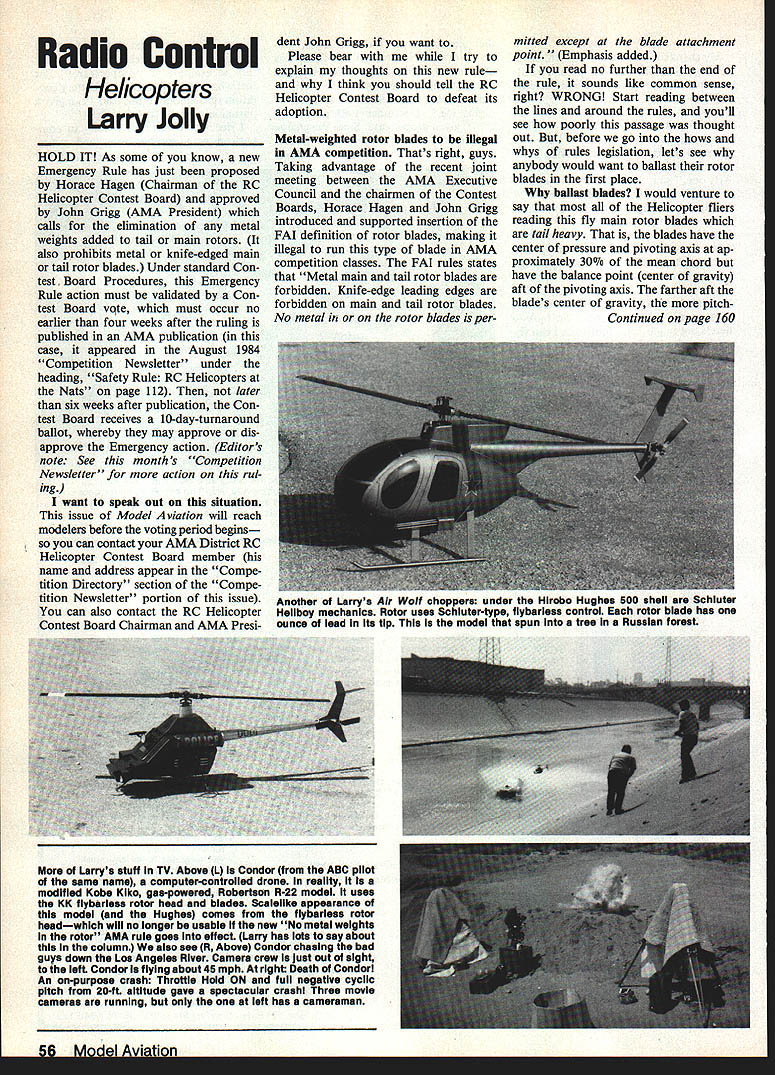
Most helicopter fliers use main rotor blades that are tail-heavy: the aerodynamic center (center of pressure) and pivoting axis are at approximately 30% of the mean chord, but the balance point (center of gravity) is aft of the pivoting axis. The farther aft the blade's center of gravity, the more pitch-sensitive the rotor blade.
Normal blade construction calls for a hardwood leading edge and a balsa trailing edge. The hardwood is important for two reasons:
- it provides the necessary blade attachment point, and
- it helps balance the rotor blade closer to the pivoting axis.
Rotors (or any airfoil with CG too far aft of the pivot) are likely to flutter. This is commonly seen on all-flying tailplanes used on RC sailplanes, but our rotor blades do it too. Without the Hiller flybar-and-paddle system — which provides necessary aerodynamic damping — many machines would be unflyable. A flybarless, Bell-input-only system (as used on the Horizon and Kobe Kiko R-22) must have CG-corrected rotor blades to perform properly. Without a flybar and with an aft center of gravity, the first control input could send the blade into an oscillation that might never return to equilibrium, negating control inputs.
Even helicopters with flybars fly better with CG-corrected rotor blades. Full-size helicopter blades have spars near the leading edges and may also use lead ballast to correct their centers of gravity.
We see that CG-corrected blades are a good idea and that blades of normal construction will require additional ballast to balance properly. If we can no longer put metal in our blades to correct CG, many flybarless head designs could become effectively obsolete.
Method of construction for CG-corrected blades
Two good examples of CG-corrected blades on the market are Horizon blades and the Kobe R-22 blades. Both provide usable blades that are unlikely to release lead missiles on impact.
The R-22 blade looks like most RC helicopter blades except that three slots are milled into the leading edge. The slots are approximately 1/2 x 3 in., equally spaced on the outer third of the rotor blade. Each slot is not milled completely through the bottom surface, forming a pocket for a 15-gram (about 1/2 oz.) lead weight. The three lead slugs are epoxy-set in place and the blades are covered.
This construction is very safe: the blade will typically break on impact and the lead is likely to stay in the broken blade and not hurt anyone. Why? Because the weights are located toward the tip. The farther out the ballast, the greater the moment arm and the less weight required. When a heavy tip strikes an object, the ballast applies leverage toward the blade center, creating a shear point so the tip breaks off and flutters to the ground. I have broken some R-22 blades and seen this happen.
FAI Legislation, or "Bonzo Goes to Paris"
You'd think each country in the FAI would send its most active modeling people to CIAM meetings. Not always. Some delegates haven't flown a model in 20 years — they may vote on RC Helicopter rules without having seen one fly.
An example: FAI Soaring (F3B). From 1976–1979 the Austrian AME group dominated Europe with their Dassel model, which had a very pointed nose. At the 1979 CIAM meeting someone proposed (and passed) a rule that all F3B soarers must have a minimum nose radius of 7.5 cm (3 in.). The rule was justified as a safety measure, but in practice it was a targeted restriction. That illustrates the kind of poor, counterproductive rulemaking that can happen.
What's wrong with the FAI helicopter rule?
The key problematic phrase is: "No metal in or on the rotor blades is permitted," except at blade attachments. The net result? You don't have to use metal to ballast blades — you can use other substances.
For example, if someone develops a plastic that is half as dense as lead, you could use twice the volume of plastic to achieve the same weight. If you read the FAI rule literally, you have not violated it by using such materials. This sloppy wording defeats the intended safety objective.
Rules that are poorly written can be worse than no rule at all. A better rule would be specific about what is dangerous and acceptable, rather than issuing blanket bans that leave loopholes and stifle technology.
What can we do?
Fight the rule at the CIAM level? That will be difficult. Our best chance is to get the AMA to adopt a better-written, safer domestic rule. Suggested actions:
- Talk to your District RC Helicopter Contest Board member (listings in the Competition Directory).
- Contact the RC Helicopter Contest Board chairman and the AMA president.
- Send letters or phone calls expressing your views — they do get noticed.
I suggest the Helicopter Contest Board find an acceptable method for installation of ballast and publish it in the AMA rule book — much as was done for acceptable single-blade propellers for CL Speed.
We can turn this Emergency ruling around. About a month from the time you read this, the ruling will be brought before the Contest Board for adoption into the rule book. If you disagree with adoption of the FAI definition of rotor blades for AMA competition, tell the Contest Board or send your views to me and I'll forward them to the right people.
A note about the future
I think we'll see more flybarless heads as electronics improve. Flying such machines safely will require blades designed from the start with CG at the proper point, and this may require built-in ballast that cannot be easily removed. Therefore the AMA should adopt rules that allow safe, effective ballast materials that won't turn blades into dangerous projectiles. Don't let a poorly written international edict destroy the progress we've made here.
Dense as lead. A modeler could enlarge the pockets on R-22 blades three times, grind plastic up, mix it with epoxy, and produce CG-correct blades that might release missiles just as deadly as metal ones. Worse yet, this adoption encourages the use of denser hardwood on the leading edge and glass-fiber composite rotor blades. In the event of an accident with these types of blades, do you really trust you'll be any safer? I think not.
Why not instead introduce a rule which states that any competitor who breaks his blades will be eliminated from the competition? I am not an anarchist — rules are necessary, but poor rules are worse than no rules at all. Any rule proposed should be well thought out, not stifle technology, and consider implications for future contestants.
We can do better by specifying acceptable ballast installation methods and materials in the AMA rule book.
BCNU.
Larry Jolly 5501 W. Como, Santa Ana, CA 92703.
Transcribed from original scans by AI. Minor OCR errors may remain.

