
Radio Control: Helicopters
Larry Jolly
Scale Fascination
Have you ever noticed how people are attracted to a scale model? Time and time again I've seen people crowd around a model that looks like a real machine and seemingly ignore the look-alike pod-and-boom types. I'm not sure what causes this magnetic attraction, but one thing is certain: people, whether modelers or non-modelers, are drawn to scale models.
On the radio control helicopter scene, scale machines seem to be making a comeback. Those of you who started flying in the last seven years may not realize that before the 1975 stick-and-bubble revolution (led by Dieter Schluter and his Heli Boy), nearly all the machines on the market were scale. The only non-scale machines that come to mind from that era were those manufactured by Du-Bro.
In the last seven years our RC helis have become standardized and optimized in design. When manufacturers discarded the scale fuselage they found they could considerably lighten and consolidate the mechanics. This, of course, made the models both lighter in weight and easier to work on. There was a side benefit not immediately realized: improved performance.
When Dieter Schluter first designed his Heli Cobra back in 1970, it was big. Mine weighed 12 pounds and was powered by a Veco .61 engine. The Veco put out almost as much power as the OS .50 FSR in my GMP Cobra. While the Heli Cobra flew fine at 12 pounds (in fact, it was like flying a Paragon sailplane), the GMP Cobra would not be very happy at that weight. So what's the difference? They both have similar power. The main difference is in gearing, which affects rotor speed and diameter. Early scale ships were load-lifters; they were heavy. Their rotors were large in diameter and turned at low rpm. You were considered brave to attempt aerobatics.
With the stick-and-bubble revolution, machines became lighter. Designers harnessed the reserve horsepower of their motors by letting the rotor speed increase. The rest is history. All the fliers in Spencer, IN, were looping and rolling their Heli Boys.
Scale didn't die, though, since there has always been a small group of dedicated scale builders. But the percentage of scale versus non-scale use dipped in favor of non-scale when the performance machines hit the market. I'm glad to see that manufacturers are now taking stick-and-bubble technology and wrapping a lightweight epoxy-glass fuselage around it. Take, for instance, Heim (Star Ranger and Bell 222), the Schluter Jet Ranger and Augusta 109, the Hirobo SST Jet Ranger, and now the Gorham Jet Ranger. These are modern, scale machines that feature light weight and good performance as well as the side benefit of better aerodynamics from their streamlined fuselages.
Recently I've had to build several scale models and have learned quite a few things I didn't know before, such as peculiarities of scale helicopter operations.
Helicopter Operations
The most important factor in operating a scale model helicopter is keeping your motor happy. In an open-framed machine the motor has plenty of fresh air around it. It is possible to take a Schluter Heli Boy in stock configuration, at about four pounds to the skids, and fly around—not just hover—but perform the kinds of maneuvers full-size helicopters do. I've done it.
It's also possible to take the same machine, wrap a Hirobo fuselage around it (adding a total of about two pounds to the flying weight), and have the same machine refuse to hover. I've done that too. Many readers have complained of poor performance after adding a fuselage shell.
In all such cases, the problem usually involves poor exhaust and cooling arrangements. Modelers often fail to ensure that the exhaust ports from the motor exit the fuselage cleanly and stay out. Not even running your motor dead lean will bring your scale ship down as fast as making your motor breathe its own exhaust!
Suggestions:
- Add an extension of rubber or Teflon hose to your muffler and clamp it tight to ensure against leaks.
- Exit the tubing in a concealed location under the fuselage and let the tube extend about 1/4 inch outside the shell.
- Seal around the tubing with silicone rubber to keep exhaust gases out of the fuselage.
- Try to set up a cooling system that allows an inlet and an outlet—preferably opposite the exhaust side.
Using a little common sense you can keep your motor running and your scale ship flying.
This Month's Photos
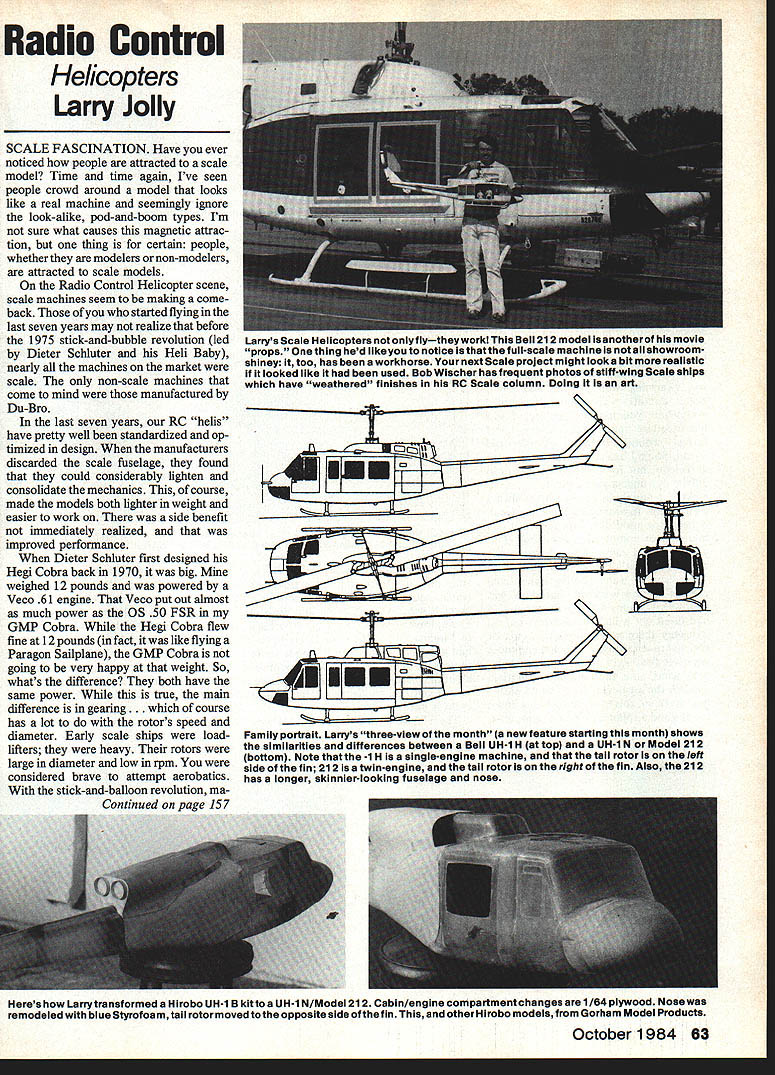
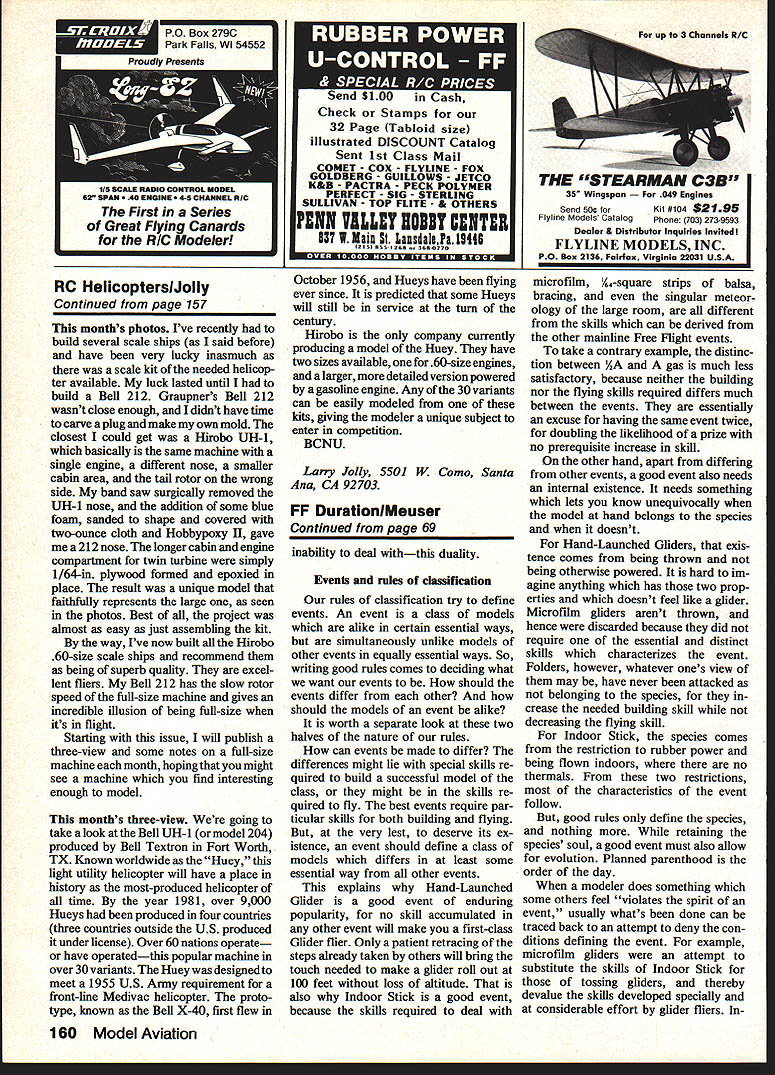
I've recently had to build several scale ships and was fortunate that scale kits of the needed helicopters were available. My luck ran out when I had to build a Bell 212. Graupner's Bell 212 wasn't close enough, and I didn't have time to carve a plug and make my own mold. The closest I could get was a Hirobo UH-1, which basically is the same machine with a single engine, a different nose, a smaller cabin area, and the tail rotor on the wrong side.
My band saw surgically removed the UH-1 nose, and the addition of some blue foam, sanded to shape and covered with two-ounce cloth and Hobbypoxy II, gave me a 212 nose. The longer cabin and engine compartment for the twin turbine were simply 1/64-inch plywood formed and epoxied in place. The result was a unique model that faithfully represents the large one, as seen in the photos. Best of all, the project was almost as easy as just assembling the kit.
By the way, I've now built all the Hirobo .60-size scale ships and recommend them as being of superb quality. They are excellent fliers. My Bell 212 has the slow rotor speed of the full-size machine and gives an incredible illusion of being full-size when in flight.
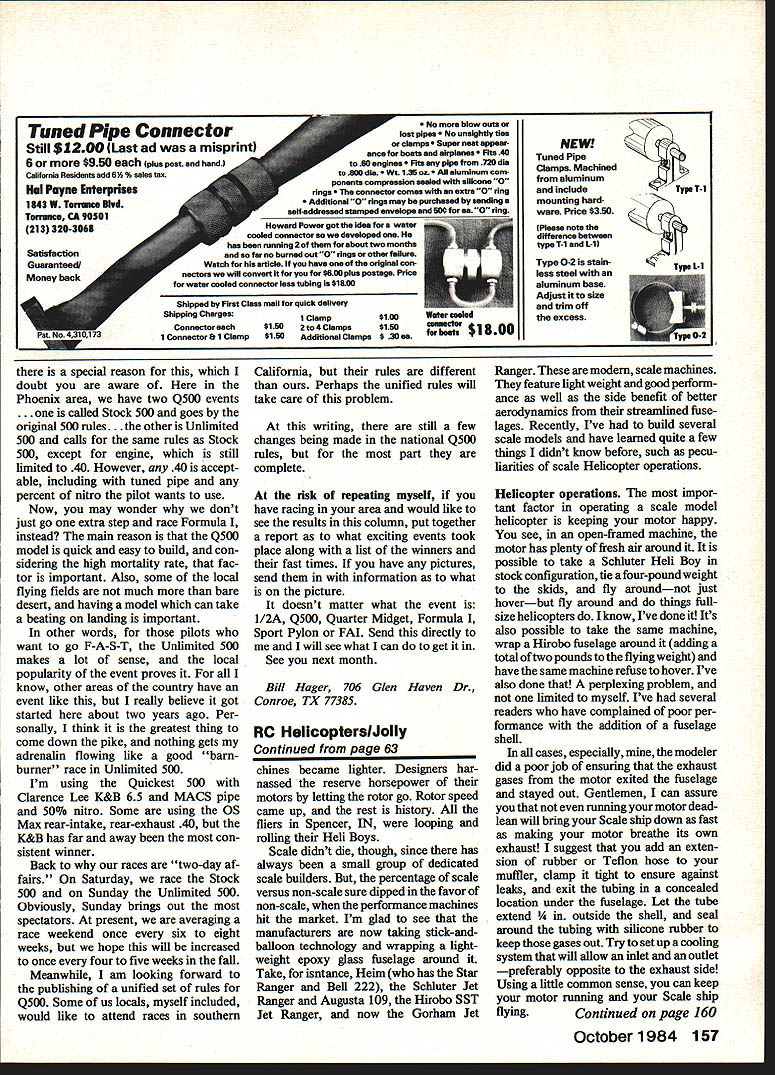
Starting with this issue I will publish a three-view and some notes on a full-size machine each month, hoping you might see a machine interesting enough to model.
This Month's Three-View
We're going to take a look at the Bell UH-1 (Model 204), produced by Bell Textron in Fort Worth, TX. Known worldwide as the "Huey," this light utility helicopter will have a place in history as the most-produced helicopter of all time. By 1981 over 9,000 Hueys had been produced in four countries (three countries outside the U.S. produced it under license). Over 60 nations operate or have operated this popular machine in more than 30 variants.
The Huey was designed to meet a 1955 U.S. Army requirement for a front-line medivac helicopter. The prototype, known as the Bell X-48, first flew in October 1956, and Hueys have been flying ever since. It is predicted that some Hueys will still be in service at the turn of the century.
Hirobo is the only company currently producing a model of the Huey. They have two sizes available: one for .60-size engines and a larger, more detailed version powered by a gasoline engine. Any of the 30 variants can be modeled from one of these kits, giving the modeler a unique subject to enter in competition.
BCNU.
Larry Jolly 5501 W. Como Santa Ana, CA 92703
Transcribed from original scans by AI. Minor OCR errors may remain.

