
Radio Control: Helicopters
Larry Jolly
Weighted Blades
In the September 1984 issue, I discussed the AMA's adoption of the FAI rule governing metal-weighted rotor blades. I shared my views and asked for reader response. I received over 30 letters and numerous phone calls on the subject. I've decided to publish portions of two of the letters. These individuals had different reasons for writing, but both exhibited genuine thought and feeling on the subject.
Letter — Dr. Cyrus Stow, Conyers, GA
Dr. Stow wrote:
"It appears to me that three separate points are inherent in the safety rule:
- No metal tail/main rotor blades;
- No knife-edge leading edges on same;
- No metal on same beyond two inches of root attachment.
"Regarding knife-edge leading edges on blades, the emergency rule has some merit. But, other than this one point, I find your argument against the new rule very substantial.
"Whether the rule is kept intact or discarded for a better ruling will have to be a matter for others to decide. But, I will suggest a thought that I hope the AMA's leadership will reflect upon: should a rapidly-moving blade—either one of the rotors of a model helicopter or one of the propellers used on fixed-wing model aircraft alike—fracture or come apart due to material fatigue from any cause and a piece of that blade subsequently happen to strike a person with enough force that it becomes embedded totally within that person's skull, chest, or abdomen, I believe that most surgeons seeking to remove that foreign body from an injured person would be most grateful to be faced with the task of locating a fragment of metal with radiopacity (i.e., capable of detection on X‑ray diagnostic film) rather than being forced to fish blindly within a person's vital organs during an attempt to save his or her life looking for a piece of wood or plastic that is generally radiolucent (i.e., essentially invisible on X‑ray diagnostic film).
"In short, I'd like to see the AMA's leadership take the farsighted and wise effort to consult one or more medical experts who might advise our rule makers about safety matters, as post‑trauma factors are also very important."
Thank you, Dr. Stow, for giving us a different viewpoint. I have to admit that I didn't even think about the procedures which might be used after the accident. After all, the AMA safety rules are designed to keep such accidents from occurring in the first place.
Letter — Albert Doucette, Stockton, CA
Albert Doucette, a retired Army helicopter pilot and former Aviation Maintenance Officer and Test Pilot who enjoys building scale tandem-rotor models, wrote:
"I received my copy of Model Aviation a few days ago and was quite taken aback by the Emergency Ruling pertaining to the rotor blades on model helicopters.
"It sounds to me like the proponents of this ruling have stock in the company that manufactures rotor blades.
"I am a retired Army helicopter pilot and former Aviation Maintenance Officer and Test Pilot, and I'm here to tell you what we used—lead weights in the ends of our main and tail rotor blades for ballast—and as far as I know, they still do.
"Your point about blade flutter and control response is right on; however, there is another reason for balancing blades, i.e., all blades are not the same weight, nor do they have the same flexibility, and it is imperative that blades, no matter how many, all track within one-fourth of an inch (this is reduced to about one-sixteenth of an inch on models with multiple‑bladed rotor systems), or the rotor system will set up vibrations that are detrimental to the rotor system, transmission, and structural components of the aircraft. To my way of thinking, this would be more detrimental to models because of their lack of structural stiffness and their receiver and servo installation.
"To enact this ruling as it is written (see 'Competition Newsletter,' September 1984, p. 117) would surely stifle those of us who are experimenting with multiple‑bladed rotor systems. Can you imagine a CH‑21 or a CH‑47 tandem‑rotor helicopter with paddle‑bars and a two‑bladed rotor system? The shift of the full‑scale helicopter industry is away from two‑bladed rotor systems, so why should modelers be limited to the proven systems, ones that would not even resemble the rotor of the scale models they are building?
"I am currently experimenting with tandem‑rotor helicopters, which have three blades per head. It takes a long time to weigh and balance six blades, not to mention the time it takes to get them all into track. One crash or tip‑over wipes out all that work, as well as extensively damaging the blades. So far, I have been able to repair the damage to the tips of my blades without too much trouble, but if I had to buy new blades every time I crashed or tipped over, at the price they are charging for rotor blades nowadays, my flying would either be pretty expensive or not at all.
"My blades (homemade, hardwood leading edge, balsa trailing edge covered with fiberglass) are balanced while installed on the rotor head. Holes are drilled in the tips to accept the weights needed to balance the rotor assembly, and these are epoxied in place after balancing is completed.
"My experience with crashes and tip‑overs has shown that metal weights do not pull out easily nor do they increase damage due to metal slugs in the hub area.
"If the rule is to be enacted, I would like to see some modifications, such as:
- allowing weights to be enclosed in such a manner that they cannot be extruded in a crash but can be removed for inspection;
- or setting a maximum allowable weight for blade‑tip weights, say 1/8 oz. or 2 grams;
- or specifying that all weights be enclosed within the blade beyond two inches of the root.
"Moreover, this leads me to believe that there is hardly any danger at all from these lead weights flying through the air. Once the rotor system strikes the ground (I use a single-bolt attachment system that yields on contact), the blades are displaced, and the loss of momentum and the fact that the blades are hitting the ground precludes the weights from flying anywhere. If anything, the weights would be imbedded in the earth when the tip first contacted the ground.
"I don't know what the statistics are on injuries from flying pieces from helicopter crashes. I haven't even heard of any, and in my opinion, somebody is crying wolf prematurely.
"If all safety procedures are followed, i.e., flying a safe distance away from spectators and, as a flier, maintaining a safe distance from your machine, there shouldn't be any injuries from flying weights or any other pieces of the aircraft. What are they going to do, write a new rule for every component on a helicopter? There are other fast-moving components on a chopper besides the rotor blades. What about blades from the cooling fan or parts of the centrifugal clutch?
"Enclosed is a picture of my model after crashing from about three feet. If you look at the tips of the blades, there is hardly any damage at all, and I don't recall losing any of the weights.
"Scenario of a crash: taxiing along the ground, caught by a gust of wind. Model lifted and rolled onto right side with blades striking the ground perpendicular. (Note: this is not ground; it is concrete.)
"I have said about all I can say on the subject. Let's just hope that our efforts will not fall on deaf ears. There are always some risks in everything we do, but to saddle us with such a ruling could be a detriment to our fledgling—and as yet undeveloped—hobby. Model helicopters have come into their own in the past few years, but there are still so many possibilities.
"To me, there is nothing more beautiful than a model helicopter in flight, but my dream is to perfect a tandem-rotor machine which will add even more beauty to the sport of model helicopter flying."
Thank you very much, Mr. Doucette, and to all who took the time to send their views. I have passed your letters on to the Helicopter Contest Board in hopes that it will do some good.
Photos and Blade Ballast
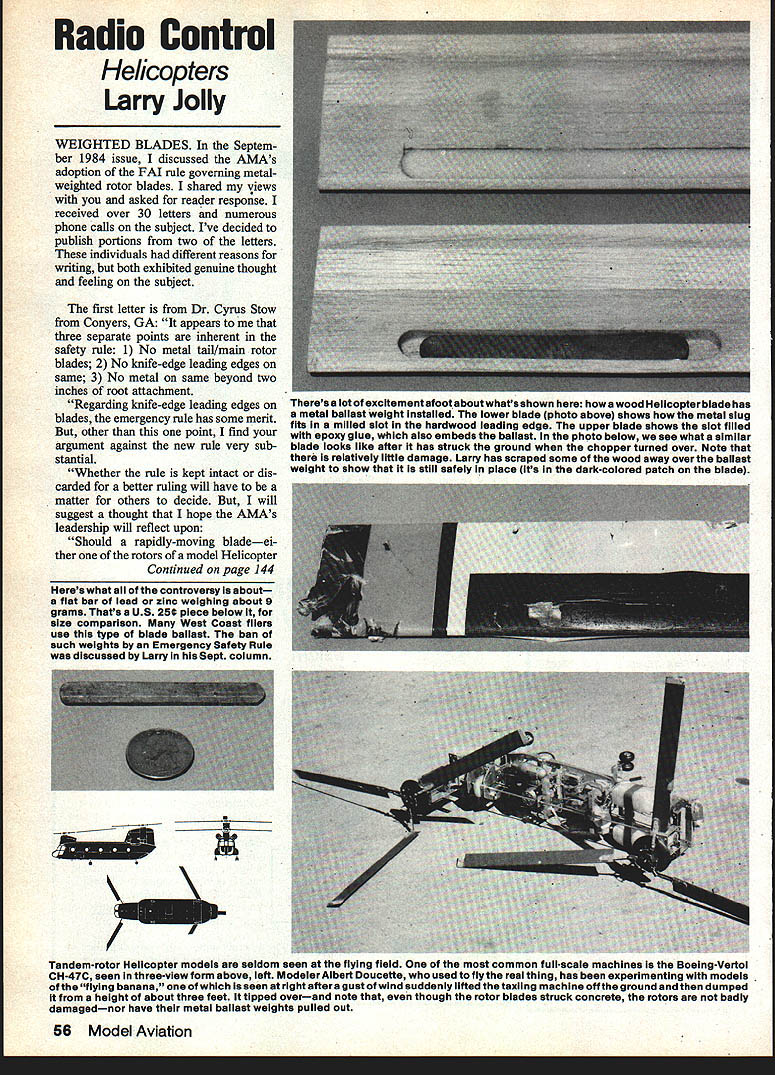
This month's photos show what I believe to be the best method for ballasting wood rotor blades. One photo shows the metal weight, which happens to be a piece of zinc that weighs 9 grams. For size comparison, note the quarter. The lead photo shows the weight in place in its milled slot in the rotor blade. The upper blade shows the weight epoxied in place. Another photo shows the results of a ground strike. Wood over the metal has been removed to show the ballast is still in place. Blades made up in this manner offer the best alternative to fiberglass composite blades with regard to safety.
Three‑View — Boeing Vertol CH‑47 (Chinook)
This month's three-view is of the Boeing Vertol CH‑47. Nicknamed the Chinook, the CH‑47 was designed in 1959 as a medium-lift transport for the U.S. Army.
- Over 1,000 Chinooks had been ordered as of 1980 by a variety of military forces and commercial operators.
- Basically a rectangular box with tandem rotors, the pair of 2,850 shaft-horsepower turboshaft engines are located on the sides of the Chinook under the aft rotor blade.
- Loading of the aircraft is via a ramp at the aft end of the fuselage. Not only troops but light armor can be carried in its spacious cabin.
- Because of its ability to carry sling loads of up to 30,000 pounds, the Chinook was credited with recovering hundreds of downed aircraft during the Vietnam War.
I am hoping that Mr. Doucette will continue his experiments with tandem rotors and that he will have success. If anyone is working with a tandem ship, please let me know of your progress. Tandem rotors have yet to be fully explored on the model scene.
Larry Jolly 5501 W. Como Santa Ana, CA 92703
Transcribed from original scans by AI. Minor OCR errors may remain.

