
Radio Control: Helicopters
Larry Jolly
FELICITATIONS! Even though this is the January issue, you will be receiving it in December. I thought it might be appropriate to wish you all a super holiday season and a happy, healthy 1985. I hope you guys all found what you were looking for under your tree!
This month's column will cover the U.S. helicopter team selection competition and some new products of interest.
U.S. Helicopter team selection
On September 22 and 23, the New Jersey RC Helicopter Society and the Monmouth Model Airplane Club co-hosted the U.S. team selection contest for the upcoming RC Helicopter World Championships, to be held in 1985 in London, Ontario, Canada. Horace Hagen and Dick Robbins acted as contest directors for the 10 entries competing. Because of the small number of pilots, six full rounds were completed.
FAI rules are used for World Championships, so the FAI schedule was used at this contest. For those unfamiliar with the FAI helicopter rules, check your AMA rule book (page 109). You will see that there are three compulsory hovering maneuvers followed by four optional maneuvers and then either a power-on or power-off landing. Different maneuvers, with varying K-factors depending on the skill required, are listed in the rule book.
These are the group from which the pilot chooses his four optional maneuvers. He must choose not only maneuvers he can do well but also a schedule that gives him the greatest possible chance of a high score. This means he might have to take a chance and do a maneuver that is difficult in order to net its higher K-factor.
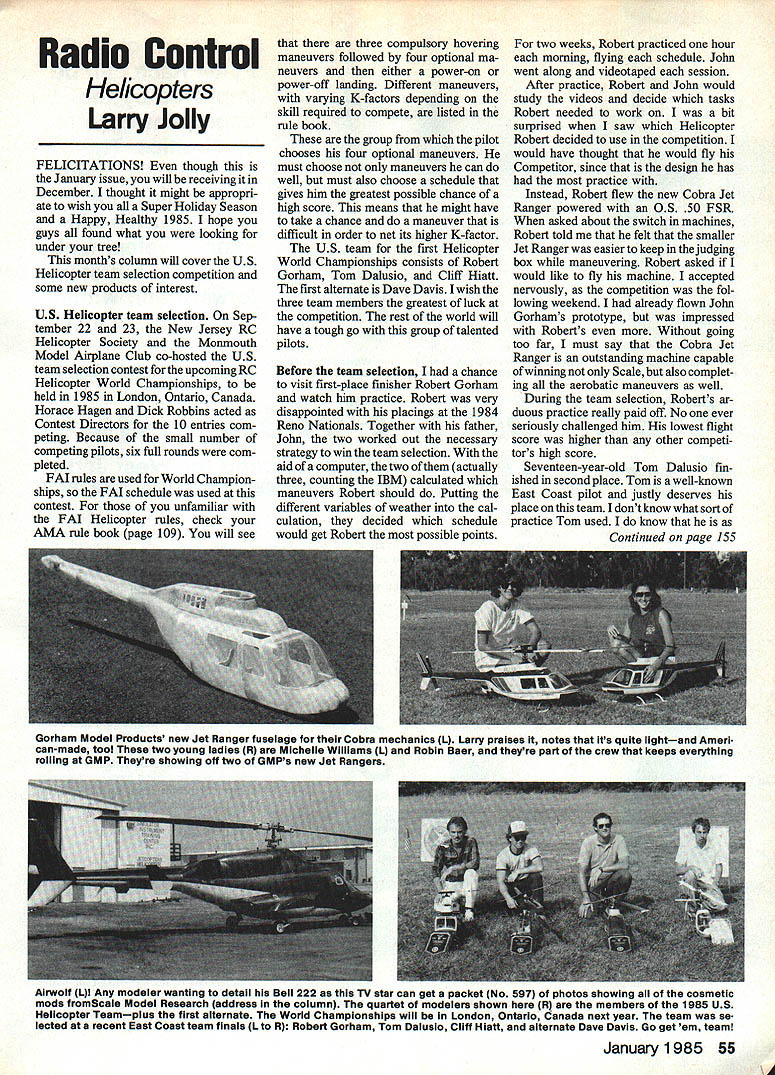
The U.S. team for the first Helicopter World Championships consists of:
- Robert Gorham
- Tom Dalusio
- Cliff Hiatt
The first alternate is Dave Davis. I wish the three team members the greatest of luck at the competition. The rest of the world will have a tough go with this group of talented pilots.
Before the team selection, I had a chance to visit first-place finisher Robert Gorham and watch him practice. Robert was very disappointed with his placings at the 1984 Reno Nationals. Together with his father, John, the two worked out the necessary strategy to win the team selection. With the aid of a computer, the two of them (actually three, counting the IBM) calculated which maneuvers Robert should do. Putting in the different variables of weather into the calculation, they decided which schedule would get Robert the most possible points.
For two weeks, Robert practiced one hour each morning, flying each schedule. John videotaped each session. After practice, Robert and John would study the videos and decide which tasks Robert needed to work on.
I was a bit surprised when I saw which helicopter Robert decided to use in the competition. I would have thought he would fly his Competitor, since that is the design he has had the most practice with. Instead, Robert flew the new Cobra Jet Ranger powered with an O.S. 50 FSR. When asked about the switch in machines, Robert said he felt the smaller Jet Ranger was easier to keep in the judging box while maneuvering.
Robert asked if I would like to fly this machine. I accepted nervously, as the competition was the following weekend. I had already flown John Gorham's prototype but was impressed with Robert's even more. Without going too far, I must say that the Cobra Jet Ranger is an outstanding machine, capable of winning not only Scale but also completing aerobatic maneuvers well.
During the team selection, Robert's arduous practice really paid off. No one seriously challenged him. His lowest flight score was higher than any other competitor's high score.
Seventeen-year-old Tom Dalusio finished in second place. Tom is a well-known East Coast pilot and justly deserves his place on the team. I don't know what sort of practice Tom used, but it is obvious he practiced a great deal—his hovering is excellent. Tom flew a stock GMP Competitor with ballasted skids; he felt the extra weight would help him in the windy conditions.
Third-place finisher Cliff Hiatt flew the same Superior that he flew at the Reno Nationals. I don't know Cliff personally, so I am unfamiliar with his contest strategies. What I do know is that he is a super pilot and will do well at the World Champs.
Congratulations, guys. I hope you can get together and destroy the competition in Canada.
New products
Already mentioned is the new Jet Ranger fuselage for the GMP Cobra. At first glance, the new Jet Ranger looks like a Japanese product. The fuselage is made from polyester and glass cloth, hand-laminated. This is more expensive to produce than the matte fuselages so prevalent in our hobby, but it yields a lighter, superior product. The fuselage is American-made and is perfect one-seventh scale. John Gorham went to a lot of trouble to create a very accurate model, using factory drawings as a guide. The model has already claimed second place in the Intermediate class at the U.S. Nationals and first place at the U.S. Team Selection Finals. Next month we will have a building review of the Cobra Jet Ranger.
Condor Hobbies (Irvine, CA) is importing a new oil that is particularly appealing for use in helicopters. The oil is called Synalube and, as its name implies, it is a synthetic lubricant with incredible viscosity. I know we've all heard of "super oils" before, but this stuff is something else! I am currently running 2% oil in my O.S. 61 FSR-Hs. Running 2% oil, 10% nitromethane, and the balance methanol gives longer duration per tank, cleaner machines, and little smoke in the exhaust. I have had no failures and no heat problems—even with my heavy scale ships. If you think I'm being risky by using 2% lubricant, I should inform you that this is exactly twice what the manufacturer recommends! I've read reports from Australia where Synalube is manufactured, and some Aussie pilots are using less than 1%. For a cleaner chopper, drop Condor a line.
I just received a note from Bob Banka at Scale Model Research. He is looking for scale documentation on a certain type aircraft; contact him. He has 36,000 photos on file, an excellent catalog, and very reasonable prices for his Foto Paks. If Bob doesn't have what you're looking for, chances are he can help you find it—he is in contact with people all over the world who compile scale data. You can reach Bob at Scale Model Research, 418 E. Oceanfront B, Newport Beach, CA 92661. I have included a picture from his latest helicopter Foto Pak, Airwolf.
Larry Jolly 5501 W. Como, Santa Ana, CA 92703
Transcribed from original scans by AI. Minor OCR errors may remain.

