
Radio Control: Helicopters
Larry Jolly
World Records (from Model Aviation, January)
I enjoy model aircraft of all types. If you read model magazines cover to cover, you may have noticed page 127 of the January issue of Model Aviation. It contained the up-to-the-minute FAI World Records. Notice the six record categories for radio control helicopters. The following are, as published in the January issue (I've converted metric values to our system):
- Duration: 3 hr, 35 min, 6 sec — F.R. Germany
- Distance, straight line: 55.7 miles — Australia
- Height: 3,674.7 ft — U.S.S.R.
- Speed: 56.8 mph — F.R. Germany
- Distance, closed course: 44.7 miles — Australia
- Speed, closed course: 44.9 mph — F.R. Germany
Those records don't look too tough, do they? Did you also notice that none of the records have a U.S.A. after them? Where's that Yankee know-how? I bet that all of those records could be captured by American enthusiasts flying basically stock machines. All you have to do is get a willing Contest Director to make sure you play by the rules, obtain record sanction from the AMA as well as follow the FAI regulations (the Sporting Code)—and have at it! Before you get too far into your brainstorm, make sure that your record-setting whirlybird fits the FAI specifications.
FAI definition and specifications
By FAI definition, a radio-controlled helicopter is a heavier-than-air aeromodel which derives all of its lift and horizontal propulsion from a power-driven rotor system rotating about a nominally vertical axis. It must also fit within the following characteristics:
- Maximum swept area of the lifting rotors: 300 dm2 (4,650 sq. in.)
- Maximum takeoff weight: 13.22 pounds
- Maximum engine size: .61 cubic inches
Which records should you tackle?
As far as I can see, the altitude record is going begging. It should be fairly obvious that any of the machines which flew at last year's Nationals are capable of topping 4,000 ft. It is also pretty obvious that no one standing on the ground is going to fly his machine to 4,000 ft., viewing it with the naked eye. With the aid of a full-size helicopter carrying the pilot of the model, the Contest Director, and the barograph, an RC helicopter should be able to top 7,000 ft., probably more.
Duration and Distance
As for duration and distance, the same helicopter could be used for both tasks. I would probably use a .50-size machine, maybe a Baron or a Cobra. I'd use them mainly because they are light—but more importantly, I could easily lengthen the tail boom to accommodate longer rotor blades.
It will be necessary to utilize low-oil fuel—or better yet, spark ignition or compression ignition—to realize the required engine run. I think that a running takeoff will also be necessary to get airborne with a maximum fuel load.
Speed
The speed records are currently held by stock Schlüter Superiors. I believe that this task, more than any of the others, is largely governed by the pilot. I know for a fact that the Superior will fly faster than 60 mph. Back in 1979, Tim Jones and I chased my Webra Speed–powered Heliboy at over 75 mph. The machines certainly are capable; the rest is just up to the pilot.
Organize a group
If some of you are serious about going after these records, it may be helpful to form groups. When attempting records (or anything, for that matter), nothing beats a well-organized, interested group.
This month's photos
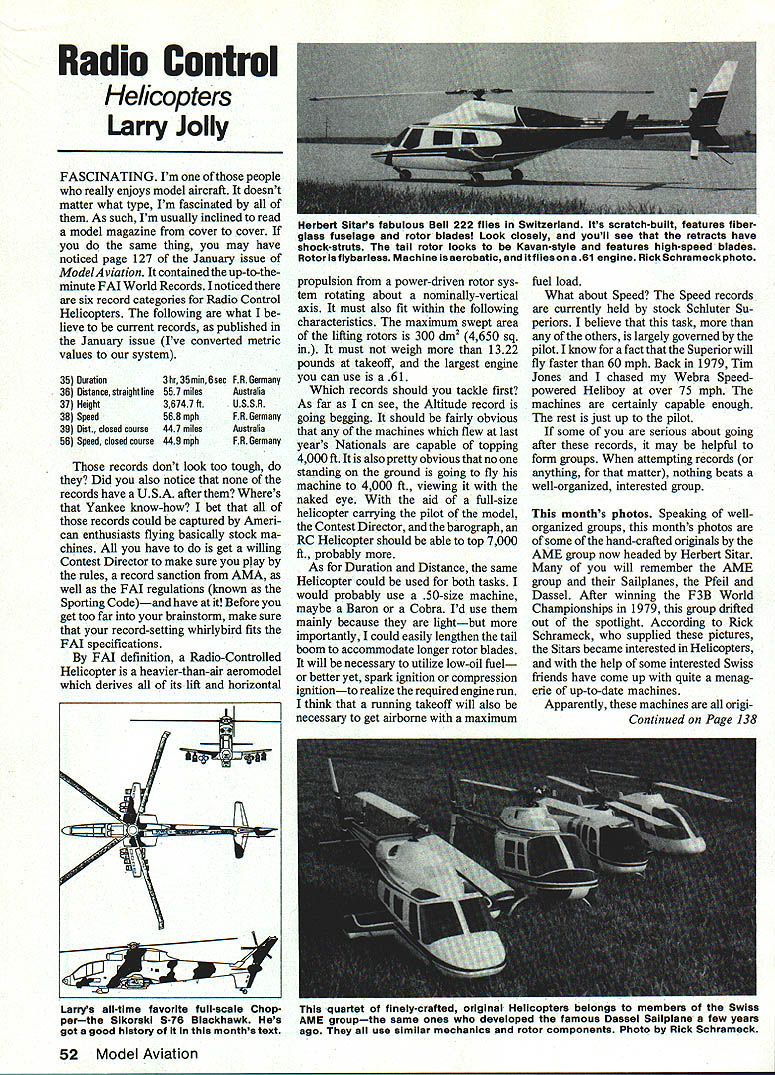
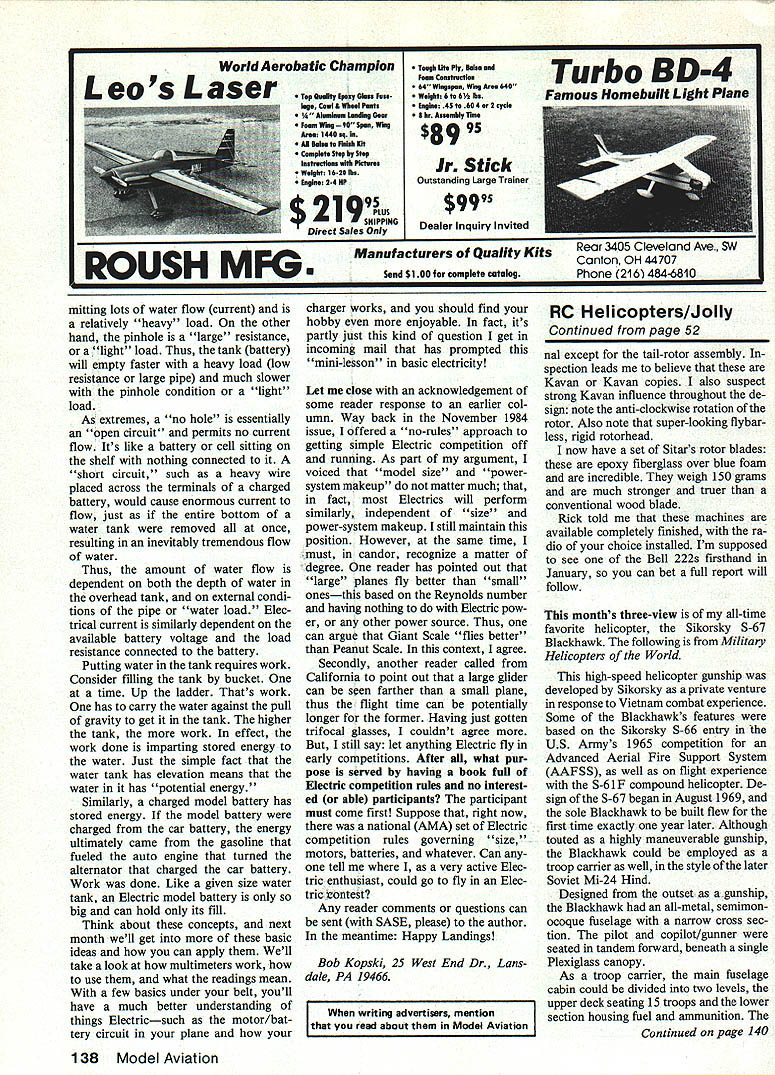
Speaking of well-organized groups, this month's photos are of some of the hand-crafted originals by the AME group now headed by Herbert Sitar. Many of you will remember the AME group and their sailplanes, the Pfeil and Dassel. After winning the F3B World Championships in 1979, this group drifted out of the spotlight. According to Rick Schrameck, who supplied these pictures, the Sitars became interested in helicopters and, with the help of some interested Swiss friends, have come up with quite a menagerie of up-to-date machines.
Apparently, these machines are all original. All are conventional except for the tail-rotor assembly. Inspection leads me to believe that these are Kavan or Kavan copies. I also suspect strong Kavan influence throughout the design; note the anti-clockwise rotation of the rotor. Also note the super-looking flybarless, rigid rotor head.
I now have a set of Sitar rotor blades; these are epoxy fiberglass over blue foam and are incredible. They weigh 150 grams and are much stronger and truer than a conventional wood blade.
Rick told me that the machines are available completely finished, with the radio of your choice installed. I'm supposed to see one of the Bell 222s firsthand in January, so you can bet a full report will follow.
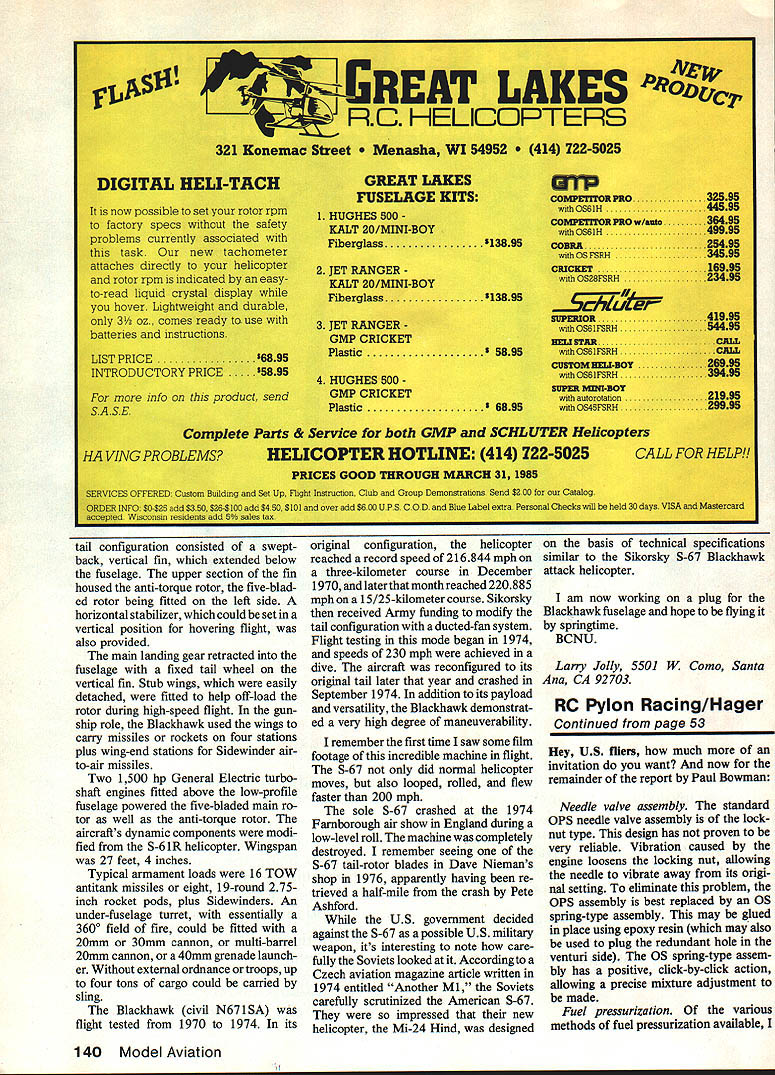
Three-view: Sikorsky S-67 Blackhawk
This month's three-view is of my all-time favorite helicopter, the Sikorsky S-67 Blackhawk. The following is from Military Helicopters of the World.
This high-speed helicopter gunship was developed by Sikorsky as a private venture in response to Vietnam combat experience. Some of the Blackhawk's features were based on the Sikorsky S-66 entry in the U.S. Army's 1965 competition for an Advanced Aerial Fire Support System (AAFSS), as well as on flight experience with the S-61G compound helicopter. Designed by Sikorsky in 1969, the sole Blackhawk to be built flew for the first time exactly one year later. Although touted as a highly maneuverable gunship, the Blackhawk would also have been an excellent troop carrier as well, in the style of the later Soviet Mi-24 Hind.
Designed from the outset as a gunship, the Blackhawk had an all-metal, semi-monocoque fuselage with a narrow cross-section. The pilot and copilot/forward gunner were seated in tandem inside a long, slender cockpit area. A troop compartment, the main fuselage cabin, could be divided into two levels: the upper deck seating 15 troops and the lower section housing fuel and ammunition.
The tail configuration consisted of a swept-back vertical fin, which extended below the fuselage. The upper section housed the anti-torque rotor, the five-bladed rotor being fitted on the left side. A horizontal stabilizer, which could be set in a vertical position for hovering flight, was also provided.
The main landing gear retracted into the fuselage with a fixed tail wheel on the vertical fin. Stub wings, which were easily detached, were fitted to help off-load the rotor during high-speed flight. In the gunship role, the Blackhawk used the wings to carry missiles or rockets on four stations plus wing-end stations for Sidewinder air-to-air missiles.
Two 1,500-hp General Electric turboshaft engines fitted above the low-profile fuselage powered the five-bladed main rotor as well as the anti-torque rotor. The aircraft's dynamic components were modified from the S-61R helicopter. Wingspan was 27 ft 6 in.
Typical armament loads were 16 TOW anti-tank missiles or eight 19-round 2.75-inch rocket pods, plus Sidewinders. An under-fuselage turret, with essentially a 360-degree field of fire, could be fitted with a 20mm or 30mm cannon, a multi-barrel 20mm cannon, or a 40mm grenade launcher. Without external ordnance or troops, up to four tons of cargo could be carried by sling.
The Blackhawk (civil N671SA) was flight tested from 1970 to 1974. In its original configuration, the helicopter reached a record speed of 216.844 mph on a three-kilometer course in December 1970, and later that month reached 220.885 mph on a 15/25-kilometer course. Sikorsky then received Army funding to modify the tail configuration with a ducted-fan system. Flight testing in this mode began in 1974, and speeds of 230 mph were achieved in a dive. The aircraft was reconfigured to its original tail later that year and crashed in September 1974. In addition to its payload and versatility, the Blackhawk demonstrated a very high degree of maneuverability.
I remember the first time I saw some film footage of this incredible machine in flight. The S-67 not only did normal helicopter moves, but also looped, rolled, and flew faster than 200 mph.
The sole S-67 crashed at the 1974 Farnborough air show in England during a low-level roll. The machine was completely destroyed. I remember seeing one of the S-67 tail-rotor blades in Dave Nieman's shop in 1976, apparently having been retrieved a half-mile from the crash by Pete Ashford.
While the U.S. government decided against the S-67 as a possible U.S. military weapon, it's interesting to note how carefully the Soviets looked at it. According to a Czech aviation magazine article written in 1974 entitled "Another M.I.", the Soviets carefully scrutinized the American S-67. They were so impressed that their new helicopter, the Mi-24 Hind, was designed on the basis of technical specifications similar to the Sikorsky S-67 Blackhawk attack helicopter.
I am now working on a plug for the Blackhawk fuselage and hope to be flying it by springtime. BCNU.
Larry Jolly 5501 W. Como, Santa Ana, CA 92703.
Transcribed from original scans by AI. Minor OCR errors may remain.

