
Radio Control: Helicopters
Larry Jolly
Cobra 206-B Jet Ranger (Gorham Model Products) — Review
This month we're taking a look at Gorham Model Products' latest offering: the Cobra 206-B Jet Ranger. If you are a regular reader, you'll recall that we reviewed the Cobra several months ago. The Cobra in its pod-and-boom, stock configuration has proved to be quite a good performer for both novices and experts. I personally find it to be one of the most agile helicopters I have ever flown.
When John Gorham called and told me he had made the Cobra even better, I raced up to Calabasas to see his latest creation. When I first saw the Jet Ranger fuselage, I thought, "Cute—a baby Jet Ranger; I wonder how much that fuselage is going to hurt the Cobra's performance?" I then learned John intended to fly the Jet Ranger in the Nationals the following week, which told me he had a great deal of confidence in the new bird.
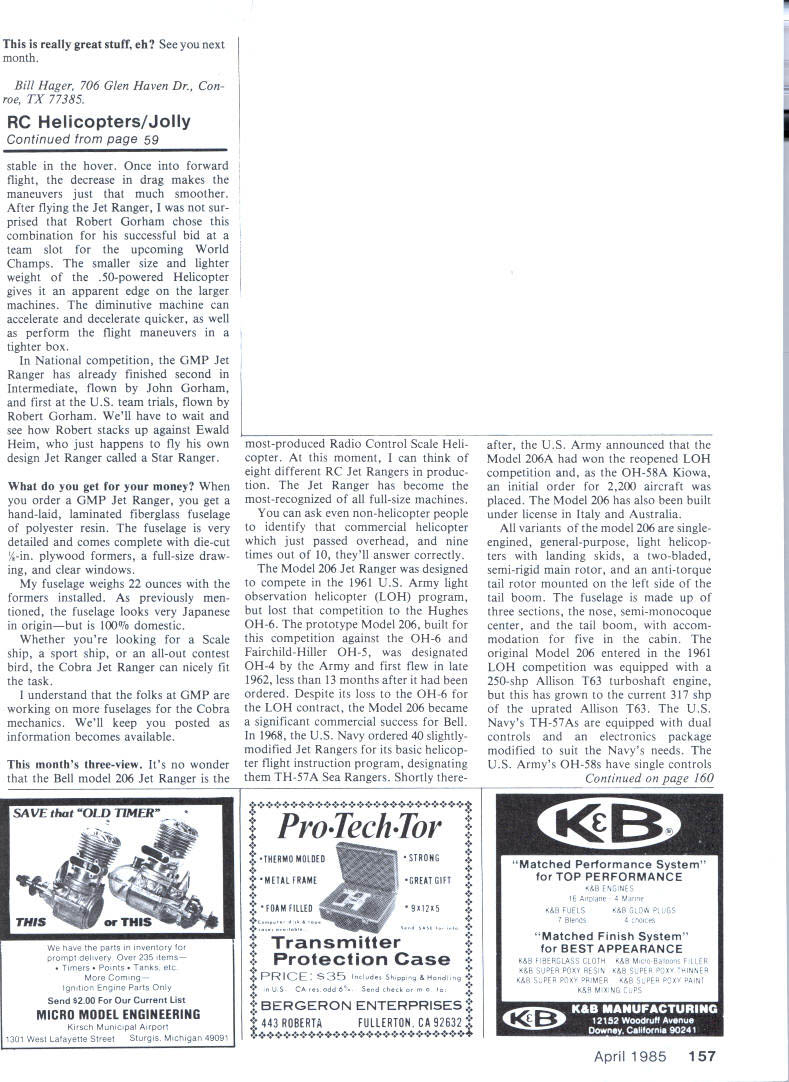
In minutes the Jet Ranger was loaded and off to the flying field. John's prototype was a basic, factory-stock Cobra powered by an OS .50 FSR-H, dressed in Jet Ranger garb. All fueled and ready to fly, the Jet Ranger tips the scales at 9½ pounds—roughly 2½ pounds heavier than a stock Cobra.
I was happily surprised to see the Jet Ranger take to the air and perform exactly like a Cobra. John was able to execute very smooth maneuvers. I had never seen John perform an autorotation before this outing; my heart nearly stopped when I watched him deliberately shut the motor off. My alarm proved unfounded as the Jet Ranger glided to a feather-soft landing right at his feet.
John asked if I'd like a go. After what I'd just seen, I figured it could survive my flight. There is something magical about Bell's classic Jet Ranger shape. Not only does it look good, but it's very aerodynamic. My first experience with a Jet Ranger was Schluter's Jet Ranger II, basically a Heli-Boy in a Jet Ranger glass fuselage. While heavier than a stock Heli-Boy, it still performed flawlessly and was one of the best-rolling machines I've flown.
The Cobra Jet Ranger shares those characteristics. Being slightly heavier than a stock Cobra makes the Jet Ranger stable in hover. Once in forward flight, decreased drag makes maneuvers much smoother.
After flying the Jet Ranger, I wasn't surprised Robert Gorham chose this combination in his successful bid for a team slot in the upcoming World Championships. The smaller size and lighter weight of the 50-powered helicopter give an apparent edge over larger machines: the diminutive machine can accelerate and decelerate quicker and perform maneuvers in a tighter box in national competition. GMP's Jet Ranger has finished second in Intermediate when flown by John Gorham and first in the U.S. team trials when flown by Robert Gorham. We'll have to wait and see how Robert stacks up against Ewald Heim, who flies his own design Jet Ranger called the Star Ranger.
What you get (mail order GMP Jet Ranger)
- Hand-laid, laminated fiberglass fuselage using polyester resin
- Die-cut 1/8-in plywood formers
- Full-size drawing
- Clear windows
- Fuselage weight: 22 ounces with formers installed
The fuselage is very detailed and looks of Japanese origin, but is 100% domestic. Whether you're after a scale ship, sport ship, or all-out contest bird, the Cobra Jet Ranger can fit the task. I understand folks at GMP are also working on other fuselages; we'll keep you posted as information becomes available.
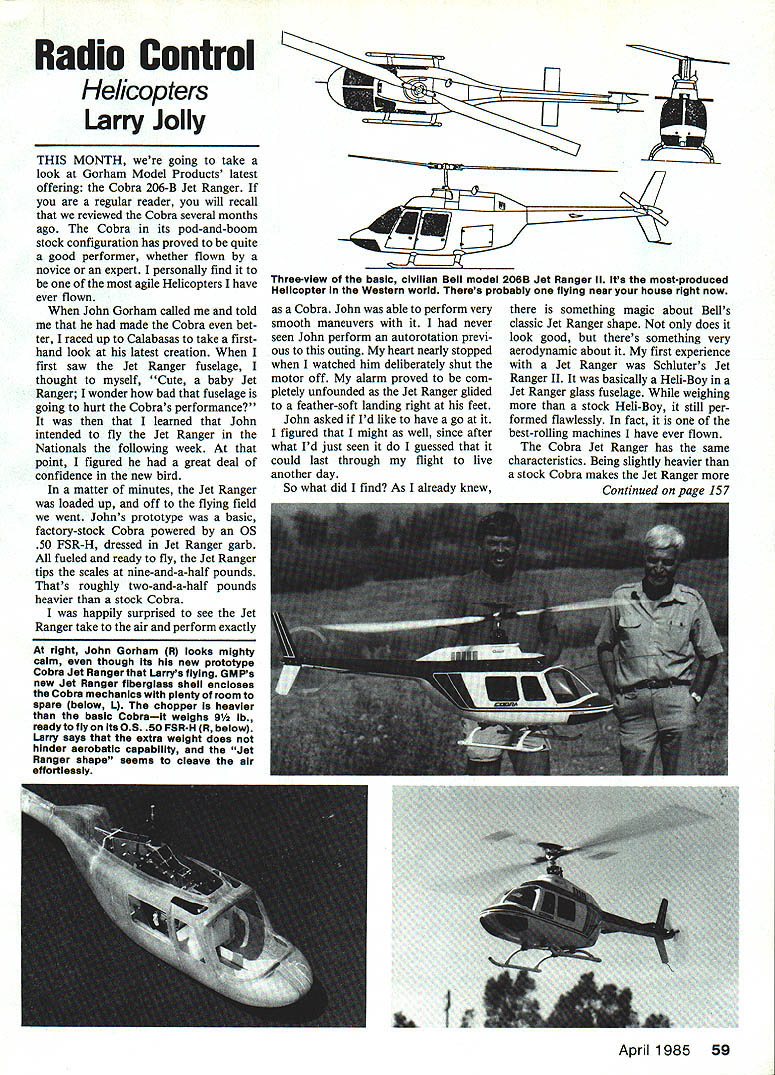
It's no wonder the Bell Model 206 Jet Ranger is the most-produced radio control scale helicopter at the moment—there are at least eight different RC Jet Rangers in production. The Jet Ranger has become the most-recognized full-size machine; ask non-helicopter people to identify a commercial helicopter overhead and nine times out of ten they'll answer correctly.
Bell Model 206 (Jet Ranger) — Background and variants
The Model 206 was designed to compete in the 1961 U.S. Army Light Observation Helicopter (LOH) program, but lost that competition to the Hughes OH-6. The prototype Model 206, built for the competition against the OH-6 and Fairchild-Hiller OH-5, was designated OH-4 by the Army and first flew in late 1962, less than 13 months after it had been ordered. Despite losing the LOH contract, the Model 206 became a significant commercial success for Bell.
Key characteristics of the Model 206 and its variants:
- Single-engined, general-purpose, light helicopters
- Landing skids
- Two-bladed, semi-rigid main rotor
- Anti-torque tail rotor mounted on the left side of the tail boom
- Fuselage composed of three sections: nose, semi-monocoque center, and tail boom
- Cabin accommodation for five occupants
The original Model 206 entered in the 1961 LOH competition was equipped with a 250-shp Allison T63 turboshaft engine; later versions grew to around 317 shp in upgraded Allison T63 engines. The U.S. Navy ordered 40 slightly modified Jet Rangers in 1968 for basic helicopter flight instruction, designating them TH-57A Sea Rangers. Shortly thereafter the U.S. Army announced the Model 206A had won the reopened LOH competition and, as the OH-58A Kiowa, an initial order for 2,200 aircraft was placed. The Model 206 has also been built under license in Italy and Australia.
Operational and variant notes:
- The U.S. Navy's TH-57As are equipped with dual controls and an electronics package modified for Navy training.
- The U.S. Army's OH-58s have single controls, an extensive communications package, and can be equipped with the XM-27 antitank kit (which includes a 7.62 mm minigun).
- Late in 1980 Bell completed a 206L Texas Ranger antitank variant designed to carry four TOW missiles or other weapons; it is fitted with a roof sight, FLIR, and laser rangefinder/designator and is intended for multipurpose use, with an Allison 250-C30 turboshaft engine.
The Model 206 and its variants have proved to be among the most popular civilian and military helicopters worldwide. Over 6,000 have been manufactured by Bell and its licensees in the past 15 years, and they are operated in most non-communist nations. Production continued in 1981 both by Bell in the United States and by Agusta in Italy.
Larry Jolly 5501 W. Como Santa Ana, CA 92703
Transcribed from original scans by AI. Minor OCR errors may remain.

