
Radio Control: Helicopters
Larry Jolly
As I write this article, many of you are still confined indoors because of severe winter weather. Even though it's too cold to venture outside for flying, you can still enjoy your helicopter. This is the time of year when you are probably working on a new model or repairing one of your regular birds.
While I don't get to spend as much time at my bench as I'd like, I do enjoy building and get great satisfaction when I have successfully removed all the run-out from a starting shaft or worked on a gear train and succeeded in getting it set just right. Even though you may not be flying, now is an excellent time to go through your machines so they will be ready to fly when spring arrives.
Off-season checklist
- Check radio gear for worn pots, bad output arms, broken wires, and weak airborne battery packs.
- Inspect for cracked or worn-out ball links.
- Look for loose screws and nuts throughout the airframe.
- Verify servos and linkages for play and wear.
- Test engines and clutches on the bench to ensure reliable starting and operation.
Reader project: Jack Schultz (Plymouth, WI)
Occasionally I hear from readers and, when space permits, publish a letter or photo. This month I'm publishing a letter and photo from Jack Schultz.
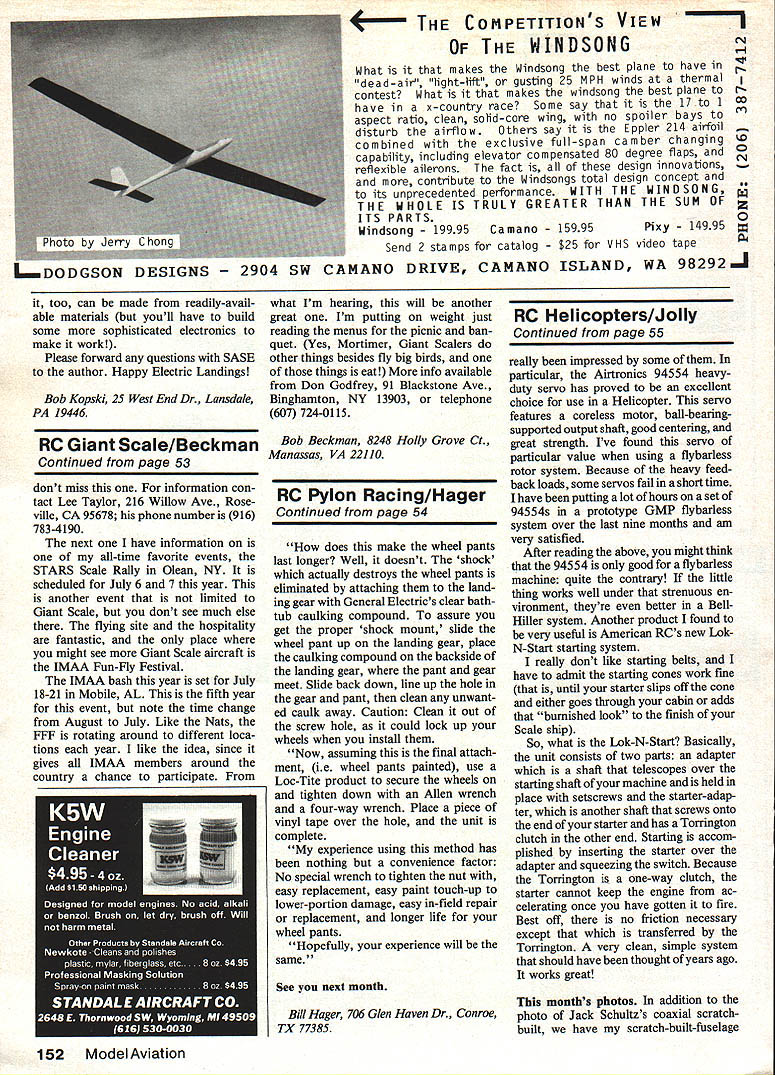
Jack has been working on a tandem RC helicopter; more correctly, a coaxial tandem ship. The model, titled Odonata (Latin for dragonfly), is a twin-rotor, coaxial, contra-rotating RC helicopter. It features 36-inch diameter rotors, 10:1 reduction gearing, and is powered by a .40 engine. Jack can vary the pitch of either rotor set alone or both together, giving collective, cyclic, and differential collective control.
Highlights from Jack's work:
- The top rotor system is a partial Bell-Hiller and stabilizes the craft well, even though the rotor heads are totally rigid except for lead/lag.
- Much of the frame, gear assembly, clutch, and rotor shaft configuration were custom designed and machined by Jack; the engine and rotor heads are stock.
- The model has flown successfully but needs a more powerful engine and clutch refinement.
- Jack's flight control system is more complicated than necessary so he can test different configurations; a production version could be much simpler.
- Because winter is near, Jack plans to concentrate on mechanics rather than flight tests for a while. He would like to hear from anyone else working on similar models.
Thank you, Jack. Your coaxial project is an interesting example of RC rotorcraft and certainly worth continued development.
Coaxial rotor comment
The coaxial concept is not new and has been used on full-size helicopters where maximum lift must be placed in minimum overall space. A notable example is the Soviet Kamov Ka-25 anti-submarine helicopter. While coaxial layouts are acceptable and have advantages in compactness, they are not as efficient as conventional single-main-rotor machines because of added transmission drag and because the lower rotor operates in the wash of the upper rotor. Still, Jack's model is a fine RC example of the concept and a worthwhile project.
Recommended equipment
I've been really impressed by some servos. In particular, the Airtronics 94554 heavy-duty servo has proved to be an excellent choice for helicopter use. Features I value:
- Coreless motor
- Ball-bearing supported output shaft
- Good centering and high strength
These servos have held up well in a strenuous flybarless prototype system. If they perform well under heavy feedback loads, they'll do even better in Bell-Hiller systems.
Another product I found very useful is American RC's Lok-N-Start starting system. I don't like starting belts, and starting cones—while they work—can cause problems when a starter slips off.
How the Lok-N-Start works:
- The unit has two parts: an adapter that telescopes over the starting shaft and attaches to the starter with thumb screws, and a starter-adapter that screws onto the end of your starter and contains a Torrington one-way clutch.
- Starting is done by inserting the starter over the adapter and squeezing the switch.
- The one-way clutch prevents the starter from holding the engine back once it fires, and there is no friction transmission to wear out the starter.
It is a clean, simple system that works very well.
This month's photos and models
- Jack Schultz's coaxial scratch-built Odonata: custom machined frame and gear assembly; underpowered by a .40 engine; Jack plans to add a rear fin to improve stability in forward flight. Stock components appear to include a GMP Cricket canopy and Schiuter rotor components.
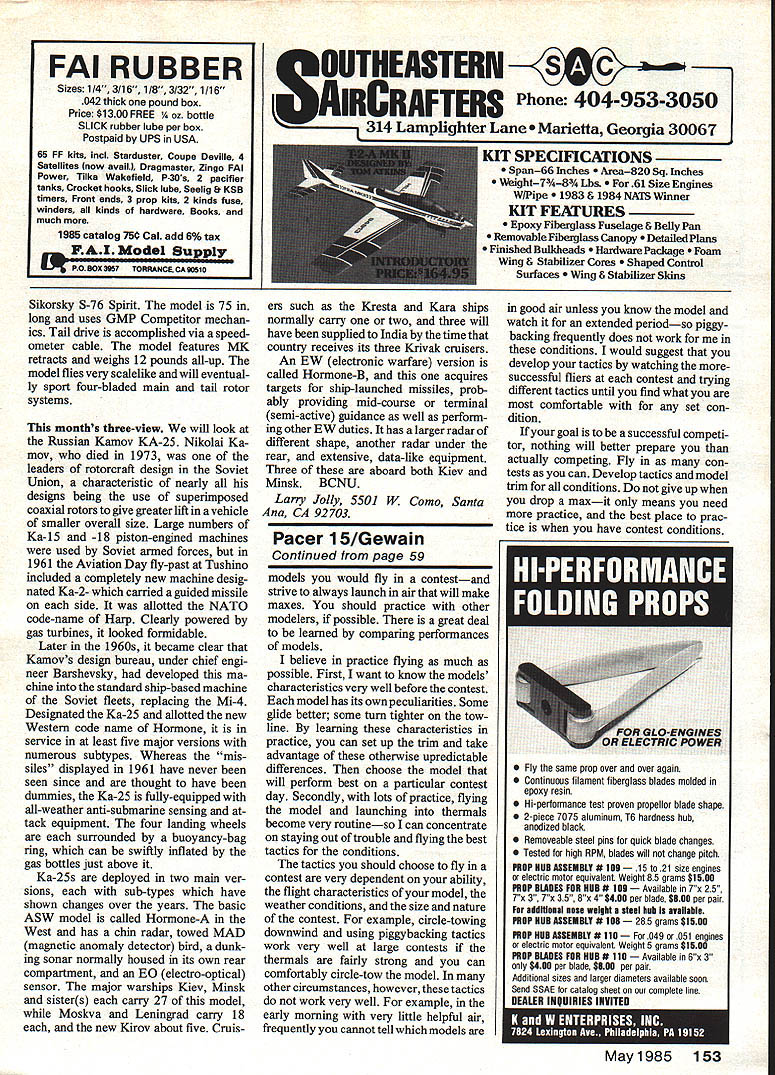
- Larry's scratch-built Sikorsky S-76 scale chopper: scratch-built fuselage over GMP mechanics. Flight photo (rear) shows the model with gear retracted. Close-up shows original fiberglass fuselage over GMP mechanics. Ship weighs 12 lb. Larry plans to add four-bladed main and tail rotors in the near future. Bell-Hiller paddles are small and almost unnoticeable.
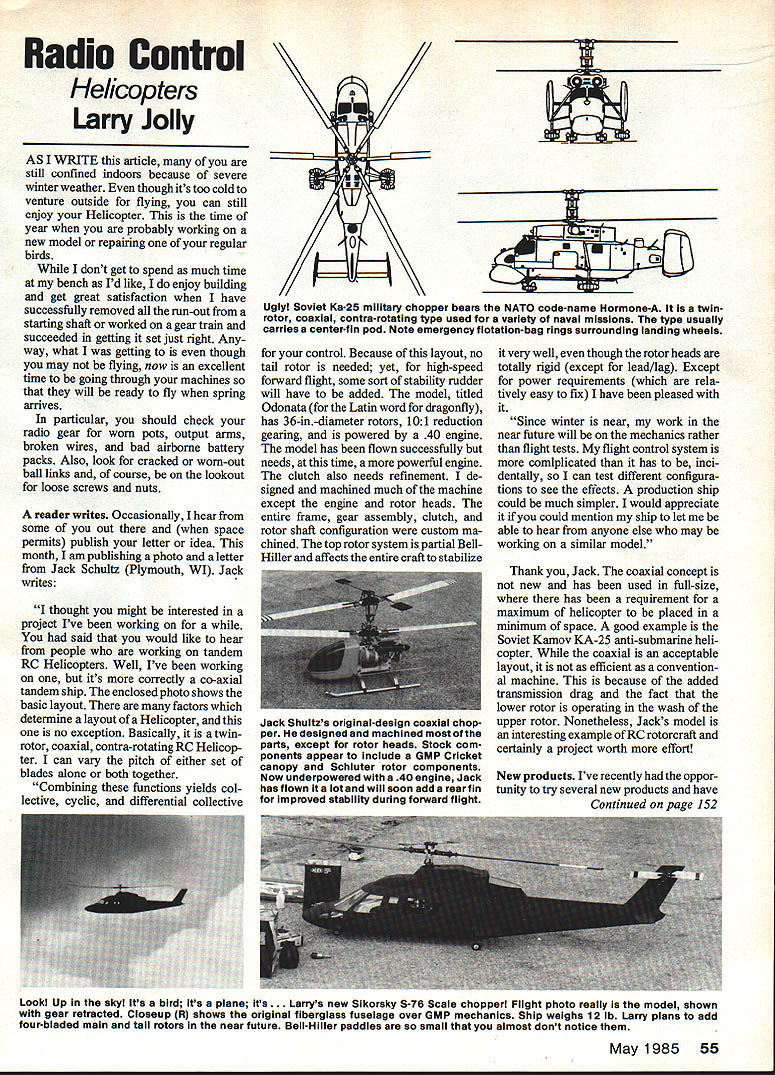
Three-view: Kamov Ka-25
Nikolai Kamov (died 1973) was a leader in Soviet rotorcraft design; many of his designs used superimposed coaxial rotors to give greater lift in a smaller overall size. Large numbers of Ka-15 and Ka-18 piston-engined machines were used by Soviet forces. In 1961, a new turbine-powered machine appeared at the Aviation Day fly-past at Tushino and was initially designated Ka-2 (NATO code name Harp). This design evolved into the Ka-25, given the Western code name Hormone, which became a standard ship-based machine for the Soviet fleets.
Ka-25 characteristics and variants:
- The Ka-25 is a shipboard anti-submarine helicopter equipped with all-weather ASW sensors and attack equipment.
- The four landing wheels each have a buoyancy-bag ring that can be quickly inflated by onboard gas bottles.
- Major versions include:
- Hormone-A (ASW): chin radar, towed MAD (magnetic anomaly detector) bird, dunking sonar in a rear compartment, and an electro-optical sensor.
- Hormone-B (EW/target acquisition): larger and differently shaped radar, additional rear radar, extensive datalink equipment, and electronic warfare gear; used to acquire targets for ship-launched missiles and provide guidance support.
Deployment notes:
- Major warships (for example, Kirov, Minsk) carried many Ka-25s; cruiser classes typically carried one or two. Several were supplied to allied navies.
Jack Schultz's coaxial model is a good small-scale illustration of the same coaxial principles used in full-size rotorcraft.
Transcribed from original scans by AI. Minor OCR errors may remain.

