
Radio Control: Helicopters
Larry Jolly
Read on, because this month we will cover the recent Toledo show and take a look at John Gorham's biggest project. Starting next month, I'm initiating a new division in this column devoted to the novice helicopter flier. If you are having any problems or have specific questions, please write to me. These questions will form the bulk of the material for the new section.
Toledo 1985
Once again, I took part in the mass exodus to Toledo, OH to see firsthand the new products made just for the hobby consumer. It is customary for manufacturers to show their latest designs, and this year certainly followed the precedent. I counted no fewer than five new machines and several new fuselages and rotor heads. Instead of going through each manufacturer's line, I will discuss the highlights as they come to mind.
A visit to the Miniature Aircraft booth proved that Dieter Schluter has been very busy. In the past, Dieter has shown us that he prefers to market his machines in a modular concept. That is, he designs a set of mechanics and markets them with a sport cabin and then designs several fuselages and rotor heads to complement the basic unit. This year, the machine is called the Champion. While it shows much of what you would expect in a Schluter design, it also encompasses some new concepts not seen before from that company. To my knowledge, the Champion is Dieter's first machine to utilize a movable swashplate. That is, collective pitch is achieved by changing the swashplate's position vertically, rather than via his usual method of sliding a wire in a grooved shaft.
While both methods work, moving the swashplate simplifies the collective mixing at the blade arm. This makes multi-bladed heads a snap, and I suspect that it is the reason the Champion sports this style of collective-pitch mechanism. You see, the accessories also include some very nice multi-bladed heads. The Champion also sports an underslung flybar and a single blade-axle passing through the yoke. I'll cover the Champion in-depth in a future issue. Also shown were scale fuselages for the MBB BK117 and a Long Ranger.
California Model Imports showed their new 60-size sport aerobatic design, known as the Fox. It uses many components of their well-known R-22 design, including the transmission, main frames, and tail boom. It also sports a new Bell-Hiller head, a cooling system, and a stylish cabin. This machine appears to be well thought out and rugged. Again, I plan to report in-depth in a future issue.
Gorham Model Products showed their well-established line of GMP/Hirobo sport models as well as their own Jet Ranger and Hughes 500 fuselages for the GMP Cobra. Also shown was Hirobo's new Agusta 109 with the DDF rotorhead. While I was in John's booth, I saw the best pitch gauge I have ever seen. John intends to market it, if it proves to be universally acceptable (that is, if it works on other designs). As soon as I can get access to one, I'll cover the method of using a pitch gauge.
Morley Helicopters (from England) are now available from Morley Southeast. They market a Hughes 300, a Bell 47, and an Agusta 109. I believe that all Morley designs are for 40-size engines. The little Agusta sports retracts and looks very good. I have ordered one, so I'll keep you posted on details.
Apparently, World Helicopters' Questar is nearly in the box and should be available soon.
Hobby Shack now imports the Kavan line, and I look forward to seeing something new from them.
While in Toledo, I saw several scale machines in the static competition:
- Four Airwolf/Heim 22s
- A very nice Jet Ranger
- An excellent Mi-24D constructed by Mike Robbins
Toledo is always a great show, and this year was no exception. I only wish they would move it later in the year. That cold weather is something else!
This Month's Photos and Visits
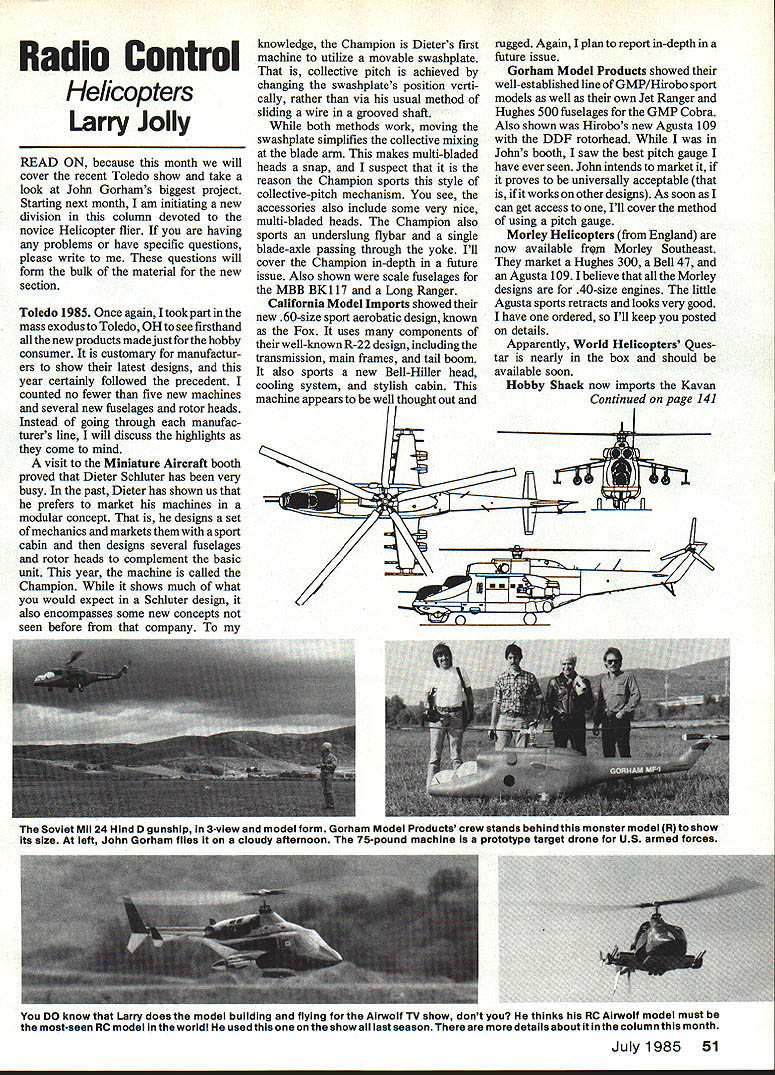
In this month's photos, during a recent visit to GMP I was able to view their new prototype Gorham MF-1 target drone. This machine is in the 10-ft.-long range and, in a word, is awesome. Intended as a training aid to our armed services, the drone features a 22-hp engine and weighs 75 pounds. The fuselage is a one-fifth-scale Mi-24 Hind D and is typical of the type operated by the Soviets. As can be seen in the photos, the MF-1 flies—and does that very well. I'm sure we all wish John well on this project—and, by the way, don't look for this one at your local hobby shop!
This month we also have some pictures of my personal Airwolf. This model features my own fiberglass fuselage, Heim retracts, and GMP Competitor mechanics. The rotorhead is a prototype flybarless design from GMP. The engine is an OS .60 FSR-H, which has proved to be excellent power for this 11-lb. machine. This particular model has approximately 40 hours on it without any failures. This speaks well for the components used and for the machine.
This month's three-view is of a large Soviet military helicopter. The design of the Mi-24 goes back to the late Sixties. The United States was already realizing the potential of an armed military machine. Indeed, this was the era that Bell came up with their successful Cobra design. While the Soviets took a little longer to get their shipping into service, the Hind-D has proved to be capable of dealing with any of our machines.
While the Mi-24 is very large (56 ft. in length), it is also very fast. The Hind cruises in the 175 mph range and holds two world speed records in its class. Because the Hind features an articulated rotorhead, it is not as nimble as its U.S. counterparts. It can, however, transport a squad of eight troops to the scene of a battle and then offer sustained weaponry as well as definite tank-busting capabilities. It is no wonder that NATO is concerned at the rapid development and deployment of this formidable machine. There is no kit for the Hind D; however, I have a one-tenth-scale fuselage available if you're planning a conquest of western Europe.
BCNU.
Larry Jolly 5501 W. Como, Santa Ana, CA 92703
Transcribed from original scans by AI. Minor OCR errors may remain.

