
Radio Control: Helicopters
Larry Jolly
MACS Show
I've just returned from the Model & Crafts Show in Long Beach, CA. While show attendance was down this year, I did see some really neat things for RC helicopters.
First, GMP's new pitch gauge has turned out to be universal in application and is now in production. I will test one as soon as it is available and show you the proper method for using it. It looks real good!
Hirobo Shuttle
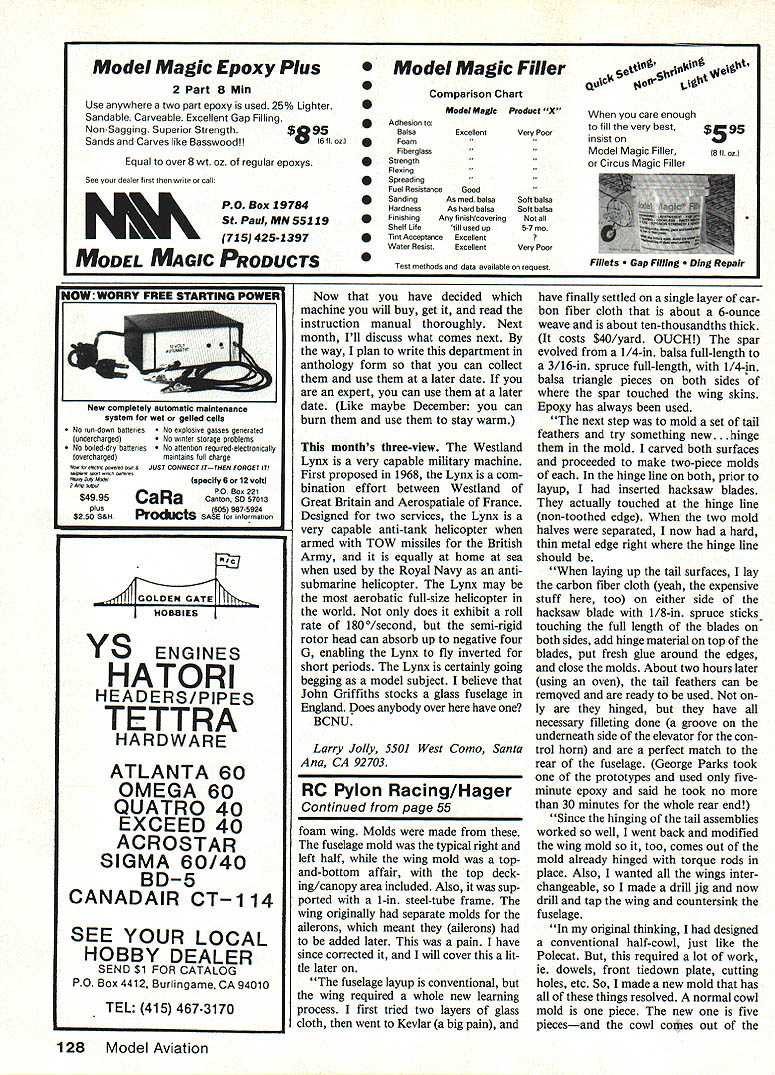
The surprise of the show was Hirobo's newly announced Shuttle. Hirobo has designed, tested, and is now marketing a truly ARF helicopter. The Shuttle is much more than just an Almost-Ready-to-Fly machine. Its concept is a machine made in molds, mainly from composite materials, with as few metal parts as possible. It features collective pitch, Bell/Hiller steering through a diminutive DDF rotor head, toothed-belt tail drive, a pre-painted cabin, and a .28-size motor and silencer included and installed. All that is left for the modeler is to install his radio—then he can go fly.
The Shuttle has the potential to get more people into RC helicopters than any previously marketed machine. Many fliers would like to try an RC heli but can't see themselves assembling all those precision parts. Hirobo has done all the work for you. Now it is up to us to have the fun.
At the MACS Show, John Gorham only had a photo of the new cutie. He told me that GMP would be receiving some samples for flight testing in June, with deliveries to follow in early August. Two days later, John called and nonchalantly announced that the Shuttle had been publicly demonstrated at the Tokyo Show. Not only did the machine fly, but it demonstrated big-machine-style aerobatics and full-down, engine-off autorotations.
Does it fly? Yes — and I am excited. GMP's new Shuttle retails for under $250. As soon as I can get my hands on one, we'll get plenty of pictures and information on this new innovation.
CMI and the Fox
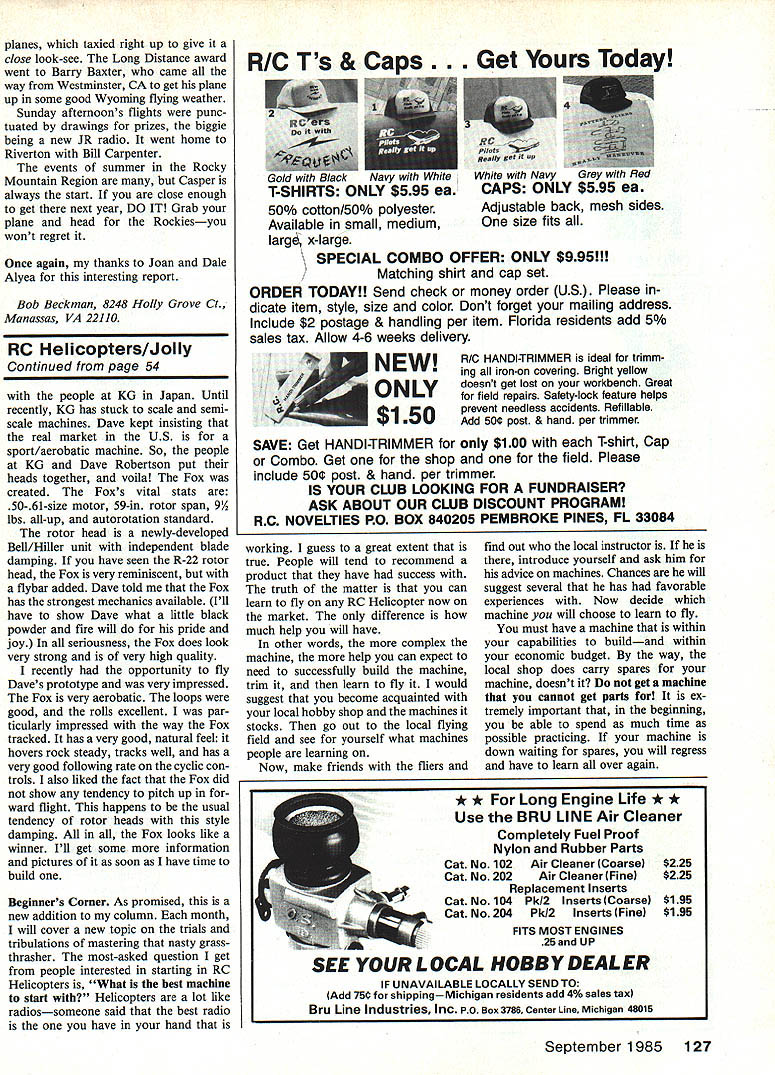
CMI (California Model Imports) was also at the MACS Show. Dave Robertson has been doing a lot of work. CMI has a new Fox — a .60-size machine suitable for sport/aerobatics as well as contest work. The structure is very rigid, and flyability is outstanding.
Until recently, KG Japan had stuck to scale/semiscale machines. Dave kept insisting the real market in the U.S. was sport/aerobatic machines. So people at KG and Dave Robertson put their heads together — voilà — Fox was created.
Fox's vital statistics:
- Motor: .50–.61-size
- Rotor span: 59 in
- All-up weight: 9-1/2 lbs
- Autorotation: standard
- Rotor head: newly developed Bell/Hiller unit with independent blade damping
I have seen the R-22 rotor head; Fox is very reminiscent of a flybar-added design. Dave told me Fox has the strongest mechanics available. What little opportunity I've had to fly Dave's prototype left me very impressed. Fox is very aerobatic — loops, good rolls. I was particularly impressed by the way Fox tracked; it has a very good, natural feel, hovers rock-steady, tracks well, and has a very good following rate to the cyclic controls. I also liked the fact Fox did show a tendency to pitch upward in flight — that happens with this style of damping. Fox looks like a winner. I'll get some information and pictures as soon as I have time to build.
Beginners Corner
As promised, a new addition to the column this month will cover the trials and tribulations of mastering the nasty grass-thrasher. The most-asked question I get from people interested in starting RC helicopters is, "What is the best machine to start with?"
Helicopters are a lot like radios — someone said that the best radio is the one you have in your hand that is working. To a great extent that's true. People will tend to recommend a product that they have had success with. The truth of the matter is that you can learn to fly on any RC helicopter now on the market. The only difference is how much help you will have.
The more complex the machine, the more help you can expect to need to successfully build the machine, trim it, and then learn to fly it. I suggest you become acquainted with your local hobby shop and the machines it stocks. Then go out to the local flying field and see for yourself what machines people are learning on.
Make friends with the fliers and find out who the local instructor is. If he is there, introduce yourself and ask him for his advice on machines. Chances are he will suggest one he has had favorable experience with. Now decide which machine you will choose to learn to fly.
You must have a machine that is within your capabilities to build — and within your economic budget. By the way, does the local shop carry spares for your machine? Do not get a machine that you cannot get parts for! It is extremely important that, in the beginning, you be able to spend as much time as possible practicing. If your machine is down waiting for spares, you will regress and have to learn all over again.
Now that you have decided which machine you will buy, get it and read the instruction manual thoroughly. Next month I'll discuss what comes next. I plan to write this department in an anthology form so you can collect the pieces and use them at a later date. If you are an expert, you can use them at a later date (like maybe December; you can burn them and use them to stay warm).
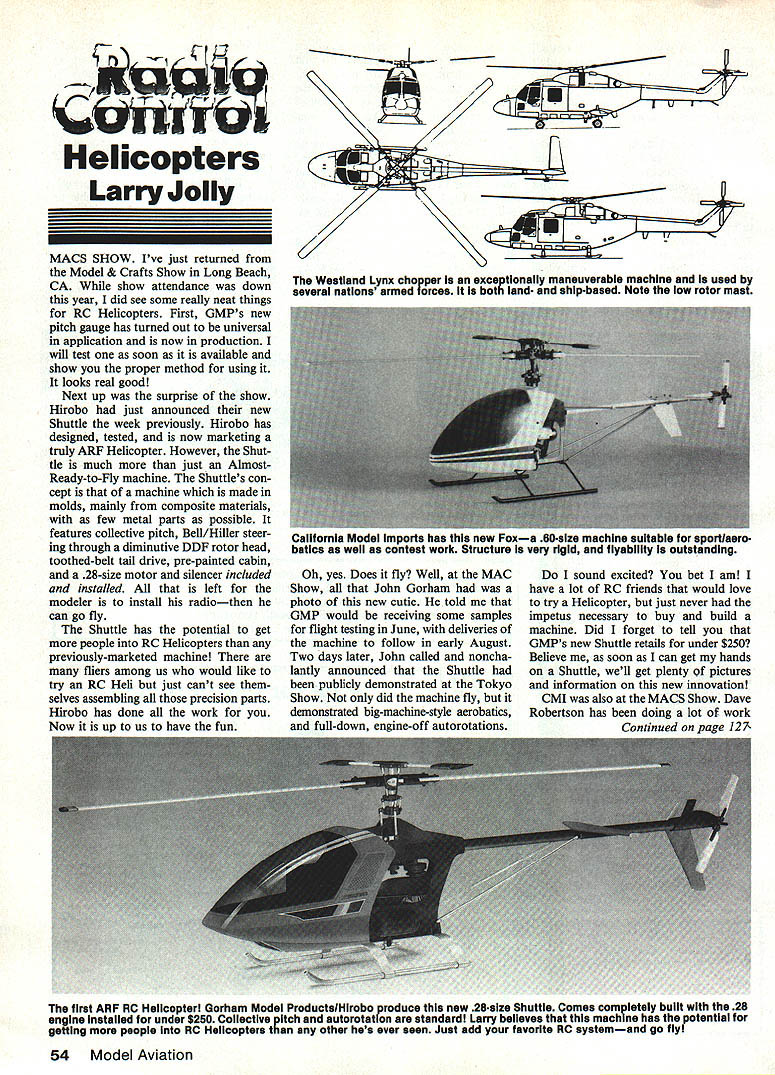
This Month's Three-View
The Westland Lynx is a very capable military machine. First proposed in 1968, the Lynx is a combination effort between Westland of Great Britain and Aerospatiale of France. Designed for two services, the Lynx is a very capable anti-tank helicopter when armed with TOW missiles for the British Army, and it is equally at home at sea when used by the Royal Navy as an anti-submarine helicopter.
The Lynx may be the most aerobatic full-size helicopter in the world. Not only does it exhibit a roll rate of 180°/second, but the semi-rigid rotor head can absorb up to −4 G, enabling the Lynx to fly inverted for short periods. The Lynx is certainly going to be a model subject. I believe that John Griffiths stocks a glass fuselage in England. Does anybody over here have one? BCNU.
Larry Jolly 5501 West Como Santa Ana, CA 92703
Transcribed from original scans by AI. Minor OCR errors may remain.

