
Radio Control: Helicopters
Larry Jolly
Review of the CMI Fox
Last month I introduced the new CMI Fox. As promised, here is more detailed information prepared by Dave Robertson that gives a good preview of this machine.
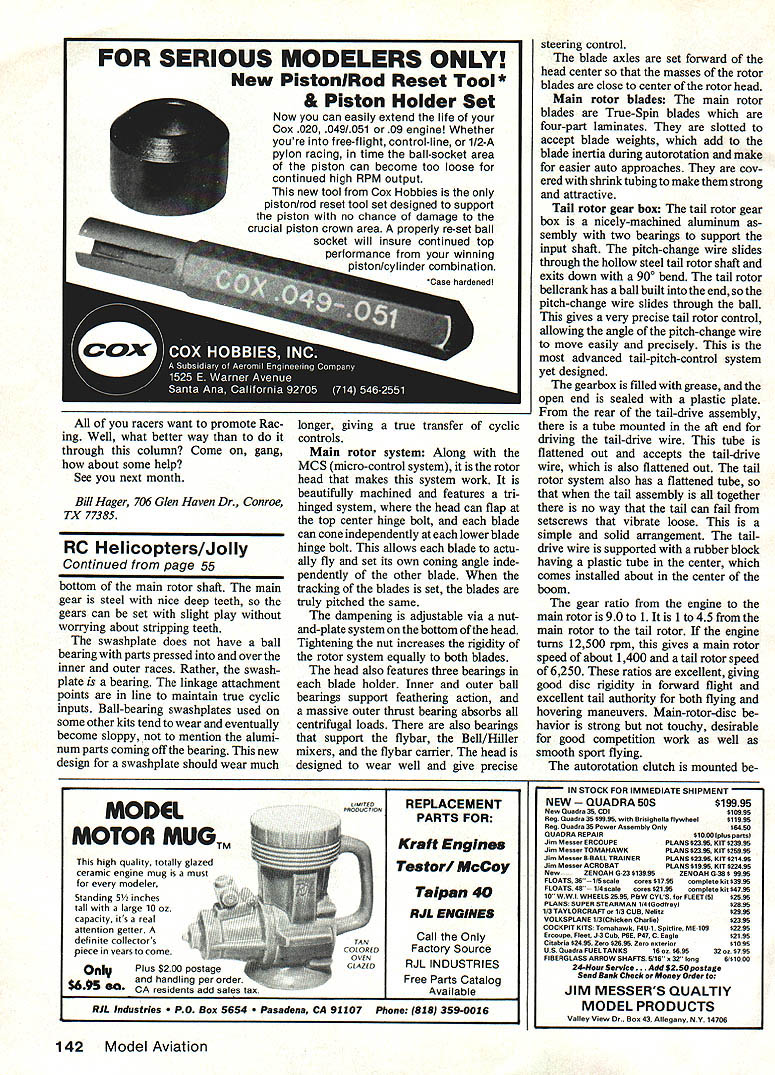
The Fox is a new, high-tech design from KG Manufacturing in Japan. The drive train is essentially the same layout as their Robinson R-22hp but with a gearing change. The rotor head resembles the R-22 head but adds a flybar and adjustable dampening. The tail boom is covered with white heat-shrink tubing, and the tail fins are cut from plywood and easily covered with MonoKote. The completed model is visually attractive and well finished.
Power plant and clutch
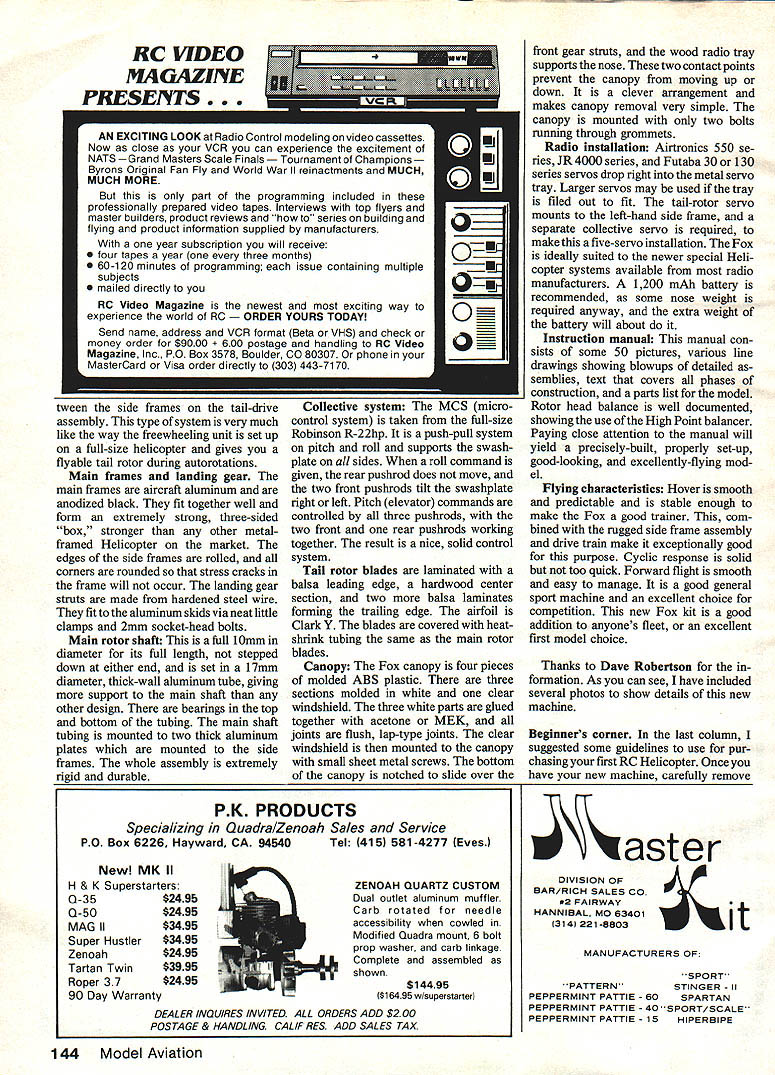
The engine mounts inverted and in line with the tail boom, with a starting cone/flywheel pointing out the back of the side frames. Alignment is not critical because there is no starting shaft to contend with; the engine is started directly like a conventional model airplane engine. The starter does not tend to jump off the cone and damage the rotor head as with some other kits.
The clutch is a typical steel split (half-moon) shoe design, with flex points drilled slightly farther out than on other kits to allow a bit higher engine speed before clutch engagement.
Initial power transfer is via a belt to the tail-drive assembly, which drives a steel main rotor gear. This system is easy to set up and should wear well over time.
Fuel tank and engine cooling
The fuel tank is mounted just ahead of the engine and is nearly perfectly in line with the carburetor. Engine cooling is provided by a newly designed, high-efficiency impeller mounted behind the clutch assembly. A partial shroud directs air over the bottom of the engine. The cooling system is simple, more than adequate, and allows easy access to the carburetor.
Drive train and autorotation clutch
The drive train combines belt and gear drives. The engine drives a belt to the tail-drive assembly. From the tail-drive assembly forward, a bevel gear engages the main rotor drive gear, which is mounted to the bottom of the main rotor shaft. The main gear is steel with deep teeth, so gears can be set with slight play without worrying about stripping.
The autorotation clutch is mounted behind the main rotor gear. The gear ratio from engine to main rotor is 9.0:1. From main rotor to tail rotor it is 1:4.5. At 12,500 rpm engine speed this yields roughly:
- main rotor speed: ~1,400 rpm
- tail rotor speed: ~6,250 rpm
These ratios provide good disc rigidity in forward flight and excellent tail authority for hovering and forward maneuvers. The main rotor disc behavior is strong but not overly touchy — desirable for competition as well as sport flying.
Swashplate and cyclic transfer
The swashplate design aligns the linkage attachment points to maintain true cyclic inputs. Unlike some ball-bearing swashplates that can wear and become sloppy (or have aluminum parts come off the bearing), this swashplate design is intended to wear longer and give true transfer of cyclic controls.
Main rotor system
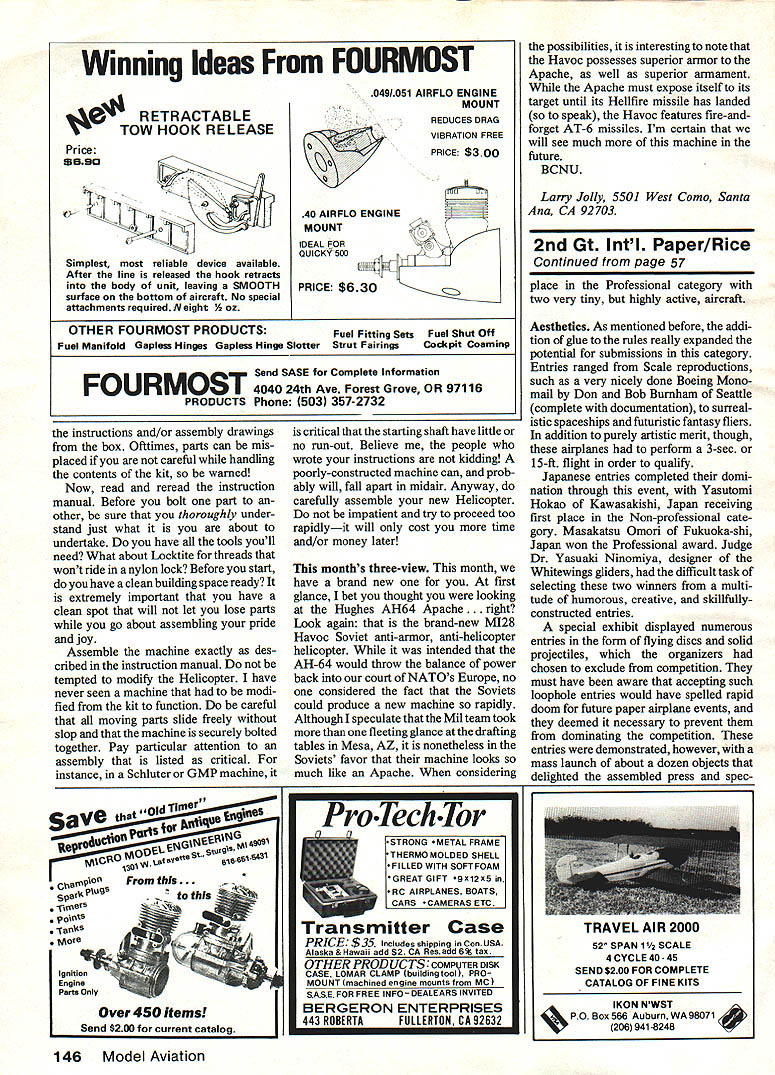
Along with the MCS (micro-control system), the rotor head is a key element of the Fox. It is beautifully machined and uses a tri-hinged system: the head can flap at the top-center hinge bolt, and each blade can cone independently at its lower hinge bolt. This allows each blade to fly and set its own coning angle independently of the other blade. Once blade tracking is set, the blades are truly pitched the same.
Dampening is adjustable via a nut-and-plate system on the bottom of the head; tightening the nut increases rigidity equally on both blades. The head features multiple bearings in each blade holder: inner and outer bearings support feathering action, and a massive outer thrust bearing absorbs centrifugal loads. There are also bearings supporting the flybar, the Bell/Hiller mixers, and the flybar carrier. The blade axles are set forward of the head center so that blade masses are close to the rotor head center. The head is designed to wear well and provide precise control.
Main rotor blades
The main rotor blades are True-Spin four-part laminates. They are slotted to accept blade weights, which add blade inertia for easier autorotations and smoother autorotation approaches. The blades are covered with shrink tubing for strength and appearance.
Tail rotor blades are laminated with a balsa leading edge, a hardwood center section, and two balsa laminates forming the trailing edge. The airfoil is Clark Y, and these blades are also covered with heat-shrink tubing.
Tail rotor gear box
The tail rotor gear box is a well-machined aluminum assembly with two bearings supporting the output shaft. The pitch-change wire runs through the hollow steel tail rotor shaft and exits downward with a 90° bend. The tail rotor bellcrank has a ball built into the end so the pitch-change wire slides through the ball, allowing very precise and low-friction tail control — an advanced tail-pitch-control system.
The gearbox is filled with grease and the open end sealed with a plastic plate. A tube mounted in the aft end of the tail-drive assembly carries the tail-drive wire; the tube and wire are flattened where required so the tail cannot fail due to vibrating setscrews. The tail drive wire is supported by a rubber block with a plastic tube in the center that installs about mid-boom. This is a simple, solid arrangement.
Canopy
The Fox canopy is four molded ABS plastic pieces: three white sections and one clear windshield. The white parts are glued together with acetone or MEK using flush lap joints. The clear windshield is mounted to the canopy with small sheet-metal screws. The canopy bottom edge is notched to slide over the front gear struts, and the wood radio tray supports the nose — these two contact points prevent vertical movement. The canopy is mounted with only two bolts running through grommets, making removal simple and secure.
Radio installation
Airtronics 550 series, JR 4000 series, and Futaba 30 or 130 series servos fit directly into the metal servo tray. Larger servos may be used if the tray is filed to fit. The tail-rotor servo mounts to the left-hand side frame, and a separate collective servo is required for a five-servo installation. The Fox is well suited to the special helicopter radio systems from most manufacturers. A 1,200 mAh battery is recommended — some nose weight is usually required and the extra battery weight helps keep the CG forward.
Instruction manual
The manual contains roughly 50 pictures, line drawings with blowups of detailed assemblies, full text covering all phases of construction, and a parts list. Rotor head balancing is well documented, showing use of the High Point balancer. Read the manual closely; following it will yield a precisely built, properly set-up, good-looking, and well-flying model.
Flying characteristics
Hovering is smooth, predictable, and stable enough to make the Fox a good trainer. Combined with a rugged side-frame assembly and drive train, it is exceptionally suitable for newcomers. Cyclic response is solid but not too quick. Forward flight is smooth and easy to manage. The Fox is a fine general sport machine and an excellent choice for competition or as a first model.
Thanks to Dave Robertson for the information. Several photos accompany the original review to show details of the machine.
Beginner’s corner
In the last column I suggested guidelines for purchasing your first RC helicopter. Once you have your new machine, carefully remove the instructions and assembly drawings from the box. Parts can be misplaced if you are not careful while handling kit contents.
Read and reread the instruction manual. Before you bolt parts together, be sure you thoroughly understand the next step. Do you have all the tools you need? Do you have Loctite for threads that must not back out? Do you have a clean building space to avoid losing small parts?
Assemble the machine exactly as described in the manual. Do not be tempted to modify the helicopter — I have rarely seen a kit that needed modification to function. Make sure all moving parts slide freely without slop and that the machine is securely bolted together. Pay particular attention to assemblies listed as critical (for example, starting shafts that must have little or no run-out). The instructions’ authors are not kidding: a poorly constructed machine can and probably will fail in flight. Do not rush — take the time to assemble carefully to avoid costing yourself more time or money later.
This month's three-view
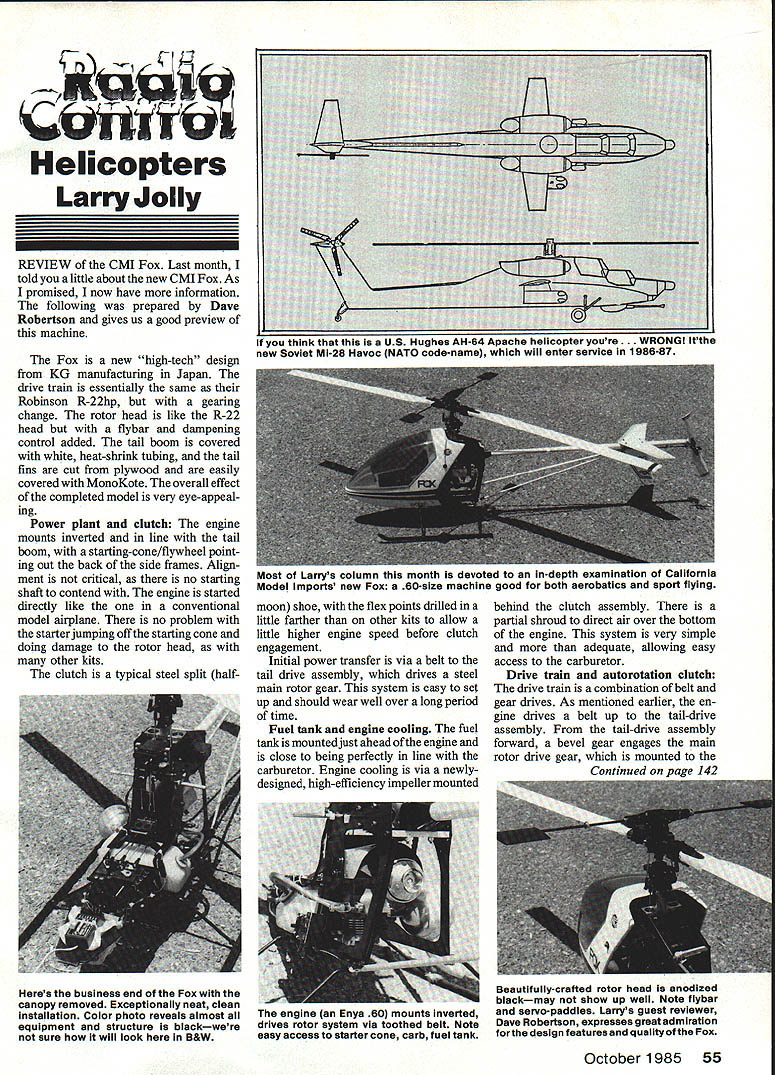
This month’s three-view features the brand-new Mi-28 Havoc, a Soviet anti-armor, anti-helicopter machine. At first glance you might think you are looking at the AH-64 Apache. While the Apache was intended to regain NATO’s battlefield edge, the Soviets produced a similar-looking machine very rapidly. The Mi-28 Havoc appears to have superior armor and armament. Unlike the Apache, which must expose itself until a Hellfire missile impacts, the Havoc features fire-and-forget AT-6 missiles. Expect to see more of this machine in the future.
BCNU.
Larry Jolly 5501 West Como, Santa Ana, CA 92703.
Transcribed from original scans by AI. Minor OCR errors may remain.

