
Radio Control: Jets
Byline
Delmar Ellis, 8877 Meadowview Drive, West Chester, OH 45069
This column's discussion is directed towards the beginner in ducted-fan jets or those considering trying them: go for it. I promise you will never regret it; I speak from experience, having made the transition during the last two years.
First, I'll review motivations. Our modeling hobby and sport is about achievement, self-esteem, infatuation with flight, artistic expression in the model's appearance and the grace of flying, and, finally, camaraderie.
A shopping mall administrator said it well following a mall show when he declared that our modeling group was the most cooperative, trustworthy, and professional group his mall had ever hosted. Generally, these qualities pervade our hobby. Our involvement rewards us with a great feeling of satisfaction.
One of the rewards of modeling is the variety of challenges and directions. We enjoy our current pursuits for a time, then reach for new goals and levels of fun and achievement. The standards of jet model building and finishing will drive your levels of achievement beyond your expectations.
There are so many avenues from which to match our interests: gliders, helicopters, Scale, Giant Scale, Pattern, and Pylon are options in RC alone. Each provides a wide range of challenges and participation, and each is rewarding. The variety of models can provide satisfaction for a lifetime.
To me, jets are the ultimate fulfillment of all the above qualities and values. The speed and grace of flight are without parallel. The power output and technical achievement levels are the highest in modeling.
Best of all are the participants. I have yet to meet anyone in jet modeling whom I did not immediately respect and identify as a close personal friend. The people with whom you share jet modeling and the feeling of achievement are the best there is; jets offer the pinnacle in self-satisfaction and fun.
Are you still debating whether or not to model jets? Perhaps these questions might help:
- Is it too expensive? Is it worth it?
- Does it really take too much commitment or time?
- Can I really do it successfully?
For most people, it ultimately boils down to confidence—will it be successful and rewarding, or will I fail, embarrass myself, and waste the investment?
If you are seriously considering jets, you are probably near the point where you can succeed; it only takes a little dedication and a disciplined approach. Two suggestions can help you:
- Find others who have gained some degree of jet modeling proficiency and ask questions and ask for help. Don't be bashful.
- Go to area fan-flys, observe methods of handling, study the characteristics of different kitted airplanes, and make friends. Build a phone list of new friends who can offer advice and answer questions.
Once you commit to jet modeling, your biggest decision is where to start: which aircraft model, which fan, and which engine. The answers will be dictated by your situation and will be offered from other jet modelers.
Consider whether your home flying site is a grass or paved strip, and consider the length of runway and the length of straightaway. Other factors include your eyesight and the depth of your pocketbook. Match your selection to the experience of those who will be helping you.
Fortunately, the availability of quality hardware is outstanding and is continuously getting better. Several manufacturers produce jet models specifically developed for the jet newcomer. Not surprisingly, some of these aircraft remain favorites for the experienced jet jockey. They provide plenty of excitement and fly great.
The following outline of models designated as trainers is alphabetized by manufacturer name. Many other kits would do well, but the following choices are particularly tailored to make your transition painless and pleasurable.
Bob Parkinson Models
Bob offers two ideal trainers, the Regal Eagle (F-15) and the F-18 Hornet. Both designs are conventional wood construction and assemble easily. Flight performance of both aircraft is excellent, with smooth and stable flight characteristics, low landing speed, and moderate flight speeds. Grass-field takeoff is achievable.
Parkinson offers his own Vector fan, but Dynamax fans are also popular. Any .65–.91 fan can be adapted if extra power and speed are desired. System price (excluding radio) with the Vector fan is $794. Add $50–100 if an alternate fan is substituted.
Bob Violett Models (BVM)
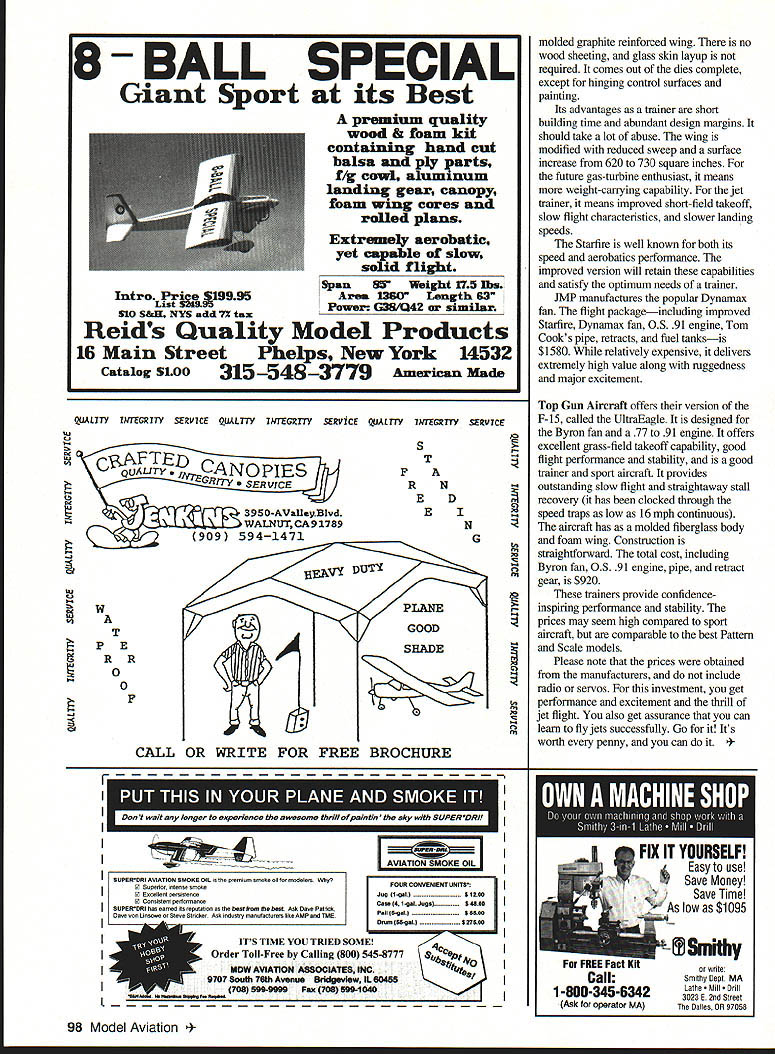
BVM offers the Maverick as their trainer. It is derived from their third-generation sport jets and is specifically designed for the first-time jet modeler. The Maverick is an extremely well-engineered aircraft, with typical blazing BVM performance. Its appearance is striking, particularly with the optional tip tanks that also improve visibility.
The Maverick can produce speeds in excess of 150 mph, with superior aerobatic performance and stable low-speed flight and landing characteristics. Because of its performance, it has quickly become a popular sport jet as well as a trainer. It is expensive, with absolutely no cost compromises; it is also an excellent value when everything is considered.
The fuselage is fiberglass with Kevlar and graphite reinforcement. The surface is finished in primer, as are the inside ducts. The wings and empennage surfaces are presheeted and use graphite spars for strength. All hardware is provided, including hundreds of molded and laminated graphite parts ranging from formers to gear to flexible gear mounts to latches and keepers.
The model is easy to build and comes with a comprehensive instruction book and portfolio of assembly photographs. BVM offers a Violett fan and an .81 or .91 engine. Incidentally, these engines are extremely reliable and trouble free in addition to providing radical performance output. The reliability is more important to the jet student because he or she will be flying this model at part throttle—for some time, anyway. The cost of the model with .81 engine, fan, pipe, retract-gear set, fuel tanks, and optional tip tanks is $1,795.
Byron Originals
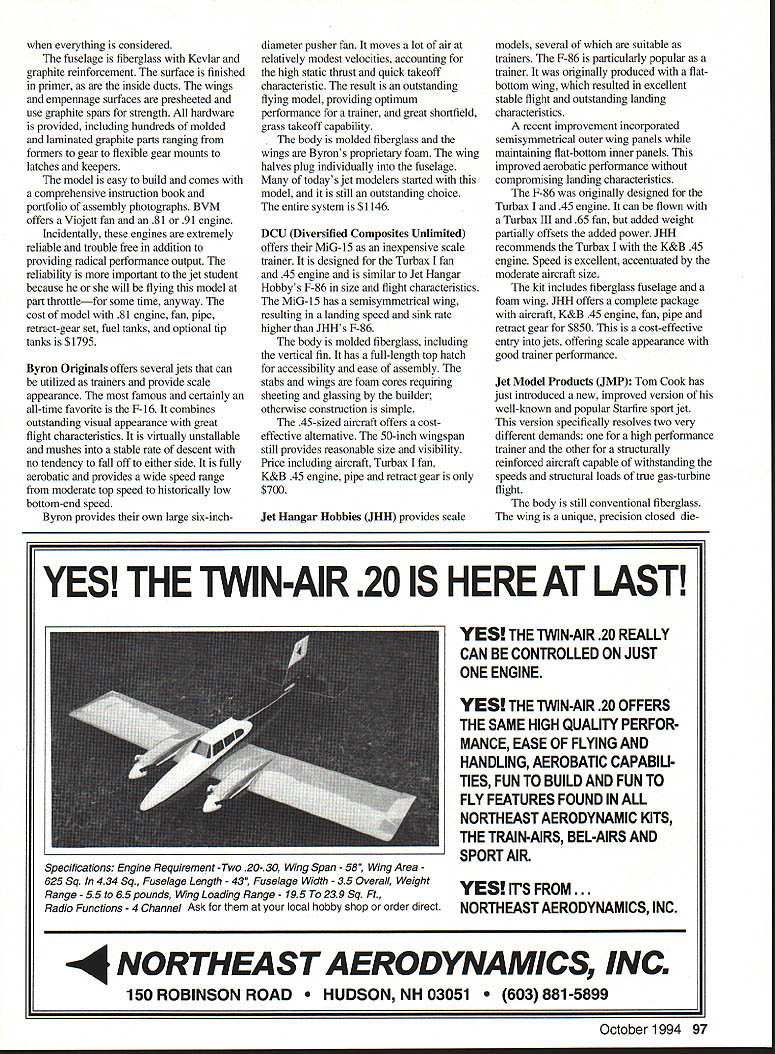
Byron Originals offers several jets that can be utilized as trainers and provide scale appearance. The most famous and certainly an all-time favorite is the F-16. It combines outstanding visual appearance with great flight characteristics. It is virtually unstallable and mushes into a stable rate of descent with no tendency to fall off to either side. It is fully aerobatic and provides a wide speed range from moderate top speed to historically low bottom-end speed.
Byron provides their own large six-inch-diameter pusher fan. It moves a lot of air at relatively modest velocities, accounting for the high static thrust and quick takeoff characteristic. The result is an outstanding flying model, providing optimum performance for a trainer and great short-field, grass takeoff capability.
The body is molded fiberglass and the wings are Byron's proprietary foam. The wing halves plug individually into the fuselage. Many of today's jet modelers started with this model, and it is still an outstanding choice. The entire system is $1,146.
DCU (Diversified Composites Unlimited)
DCU offers their MiG-15 as an inexpensive scale trainer. It is designed for the Turbax I fan and .45 engine and is similar to Jet Hangar Hobby's F-86 in size and flight characteristics. The MiG-15 has a semisymmetrical wing, resulting in a landing speed and sink rate higher than JHH's F-86.
The body is molded fiberglass, including the vertical fin. It has a full-length top hatch for accessibility and ease of assembly. The struts and wings are foam cores requiring sheeting and glassing by the builder; otherwise construction is simple.
The .45-sized aircraft offers a cost-effective alternative. The 50-inch wingspan still provides reasonable size and visibility. Price including aircraft, Turbax I fan, K&B .45 engine, pipe, and retract gear is only $700.
Jet Hangar Hobbies (JHH)
JHH provides scale models, several of which are suitable as trainers. The F-86 is particularly popular as a trainer. It was originally produced with a flat-bottom wing, which resulted in excellent stable flight and outstanding landing characteristics.
A recent improvement incorporated semisymmetrical outer wing panels while maintaining flat-bottom inner panels. This improved aerobatic performance without compromising landing characteristics.
The F-86 was originally designed for the Turbax I and .45 engine. It can be flown with a Turbax III and .65 fan, but the added width partially offsets the added power. JHH recommends the Turbax II with the K&B .45 engine. Speed is excellent, accentuated by the moderate aircraft size.
The kit includes a fiberglass fuselage and a foam wing. JHH offers a complete package with aircraft, K&B .45 engine, fan, pipe, and retract gear for $850. This is a cost-effective entry into jets, offering scale appearance with good trainer performance.
Jet Model Products (JMP)
Tom Cook has just introduced a new, improved version of his well-known and popular Starfire sport jet. This version specifically resolves two very different demands: one for a high-performance trainer and the other for a structurally reinforced aircraft capable of withstanding the speeds and structural loads of true gas-turbine flight.
The body is still conventional fiberglass. The wing is a unique, precision closed die-molded, graphite-reinforced wing. There is no wood sheeting, and glass skin layup is not required. It comes out of the dies complete, except for hinging control surfaces and painting.
Its advantages as a trainer are short building time and abundant design margins. It should take a lot of abuse. The wing is modified with reduced sweep and a surface increase from 620 to 730 square inches. For the future gas-turbine enthusiast, it means more weight-carrying capability. For the jet trainer, it means improved short-field takeoff, slow flight characteristics, and slower landing speeds.
The Starfire is well known for both its speed and aerobatic performance. The improved version will retain these capabilities and satisfy the optimum needs of a trainer. JMP manufactures the popular Dynamax fan. The flight package—including the improved Starfire, Dynamax fan, O.S. .91 engine, Tom Cook's pipe, retracts, and fuel tanks—is $1,580. While relatively expensive, it delivers extremely high value along with ruggedness and major excitement.
Top Gun Aircraft
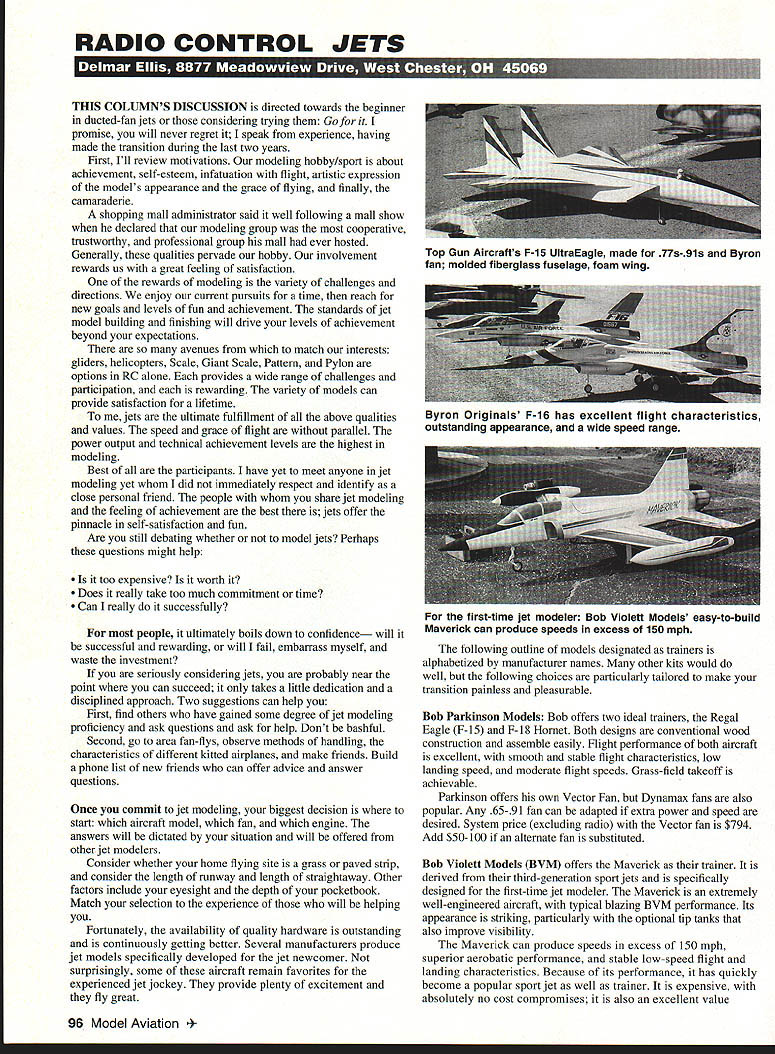
Top Gun Aircraft offers their version of the F-15, called the UltraEagle. It is designed for the Byron fan and a .70 to .91 engine. It offers excellent grass-field takeoff capability, good flight performance and stability, and is a good trainer and sport aircraft. It provides outstanding slow flight and straightaway stall recovery (it has been clocked through the traps as low as 16 mph continuous). The aircraft has a molded fiberglass body and foam wing. Construction is straightforward. The total cost, including Byron fan, O.S. .91 engine, pipe, and retract gear, is $2,920.
These trainers provide confidence-inspiring performance and stability. The prices may seem high compared to sport aircraft, but are comparable to the best Pattern and Scale models.
Please note that the prices were obtained from the manufacturers and do not include radio or servos. For this investment, you get performance and excitement and the thrill of jet flight. You also get assurance that you can learn to fly jets successfully. Go for it! It's worth every penny, and you can do it.
Transcribed from original scans by AI. Minor OCR errors may remain.

