
RADIO CONTROL JETS
Delmar Ellis 8877 Meadowview Drive, West Chester, OH 45069
This issue of Model Aviation is dedicated to beginners in each phase of the flying hobby. For those of you who are interested in ducted fans, I'll refer you to the "RC Jets" column in the October 1994 issue of MA.
AMA Jet Meet
Several people have asked me about the best way to get into turbines. My initial response has usually been to recommend shopping at one of the big static shows, such as the Weak Signals R/C Expo at Toledo. After you compare turbines and talk to the suppliers, you will have some idea of what you want and where to start.
Now a better answer is to suggest attending the AMA Jet Meet at the International Aeromodeling Center at Muncie, June 7–9. All of the turbine suppliers and the major jet-model suppliers will be there to answer questions, display their products, and to demonstrate them in flight. The meet will also provide a three-day weekend of fun-filled informal flying for all jet fliers—ducted fan and turbine. See the "RC Jets" column in the April 1996 Model Aviation for more information.
By the way, the Telstar and SKS video production companies will be taping the weekend; Telstar will be presenting the event on national television.
Golden West FD3/67LS Turbine
This latest production turbine hit the scene at DeLand, Florida this year; it is the new version of the Schreckling turbine. Both manufacturing and distribution (in the USA) are provided by Golden West Models under license from Schneider-Sanchez in Austria. This engine is delivered fully assembled and balanced. A factory test report of each engine is included with each delivery. To date, Golden West has delivered 20 engines to Schneider-Sanchez, and is in the process of delivering the first 32 U.S. orders.
Earlier European engines were advertised as having 6.7 pounds of thrust. The Golden West design updates have shown improved thrust. Current runs have produced 7.5 pounds of thrust (or more) at 85,000 rpm—the current operating limit.
This engine is unique in several ways:
- Materials and weight: It is made of high-strength aerospace alloys and is very light. The turbine weighs only 28 ounces. Accessories add 16 ounces to the flying weight; these include the onboard computer control, fuel pump, 1,400‑mAh battery, and plumbing.
- Electronic control and safety monitoring: A sophisticated onboard system provides fault shutdown from safety parameters, including speed and temperature. It records monitored safety data for the last four minutes of operation; the data can be downloaded into a personal computer with an optional harness.
- Fuel and starting: The turbine's fuel system burns 85% kerosene (Jet A) and 15% white gasoline (Coleman fuel). It is started with propane from a small external tank, then switched to kerosene; the propane is disconnected prior to high-speed operation.
- Ease of operation and installation: Much of the starting hassle is eliminated by the auto-control sequencing of the onboard computer. Flight operation is also computer controlled. The receiver channel directs the throttle, modulating fuel flow; the pressure-variable pump control does not require a separate throttle servo. Engine mounts are provided; an optional extractor tailpipe is available from Golden West. Inlet air is dumped into the fuselage, which is used as a plenum for the engine intake, allowing simple installation with minimum ducting.
Initial flying examples utilized a standard 50-ounce R/C fuel tank. After an unfortunate accident at DeLand '96, future installations will incorporate multiple graphite-reinforced tanks.
AMA's Turbine Committee recently received a turbine for evaluation. Plans are to install it in a CS Models Terminator; the weight goal is 8.5 pounds dry, 11 pounds gross takeoff. We hope to explore the full performance potential of the engine.
What's Next After Buying a Turbine?
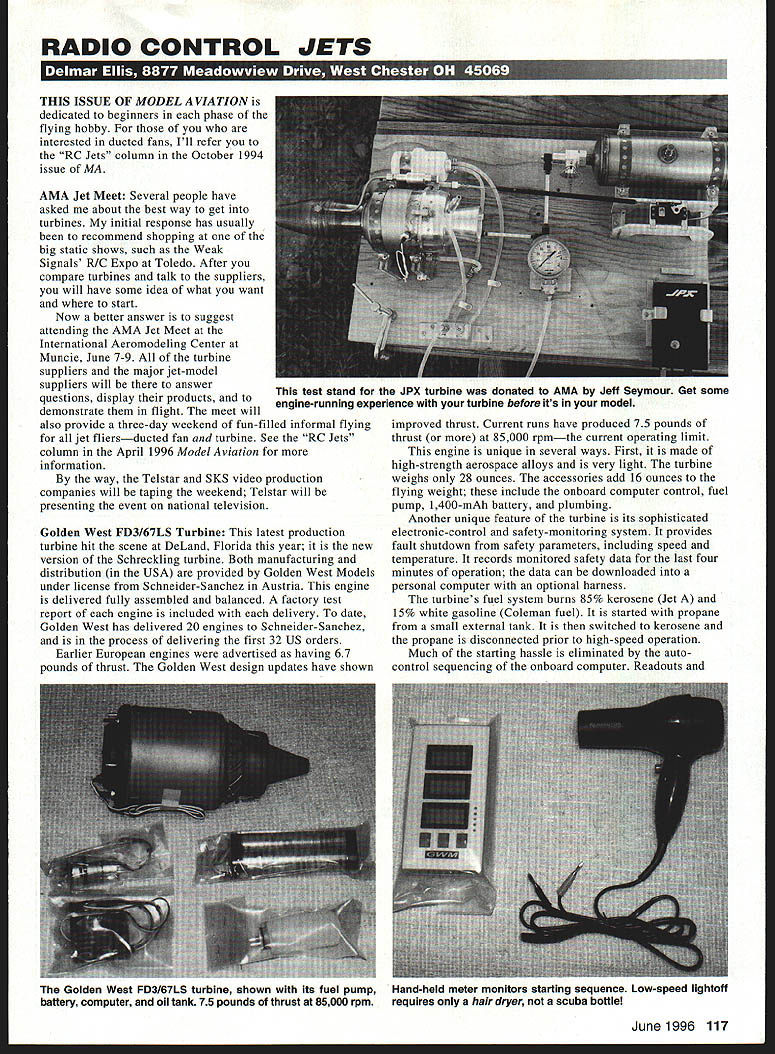
Hopefully you've selected a turbine and your first aircraft application. If you're building a model, get some engine-running experience. Build yourself a simple test stand (it can be as simple as a mounting board), pick your ground crew, and get enough runs in to be comfortable with turbine operation.
Undoubtedly you will have picked up some experience in the manufacturers' ground school when you bought your engine. Test-running gives you an opportunity to gain confidence and evaluate fuel and oil consumption and flight duration. Note the variation in oil consumption with throttle settings and ambient temperature. Practice fueling and starting procedures. Good luck!
1996 Summer Thunder
In the April column I described an ideal jet field at Hebron, Ohio. In previous years, it was the site of the jet nationals. This year, a more informal "Summer Thunder" jet meet will be held July 27–28. It will feature fun flying only, with no competition or trophies. Door prizes will be given out. Speed traps will be available for information readings only.
Additional entertainment will be available. Saturday a hot rod and custom car cruise-in will be held in the parking area. A "Night of Fire" will be held at the nearby NHRA drag strip Saturday night; it will feature gas-turbine-powered drag racing. This will be a blast of magnificent proportions (you didn't really think I would get too far away from turbines, did you?). The entry fee to the jet meet is $15 for one day or $20 for the weekend. Special admission prices for the drag race are being negotiated.
RC Bloopers Video
We are fortunate to have SKS and Telstar as sources for quality videotapes of our jet events.
A new tape just released by SKS is particularly delightful. I am not into crashes or the negative aspects of our hobby, but I did find SKS' new RC Bloopers tape entertaining and thought-provoking. Although it spares no one (including yours truly), it shows our vulnerability with sensitivity. The footage is up-close and provides great detail; it includes ducted fans, turbines, and Scale Masters competition.
Transcribed from original scans by AI. Minor OCR errors may remain.

