
RADIO CONTROL: JETS
Delmar Ellis 8877 Meadowview Drive, West Chester, OH 45069
Jets at Toledo
The RC Expo at the Toledo Seagate Centre always includes strong jet model participation. This year's Expo (held April 12–14) was no exception. Almost every current jet manufacturer was present. The displays gave visitors an opportunity to shop and investigate the newest products and technologies, and to talk to the supplier sources.
I counted a dozen jet-aircraft manufacturers' displays. Most of the equipment and accessory suppliers provided elaborate layouts as well. Some of the largest and busiest booths were from radio suppliers. There is a technology race from which jet modelers can really benefit. The capabilities of the latest computerized radios are staggering.
One of the interesting highlights of the Expo is the static model competition; it includes boats, cars, and aircraft. It's always a little frustrating to see so many magnificent models and realize that many modelers can reach a level beyond my own grasp. It motivates one to try harder. Jets competed in two categories: Scale Jet and Sport Jet. Both categories were well represented.
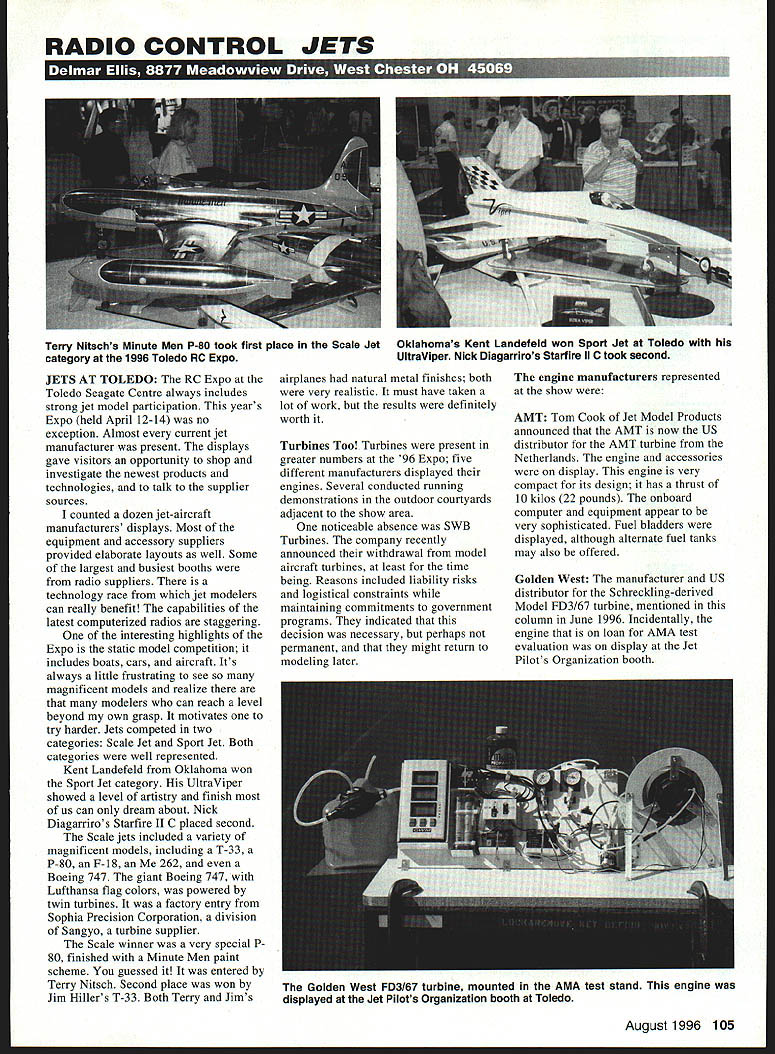
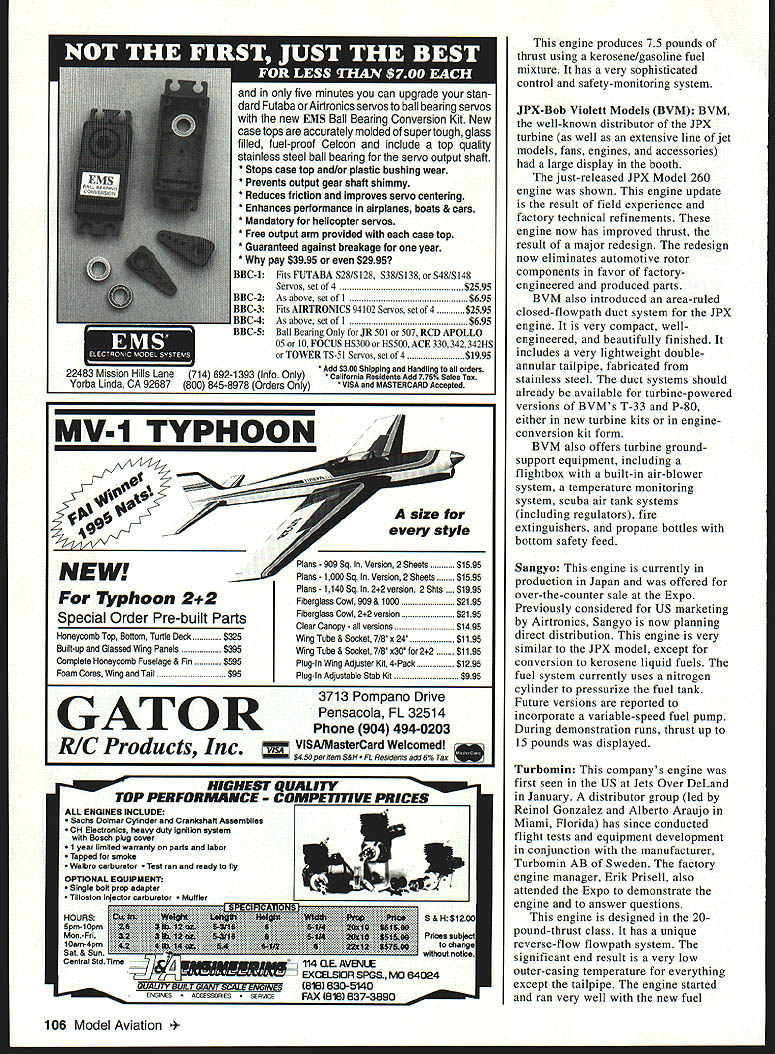
Kent Landefeld from Oklahoma won the Sport Jet category. His UltraViper showed a level of artistry and finish most of us can only dream about. Nick Diagarro's Starfire II C placed second.
The Scale jets included a variety of magnificent models, including a T-33, a P-80, an F-18, an Me 262, and even a Boeing 747. The giant Boeing 747, with Lufthansa colors, was powered by twin turbines. It was a factory entry from Sophia Precision Corporation, a division of Sangyo, a turbine supplier.
The Scale winner was a very special P-80, finished with a Minute Men paint scheme. It was entered by Terry Nitsch. Second place was won by Jim Hiller's T-33. Both Terry's and Jim's airplanes had natural metal finishes and were very realistic. It must have taken a lot of work, but the results were definitely worth it.
Turbines
Turbines were present in greater numbers at the '96 Expo; five different manufacturers displayed their engines. Several conducted running demonstrations in the outdoor courtyards adjacent to the show area.
One noticeable absence was SWB Turbines. The company recently announced their withdrawal from model aircraft turbines, at least for the time being. Reasons included liability risks and logistical constraints while maintaining commitments to government programs. They indicated that this decision was necessary, perhaps not permanent, and that they might return to modeling later.
Engine manufacturers represented
- AMT: Tom Cook of Jet Model Products announced that AMT is now the U.S. distributor for the AMT turbine from the Netherlands. The engine and accessories were on display. This engine is very compact for its design and has a thrust of 10 kilos (22 pounds). The onboard computer and equipment appear to be very sophisticated. Fuel bladders were displayed, although alternate fuel tanks may also be offered.
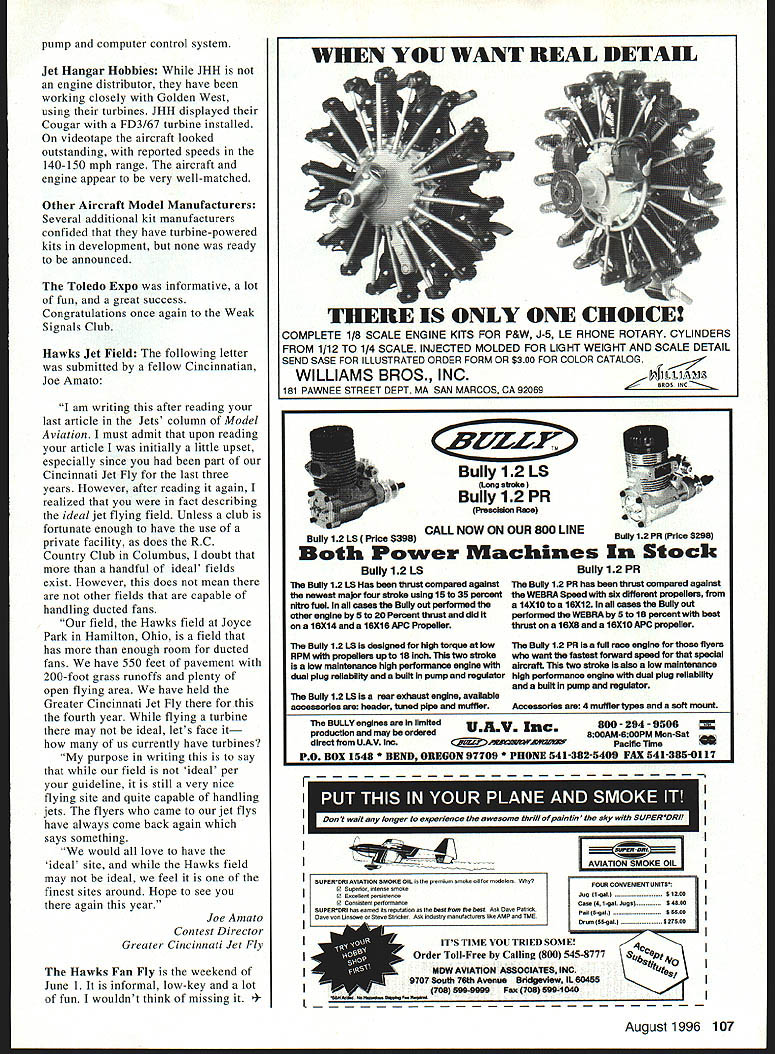
- Golden West: Manufacturer and U.S. distributor for the Schreckling-derived Model FD3/67 turbine, mentioned previously. This engine produces about 7.5 pounds of thrust using a kerosene/gasoline fuel mixture. It has a very sophisticated control and safety-monitoring system. The engine that is on loan for AMA test evaluation was on display at the Jet Pilot's Organization booth.
- JPX — Bob Violett Models (BVM): BVM, the well-known distributor of the JPX turbine (as well as an extensive line of jet models, fans, engines, and accessories) had a large display. The just-released JPX Model 260 engine was shown. This update is the result of field experience and factory technical refinements; these changes have improved thrust via a major redesign that eliminates automotive rotor components in favor of factory-engineered and produced parts.
BVM also introduced an area-ruled closed-flowpath duct system for the JPX engine. It is very compact, well-engineered, and beautifully finished. It includes a very lightweight double-annular tailpipe fabricated from stainless steel. The duct systems should already be available for turbine-powered versions of BVM's T-33 and P-80, either in new turbine kits or in engine-conversion kit form.
BVM also offers turbine ground-support equipment, including a flight box with a built-in air-blower system, a temperature monitoring system, SCUBA air-tank systems (including regulators), fire extinguishers, and propane bottles with bottom safety feed.
- Sangyo: The Sangyo engine is currently in production in Japan and was offered over-the-counter at the Expo. Previously considered for U.S. marketing by Airtronics, Sangyo is now planning direct distribution. This engine is very similar to the JPX model, except for conversion to kerosene liquid fuels. The fuel system currently uses a nitrogen cylinder to pressurize the fuel tank; future versions are reported to incorporate a variable-speed fuel pump. During demonstration runs, thrust up to 15 pounds was displayed.
- Turbomin: This engine was first seen in the U.S. at Jets Over L.A. in January. A distributor group (led by Reinol Gonzalez and Alberto Araujo in Miami, Florida) has since conducted flight tests and equipment development with the manufacturer, Turbomin AB of Sweden. The factory engine manager, Erik Prisell, attended the Expo to demonstrate the engine and answer questions.
The engine is designed in the 20-pound-thrust class with a unique reverse-flow, low-flowpath system. The significant end result is a very low outer-casing temperature for everything except the tailpipe. The engine started and ran very well with the new fuel.
- Jet Hangar Hobbies (JHH): While JHH is not an engine distributor, they have been working closely with Golden West, using their turbines. JHH displayed their Cougar with an FD3/67 turbine installed. On videotape the aircraft looked outstanding, with reported speeds in the 140–150 mph range. The aircraft and engine appear to be very well matched.
- Other aircraft model manufacturers: Several additional kit manufacturers confided that they have turbine-powered kits in development, but none was ready to be announced.
The Toledo Expo was informative, a lot of fun, and a great success. Congratulations once again to the Weak Signals Club.
HAWKS JET FIELD
Letter from Joe Amato
I am writing this after reading your last article in the Jets column of Model Aviation. I must admit that upon reading your article I was initially a little upset, especially since you had been part of our Cincinnati Jet Fly for the last three years. However, after reading it again, I realized that you were in fact describing the ideal jet flying field. Unless a club is fortunate enough to have the use of a private facility, as does the R.C. Country Club in Columbus, I doubt that more than a handful of ideal fields exist. However, this does not mean there are not other fields that are capable of handling ducted fans.
Our field, the Hawks field at Joyce Park in Hamilton, Ohio, is a field that has more than enough room for ducted fans. We have 560 feet of pavement with 200-foot grass runoffs and plenty of open flying area. We have held the Greater Cincinnati Jet Fly there for the past three years. While flying a turbine there may not be ideal, let's face it—there may not be an ideal field. My purpose in writing this is to say that while our field is not "ideal" for your guideline, it is still a very nice flying site and quite capable of handling jets. The flyers who came to our jet flies have always come back again, which says something.
We would all love to have the "ideal" site, and while the Hawks field may not be ideal, we feel it is one of the finest sites around. Hope to see you there again this year.
Joe Amato Contest Director Greater Cincinnati Jet Fly
The Hawks Fan Fly is the weekend of June 1. It is informal, low-key, and a lot of fun. I wouldn't think of missing it.
Transcribed from original scans by AI. Minor OCR errors may remain.

