

RADIO CONTROL JETS
Delmar Ellis 8877 Meadowview Drive, West Chester OH 45069
In 1995, fliers from the United States were World Champions in FAI Jet Scale, both as a team and individually, with Garland Hamilton winning top honors. The event is held every two years. In anticipation of the 1997 world competition, U.S. team tryouts will be held this fall. The qualification event will be held at Metropolis, Illinois on October 2–3, immediately before the Superman jet meet. Judging will be based on the static score and the average of two flying rounds. Contestants will be competing for four spots: two in Expert class and two in Team class. Registration is $100 per Scale entry.
Regional Fan Flys
- Cincinnati Fan Fly: This fan fly took place in early June and was a most enjoyable event. These regional events are low-key, noncompetitive, and rarely overpopulated—more like a homecoming.
- Winamac Fan Fly: Held July 12–13 in Winamac, Indiana. The air was never crowded. The meet had personal significance to the author as it was his first public flight with Turbinetime, the JPX-powered Maverick.
- Night of Fire (Hebron, Ohio): A one-day fun fly at Hebron's RC aviation field that allowed turbines, ducted fans, sport models, Giant Scale models, and helicopters to participate. The meet demonstrated excellent cooperation and support among various aircraft categories. Everyone had the opportunity to fly and enjoyed the variety of models. The turbine-powered night drag racing following the meet was particularly exhilarating.
The Heart of Ohio and Superman meets are coming up; they will allow turbines to fly simultaneously with other aircraft. Other meets likely have the same plan. Manufacturers that may attend one or both meets include:
- AMT
- Golden West
- Turbomin
- Sophia
- JPX
Turbine Startup Area
One of the regulations in the 1997 AMA turbine safety rules defines the starting area (and fueling area for propane models) as a space that is at least 25 feet from all personnel who are not essential to engine operation (everyone except the pit crew).
Experience at some meets has shown this is difficult to enforce. Spectators are naturally inquisitive and camcorders want close-up views. Invariably, people edge toward a starting turbine until a ring of spectators surrounds the activity. This was seen at its worst at the Toledo show when several engine suppliers gave engine-running demonstrations just outside the building.
This safety issue is real. While in the startup area, an aircraft is positioned with the inlet pointed into the prevailing wind to prevent backflow of fuel vapor into the inlet. During propane engine fueling a significant amount of fuel is vented to the atmosphere; though it dissipates quickly, it is flammable. Any engine startup has the potential for a hard start—with flames momentarily extending out the tailpipe. If spectators are too close, they are at risk.
A model engine checkout includes a ground runup to full power. If someone inadvertently walks behind the aircraft during runup at close range, the model can literally melt shoes or burn grass; this was demonstrated at a recent Field Dreams meet. Although unlikely, startup failures can eject hot particles from the tailpipe into the model.
Engines can be operated safely by a trained crew so long as everyone complies with the safety rules. Marking and fencing off a designated starting area and requiring spectator compliance should be the responsibility of the Contest Director (CD). The CD and pilot should ensure the pit crew is limited to essential personnel. Once ground checks are complete, turbine aircraft can enter the flight area like other aircraft as long as everyone stays behind the pilot's station and flightline.
No one wants an aborted-takeoff turbine.
Equipment Notes and Recent Appearances
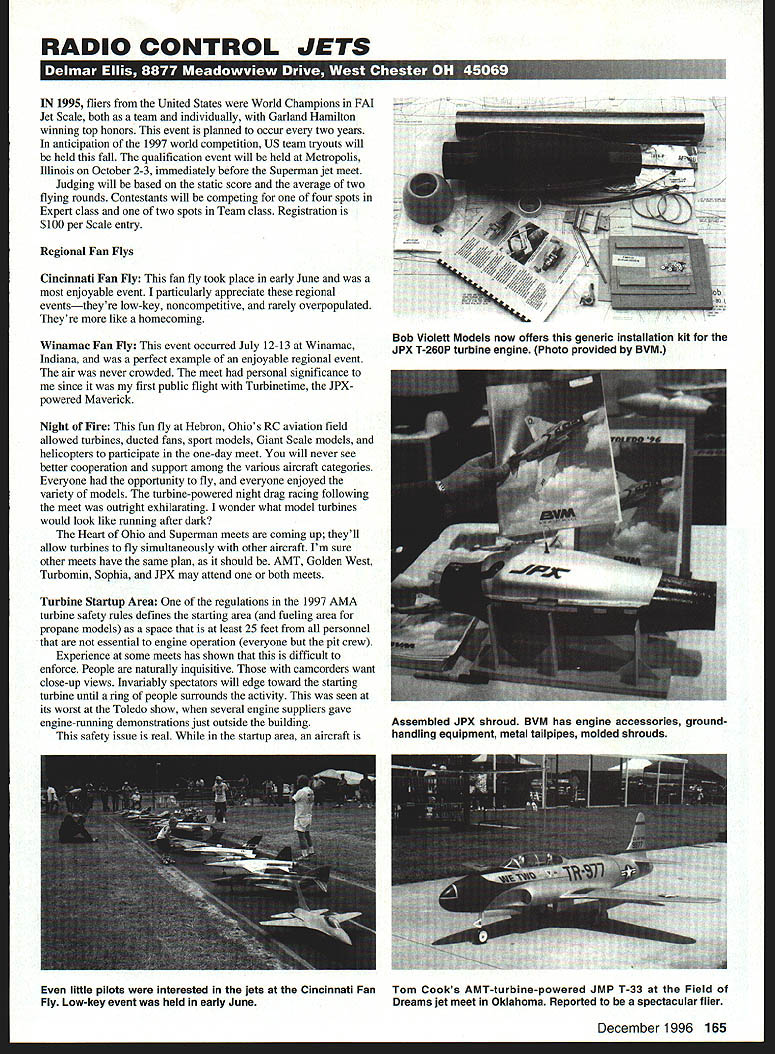
- Bob Violett Models (BVM) now offers a generic installation kit for the JPX T-260P turbine engine. BVM has assembled JPX shrouds and engine accessories, ground-handling equipment, metal tailpipes, and molded shrouds for pilots interested in jets.
- Tom Cook's AMT-turbine-powered JMP T-33 was seen at the Cincinnati Fan Fly. A low-key field fly held in early June showcased a variety of turbine models.
Turbine Engine Update
Sophia Engine
- More than 200 Sophia engines have been sold worldwide, with distribution in the U.S. Current advertising indicates ongoing availability.
- The engine burns a mixture of kerosene and white gasoline and produces approximately 12 pounds of thrust.
- The current configuration uses a small on-board nitrogen bottle to pressurize the metal fuel tank.
- A revision utilizing a variable fuel pump and alternate tanks is planned and is reported to be interchangeable with current engines.
JPX / BVM
- BVM announces immediate availability of the JPX T-260 engine in the U.S.; BVM is the exclusive distributor.
- The company offers an extensive line of engine accessories, ground-handling equipment, aircraft, and molded turbine shrouds with various metal tailpipes.
New Airframe: Bandit
- A new sport airplane called the Bandit should be demonstrated at Superman and may be introduced at Heart of Ohio.
- It is scaled to allow space for a turbine and a large fuel tank. Reports indicate it will be all-graphite, very quick, and especially aerobatic.
AMT / JMP
- Jet Model Products (AMT) and Tom Cook recently demonstrated the marriage of the AMT turbine and JMP's T-33. It flew at Field of Dreams with spectacular reports.
- The engine operated on a test stand at Turbine America; it started and performed flawlessly. JMP is the U.S. distributor for the AMT turbine.
Golden West
- Recent improvements in Golden West's engine increased thrust from about 7.5 to 8 pounds, in part due to a rotor-speed increase to 90,000 rpm.
- The factory reports safe operation has been demonstrated to speeds of at least 100,000 rpm.
- Each engine includes a fail-safe computer that senses and prevents overspeed—shutting off the fuel if 95,000 rpm is reached.
Transcribed from original scans by AI. Minor OCR errors may remain.

