
RADIO CONTROL JETS
Delmar Ellis, 8877 Meadowview Drive, West Chester OH 45069
JET PILOTS' Organization (JPO) Jet America Meet 1997
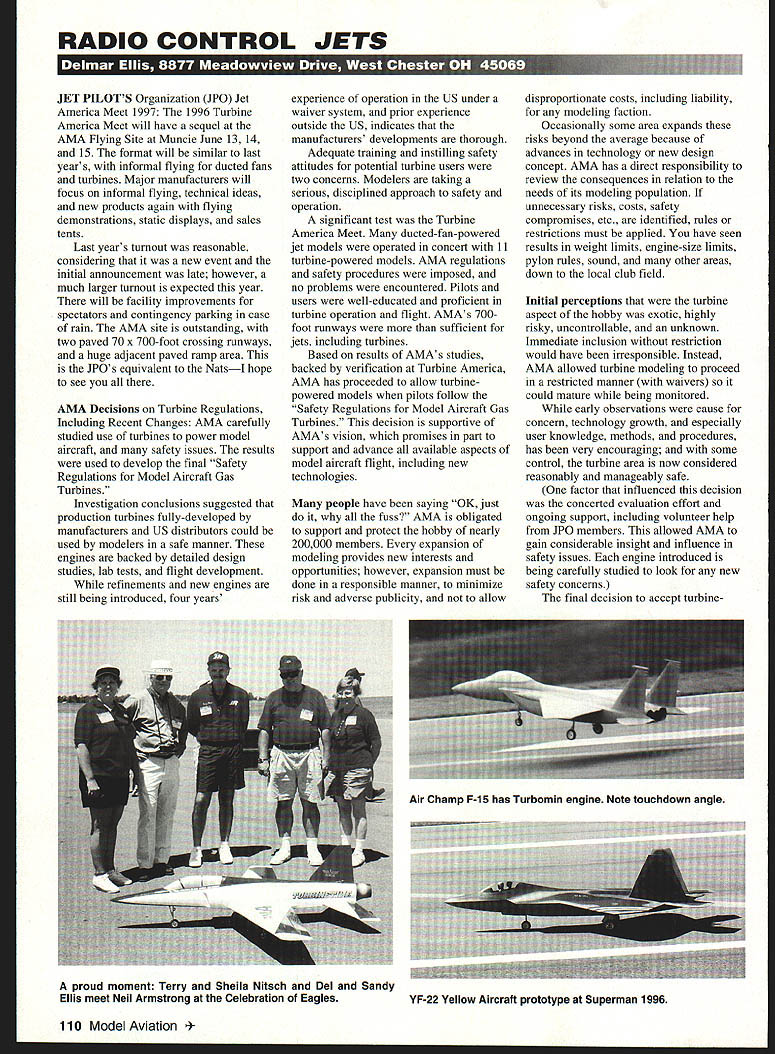
The 1996 Turbine America Meet will have a sequel. The JPO Jet America Meet will be at the AMA flying site at Muncie June 13, 14, and 15. The format will be similar to last year's, with informal flying for ducted fans and turbines. Major manufacturers will focus on informal flying, technical ideas, and new products again, with flying demonstrations, static displays, and sales tents.
Last year's turnout was reasonable, considering that it was a new event and the initial announcement was late; however, a much larger turnout is expected this year. There will be facility improvements for spectators and contingency parking in case of rain. The AMA site is outstanding, with two paved 70 x 700-foot crossing runways and a huge adjacent paved ramp area. This is the JPO's equivalent to the Nats—I hope to see you all there.
AMA Decisions on Turbine Regulations, Including Recent Changes
Background and findings
AMA carefully studied the use of turbines to power model aircraft and many related safety issues. The results were used to develop the final "Safety Regulations for Model Aircraft Gas Turbines."
Investigation conclusions suggested that production turbines fully developed by manufacturers and U.S. distributors could be used by modelers in a safe manner. These engines are backed by detailed design studies, lab tests, and flight development. While refinements and new engines are still being introduced, four years' experience of operation in the U.S. under a waiver system, and prior experience outside the U.S., indicate that the manufacturers' developments are thorough.
Adequate training and instilling safety attitudes for potential turbine users were two concerns. Modelers are taking a serious, disciplined approach to safety and operation.
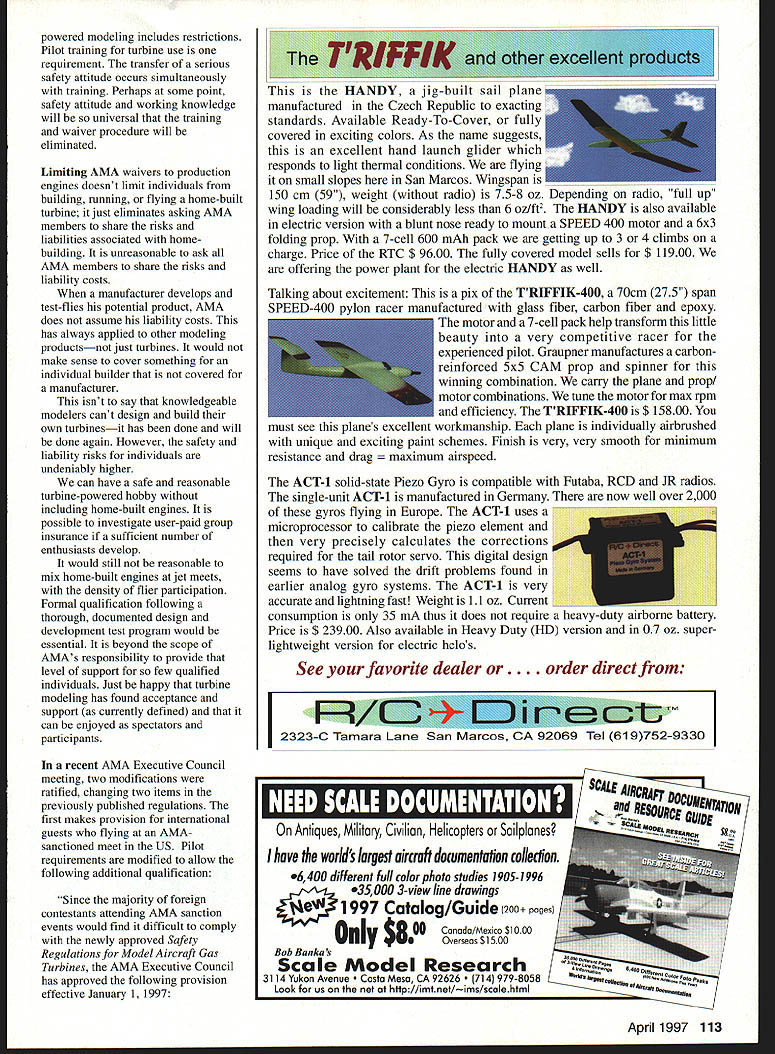
A significant test was the Turbine America Meet. Many ducted-fan-powered jet models were operated in concert with 11 turbine-powered models. AMA regulations and safety procedures were imposed, and no problems were encountered. Pilots and users were well-educated and proficient in turbine operation and flight. AMA's 700-foot runways were more than sufficient for jets, including turbines.
Based on results of AMA's studies, backed by verification at Turbine America, AMA has proceeded to allow turbine-powered models when pilots follow the "Safety Regulations for Model Aircraft Gas Turbines." This decision is supportive of AMA's vision, which promises in part to support and advance all available aspects of model aircraft flight, including new technologies.
Many people have been saying "OK, just do it, why all the fuss?" AMA is obligated to support and protect the hobby of nearly 200,000 members. Every expansion of modeling provides new interests and opportunities; however, expansion must be done in a responsible manner to minimize risk and adverse publicity, and not to allow disproportionate costs, including liability, for any modeling faction.
Occasionally some areas expand these risks beyond the average because of advances in technology or new design concepts. AMA has a direct responsibility to review the consequences in relation to the needs of its modeling population. If unnecessary risks, costs, safety compromises, etc., are identified, rules and restrictions must be applied. You have seen results in weight limits, engine-size limits, pylon rules, sound, and many other areas, down to the local club field.
Initial perceptions were that the turbine aspect of the hobby was exotic, highly risky, uncontrollable, and an unknown. Immediate inclusion without restriction would have been irresponsible. Instead, AMA allowed turbine modeling to proceed in a restricted manner (with waivers) so it could mature while being monitored.
While early observations were cause for concern, technology growth—and especially user knowledge, methods, and procedures—have been very encouraging; and with some control, the turbine area is now considered reasonably and manageably safe.
One factor that influenced this decision was the concerted evaluation effort and ongoing support, including volunteer help from JPO members. This allowed AMA to gain considerable insight and influence in safety issues. Each engine introduced is being carefully studied to look for any new safety concerns.
Waivers, training, and production engines
The final decision to accept turbine-powered modeling includes restrictions. Pilot training for turbine use is one requirement. The transfer of a serious safety attitude occurs simultaneously with training. Perhaps at some point, safety attitude and working knowledge will be so universal that the training and waiver procedure will be eliminated.
Limiting AMA waivers to production engines doesn't limit individuals from building, running, or flying a home-built turbine; it just eliminates asking AMA members to share the risks and liabilities associated with home-built engines. It is unreasonable to ask all AMA members to share the risks and liability costs.
When a manufacturer develops and test-flies his potential product, AMA does not assume his liability costs. This has always applied to other modeling products—not just turbines. It would not make sense to cover something for an individual builder that is not covered for a manufacturer.
This isn't to say that knowledgeable modelers can't design and build their own turbines — it has been done and will be done again. However, the safety and liability risks for individuals are undeniably higher.
We can have a safe and reasonable turbine-powered hobby without including home-built engines. It is possible to investigate user-paid group insurance if a sufficient number of enthusiasts develop.
It would still not be reasonable to mix home-built engines at jet meets with the density of flier participation. Formal qualification following a thorough, documented design and development test program would be essential. It is beyond the scope of AMA's responsibility to provide that level of support for so few qualified individuals. Just be happy that turbine modeling has found acceptance and support (as currently defined) and that it can be enjoyed as spectators and participants.
Recent modifications to the regulations
In a recent AMA Executive Council meeting, two modifications were ratified, changing two items in the previously published regulations.
- International guests: Pilot requirements are modified to allow the following additional qualification:
"Since the majority of foreign contestants attending AMA-sanctioned events would find it difficult to comply with the newly approved Safety Regulations for Model Aircraft Gas Turbines, the AMA Executive Council has approved the following provision effective January 1, 1997:"
AMA will accept a letter from the National Aero Club stating that the pilot is qualified and experienced in operating a model powered by a turbine engine on the accepted AMA list. The pilot recognizes only certain engines are accepted for use in events in the U.S. For a current status, call 1-765-287-1256 and ask for extension 250.
- Airframe/installation wording: The following regulation is substituted for the original in Paragraph 8:
"Engine installation must be designed with attention to duct/flowpath and the integration of related equipment and fire containment/suppression at start-up."
This revision allows more leniency in aircraft selection, while maintaining proper focus on engine installation and integration.
Gas turbine afterburners
Several people have asked for clarification of the regulation eliminating afterburners. Simulation of smoke trails in the exhaust stream is of particular interest. Smoke trails are common in sport and Giant Scale models, and in some ducted fans.
Smoke trails are easily accomplished using commercially available smoke oil, or homebrewed mixtures of used auto transmission oil and kerosene.
The AMA Safety Committee was asked to clarify limitations with turbines. Officially, any combustible fluid ingested into the turbine exhaust nozzle is unacceptable. Any other attempt at ingesting material into the tailpipe duct should also be approached cautiously. The major concern is flammable fluid combustion, with burning occurring where ducting and aircraft materials will not withstand resulting temperatures. Any combustion of flammable liquids outside the turbine combustor is considered an afterburner and is prohibited, regardless of whether flameholders are incorporated.
AMA will test and investigate various configurations for safety and to see if any non-flammable fluids provide a visible vapor trail.
Transcribed from original scans by AI. Minor OCR errors may remain.

