
RADIO CONTROL: JETS
By Delmar Ellis
Delmar Ellis, 8877 Meadowview Drive, West Chester, OH 45069
Jet flying reaches new heights in late summer and fall. Two outstanding jet meets in the Midwest are famous for their level of activity, quality of participation, and new product introductions: Heart of Ohio in late August and Superman in early October. Rather than review the meets, I’ll discuss the new products shown at them; my next report will present some of the individual entries.
RA Microjet (RAM)
Turbomin USA in Florida has been renamed RA Microjet, or RAM. The company will still distribute Turbomin engines and is introducing a new line of turbine engines produced in the U.S.
The new RAM turbine is offered in two versions (13 or 17 pounds of thrust). The difference is in the controller settings; if you buy both controllers, you can vary thrust settings on the same engine for different-weight aircraft. The price is less than $2,600 and deliveries were scheduled to start in November 1997.
At Heart of Ohio the RAM turbine was demonstrated on a bench test. After 75 starts and runs, witnesses were convinced about the ease of operation and reliability of the engine; it starts on propane and switches to Jet A or kerosene. Controls are simple and safety features are built in.
Prior to Superman, RAM received formal approvals from the Academy of Model Aeronautics (AMA) for the turbine. At Superman the engine was demonstrated in a Bob Violett Models Bandit; Garland Hamilton conducted the demonstration flights. Performance of this engine/aircraft combination was remarkable—the aircraft already had superior aerobatic performance, and speed was blazing with the engine. Even the usually unflappable Garland was visibly excited. We all might want one!
AMT
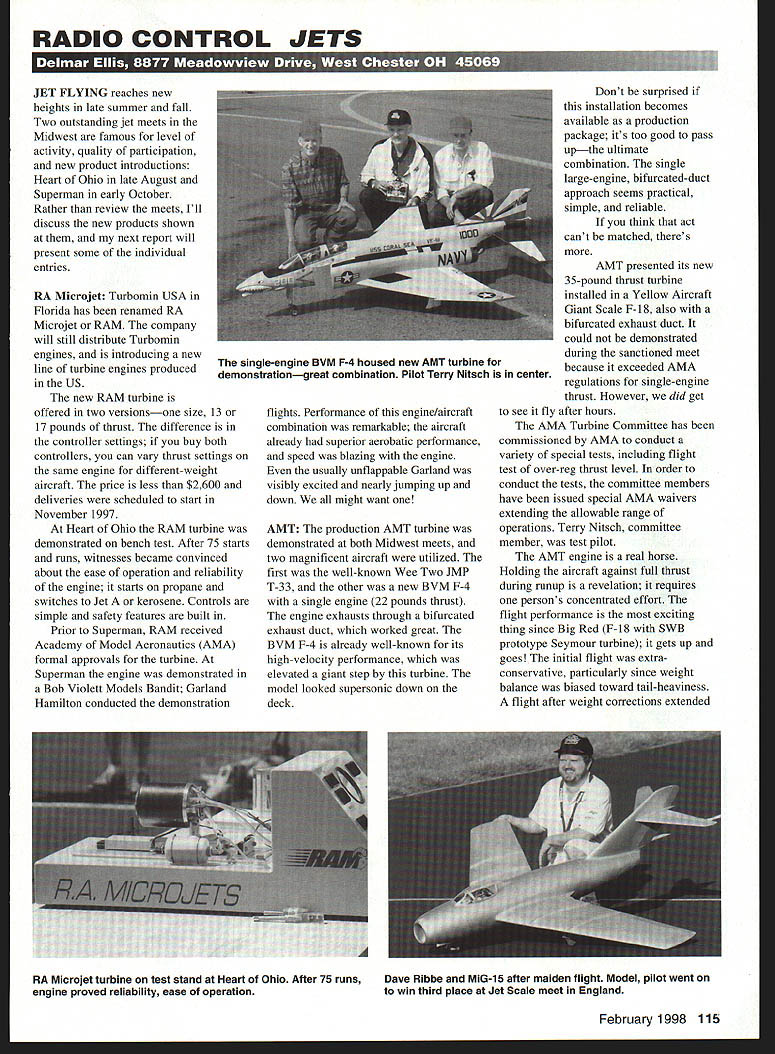
The production AMT turbine was demonstrated at both Midwest meets, installed in two magnificent aircraft. The first was the well-known Wee Two JMP T-33, and the other was a new BVM F-4 with a single engine producing 22 pounds of thrust. The engine exhausts through a bifurcated exhaust duct, which worked great. The BVM F-4 is already known for its high-velocity performance; this turbine was a giant step forward. The model looked supersonic down on the deck.
Don’t be surprised if this installation becomes available as a production package—it’s too good to pass up. The single large-engine, bifurcated-duct approach seems practical, simple, and reliable.
If you think that act can’t be matched, there’s more. AMT presented its new 35-pound-thrust turbine installed in a Yellow Aircraft Giant Scale F-18, also with a bifurcated exhaust duct. It could not be demonstrated during the sanctioned meet because it exceeded AMA regulations for single-engine thrust. However, we did get to see it fly after hours.
The AMA Turbine Committee has been commissioned to conduct a variety of special tests, including flight tests of over-regulation thrust levels. To conduct the tests, committee members have been issued special AMA waivers extending the allowable range of operations. Terry Nitsch, a committee member, was test pilot.
The AMT engine is a real horse. Holding the aircraft against full thrust during runup is a revelation; it requires concentrated effort. The flight performance is the most exciting thing since Big Red (F-18 with SWB prototype Seymour turbine); it gets up and goes! The initial flight was extra-conservative, particularly since weight balance was biased toward tail-heaviness. A subsequent flight after weight corrections extended the range of evaluation.
Future AMA testing will evaluate total performance-range characteristics. Engine and aircraft operation and safety were flawless. It is similar to going hunting with an elephant gun—what firepower! The question is, should this be for everyone?
One other item announced by AMT: a new, compact turbine engine in the 15–16 pound thrust range is under development. Production engines are projected to be available in April or May 1998.
Turbine Scene
With the introduction of the new RAM and the pending AMT engines, the turbine scene is expanding and getting better, and costs are coming down.
Other engines at the meets included:
- Golden West
- JPX
- Sophia
The shocker was that of 182 pilots with more than 200 aircraft at Superman, approximately one-third of the aircraft were turbine-powered. All of the jets are exciting, but turbines certainly raise the level.
Meet management and ground control are getting more complicated—especially pit operations. AMA will review safety requirements; no problems occurred in the pits at Superman, but discipline will need to be maintained. One crash did produce a contained fire when an engine broke off its mount and crushed an aluminum fuel tank containing a kerosene/gasoline mixture.
Century Jet Models
At Heart of Ohio, Century displayed its new F-104 and F-105 scale models; kits will be available soon. The F-105 actually flew there, and the F-104 achieved an abbreviated liftoff at Superman but flight was aborted because of a center-of-gravity problem.
Their F-4 twin had a flight mishap at Heart of Ohio and was rebuilt by the time of Superman as the E model (nose revision). If anything, this revision was quicker than the previous one. New model news from Century will be announced in the next report.
Bob Violett Models
Along with the usual Bandits, Mavericks, P-80s, and magnificent F-4s at Superman, a large MiG-15 was introduced. The prototype was flown impressively by Dave Ribbe and awarded Best Scale; it flew in the 150-mph range and looked rock-solid.
FAI International Jet Scale Meet
Dave Ribbe developed the MiG-15 design and prototype over the previous two years and entered it in the worldwide Jet Scale Meet in England, where he earned a third-place finish. Congratulations to Dave—it's a great accomplishment! I was privileged to attend the maiden flight of this model, which was an exciting and successful occasion.
Other U.S. competitors did not fare so well at the meet; there were many compromising circumstances, some of which will be dealt with in advance of future international competition. It's too bad, because the level of competition was keen and would have been entertaining.
CAI
CAI is a new modeling company led by Scotty Bolduc. The corporation exhibited immediate expertise and preparation with a high-speed sport airplane—the Razor. It’s explicitly prepared for turbines such as Sophia and JPX.
Flight demonstrations with a Sophia engine were impressive, showing very competitive speed and aerobatic performance. CAI’s other products include turbine shrouds, ducts, and a new ECU fuel pump system for Sophia and other turbines.
Transcribed from original scans by AI. Minor OCR errors may remain.

