
RADIO CONTROL JETS
Delmar Ellis, 8877 Meadowview Drive, West Chester, OH 45069
GROUND SUPPORT: Don't you forget it!
The most important ground support for your flying hobby (jets or otherwise) is the consent and support of your spouse.
You may have noticed model flying is a predominantly male avocation. Her understanding and approval of the time, financial commitment, and intense focus required to fly jets borders on veto power. If you have your wife's approval, consider yourself blessed. If she participates openly, you are doubly blessed.
I thought I lost my wife's support just as I was making the transition to jets. Our club had invited Terry Nitsch to put on a jet-flying demonstration, and (under pressure) Sandy agreed to attend and witness firsthand this jet thing about which I talked endlessly. Terry's wife Sheila came as his ground support. She removed the model from the van, took off the wing mittens, wiped it down (it was already spotless), then informed Terry that he could fuel it. They started it together. Sheila carried it out, spotted it on the runway, and became backup person during the flight. After landing, Terry returned the radio to the impound while Sheila retrieved the model, inspected it, and wiped it down again.
Jean Famey tapped Sandy on the arm and announced, "Now Mrs. Del, that's your new job." I was sure my cause had just become hopeless, but I never lost her support and approval. Believe me, I do recognize my very special blessing.
I see some of these special wives at the Fun-Flys. Not all become pit crew and spotters like Sheila and Sandy. Any of the ladies who pack up, attend meets, are supportive, and share in the time away from home deserve special recognition. Those who bring the kids for the weekend must really be saints.
In this season of love and gift giving, don't forget your spouse—your most important supporter in all of life. Maybe you could give her a new radio, or a set of those great-looking scale wheels with the built-in brakes—or her own model.
Gas Turbine Development
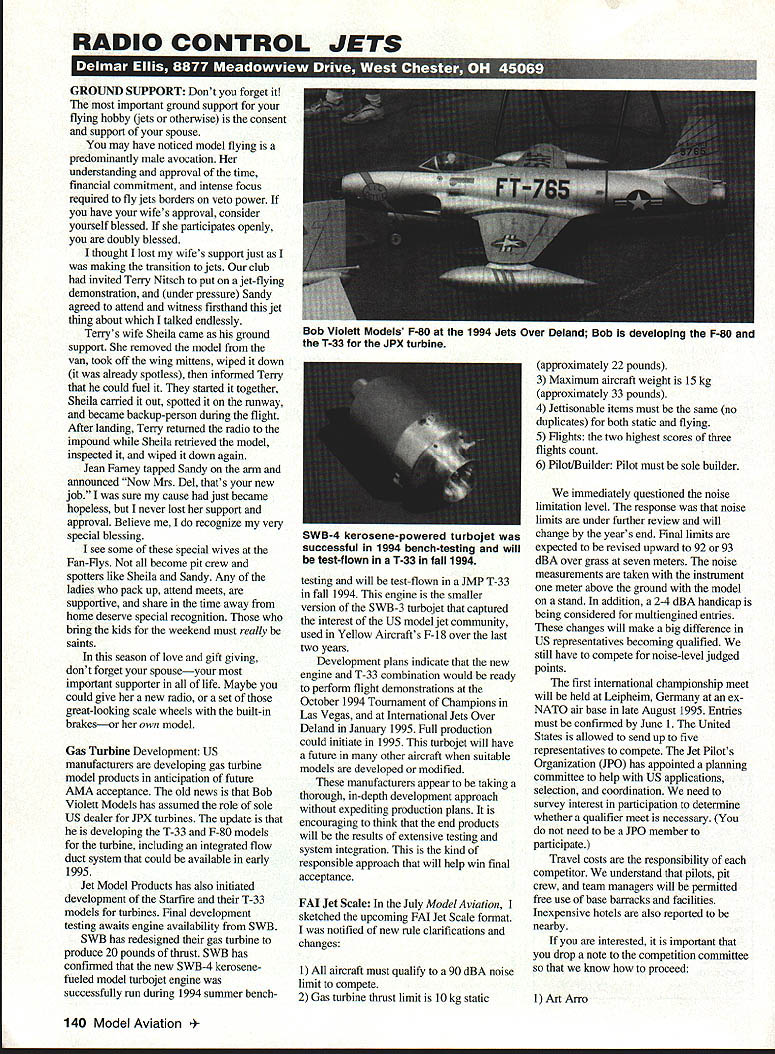
U.S. manufacturers are developing gas turbine model products in anticipation of future AMA acceptance. The old news is that Bob Violett Models has assumed the role of sole U.S. dealer for JPX turbines. The update is that he is developing the T-33 and F-80 models for the turbine, including an integrated flow duct system that could be available in early 1995.
Jet Model Products has also initiated development of the Starfire and the T-33 models for turbines. Final development testing awaits engine availability from SWB.
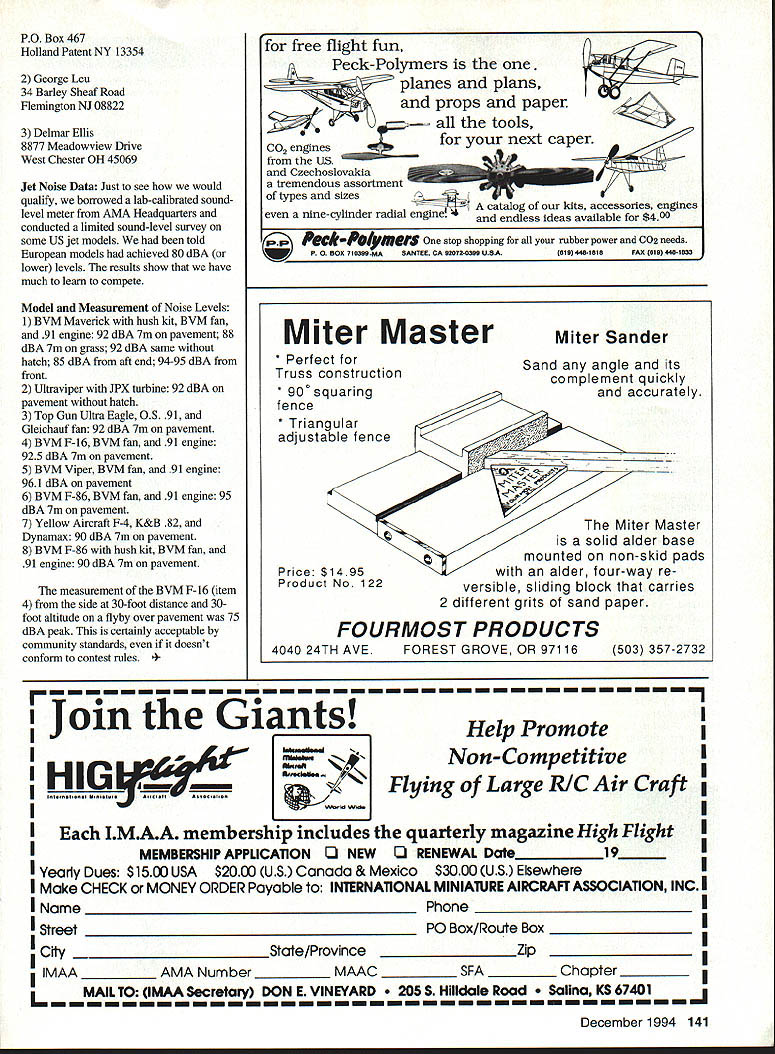
SWB has redesigned their gas turbine to produce 20 pounds of thrust. SWB has confirmed that the new SWB-4 kerosene-fueled model turbojet engine was successfully run during 1994 summer bench-testing and will be test-flown in a JMP T-33 in fall 1994. This engine is the smaller version of the SWB-3 turbojet that captured the interest of the U.S. model jet community used in Yellow Aircraft's F-18 over the last two years.
Development plans indicate that the new engine and T-33 combination would be ready to perform flight demonstrations at the October 1994 Tournament of Champions in Las Vegas, and at International Jets Over Deland in January 1995. Full production could initiate in 1995. This turbojet will have a future in many other aircraft when suitable models are developed or modified.
These manufacturers appear to be taking a thorough, in-depth development approach without expediting production plans. It is encouraging to think that the end products will be the results of extensive testing and system integration. This is the kind of responsible approach that will help win final acceptance.
FAI Jet Scale
In the July Model Aviation, I sketched the upcoming FAI Jet Scale format. I was notified of new rule clarifications and changes:
- All aircraft must qualify to a 90 dBA noise limit to compete.
- Gas turbine thrust limit is 10 kg static (approximately 22 pounds).
- Maximum aircraft weight is 15 kg (approximately 33 pounds).
- Jettisonable items must be the same (no duplicates) for both static and flying.
- Flights: the two highest scores of three flights count.
- Pilot/Builder: Pilot must be sole builder.
We immediately questioned the noise limitation level. The response was that noise limits are under further review and will change by the year's end. Final limits are expected to be revised upward to 92 or 93 dBA over grass at seven meters. The noise measurements are taken with the instrument one meter above the ground with the model on a stand. In addition, a 2–4 dBA handicap is being considered for multi-engined entries. These changes will make a big difference in U.S. representatives becoming qualified. We still have to compete for noise-level judged points.
The first international championship meet will be held at Leipheim, Germany, at an ex-NATO air base in late August 1995. Entries must be confirmed by June 1. The United States is allowed to send up to five representatives to compete. The Jet Pilot's Organization (JPO) has appointed a planning committee to help with U.S. applications, selection, and coordination. We need to survey interest in participation to determine whether a qualifier meet is necessary. (You do not need to be a JPO member to participate.)
Travel costs are the responsibility of each competitor. We understand that pilots, pit crew, and team managers will be permitted free use of base barracks and facilities. Inexpensive hotels are also reported to be nearby.
If you are interested, it is important that you drop a note to the competition committee so that we know how to proceed:
- Art Arro
P.O. Box 467 Holland Patent, NY 13354
- George Leu
34 Barley Sheaf Road Flemington, NJ 08822
- Delmar Ellis
8877 Meadowview Drive West Chester, OH 45069
Jet Noise Data
Just to see how we would qualify, we borrowed a lab-calibrated sound-level meter from AMA Headquarters and conducted a limited sound-level survey on some U.S. jet models. We had been told European models had achieved 80 dBA (or lower) levels. The results show that we have much to learn to compete.
Model and measurement of noise levels:
- BVM Maverick with hush kit, BVM fan, and .91 engine: 92 dBA at 7 m on pavement; 88 dBA at 7 m on grass; 92 dBA same without hatch; 85 dBA from aft end; 94–95 dBA from side.
- Ultraviper with JPX turbine: 92 dBA on pavement without hatch.
- Top Gun Ultra Eagle, O.S. .91, and Gleichauf fan: 92 dBA at 7 m on pavement.
- BVM F-16, BVM fan, and .91 engine: 92.5 dBA at 7 m on pavement.
- BVM Viper, BVM fan, and .91 engine: 96.1 dBA on pavement.
- BVM F-86, BVM fan, and .91 engine: 95 dBA at 7 m on pavement.
- Yellow Aircraft F-4, K&B .82, and Dynamax: 90 dBA at 7 m on pavement.
- BVM F-86 with hush kit, BVM fan, and .91 engine: 90 dBA at 7 m on pavement.
The measurement of the BVM F-16 (item 4) from the side at 30-foot distance and 30-foot altitude on a flyby over pavement was 75 dBA peak. That is certainly acceptable by community standards, even if it doesn't conform to contest rules.
Transcribed from original scans by AI. Minor OCR errors may remain.

