
Radio Control: Jets
Delmar Ellis, 8877 Meadowview Drive, West Chester OH 45069
AMT MERCURY:
The AMA Turbine Committee just got its first opportunity to observe and run AMT's new Mercury 15.5-pound-thrust turbine. It is a definite winner. Starting ease and simplicity is assured by the ECU controller, including all previous safety features. Accel/decel rate 2–2.5 seconds limit-to-limit, with absolute smooth steadiness throughout. Max fuel consumption is seven ounces per minute at full throttle. This engine is definitely a desirable propulsion package.
Data and application for AMA recognition as a production engine has already been submitted.
Our testbed aircraft, Turbinetime, will get a new lease on life with increased thrust when this engine arrives. Production deliveries are anticipated to initiate about April or May.
CAI-Sophia Turbines:
CAI and Scotty Balduc are working closely with Sophia USA to launch a CAI ECU-controlled production version of the current Sophia turbine. Data is being prepared for submittal to AMA. Our Turbine Committee will be testing this engine version in just two weeks (as this is written). Preliminary data on the controller and pump looks very promising.
Sophia is currently offering its engine with a new ECU system from Germany. We will be testing this version as well. The engine produces 13 pounds of thrust with either system and is priced in the mid-$3,000 range.
AMA Turbine Test Programs:
In addition to evaluating new production engines, our Turbine Committee has been commissioned to conduct three experimental programs regarding turbines:
- Twin turbine installation: We are installing two Sophia turbines with CAI controllers in a Yellow Aircraft F-18 to evaluate the complexities of multiple-engine operation.
- 35-pound-thrust operation: We are examining the safety issues regarding single-engine increased thrust. We are fortunate in being offered access to AMT's 35-pound-thrust Olympus engine installed in a Yellow Aircraft F-18. Initial experience was mentioned in the last "RC Jets" column.
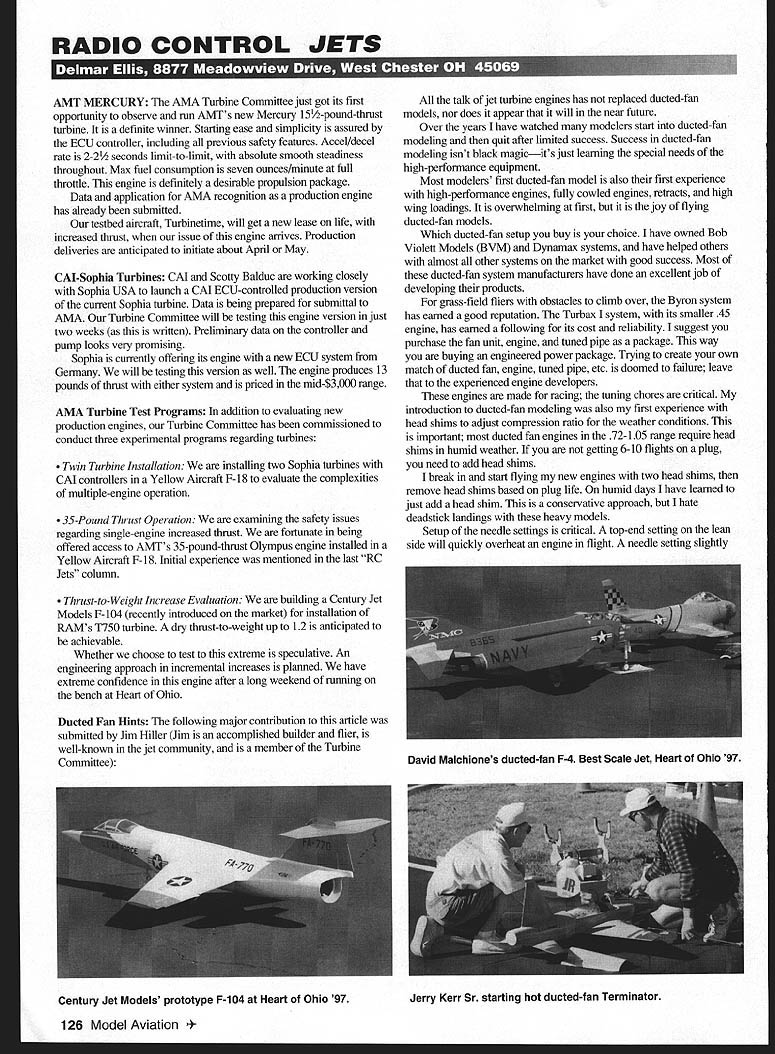
- Thrust-to-weight increase evaluation: We are building a Century Jet Models F-104 (recently introduced on the market) for installation of RAM's T750 turbine. A dry thrust-to-weight ratio up to 1.2 is anticipated to be achievable.
Whether we choose to test this extreme is speculative. An engineering approach in incremental increases is planned. We have extreme confidence in this engine after a long weekend of running on the bench at Heart of Ohio.
Ducted Fan Hints:
The following major contribution to this article was submitted by Jim Hiller (Jim is an accomplished builder and flier, is well-known in the jet community, and is a member of the Turbine Committee):
All the talk of jet turbine engines has not replaced ducted-fan models, nor does it appear that it will in the near future.
Over the years I have watched many modelers start into ducted-fan modeling and then quit after limited success. Success in ducted-fan modeling isn't black magic — it's just learning the special needs of high-performance equipment. Most modelers' first ducted-fan model is also their first experience with high-performance engines, fully cowled engines, retracts, and high wing loadings. It is overwhelming at first, but it is the joy of flying ducted-fan models.
Recommendations and tips:
- Purchase a matched power package: Buy the fan unit, engine, and tuned pipe as a package so you are getting an engineered power package. Trying to match fan, engine, and tuned pipe yourself is likely to fail; leave it to experienced engine developers. Engines made for racing have tuning chores critical to their introduction.
- Head shims: Ducted-fan modeling is often the first experience with head shims to adjust compression ratio for weather conditions. This is important; most ducted-fan engines in the .72–.105 range require head shims in humid weather. Expect to get 6–10 flights on a plug; you may need to add head shims. My conservative approach: break in and start flying new engines with two head shims, then remove shims based on plug life. On humid days add a shim—it's conservative but helps avoid deadstick landings with heavy models.
- Needle settings: Proper setup of needle settings is critical. A top-end setting on the lean side will quickly overheat an engine in flight. A needle setting slightly on the rich side of peaked will develop as much power and will not overheat. Idle needle setting is more sensitive on these engines; take your time. An idle setting with the engine hatch off may not be right with it on—be patient and get it right.
- Idle test hint: At idle, pinch the fuel line and listen to the engine as it quits. When rich, it will speed up as it quits; when lean, the engine will slowly wind down in RPM. Do your final test with the engine hatch on.
- Mixture control: Mixture control is a great option. I flew reliably for two years without it, then installed one and now won't build a model without it. It is particularly useful if you have a limited runway with obstacles to clear after takeoff. The ability to tweak the needle for takeoff power, then richen the mixture as fuel burns, keeps maximum power available for the whole flight (ducted-fan engines tend to lean out as fuel burns off). Not necessary, but highly recommended.
- Fuel and plugs: Most of these engines require fuel with high oil content due to higher RPMs and temperatures. I strongly advise against running them on anything less than the recommended fuels. Glow plugs for these high-compression engines have specific requirements—use the plug recommended by the power system manufacturer. I use McCoy MC-9 and K&B HP plugs; others prefer McCoy MC-9 and Rossi plugs. Follow manufacturer recommendations.
- Model selection and field suitability: Determine your needs before choosing a kit. Not all ducted-fan models are suitable for grass-field operation; some have 45–60-ounce wing loadings with only 2 1/4-inch-diameter tires. If you plan to fly from grass regularly, look into designs with more reasonable wing loading. The Regal Eagle, Eagle, and similar designs have proven effective on grass. My opinion, though, is that since full-scale jets fly from paved runways, my models fly from paved runways.
- Pilot technique after takeoff: Ducted-fan thrust at low speeds is less than a propeller's thrust (but greater at high speeds), and jets often have low-aspect-ratio wings that do not climb well at low airspeeds. After takeoff, level off and gain airspeed before attempting to climb. Hanging on the elevator to climb will get you behind the power curve and may prevent clearing obstacles. I suggest at least a 500-foot runway and 800 feet to the nearest tree line for test flights—being conservative greatly increases your chances of success.
- Landing: Expect higher landing speeds due to higher wing loadings (most ducted-fan models have 44–60 ounces per square foot wing loading). Fly by watching angle of attack rather than airspeed if you can. These higher landing speeds are another reason to perform test flights on the longest paved runway available.
- Testing support and community: I often drive three hours to RC Aviation Country Club to test-fly models because they have a long paved runway. Experienced ducted-fan modelers, such as Jerry Kerr Jr., can be invaluable at test flights. Even after many years of ducted-fan modeling, take test flights seriously.
When the bug bites to join ducted-fan modeling, contact the Jet Pilot's Organization (JPO). JPO is a Special Interest Group dedicated to promoting ducted-fan and jet modeling. Any of the officers can help you get in touch with local ducted-fan modelers who can help you with the learning curve.
Transcribed from original scans by AI. Minor OCR errors may remain.

