
RADIO CONTROL JETS
Delmar Ellis, 8877 Meadowview Drive, West Chester, OH 45069
AMA TURBINE RULE CHANGE
In October 1998, AMA's Executive Council approved the AMA Safety Committee's recommendations to allow thrust increase for single-turbine engines. The new rule reads:
"Total aircraft static thrust shall not exceed 35 pounds regardless of the number of engines. The static thrust to dry weight ratio of the aircraft must be within 0.5 to 0.9."
This means that a whole new generation of turbine engines and attendant large model aircraft will be upon us, starting this year. The AMT Olympus, rated at 35 pounds thrust, is available, and the new Golden West/Turbomin 1000 turbine, rated at 34 pounds thrust, will be available. By the time you read this, both engines will probably be AMA-recognized.
We have all done well in keeping safety oriented. As a result, we have been entrusted with greater power. Let's enjoy it and keep that trust!
Turbine Inlets and Ducts
By evaluating turbine engines and watching them perform at the field, I am beginning to comprehend the importance and consequences of inlet and duct design.
As an engineer, I have available the equations with which to properly size flow fields. This column is not intended to be that technical. But looking at the flying experiences, one gets a grasp of the significance of relative design values.
The first illustration was the JPX engine in the F-16 at Top Gun 1993. The ducting was open-fuselage, and even with a sort of sized aft nozzle opening, net power was extremely marginal. Still, it was most memorable, and certainly a benchmark occasion. It was the real initiation of the model turbine movement in the U.S.
The same engine in Kent Nogy's Viper (a noticeably cleaner airframe) demonstrated very strong performance and a top speed well above 200 mph only slightly more than a year later.
The BVM (Bob Violett Models) philosophy of area ruling and flowpath analytical sizing was applied. The results were an undeniable jump in available power and performance.
The Turbine Committee saw the same type of result before and after design improvements were incorporated into the tailpipe of the Golden West-powered Terminator. Closing tailpipe diameters to the proper dimensions increased installed power appreciably.
As you observe all of the turbine installations at the meets, you might begin to notice different levels of performance. Sometimes this is true even with different installations of the same engine and aircraft.
Overall, turbines are exciting — they sound right, they pack a lot of power in a small package, and they offer performance exceeding fans — except, perhaps, on takeoff. It just seems that some installations are more optimally designed and deliver better results. You can easily distinguish the real performers.
For instance, all BVM models with factory ducting are representative. Their airplanes are already designed for speed; their ducting, shrouds, and inlets are also optimized.
Crow Aviation, Inc.'s fleet of sport airplanes shows the same attention to design detail resulting in performance. The JPX installation on the BVM Maverick used the standard fan inlet mated to an oversized shroud followed by a well-made tailpipe sized to JPX factory specifications. Power on takeoff and climbout was very strong. Top speed seemed limited primarily because the oversized inlets resulted in drag. The Maverick is no slouch; top speed in level flight was between 175–180 mph. Speeds in a dive were significantly higher. In this case the results were good on an airframe designed to sustain speeds with a three- to four-pound heavier turbine fuel load.
Airframe loads were way up in turns, and it takes discipline to fly a jet model. If you were to jerk around turns like a real jet, a model helps keep loading within marginal design limits. In this configuration pilots' skills were also limited; the ability to just keep up with speed was an unrecognized blessing. At lower speeds the installation design was self-regulating; the extra drag offset the power.
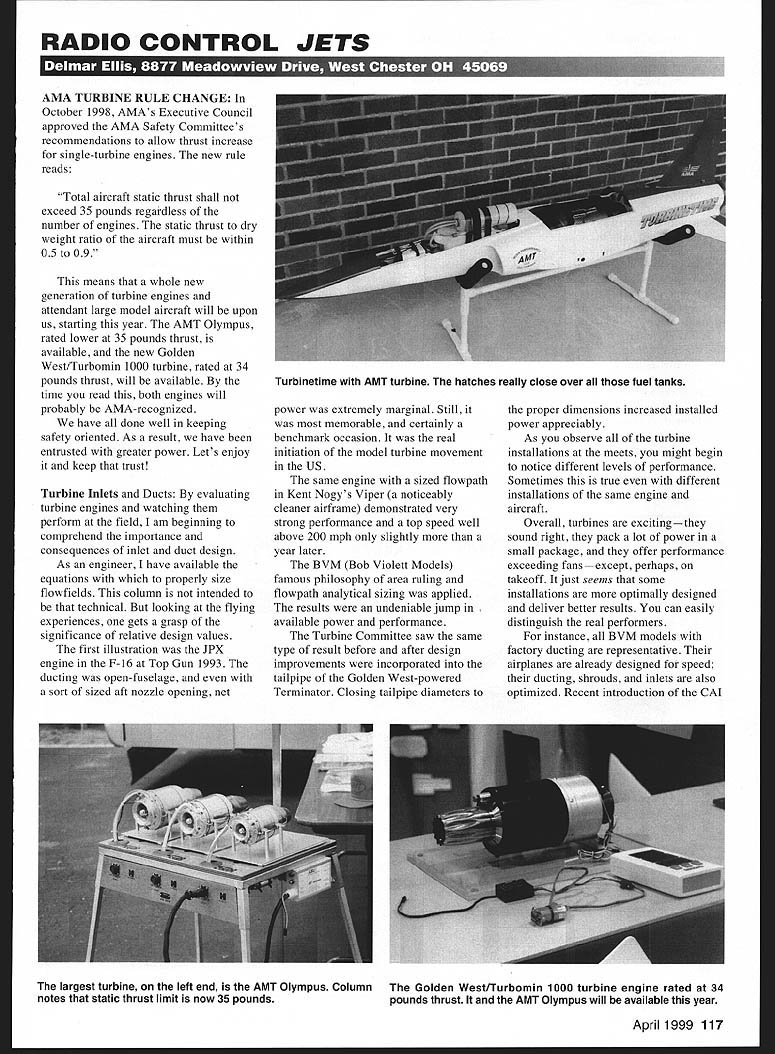
At higher speeds the old Turbinetime Maverick, resurrected with the AMT Mercury turbine, is now flying with a new tailpipe designed, fabricated, and installed at the AMT U.S. factory. Static thrust is now up: JPX's 12 pounds, AMT's 15 pounds. Dry weight is now well above 17 pounds, leading me to believe old readings of the JPX were on the low side — never trust cheap spring scales. You can bet Maverick's performance is up, up. Takeoff is like a drag racer — 0–60 mph in about 2 seconds. Climbout is vertical right after retracting gear and flaps. Boy, exciting! Top speed in flat level flight is 180–185 mph. That's a significant increase; the increased power quickly overcomes the drag penalty of large inlets, resulting in marginally lower drag overall. (BVM might debate that; he has the facts.)
The Bandit does have optimized smaller inlets, while both have the same factory-optimized tailpipes. The Maverick can out-accelerate and out-climb the Bandit, but the Bandit can outrun the Maverick. For my case, the Maverick limitations are perfect. I couldn't handle more speed, and neither could its fan-duct-designed airframe.
Tailpipe sizing reduces unnecessary thrust loss. Larger inlets induce extra drag, limiting top speed, but not vertical performance. If you need the speed, optimize everything and design for the speed and resulting loads. If you are converting ducted-fan models, large inlets inhibit excessive speeds, but that's not all bad — it can make a model more manageable.
The Maverick makes a superior airplane for us average fliers. Fifty-six ounces of fuel result in 6-1/2–7 minutes of flight time. That is mostly at 1/2–2/3 throttle, producing 140–160 mph speeds. (I bet BVM could fit his conformal fuel tanks and provide a few additional ounces of fuel.)
It seems safe, and sure would be popular. I hope to show the "new" Turbinetime to you sometime this year.
Transcribed from original scans by AI. Minor OCR errors may remain.

