

RADIO CONTROL JETS
Delmar Ellis, 8877 Meadowview Drive, West Chester, OH 45069
Mixing Jets with Other Aircraft
It always amazes me to watch model aircraft with drastically different flight characteristics mixing on the same flight line. Most of the time it works out without incident.
One of the less-compatible combinations is helicopters and fixed-wing aircraft. Model helicopters do astounding maneuvers, many of which make the helicopters seem to be stationary — right in the main straightaway. Most fixed-wing pilots seem to compensate without complaint, and helicopter pilots seem to have incredible instincts for last-minute avoidance.
Different kinds of fixed-wing aircraft also show variance in flight characteristics and resulting use of airspace. Pattern models fly in their "box" and the pilot is devastated if he has to interrupt his routine for flight avoidance (and rightfully so).
A new aircraft type called Gremlins has become popular at our field. They do close-in combat, and it's almost like flying with helicopters when they are going at it. Once I accidentally cut off a streamer when flying through a gaggle of Gremlins.
It all seems to boil down to common courtesy and respect for the special interests of others. Fortunately, at my local club the intermingling has worked well.
Introducing Jets at Our Field
When we introduced jets at our local field during the last two years I was apprehensive. What would everyone's reaction be to our high-speed passes at 150–200 miles per hour, and our undeniable urge to land when these things quickly run dry?
The results to date are amazing! Everyone else lands, and no one flies when the jets are up and at it. Maybe the novelty hasn't worn off, or maybe it is purely fear of being blindsided by an incoming missile.
This actually imposes a responsibility on the jet pilots: we owe the other pilots similar courtesy. I try to wait for a break in the action and light up when the field is inactive. No one has accused us of hogging the frequency too long — we just don't carry the fuel to do that. (Actually, ground runup time may be longer while dialing in the engine.) The only complaint I ever received was about the blasted noise while still in the pits.
Our jets still receive plenty of attention and interest at our field. We even get a round of applause occasionally when we make it in safely on our short runway.
All you jet enthusiasts out there: don't forget you represent our special jet interest, and it's our responsibility to be thoughtful and courteous. It is one of modeling's rewards to share and receive friendly acceptance with each other.
Ode to Jet Models
Did you ever see a prettier sight Than a streaking model jet in midflight? It climbs with power and fears no heights. It arches through the sky in endless curves. It challenges the pilot and tests his nerves. Its roar becomes a whine when it screams down the line. It takes your breath away; it sure did mine.
If you can hold your breath without passing out Then flying jets is what it's all about. It is maximum excitement in the shortest time.
It's art; it's beauty, it's grace sublime. If this isn't enough, don't vacillate or teeter-totter. Gas turbines are coming and they are even hotter.
(My wife promises she will never tell who wrote this.)
Going to Jet Meets
We mentioned the educational value of going to jet meets in previous articles. It is an essential way to see and evaluate which models you like, and to find out how to solve those things that can hold up your building. You can also make friends who can offer invaluable advice.
I just got back from the Superman Fan Fly in Metropolis, Illinois. It reminded me of the fun and rewards in participating in a jet meet. We had several participants from our Cincinnati clubs, where in the past only one or two had flown at the major meets.
Flying at such a major meet with more than 120 pilots and seven active flying stations is an exciting challenge — especially for the newcomer. It is a real test of courage and concentration. The successful result improves your self-confidence and inspires further self-development. You can't help being self-conscious when you realize you are flying in the presence of the great national figures in jet modeling. I still get that feeling after two short years of participation.
In addition to a great flying experience, the whole weekend was outstanding. It's easy to make and renew friendships with everyone. Jet modelers aren't bashful or withdrawn.
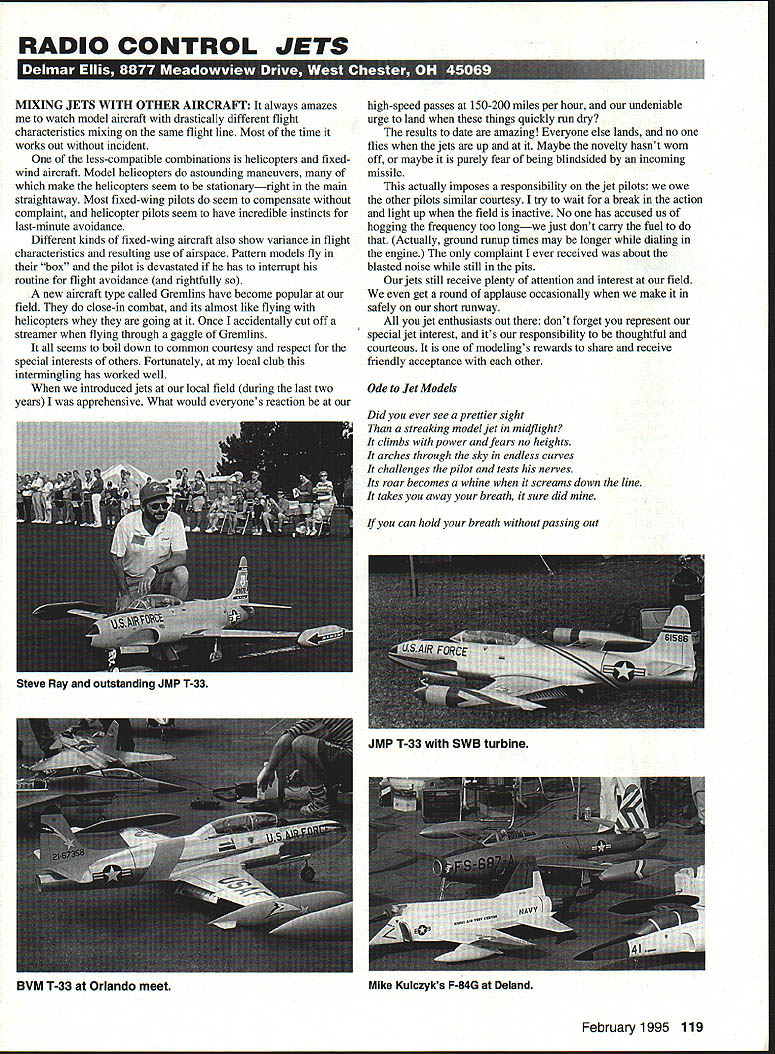
You also get a chance to see many great models, both sport and scale, including most of the new kit designs. The photo examples shown concentrate on the T-33s and an F-84 from the same era (I'm hung up on T-33s).
—Steve Ray
One T-33 on static display incorporated the new SWB turbine, rated at 20 pounds thrust. I hope to report on upcoming test flights very soon.
In addition to informal flying, a Scale demonstration event and speed runs were conducted. The whole meet was very exciting and entertaining.
The speed-run events were particularly well organized and successful. Qualifying flights were limited to one flight station and to one part of the day. I did not see any conflict with open sport flying.
Final trophy runs were conducted late Sunday, after everyone else's head slowed down anyway. The new JPO speed traps were used and they seemed to function flawlessly. Top speeds were more than 220 mph.
Superman '94 was the best yet, with perfect, crisp, clear flying weather; excellent turnout and participation; great, safe flying; an outstanding organized-but-relaxed atmosphere; and modeling excellence you have to see to believe. Congratulations to Jerry Caudle and his crew.
Transcribed from original scans by AI. Minor OCR errors may remain.

