
Radio Control: Jets
Delmar Ellis 8877 Meadowview Drive West Chester, OH 45069
Flight-Test Program (AMA Gas Turbine Committee)
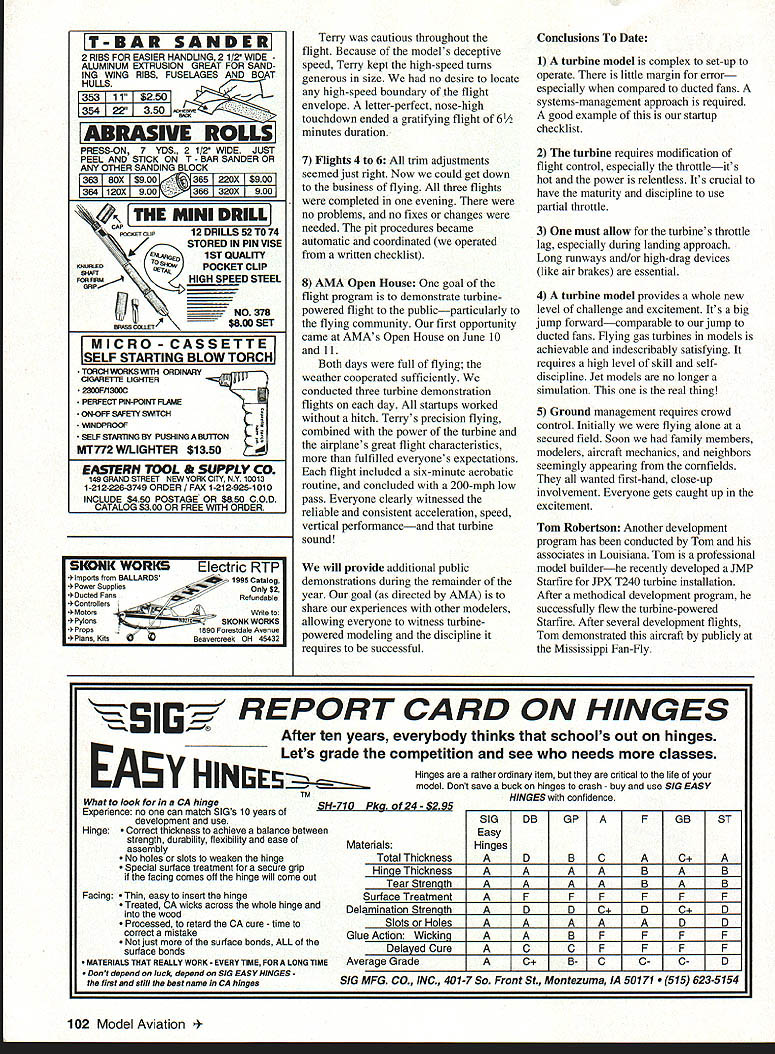
The Academy of Model Aeronautics' gas turbine committee has initiated a flight-test program. I am fortunate to be part of this activity. Our first test aircraft, Hot Flash, was built and is piloted by Terry Nitsch. Initial flight tests were conducted at a private full-scale airport. Early test experiences unfolded as follows:
- Taxi Test
- Initial test uneventful. We increased the steering throw and repeated the test.
- First Flight
- Takeoff was rock-solid and stable; acceleration and climbout were very strong. Power delivery was deceptively smooth—it kept building up. Terry pulled back to one-half throttle shortly after retracting the landing gear, then went to full throttle for vertical climbout. Vertical performance was literally out of sight.
- The model doesn’t want to slow down for landings. Terry incorporated two-stage flaps and a two-stage split-rudder air-brake. With full flaps and brakes, airspeed can be reduced to a crawl while still maintaining partial power. This worked effectively as an alternative to throttle management on approach.
- Throttle lag is very pronounced on turbines, complicating speed control and go-around decisions. Terry’s landing was intentionally a little hot but accurate. BVM wheel brakes provide control and shorten the landing run.
- Second Flight — First Attempt
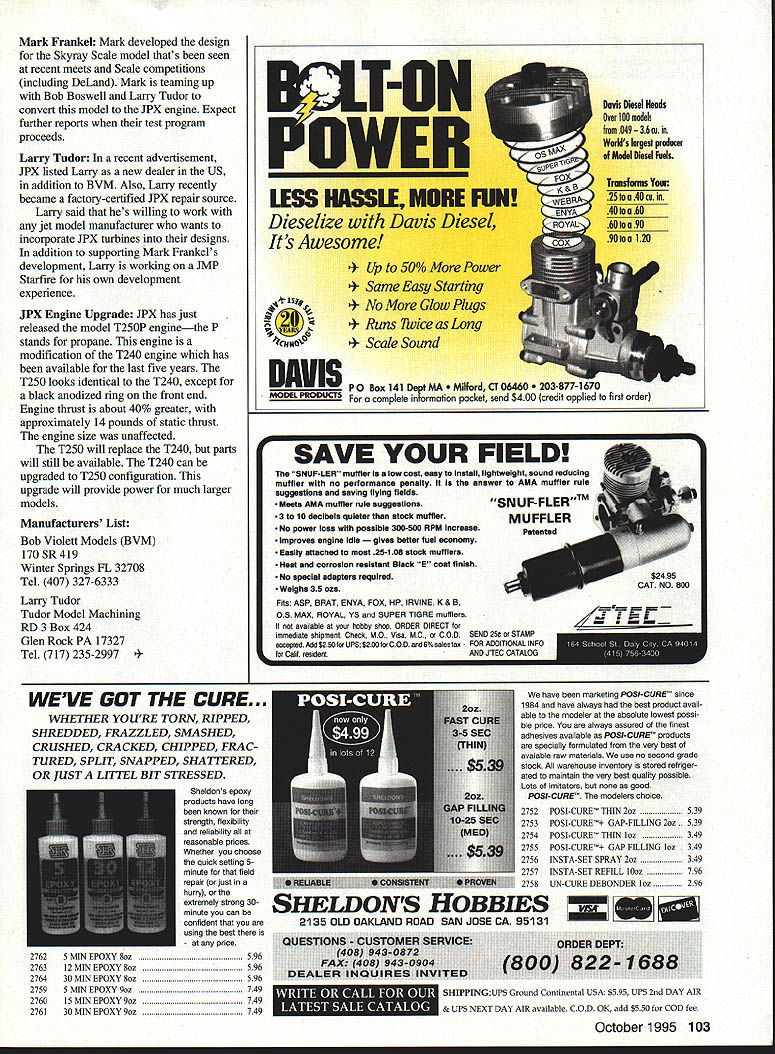
- Pit gremlins dominated the second night. We had a propane fuel leak at the forward fuel-line couplings. The engine had been lit before we identified the problem, but there was no fire. The flight was aborted and we practiced an emergency shutdown. The culprit was a faulty L-coupler fitting (an older design). We replaced it with a newer unit and replaced the adjoining fuel tube.
- Second Flight — Second Attempt
- The fuel-system fix checked out. Engine starts were inconsistent and hesitant, so we refined throttle-management procedures. Starts became consistently smooth. The engine is a joy to operate, though it demands respect.
- The flight allowed small trim adjustments. Full-flap takeoff produced a strong pitch-up, so Terry will not use full flaps on takeoff again. One vertical climbout (with rolls) was done at partial throttle. Terry decelerated the model to stall and it snap-rolled instantly—don’t initiate an unplanned stall with this airplane; the swept-wing configuration can bite hard.
- A slow-speed landing with full flaps and split air brakes floated in like a dream, producing a short, light landing. Trim changes for the next takeoff included up-elevator and reduced first-stage flap throw.
- Third Flight — First Attempt
- Wheel brakes wouldn’t engage and the model rolled down the runway at idle. It was going too fast to turn around; Terry finally shut off the engine and retrieved the airplane after a lengthy walk. The issue was that the trim change had shortened elevator throw so brakes weren’t being activated. We increased down-elevator throw and the brakes worked perfectly.
- Third Flight — Second Attempt
- Success. Liftoff was perfect with partial flaps and trims felt right. Terry relaxed and performed his aerobatic routine—this airplane really performs. Because models are deceptive in speed, high-speed turns were kept generous; we avoided testing high-speed boundaries. A nose-high, letter-perfect touchdown ended the flight (about 6½ minutes). After seven flights and four to six trim adjustments, we settled into routine flying. Pit procedures became automatic and coordinated (we operated from a written checklist).
- Flights 4 to 6
- All trim adjustments seemed correct. Three flights were completed in one evening with no problems, no fixes, and no changes needed. Pit procedures were routine.
- AMA Open House (June 10–11)
- One goal of the program is to demonstrate turbine-powered flight to the public. We conducted three turbine demonstration flights each day. All startups worked without a hitch. Terry’s precision flying, the turbine’s power, and the airplane’s handling exceeded expectations. Each flight featured a six-minute aerobatic routine and concluded with a 200-mph low pass. The demonstrations showcased reliable acceleration, speed, vertical performance, and the turbine sound.
- We will provide additional public demonstrations throughout the year to share our experiences with other modelers and to illustrate the discipline required for turbine-powered modeling.
Conclusions To Date
- A turbine model is complex to set up and operate. There is little margin for error compared to ducted fans. A systems-management approach is required (for example, using a startup checklist).
- The turbine requires modification of flight control techniques—especially throttle discipline. The power is relentless; it’s crucial to use partial throttle with maturity and discipline.
- Allow for the turbine’s throttle lag, especially on approach. Long runways and/or high-drag devices (air brakes) are essential.
- A turbine model provides a new level of challenge and excitement. It’s a big jump forward—comparable to the transition to ducted fans. Fast-jet modeling is more achievable and indescribably satisfying, but it requires a high level of skill and self-discipline. These jet models are the real thing, not a simulation.
- Ground management requires crowd control. Once word spread, family, friends, acquaintances, and neighbors wanted close involvement. Demonstrations attract attention and excitement.
Other Development Programs
- Tom Robertson
- Tom and associates in Louisiana conducted a development program. A professional model builder, Tom developed a JMP Starfire for JPX T240 turbine installation. After systematic development flights, he demonstrated the turbine-powered Starfire publicly at the Mississippi Fan-Fly.
- Mark Frankel
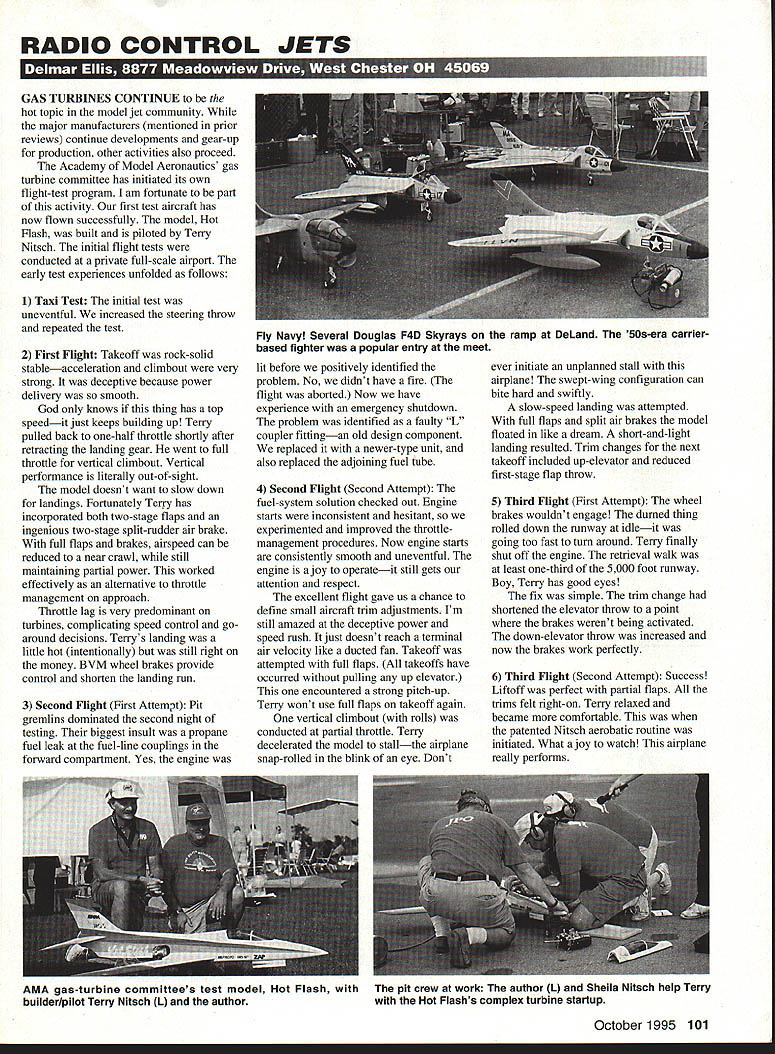
- Mark designed the Skyray scale model seen at recent meets and scale competitions (including DeLand). He is teaming with Bob Boswell and Larry Tudor to convert the model to the JPX engine. Expect further reports as their test program proceeds.
- Larry Tudor
- JPX recently listed Larry as a new dealer in the U.S., in addition to BVM. Larry also became a factory-certified JPX repair source and is willing to work with jet model manufacturers to incorporate JPX turbines. He is supporting Mark Frankel’s development and is working on a JMP Starfire for his own development experience.
JPX Engine Upgrade
- JPX has released the T250P engine (the P stands for propane). It is a modification of the T240 engine that has been available for several years. The T250 looks identical to the T240 except for a black anodized ring on the front end.
- Engine thrust is about 40% greater—approximately 14 pounds of static thrust—while the engine size is unchanged. The T250 will replace the T240, but parts for the T240 will remain available. The T240 can be upgraded to T250 configuration, providing power for much larger models.
Manufacturers' List
- Bob Violett Models (BVM)
170 SR 419 Winter Springs, FL 32708 Tel. (407) 327-6333
- Larry Tudor (Tudor Model Machining)
RD 3 Box 424 Glen Rock, PA 17327 Tel. (717) 235-2997
Transcribed from original scans by AI. Minor OCR errors may remain.

