
RADIO CONTROL JETS
Delmar Ellis, 8877 Meadowview Drive, West Chester, OH 45069
FAI JET SCALE
This column is directed toward jet activities; others report on Scale modeling. However, two recent activities combined jets and Scale.
First was the international meet for the new provisional F4J division of FAI Jet Scale. This competition brought contestants from around the world, and the United States was well represented.
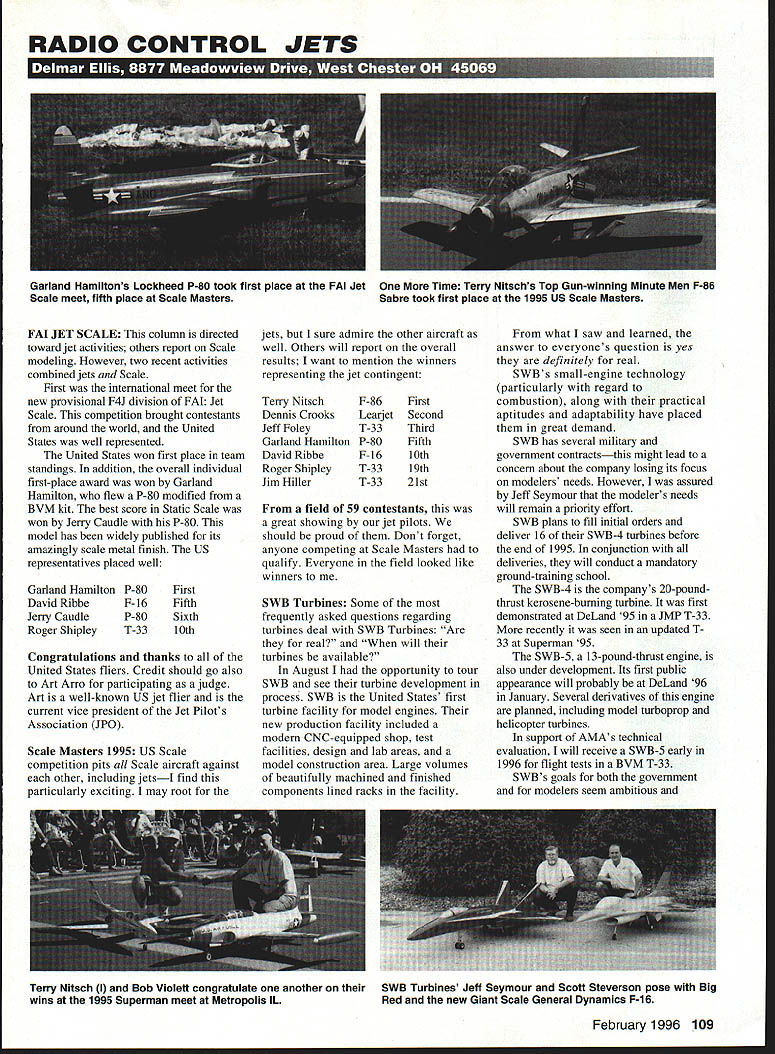
The United States won first place in team standings. In addition, the overall individual first-place award was won by Garland Hamilton, who flew a P-80 modified from a BVM kit. The best score in Static Scale was won by Jerry Caudle with his P-80. This model has been widely published for its amazingly scale metal finish. The US representatives placed well:
- Garland Hamilton — P-80 — First
- David Ribbe — F-16 — Fifth
- Jerry Caudle — P-80 — Sixth
- Roger Shipley — T-33 — 10th
Congratulations and thanks to all of the United States fliers. Credit should also go to Art Arro for participating as a judge. Art is a well-known US jet flier and is the current vice president of the Jet Pilot's Association (JPO).
Scale Masters 1995
US Scale competition pits all Scale aircraft against each other, including jets — I find this particularly exciting. I may root for the jets, but I sure admire the other aircraft as well. Others will report on the overall results; I want to mention the winners representing the jet contingent:
- Terry Nitsch — F-86 — First
- Dennis Crooks — Learjet — Second
- Jeff Foley — T-33 — Third
- Garland Hamilton — P-80 — Fifth
- David Ribbe — F-16 — 10th
- Roger Shipley — T-33 — 19th
- Jim Hiller — T-33 — 21st
From a field of 59 contestants, this was a great showing by our jet pilots. We should be proud of them. Don't forget, anyone competing at Scale Masters had to qualify. Everyone in the field looked like a winner to me.
SWB Turbines
Some of the most frequently asked questions regarding turbines deal with SWB Turbines: "Are they for real?" and "When will their turbines be available?"
In August I had the opportunity to tour SWB and see their turbine development in process. SWB is the United States' first turbine facility for model engines. Their new production facility included a modern CNC-equipped shop, test facilities, design and lab areas, and a model construction area. Large volumes of beautifully machined and finished components lined racks in the facility. From what I saw and learned, the answer to everyone's question is yes — they are definitely for real.
SWB's small-engine technology (particularly with regard to combustion), along with their practical aptitudes and adaptability, have placed them in great demand.
SWB has several military and government contracts — this might lead to concern about the company losing its focus on modelers' needs. However, I was assured by Jeff Seymour that modelers' needs will remain a priority.
SWB plans to fill initial orders and deliver 16 of their SWB-4 turbines before the end of 1995. In conjunction with all deliveries, they will conduct a mandatory ground-training school.
The SWB-4 is the company's 20-pound-thrust kerosene-burning turbine. It was first demonstrated at DeLand '95 in a JMP T-33. More recently it was seen in an updated T-33 at Superman '95.
The SWB-5, a 13-pound-thrust engine, is also under development. Its first public appearance will probably be DeLand '96 in January. Several derivatives of this engine are planned, including model turboprop and helicopter turbines.
In support of AMA's technical evaluation, I will receive a SWB-5 early in 1996 for flight tests in a BVM T-33.
SWB's goals for both the government and for modelers seem ambitious and questionably attainable, yet the progress they have already made and the credibility they have established must be acknowledged. They have made great progress in products including fuel delivery systems, auto-start sequencers, and automatic safety monitoring/shutdown systems. Modelers will benefit as much of the technology will spin off into modelers' products. For example, a Giant Scale F-16 that will be available for the 20-pound-thrust SWB-4 has been test-flown. SWB should become a major supplier to the model-jet market — high quality, high technology, U.S. origin, and reportedly competitively priced.
Superman 1995
Many of us have just returned from our last jet meet of the year at Metropolis, Illinois. Held the first weekend in October, it is always one of the biggest and best meets. This year was no exception — several new and recently introduced sport jets were on the scene, along with the usual variety of high-quality models.
One company, Century Jet Models, resurfaced in force. Their factory test team was led by Lewis Patton; they demonstrated a scale twin-engine F-4 and a German Heinkel. I also saw a fuselage for a prototype F-104.
Several gas turbines were present, and demonstrations were conducted at midday.
Terry Nitsch conducted his usual flawless aerobatic presentation with the JPX-powered Hot Flash. The model is now powered by the T250P engine; it has significantly more power potential, but Terry hasn't run it at full power yet. Can you imagine Hot Flash with more power? By the way, Terry received the Technical Achievement award.
The other JPX-powered aircraft in attendance were BVM T-33s. One was piloted by Kent Noyes; he flew the same aircraft he demonstrated at DeLand '95. The weekend included a real treat — Bob Fiorenze conducted the inaugural flight of his T250P-powered T-33 early Sunday morning, followed by a demonstration in the midday show. This engine/aircraft marriage appears to be ideal, with strong performance and a striking visual appearance. Bob and the T-33 won the Best Turbine trophy.
Jeff Seymour and the SWB crew were back with a beautiful orange-and-white T-33 powered by the SWB-4. With JMP's latest developments and several pounds of weight reduction, this aircraft flew even better than the previous demonstrator did at DeLand '95. Most notable were the soft, slow landings. The weight reduction has really paid off. Flight performance was smooth and very strong. Tom Cook was the demo pilot.
Big Red was back, piloted by Bob Fiorenze. The SWB team (including Tom Cook of JMP and Bob Fiorenze) was awarded Best of Show for their team effort.
Transcribed from original scans by AI. Minor OCR errors may remain.

