
Radio Control Nationals: Helicopters
Larry Jolly
Overview
The 1992 AMA Nationals at Westover Air Force Base, Chicopee, Massachusetts, consolidated all the Nationals events in one location for the first time in many years. This was made possible by the utilization of all RC frequencies and careful scheduling by AMA.
RC helicopter events were flown over four action-packed days beginning Saturday, June 20. There were a total of 90 entries in all classes:
- 22 in Class I
- 21 in Class II
- 11 in Class III
- 30 in FAI
- 6 in Scale
Event organization
AMA selected Frank Dykes as Event Director. Frank — known around the hobby as "Mr. Calm" — did an excellent job assembling the manpower needed to run an efficient contest. By using two flight lines and careful scheduling, one round of flying per day in each class was easily accomplished.
A big thank-you goes to all the volunteers who served as judges, worked at transmitter impound, and kept scores. Without their energy and hard work, the contest would not have run as smoothly or been as enjoyable.
Field conditions and incidents
On my initial visit Sunday morning, Frank explained that everything had been running smoothly except for trouble getting authorization to mow the two flight circles. The site was basically a large meadow with grass about 18 inches high and bordered by trees on two sides. The area was home to a lot of wildlife, including an endangered bird species, so Frank had to get federal permission to mow the flight circles.
Once the circles were mowed, a large prairie fire started just south of the site and flying was halted while the Westover fire crew extinguished it. About an hour later, two armored personnel carriers on maneuvers detoured through the FAI Class III flight lines and disappeared behind some distant trees. Frank joked that if tanks could stand up to fires, they were probably tough enough to endure helicopters — a wry comment on disturbing birds to mow the circles.
Typical Northeastern weather prevailed: conditions varied from warm with light winds to severe thunderstorms. Part of the time it was windy — naturally, since flying was crosswind to the FAI Class III circles. FAI fliers were somewhat better off because their circles were farther upwind; the trees near the second circle produced definite rotor-effect turbulence.
International visitors and manufacturers
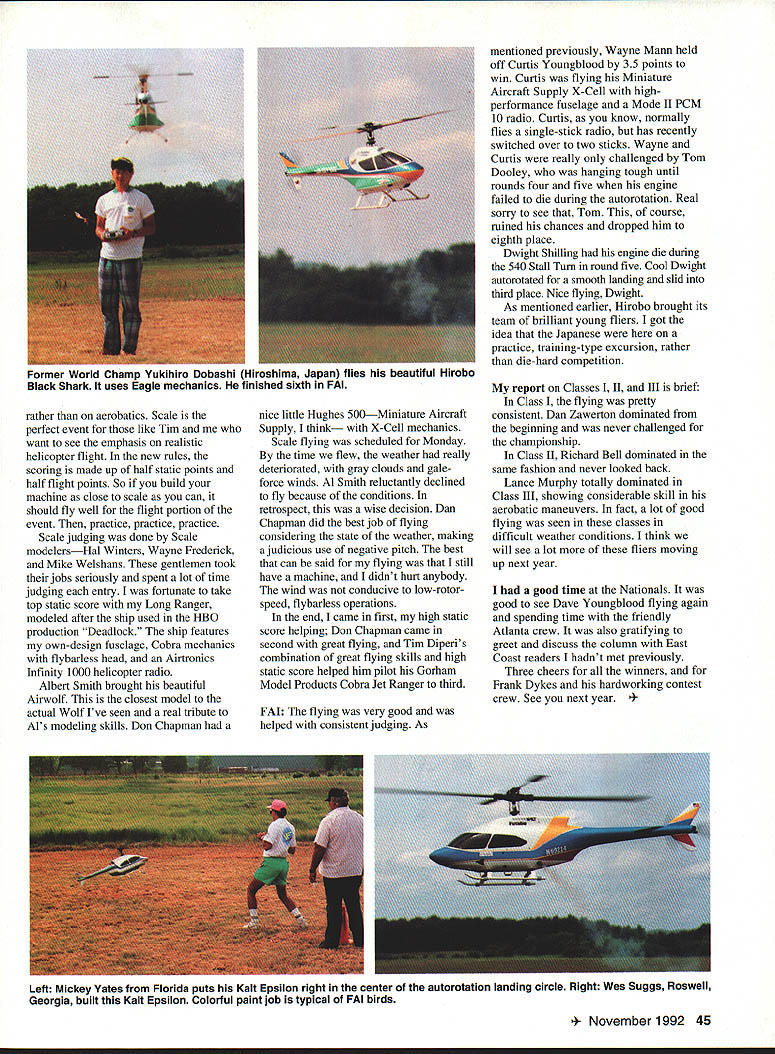
This year will be remembered because Team Hirobo visited the Nationals. There was discussion among FAI fliers about the possibility of a Japanese competitor becoming U.S. National Champion — something for the Academy to ponder, since foreign nationals are currently permitted to enter Nationals. Fliers welcomed the chance to see pilots such as Dobashi in action.
I spent time at the Hirobo camp where Altech, U.S. distributor for Hirobo, displayed several new products. Highlights included a UH-1B Huey shuttle-type machine and a new 60-size machine designed primarily for the American market. An unnamed new 60-size model — mainly plastic — showed good design ingenuity and excellent flight characteristics. Takayanagi finished in fifth place; I’ll report more when the machine becomes available.
New machines and notable equipment
There was a lot of new hardware on display and flying at the Nationals:
- FAI: Wayne Mann and Ted Schoonard showed up with beautifully painted Optima fuselages.
- X-Cell Pro machines with twin tail rotors drew a lot of interest, as did Dan Chapman’s twin-tail work — an idea of long-standing interest since Dan won the FAI class previously.
- Kyosho’s new Miniature machine looked and flew great.
- Wayne Mann ran a 1720 rpm head speed, which helped him hover and contend better in wind; he eventually became AMA champion in the FAI class. Congratulations to Wayne — perseverance pays off.
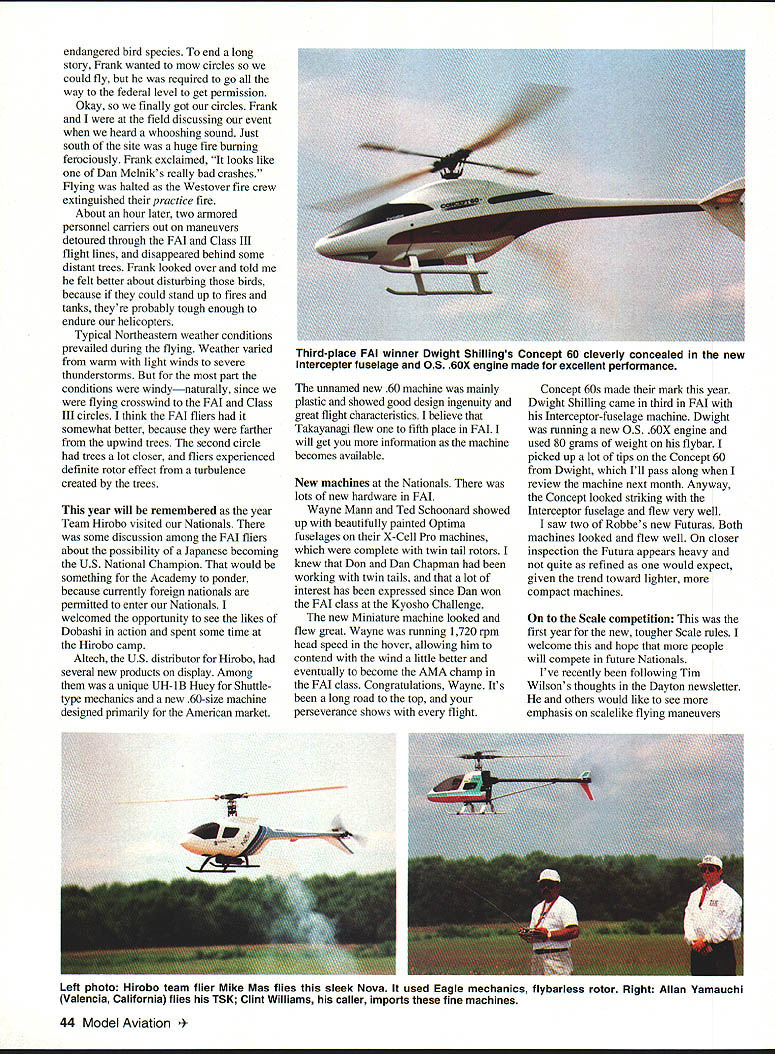
- Flight Concept 60s made a mark: Dwight Shilling took third in FAI with an Interceptor-fuselage machine, running the new OS 60X engine and using an 80-gram weight on the flybar. The Concept looked striking and the Interceptor fuselage flew very well.
- I saw two Robbe Futura machines; both looked and flew well. On closer inspection the Futura appears heavy and not quite as refined as one might expect, given the trend toward lighter, more compact machines.
Scale competition
This was the first year for the new, tougher Scale rules — a welcome change that should encourage more participation in future Nationals.
The new rules emphasize scale-like flying maneuvers rather than pure aerobatics. Scoring is split half static points and half flight points, so building a model as close to scale as possible and practicing the flight routine are both crucial.
Scale judging was handled by Scale modelers Hal Winters, Wayne Frederick, and Mike Welshans. These gentlemen took their jobs seriously and spent a lot of time evaluating each entry.
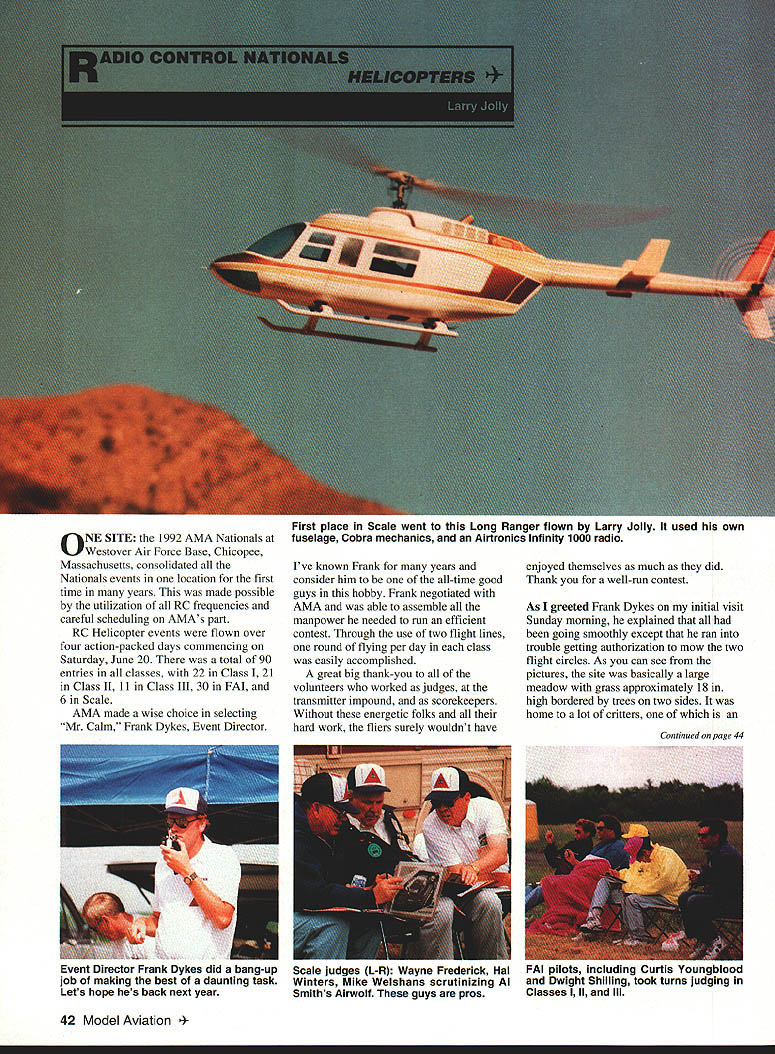
I was fortunate to take top static score with my Long Ranger, modeled after the ship used in the HBO production Deadlock. The ship features my own-design fuselage, Cobra mechanics with a flybarless head, and an Airtronics Infinity 1000 helicopter radio.
Albert (Al) Smith brought his beautiful Airwolf — the closest model to the actual Wolf I’ve seen and a real tribute to his modeling skills. Don Chapman flew a nice little Hughes 500 (Miniature Aircraft Supply, I think) with X-Cell mechanics.
Scale flying was scheduled for Monday, by which time the weather had deteriorated to gray clouds and gale-force winds. Al Smith wisely declined to fly. Dan Chapman did the best flying in the conditions, making good use of negative pitch. My own flying left me with one intact machine and no injuries — about the best one could hope for in those winds, which were not conducive to low-rotor-speed flybarless operations.
In the end I finished first overall, my high static score helping. Don Chapman came in second with excellent flying, and Tim Diperi combined great flying skills with a high static score to place third flying his Gorham Model Products Cobra Jet Ranger.
FAI competition
FAI flying was very good and benefited from consistent judging. Wayne Mann held off Curtis Youngblood by 3.5 points to win. Curtis was flying his Miniature Aircraft Supply X-Cell with a high-performance fuselage and a Mode II PCM10 radio. Curtis has recently switched from a single-stick to a two-stick radio.
Tom Dooley was a strong challenger until rounds four and five, when his engine failed to restart during an autorotation. That failure ruined his chances and dropped him to eighth place — disappointing after solid earlier rounds.
Dwight Shilling’s engine died during the 540 stall turn in round five; he autorotated to a smooth landing and slid into third place. Nice flying, Dwight.
Hirobo’s team of young fliers appeared more focused on practice and training than on die-hard competition, but their presence was a highlight.
Classes I, II, and III
A brief look at the other classes:
- Class I: Dan Zaunertow dominated from the beginning and was never seriously challenged for the championship.
- Class II: Richard Bell dominated in the same fashion and held on comfortably.
- Class III: Lance Murphy totally dominated, showing considerable skill in his aerobatic maneuvers.
A lot of good flying was seen in these classes despite difficult weather. I expect many of these fliers will move up next year.
Closing notes
I had a good time at the Nationals. It was great to see Dave Youngblood flying again and to spend time with the friendly Atlanta crew. It was also gratifying to meet East Coast readers I hadn’t met previously.
Three cheers for all the winners, and for Frank Dykes and his hardworking contest crew. See you next year.
Transcribed from original scans by AI. Minor OCR errors may remain.

