
Radio Control Nationals: Pattern
Authors
Norm Staub and Dave Lockhart
The Nationals' New Scoring System for F3A
Tony Stillman, RC Pattern Event Director for the Nationals, developed a new scoring system for the F3A class that deviated from the standard F3A rules. Its intent was to make entry into the final flyoffs fairer by seeding pilots based on past performance so that four flight lines of roughly equal talent would be created. Pilots would primarily fly against those on their own line rather than against the entire field.
A simplified explanation:
- Data from the Nationals and U.S.A. team selection contests over the past few years were collected and analyzed to create seeding of F3A pilots based on past performance.
- The objective was to form four flight lines of equal talent so the pilots on each line would compete more directly with one another.
- The planned finals qualifiers were the top four on each line, plus four additional Americans (and any foreigners) who fell into the top 20, depending on the entry makeup.
Expected benefits included:
- Reduced effect of day-to-day weather changes or judge standard shifts, since comparison would be line-based.
- Faster completion of rounds.
Major deviations from the rule book:
- Scores from preliminary rounds were discarded and only scores from the finals were used to determine winners.
Assessment and outcomes:
- Because F3A turnout was low in 1992 (37 pilots versus 88 the previous year), the system did not get a full test; it is believed to work best with larger numbers.
- A comparison with the rule-book method showed the same pilots would have reached the finals under either system. Some final placings would have shifted slightly: for example, Chip Hyde would have finished second instead of third if preliminary scores had been carried forward.
- Tony Stillman said he will recommend that, if a future Contest Director wishes to use his system, scores from preliminary rounds should be carried forward.
- Most contestants seemed to view the new system favorably.
A NEW ERA
An evolution in U.S. RC Pattern competition occurred at the 1992 Nationals: all classes flew "Turnaround." Turnaround requires the model to perform all maneuvers while remaining within the boundaries of an imaginary box.
Event structure:
- The contest was separated into four classes: Sportsman, Masters, Advanced, and FAI (F3A).
- Sportsman and Masters competed June 20–22.
- Advanced and FAI competed June 23–25.
Weather and scheduling:
- Saturday saw only one completed round for the lower classes due to late-afternoon rain. Sunday cleared and nearly completed three rounds; remaining rounds and unfinished portions were completed Monday.
- Temperatures ranged from the 60s to the 80s. Overall, the weather was mild to cool, though later F3A rounds faced strong winds (about 20–25 mph).
Equipment trends:
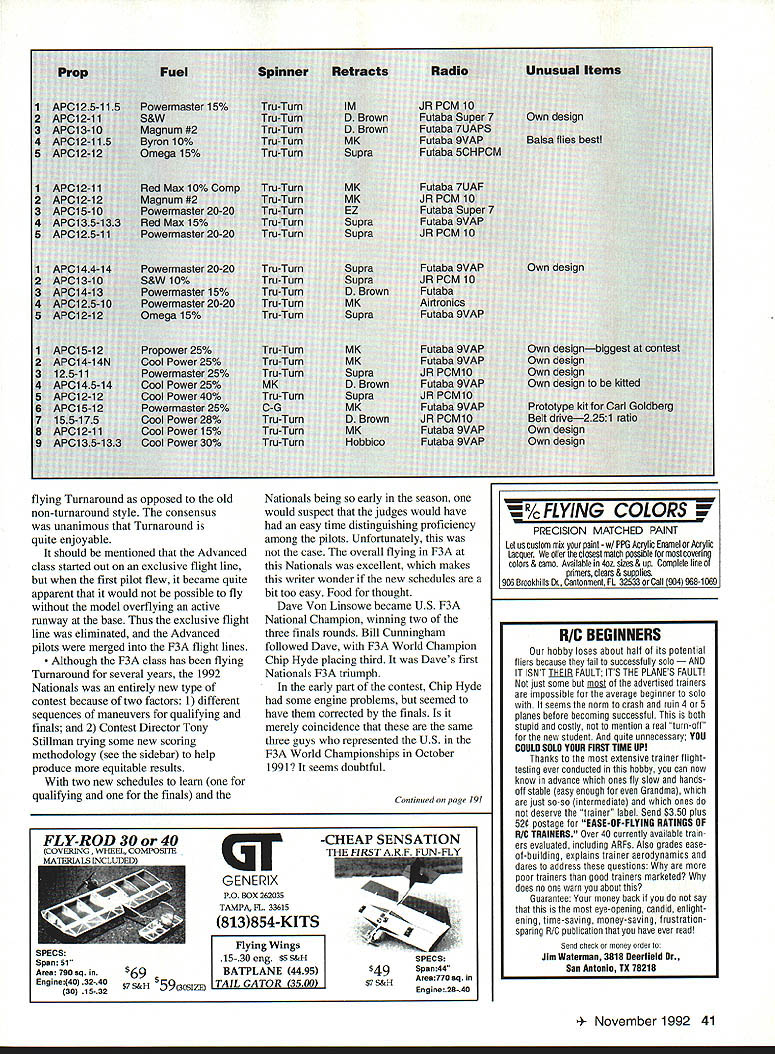
- Sportsman was dominated by two-stroke .61 engines, reflecting reliability and simplicity.
- In Masters, the top 10 were evenly split between two-strokes and four-strokes. Four-strokes were often running a bit more nitro and hauling larger airframes; taildraggers were becoming more popular.
- No other significant new trends were observed beyond increased use of taildraggers and the K = 1 factor on takeoffs/landings.
Sportsman and Masters Classes
By Dave Lockhart
These two classes were flown Saturday through Monday. Rain interrupted the first day, but rounds were completed by Monday. The competition produced a wide variety of models and flying styles.
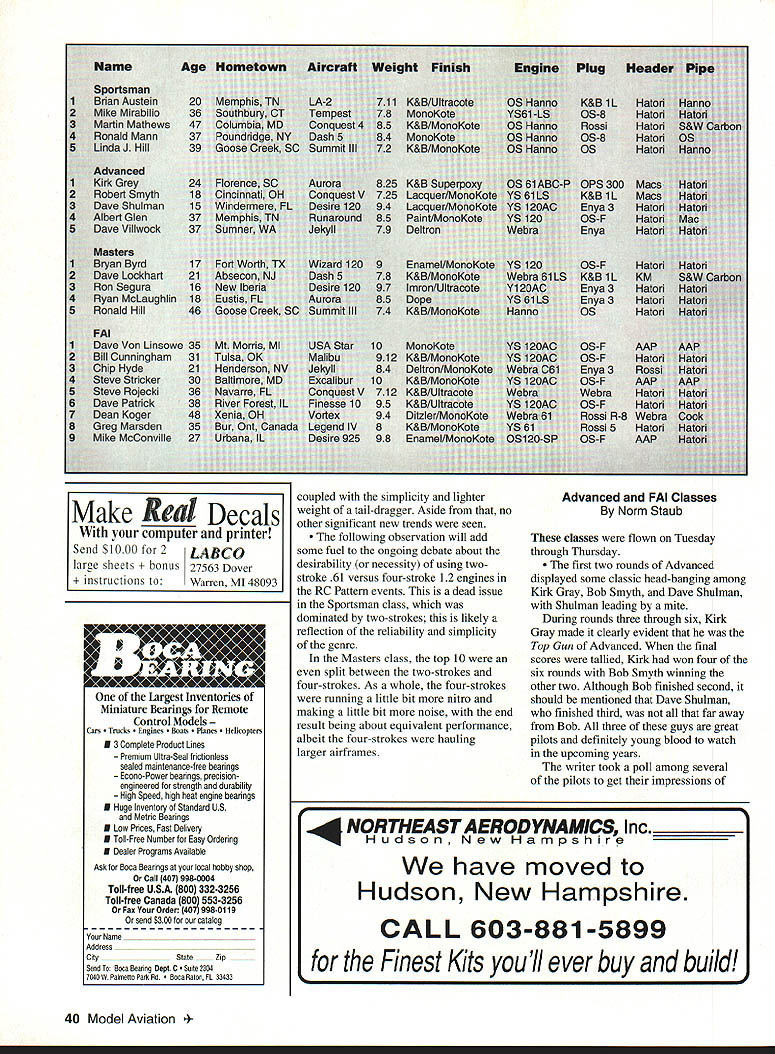
Sportsman (29 entrants)
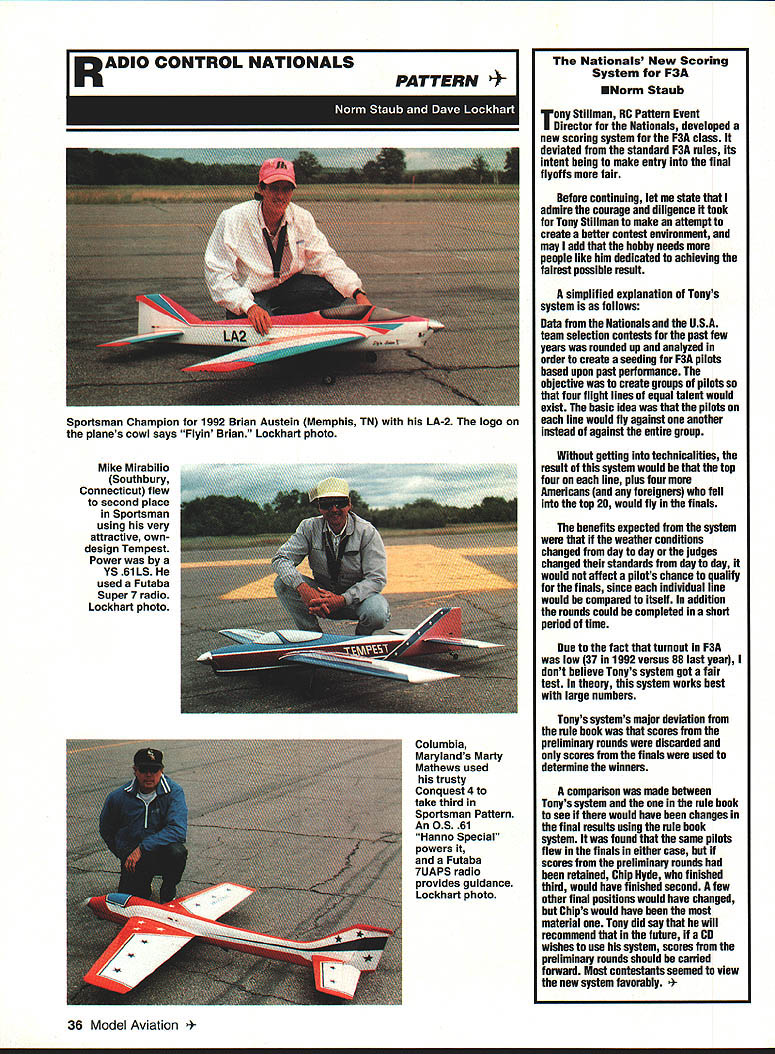
- Winner: Brian Austein (Memphis, Tennessee) — dominated early by winning the first round and then the next five rounds, flying an LA-2 with polished, smooth maneuvers and evident rudder use.
- 2nd: Michael Mirabilio (Southbury, Connecticut) — flying his own design, Tempest; finished with 3,875 points, 112 ahead of third. Posted a normalized score of 996 in round five (99.6% of Brian’s score).
- 3rd: Martin Mathews (Columbia, Maryland) — flying a Conquest IV; consistent flying earned him the podium.
- 4th: Ron Mann — flying a Dash Five.
- 5th: Linda Hill — with husband Ron Hill calling.
Masters (15 entrants)
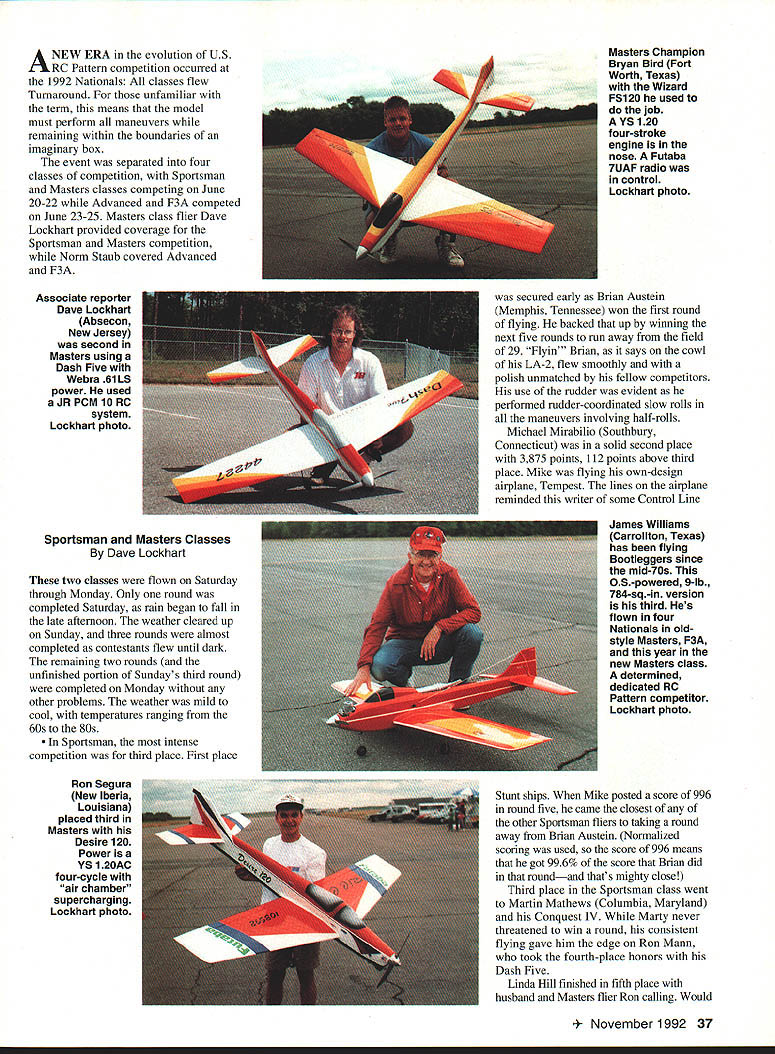
- The field was small but competitive. Bryan Byrd (Fort Worth, Texas) flew very smooth, slow, constant-speed maneuvers with his Wizard FS120.
- Notable pilots and round highlights:
- Round 1 winner: Bryan Byrd.
- Round 2: Ryan McLaughlin (Eustis, Florida) scored a 1,000 flying an Aurora powered by Y.S. .61.
- Round 3 winner: Dave Lockhart (author), flying a Dash Five with Webra .61.
- Round 4 winner: Joe Walker.
- Round 5 winner: Dave Lockhart (second 1,000).
- Round 6 winner: Ron Hill (moved from sixth to first that round).
- Final standings (close competition; only about 25 points separated the top four out of 2,000):
- Bryan Byrd (17) — winner.
- Dave Lockhart (21) — second.
- Ronald “Roscoe” Segura (17) — 1991 Advanced champion; third.
- Ryan McLaughlin (18) — fourth.
- Ron Hill (approx. 46) — edged out Joe Walker by 0.27 points out of nearly 4,000.
- Joe Walker (19) — close behind.
Observations:
- The competition was tight, with many young pilots performing strongly.
- Taildraggers’ popularity is increasing, likely due to scoring emphasis and the K-factor on takeoffs/landings.
Advanced and FAI (F3A) Classes
By Norm Staub
These classes flew Tuesday through Thursday. Advanced initially had a separate flight line, but because of overflight concerns with an active runway, Advanced pilots were merged into F3A flight lines.
Advanced
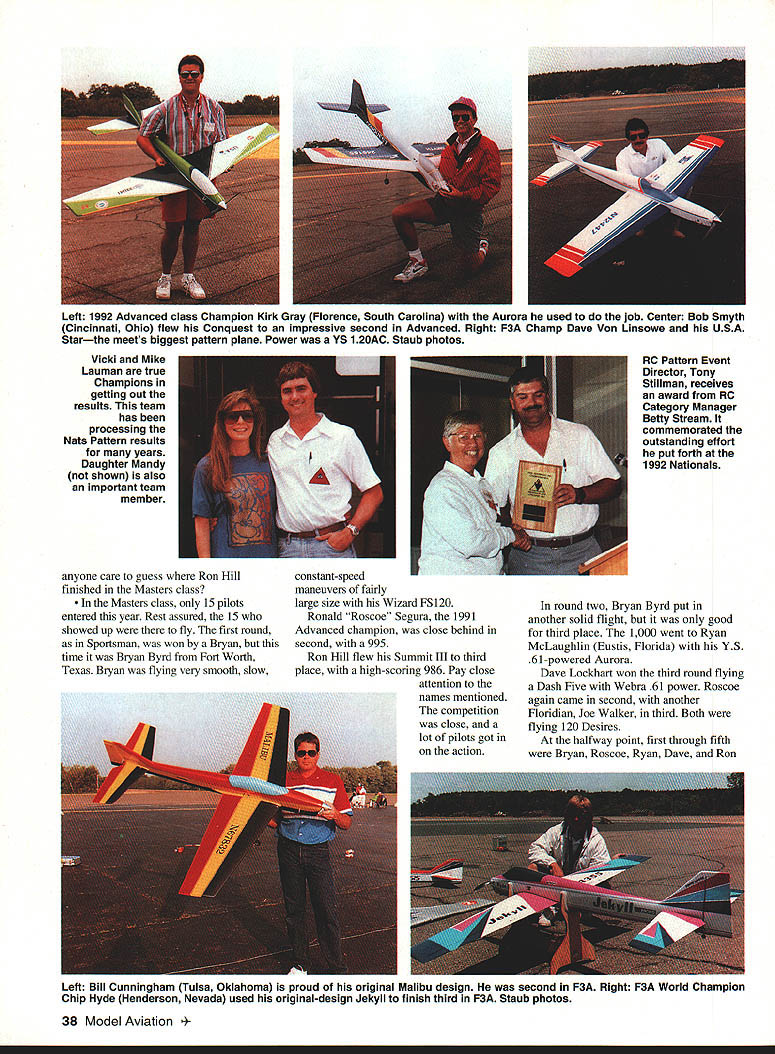
- The first two rounds saw close competition among Kirk Gray, Bob Smyth, and Dave Shulman, with Shulman leading slightly early.
- Rounds three through six cemented Kirk Gray as the Top Gun of Advanced, winning four of six rounds. Bob Smyth won the other two and finished second overall; Dave Shulman finished a close third.
- Pilots polled enjoyed Turnaround compared to the old non-turnaround style.
F3A (FAI)
- The 1992 Nationals introduced two new schedules: one for qualifying and one for the finals. Combined with the new scoring experiment, it made this Nationals a different contest from previous years.
- Overall flying was excellent; this raised the question whether the new schedules might be slightly easier than previous ones.
- Weather for most of the contest was cool and crisp, with winds occasionally strong (20–25 mph). Many pilots flew quite close in despite wind — possibly influenced by styles from the 1991 World Championships.
Finals and results:
- U.S. F3A National Champion: Dave Von Linsowe — won two of the three finals rounds; this was his first Nationals F3A triumph.
- 2nd: Bill Cunningham.
- 3rd: Chip Hyde — had engine troubles early but corrected them by the finals.
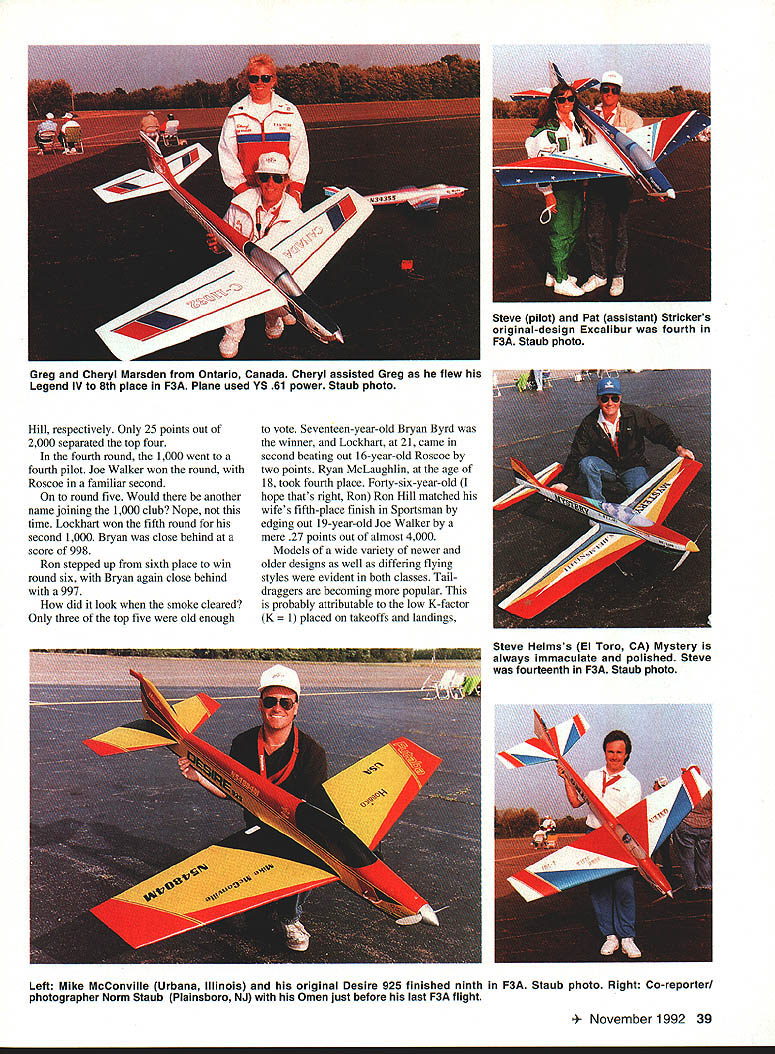
- 4th: Steve Stricker — pushed hard for a podium spot.
- Note: The top U.S. pilots mirrored the team that represented the U.S. at the 1991 F3A World Championships.
Additional observations:
- Attendance for Pattern was down overall; reasons suggested included early-season timing, economic factors, and the impending N-PAC competition.
- One curious trend observed: despite strong winds, several pilots chose to fly very close in; one pilot who moved his flight in on the last finals flight received his best score of the contest. Further data (e.g., from N-PAC) may clarify whether this is a broader trend.
Summary and Thanks
- The 1992 Nationals RC Pattern event introduced Turnaround across all classes and tested a new F3A scoring system intended to make finals qualification fairer.
- Despite smaller F3A turnout, the event was a success with excellent flying across classes.
- Thanks and congratulations to the winners and to Tony Stillman and the AMA for organizing the contest.
Transcribed from original scans by AI. Minor OCR errors may remain.

