
RADIO CONTROL NATIONALS
PYLON RACING
Wayne Yeager
QUICKIE 500
Quickie 500 pylon racing at this year's Nationals was rousing but manageable, although the numbers were down compared with the last two years in Lawrenceville. The two previous years saw 97 and 79 entries in Quickie 500, which resulted in little flying because the hours were restricted to 7:00 a.m. until noon.
A total of 15 hours for 97 entries, for example, is run-like-the-dickens to get in five rounds. This year we had 57 entries and were able to complete a full 10 rounds plus a couple of flyoffs. From a personal standpoint, lower entry numbers are just fine. (Editor's note: Author Wayne Yeager was the Event Director for RC Pylon Racing at the 1992 Nationals.)
Processing for each event must take place on the day before, because we fly in the mornings and there is no other time to complete this chore. Quickie processing started at 1:00 p.m. on Friday and was finished by 5:00 p.m. The rumor winds had indicated that a bunch of weird designs would appear; however, they didn't materialize.
Convention was the rule. Probably the most unconventional designs were V or T tails. Wing fillets larger than 1/4 in. were not allowed by the Contest Board, and, surprisingly, only two airplanes had any kind of radius. All models were measured for wing area plus pertinent fuselage dimensions, safety checks were performed, model weights were checked — and we were ready for racing.
The weather guy was good to us for Quickie by giving us an overcast first day so the fliers didn't have to fight the sun.
The dreaded first heat was off at 7:08 a.m. Competing were John "Yazz" Yassemedis, Joe Ruh, and Ted Puzio, with Ruh winning with a respectable 1:20. (Editor's note: Flights are listed in minutes:seconds.)
We started with three-plane heats because the 57 entries required a 4 x 15 matrix, leaving us with three three-plane heats and a fourth for four planes. We like to put heats consisting of fewer planes first, which usually results in less worker confusion and allows a rhythm to develop before we throw the fourth person into the fray.
These guys were followed by John Albritton, George Rodriguez, and Art Edsall. Albritton won this heat, with Edsall second, Rodriguez third — and on we went. After a while the heats tend to run together and you lose track of standings, location, you name it.
Such is the case with Nationals racing, because up until quitting time, there is a constant flow with no breaks anywhere. Heat after heat is being churned out, and it all becomes a blur.
We had a first this year — a new Shadel was enrolled. Not David, renowned FAI and Formula 1 pilot, but Bryan, son of David. You could say "son-of-gun," since father has been close to the top, or on top, for quite a while. Maybe we say, "son-of-Top-Gun." How about "son-of-a-gun"? How about I shut up and get on with it!
Anyway, we watched the kid fly, and I saw a lot of Poppa out there. He flew smoothly with very few bobbles, and as each day passed, he got closer to the sticks. When he really discovers where they are, look out, because I have a feeling the Shadel name will be right there on top of the list. That is, until he discovers girls! (Heh, heh!)
Round one concluded after 15 heats with, naturally, a 15-way tie for first. Off to a good start were Rick Landers, with the best time of 1:10.13, followed by Craig Grunkemeyer, Jerry Salisbury, Joe Dodd, Rick Moreland, Ray Dolat, Jeff Horn, John Albritton, Jerry Krasser, Craig Korsen, Bob Brogden, Dan Myer, Joe Ruh, Cliff Telford, and Arnie Wile.
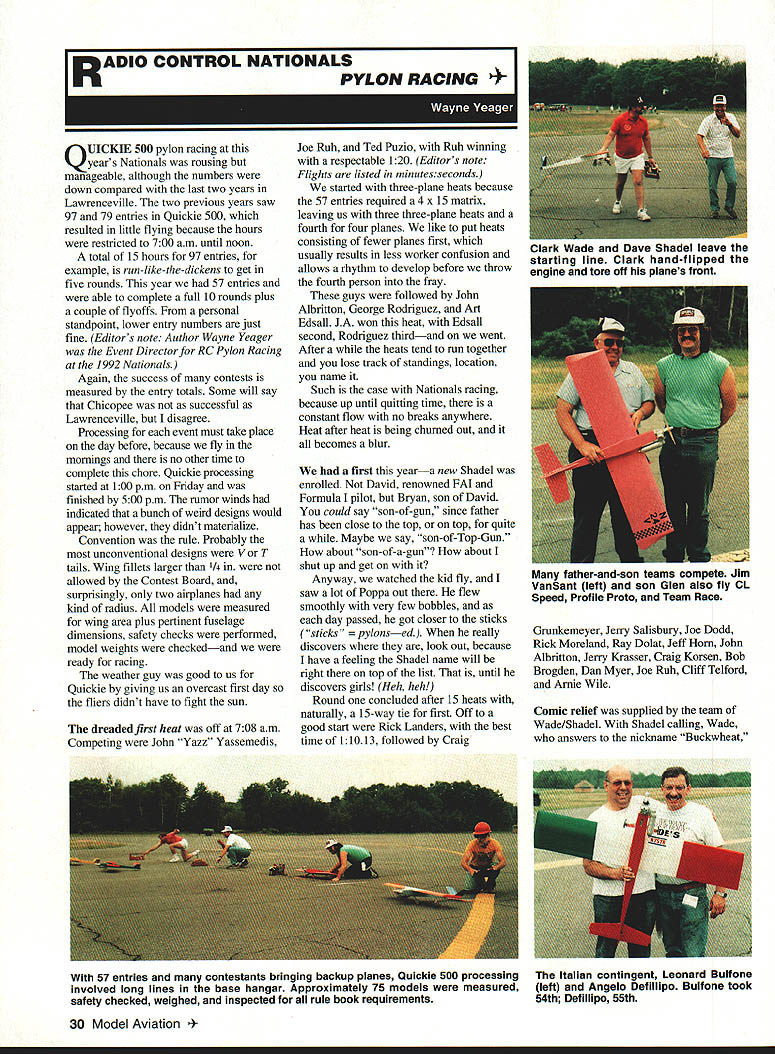
Comic relief was supplied by the team Wade/Shadel — Shadel calling, Wade (who answers to the nickname "Buckwheat") attempting to start his engine, which was a bit dry and balky. So he stuck his finger over the carb to choke a little fuel into the engine. At the same time, Shadel had his finger over the muffler outlet with the same purpose in mind, and between the two of them an immediate gush of fuel produced a gigantic hydraulic lock between piston and head.
"No problem," says Buckwheat, "I'll just hand-flip it and clear it out." After the first hand flip, both caller and pilot were observed rolling on the ground in glee. A quick glance at the plane explained why. Dangling by the throttle cable was the entire front end of the plane — engine, firewall, and all.
Buckwheat's hand flip was greater than his glass job, so it seems. Needless to say, glue doesn't dry fast enough, so Mr. Wade started off with a big zero. The people on the line appreciated the episode and gave him a 10 for tension release.
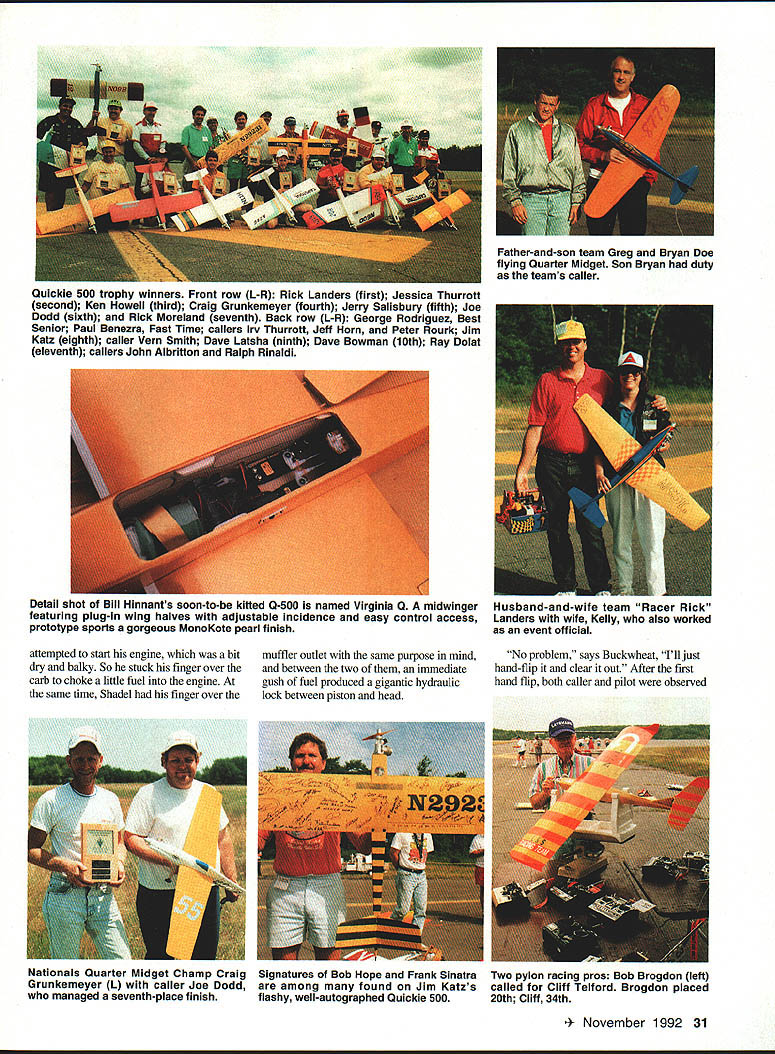
Did I mention we had a girl flying? Not that it's unusual or rare, but not too many girls get involved in pylon racing. In this case it was old pro Jessica Thurrott (I know, you're only 24, but admit it, you've been doing this for a while, right?), who has several seasons of North East Pylon Racing Organization (NEPRO) fast-time awards to her credit and, quite frankly, flies as well as anyone I know. She lost her first heat to Craig Grunkemeyer, with a 1:14 to Grunkemeyer's 1:11; however, after that it was "Look out!" Anyone thinking the competition wasn't fierce was badly mistaken, because that girl knows where the sticks are.
In retrospect, I doubt if anyone even thought about easy ones, because Jess is well known and respected. A lot of cheers were heard every time she beat one of the good guys. That puzzled me, because she should be treated as an equal. There's nothing odd about her. She has one head, two eyes, hands, feet, you name it. Just your normal, everyday pylon racer who is good enough to stomp the lesser racers. Just one of the guys, in my eyes.
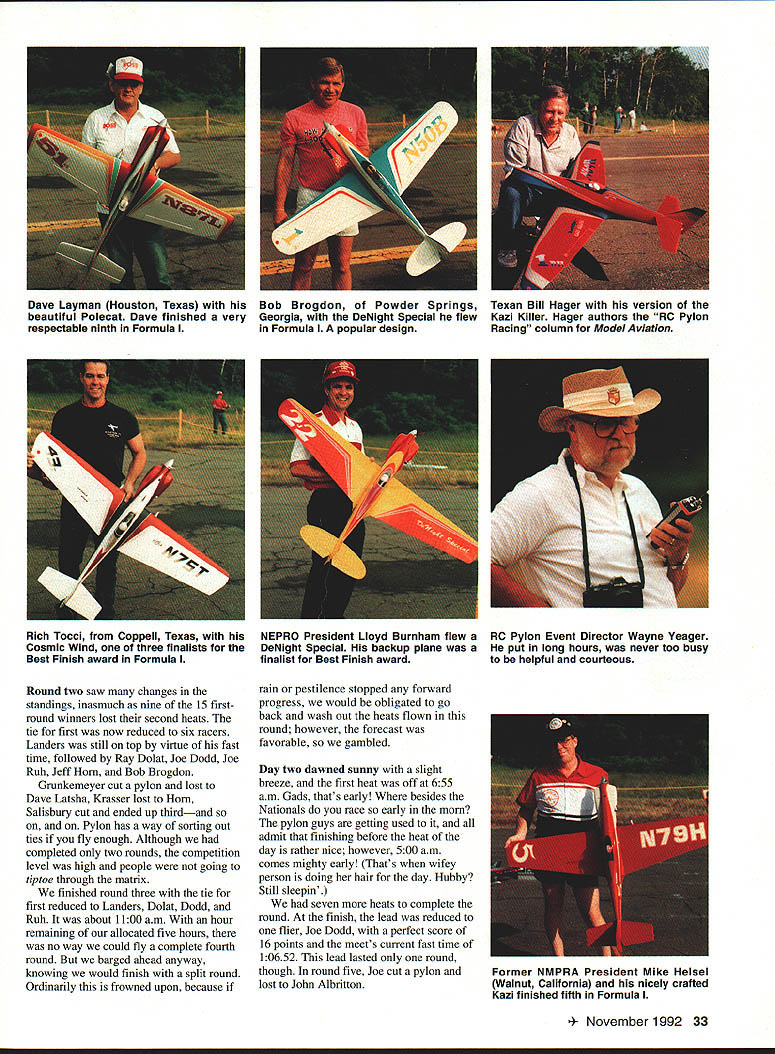
Round two saw many changes in the standings, inasmuch as nine of the 15 first-round winners lost their second heats. The tie for first was now reduced to six racers. Landers was still on top by virtue of his fast time, followed by Ray Dolat, Joe Dodd, Joe Ruh, Jeff Horn, and Bob Brogdon.
Grunkemeyer cut a pylon and lost to Dave Latsha, Krasser lost to Horn, Salisbury cut and ended up third—and so on. Pylon has a way of sorting out ties if you fly enough. Although we had completed only two rounds, the competition level was high and people were not going to tiptoe through the matrix.
We finished round three with the tie for first reduced to Landers, Dolat, Dodd, and Ruh. It was about 11:00 a.m. With an hour remaining of our allocated five hours, there was no way we could fly a complete fourth round. But we barged ahead anyway, knowing we would finish with a split round. Ordinarily this is frowned upon, because if rain or pestilence stopped any forward progress, we would be obligated to go back and wash out the heats flown in this round; however, the forecast was favorable, so we gambled.
Day two dawned sunny with a slight breeze, and the first heat was off at 6:55 a.m. Gads, that's early! Where besides the Nationals do you race so early in the morn'? The pylon guys are getting used to it, and all admit that finishing before the heat of the day is rather nice; however, 5:00 a.m. comes mighty early! (That's when wifey person is doing her hair for the day. Hubby? Still sleepin'.)
We had seven more heats to complete the round. At the finish, the lead was reduced to one flier, Joe Dodd, with a perfect score of 16 points and the meet's current fast time of 1:06.52. This lead lasted only one round, though. In round five, Joe cut a pylon and lost to John Albritton.
Rick Landers was back in a tie for first with Dodd and Howell; Thurrott and Grunkemeyer, who were one point behind, tied for third. The best heat of the round was between two of the people in the top five, Jessica Thurrott and Ken Howell. Kenny barely edged out Jessica at 1:08.28 to 1:08.36—and that's racing, as they say. This also was the last heat Jessica lost; she tore everyone up the rest of the way.
Round six progressed smoothly and ended the way it started—Dodd and Landers tied for first, with Howell, Grunkemeyer, and Thurrott tied for third.
As round seven ended the day's flying, we realized a sort of phenomenon had occurred: thus far we had had no reflights attributable to mistakes by the officials! Not one! Could it be, I mused? This is my goal. Someday it will happen, but not this Nationals.
We did go completely through four days before the first one hit us—on the fifth day of flying.
That's completely through Quickie and Quarter Midget without one single refly due to a mistake by the race officials! I was amazed. Credit must be given to the work of the crew. One hundred and fifty heats of Quickie plus 45 heats of Quarter without a mistake. Ya gotta love it!
Round seven also finished with the meet's fast time of 1:06.13, set by Paul Benezra in a heat against Bulfone, Estabrook, and Schmauch.
The final day of Quickie started the same as day two, with the first heat off before 7:00 a.m. Since we knew four full rounds couldn't be completed, three more were scheduled to complete the contest. This resulted in a slight slowdown, with plenty of time left for any possible flyoffs.
Round eight saw the demise of what the pilots thought was the best-finished model. Peter Rourk and some other guys—Jim Katz, Rick Moreland—are finishing their planes with tissue and dope instead of the usual MonoKote. Pete's model was very nicely finished; however, as sometimes happens, an unexplained fly-away occurred and Pete lost a pretty plane.
He looked for it in a faraway woods to no avail. Some time later Betty Stream and Al Williamson, the Nats RC Category Manager and Director, were driving along a little road heading for the pylon site and found the remains of Pete’s plane buried in the ground up to its neck. At least he got his engine and radio back.
The round ended with Rick Landers back on top all alone, since Joe Dodd turned a 1:13.31 and got smoked by Jim Katz with a 1:10.13 and by Jessica Thurrott with a 1:09.77. Poor Joe said, “Wha’ happen?”
With two rounds yet to fly, plenty could happen and did to one of the top people, Ken Howell, who lost to “Mr. Steak,” Jerry Salisbury, and Clark Wade. A two-point drop put Kenny back into a tie for fifth with Joe Dodd. Rick Landers was still leading, followed by Thurrott and Grunkemeyer tied for second and third and Salisbury all alone in fourth.
Round 10 sorted out the remaining places. Rick Landers won his heat and his first Nationals, finishing one point down from a perfect score. Second and all alone was Jessica Thurrott, two points from a perfect score.
Kenny Howell won his last heat and connected with a two-point drop by Grunkemeyer and a single-point drop by Salisbury, so that all three were tied for third with 38 points.
Howell won the three-way flyoff, giving him third place in the meet. Grunkemeyer was second, awarding him fourth place overall; and Salisbury finished third, for fifth place. Joe Dodd was sixth with 36 points; Rick Moreland was seventh with 34; Jim Katz was eighth with 33; and Dave Latsha, Dave Bowman, and Ray Dolat were tied for ninth.
This required another flyoff. Latsha won, putting him in ninth place. Bowman came 10th; Ray Dolat, 11th and the last trophy.
Our Best Senior was George Rodriguez who just beat out Bryan Shadel by one point. Of the two, Shadel turned in the best time of 1:13.51. Not chopped liver, Bryan!
The last round brought more comic relief as Clark Wade struck again. This time he forgot to turn on his receiver. That could be bad from a safety standpoint, but, thankfully, enough down trim kept it on the ground after release; however, the plane erased itself as it scurried along the ground.
At this same moment, someone standing near Henry Nelson heard a very definite ka-ching in his pocket. In fact, every time a plane crashed, Henry’s hand was observed making a noticeable cash register motion in his pocket followed by a distinct sound—ka-ching. “It’s only money,” says Henry.
The awards were passed out, pictures taken, and after a quick lunch, it’s off for Quarter Midget processing. No rest! I’m telling ya, no rest! Ohhh well.
Quickie final results:
- Rick Landers
- Jessica Thurrott
- Ken Howell
- Craig Grunkemeyer
- Jerry Salisbury
- Joe Dodd
- Rick Moreland
- Jim Katz
- Dave Latsha
- Dave Bowman
- Ray Dolat
- Paul Benezra
- Tom Scott
- Jeff Horn
- Mike Mungavin
- John Albritton
- Jerry Krasser
- Craig Korsen
- Vern Smith
- Bob Brogdon
- Art Edsall
- Mike Bumbaca
- Dan Myer
- Mike Fiorito
- Anthony Piraino
- Joe Ruh
- Greg Doe
- John Yassemedis
- Clark Wade
- George Schmauch
- Lewis Schwab
- Bill Glode
- Peter Rourk
- Cliff Telford
- George Denault
- Dick Hanson
- Bob Beaudette
- Ralph Rinaldi
- James VanSant
- George Rodriguez
- Dick Berner
- Bryan Shadel
- C. Schaefer
- Bill Hinter
- Glen VanSant
- Paul Seiden
- John Fike
- Bob Voysey
- Vince Perillo
- Ted Puzio
- J. Wilson
- Arnie Wile
- John Hoover
- Leonard Bulfone
- Angelo DeFillipo
- Dick Estabrook
- Scott Puzio
QUARTER MIDGET
Quarter Midget suffered from poor attendance with only 16 entries. It's tough for a guy to travel all the way to the Nationals and spend a bunch of money to fly an event that is allocated only five total hours. However, the low number of entries does not justify allocating any longer hours, so this is a real catch-22 with no apparent solution.
Added to the other reasons for this year's poor attendance is the fact that the East Coast isn't really a hotbed of Quarter fliers.
The good thing about the event is that the competition level is intense. No one gets a free ride in Quarter. In any given heat the potential for having your doors blown off is always present.
We started Tuesday morning with a 5 x 4 matrix, which is not the most desirable condition. Sixteen entries result in one four-plane heat and four three-plane heats. But if there was any attrition, we planned to rematrix after five rounds with the goal of eliminating the four-plane heat.
The first guys airborne were Vern Smith, Matt Desimone, and Jim Young. Young won, and Desimone finished second. Vern Smith doubled-out and started with a zero.
After a few heats, we noticed that several people were cutting pylons badly. Because all of these people had flown Quickie, we surmised that their timing was off somewhat since Quickie is close to one second per lap faster. Once the guys got their timing down, this phenomenon disappeared. In the meantime, it cost some people dearly.
At the end of round one, five guys were tied for the lead—Grunkemeyer, Jett, Young, Katz, and Moreland—with five more guys one point back. Makes sense. Flying one round, and naturally, there are five winners and five more who finish second.
QM progressed into round two with Jett, Grunkemeyer, and Moreland on the list. Jett was second; and Moreland double-cut. There's some tough guys in this class.
In the second round, Dub Jett, current F3D World Champion and perennial Formula 1 master, turned in the meet's fast time of 1:12.18, which ain't bad for a guy who flies Quarter Midget once a year, usually at Nationals. This is especially good because it is a match for the second quickest existing Quarter Midget record of 1:11.20, held by another Nationals competitor, Paul Benezra. Not too shabby, Dub!
Round two ended with Jett, Grunkemeyer, and Young still tied for first, and Katz, Latsha, and Moreland one point back. Since there were only five races to a round, they were zipping at a fast rate. In fact, we were running about six heats per hour and were easily finishing a round in half an hour.
At the end of the third round, the lead was reduced to Jett and Grunkemeyer, since Jimmy Young's 1:25 fell to Jett's 1:19.
On into round four we barged, and the heats were popping in at a blur. Before I knew it, this round was completed and the lead suddenly was Grunkemeyer all alone, since Jett registered a cut and finished third to Grunkemeyer and Moreland, two old pros. Tough guys to pass, you may be sure, and Dub discovered that shortening the course doesn't help.
We started round six with a rematrix and all three-plane heats, because John Albritton had broken an airplane in round four and had no backup model. Still on top was Craig Grunkemeyer by two points. Jimmy Young fell another point off the pace with a loss to the leader.
"Racer Rick" Landers, who won Quickie, was not having the same luck he had in the former event. He registered three zeroes in the first five rounds, and will double-cut. Racin' is cruel, Ricky!
Round six evaporated, and so did Jett's standing as he registered a zero along with Katz and Salisbury. This pushed Doe ahead of him, tied for second with Jimmy Young and two points behind the leader.
The standings now were: Grunkemeyer with 23 points, Doe and Young with 21, Jett with 18, and Latsha with 17 to round out the top five.
Round seven finished with some surprises. Craig Grunkemeyer and Jim Young tied for second, both double-cut—and whooooooooeeee, things were getting tight! It was decided at this point that nine rounds would complete the contest, since we were running out of time and the two remaining rounds would decide several positions. With the cuts registered by the above two guys, at the end of round seven the standings were: Doe and Grunkemeyer tied with 23 points, Young and Jett tied with 21, and Latsha in fifth place with 20.
Unfortunately for Jimmy Young, cuts plagued him the rest of the way and he recorded no more points; however, he did tell me he was having fun. I like your attitude, Jimmy. One of the good guys!
Round eight continued with Grunkemeyer, Doe, and Jett all winning their heats, so a sprint to the finish was set. As they say, the last round settled things, and I guess it did; however, if we had flown another, a whole new set of circumstances would have occurred. But we didn't, and they didn't.
Grunkemeyer won his last heat, and Doe lost his, putting "Grunk" all alone at the top with no ties. Greg Doe had a bad engine run and registered a 2:37.13; however, the point he gained kept him tied for second with Dub Jett, so it was flyoff time to settle second and third.
Greg had trouble keeping up with Jett, so the race was over quickly with Jett taking second place in the meet. By coincidence, this was the third straight year that Dub was involved in a flyoff for second place.
QM final standings:
- Craig Grunkemeyer
- Dub Jett
- Greg Doe
- Dave Latsha
- Rick Moreland
- Jim Katz
- Joe Dodd
- Jim Young
- Art Arno
- Jerry Salisbury
- Vern Smith
- Matt Desimone (Senior)
- Tony Piraino
- Rick Landers
- Peter Rourk
- John Albritton
FAI
The FAI event is not particularly popular in this country, and it usually draws one of the lowest turnouts in Nationals pylon racing. However, the entry this year—15—was no lower than in previous years.
All planes were checked for the special dimensions required in the FAI event, plus the usual safety items, and we were once more ready for racing the next morning—which was Wednesday. The morning was not lit up with the bright sunshine we were accustomed to seeing. In fact, it was downright dreary. We did get started a few minutes after 7:00 a.m., but the rain—light at first, then heavier—began early in the first round. Racing stopped after four heats, one heat short of a complete round.
So we sat under tents. Thank goodness for tents—right, guys? The rain continued for about an hour and a half, and then stopped completely. So off we dashed to complete round one, and on we went into round two.
After round one, Rich Verano led with 75 points. This may sound confusing, so let me 'splain: In FAI, we race the clock. Points are seconds; therefore, if a guy turns a 1:20, we convert that to seconds, which becomes 80, and that's his points. The person with the least number of points wins.
In round one, Richard turned a 1:15 flat, which converted to 75 points—a very respectable score. Close behind was Dave Shadel with 77.2, Dub Jett with 81.2, and Don McStay with 83.3. Incidentally, there's another variation on scoring in that the times are rounded to the nearest tenth of a second.
Round two concluded as the rains started. The scoring at the time was: Shadel first with 150.9 points; Verano second with 156.8; Katz third with 161.1; Jett fourth with 161.4; and Helsel fifth with 167.0.
This was also the day of our first refly, because a lap counter mistakenly flipped two cards over on Dave Shadel. We didn't catch it in time, so unfortunately we were obligated to refly him.
In FAI, mistakes that in other events result in a "no-time" for the flier are settled with a refly instead. The fliers must record a time, because time is their score. In fact, we run two watches for backup.
Another FAI requirement states that all collisions, minor or not, are called and, if flyable, refliess. Therefore, any light bump leads to a refly. Fortunately, we had no mishaps of that sort, and the mistake on Dave's flight was the only refly of the event.
We sat out for about two more hours before calling the day's flying off until instructions to return Thursday morning, weather permitting, when we would steal a little time from Formula I to get in a little more FAI. Unfortunately, Rick Moreland and John Albritton had to leave for home, but everyone else returned.
Thursday morning broke with clear skies and the third round off at 6:30 a.m. Since each round took approximately 30 minutes, the plan was to run two rounds that morning and call it a contest.
At the end of round three, Dave Shadel was still on top with a score of 225.5 points. Dub Jett moved into second with 234.5. Jim Katz was third with 238.2, Mike Helsel was fourth with 245.0, and Dave Doyle rounded out the top five with 289.6.
Round four decided Dave Shadel as the winner with 221.8 points.
At this point I should address slightly: FAI has another rule that states, “If four or more rounds are flown, the flier's worst score is dropped.” Therefore, the final scoring includes only the three best scores.
Shadel's score, for example, divided by the three rounds, equaled an average of 73.9 points, or 1:13.5, for his three flights. Since the FAI course is within a few feet of the Formula I course in total length, a direct comparison can be made.
The current record in Formula I is 1:03.16, and the FAI record is 1:06.6—a slight difference of only three seconds, and proof that these FAI jobs do purr along.
Finishing second was Rich Verano, who also held fast time of 1:10.8. Dub Jett was third, Mike Helsel fourth, and Jim Katz fifth. Once again, trophies were awarded, pictures taken of the winners—and we prepared to start Formula I racing.
FAI final positions:
- Dave Shadel — 221.8
- Rich Verano — 227.6
- Dub Jett — 234.5
- Mike Helsel — 235.5
- Jim Katz — 238.2
- Don McStay — 248.1
- Dave Doyle — 264.0
- Art Arno — 294.4
- Jim Young — 341.7
- Bob Wallace — 359.5
- Pete Reed — 521.0
- J. Albritton — 600.0
- Clark Wade — 600.0
- Rick Moreland — 600.0
- G. Hyde — 600.0
FORMULA I
We inspected, safety-checked, and measured all the things required in the event on Thursday evening, then judged the planes for beauty to determine their takeoff position. This is one aspect of Formula I that I hate. The purpose of the judging is reasonable, and, if it helps maintain standards for the integrity of finish of these planes, then I feel it's good for the event. The bad side is that no matter what system is used, people go away unhappy.
This year was no exception. I tried to ease things by recruiting what I thought were three qualified judges. Each flier brought his plane before this panel, set it on the ground, and selected a number that, in his opinion, fit the plane's beauty.
I think the judges did a great job, but the drawback is that someone always feels his own creation is a little better than where it's finished in the judging—and that may be so. It is, to be very subjective, and feelings always get hurt.
This year we had approximately 16 planes judged number one. From those, we had to select our finalist for our Best Finish award. I did not get involved in judging the individual planes, but I certainly did look at all the finalists for the number one spot. All had something for which I would give demerits. Some were greatly noticeable, but most had only small items here and there. Nevertheless, all had something that I felt detracted.
The most prominent negative item was the undersides. We do not judge the planes' bottoms in the first go-round, but we certainly do when selecting the best. Many guys put a great finish on the top with hand rubbing and polish, but leave orange peel on the bottom. All of this detracts, and unfortunately some very pretty airplanes were set aside after inspection of the bottoms.
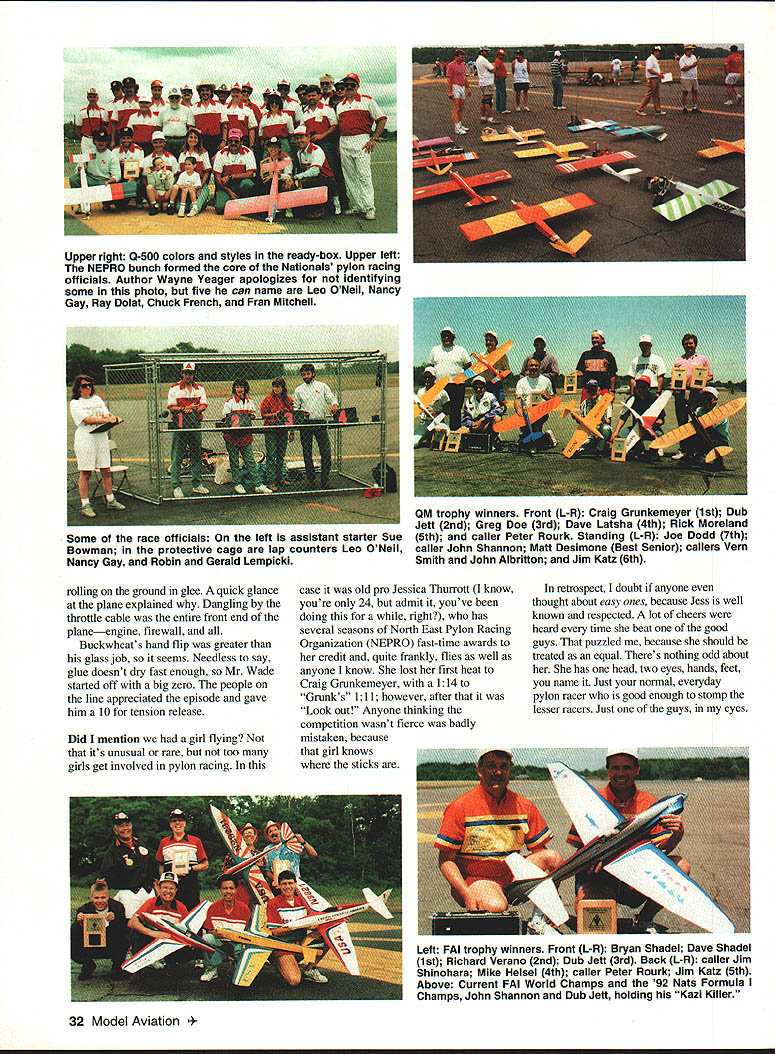
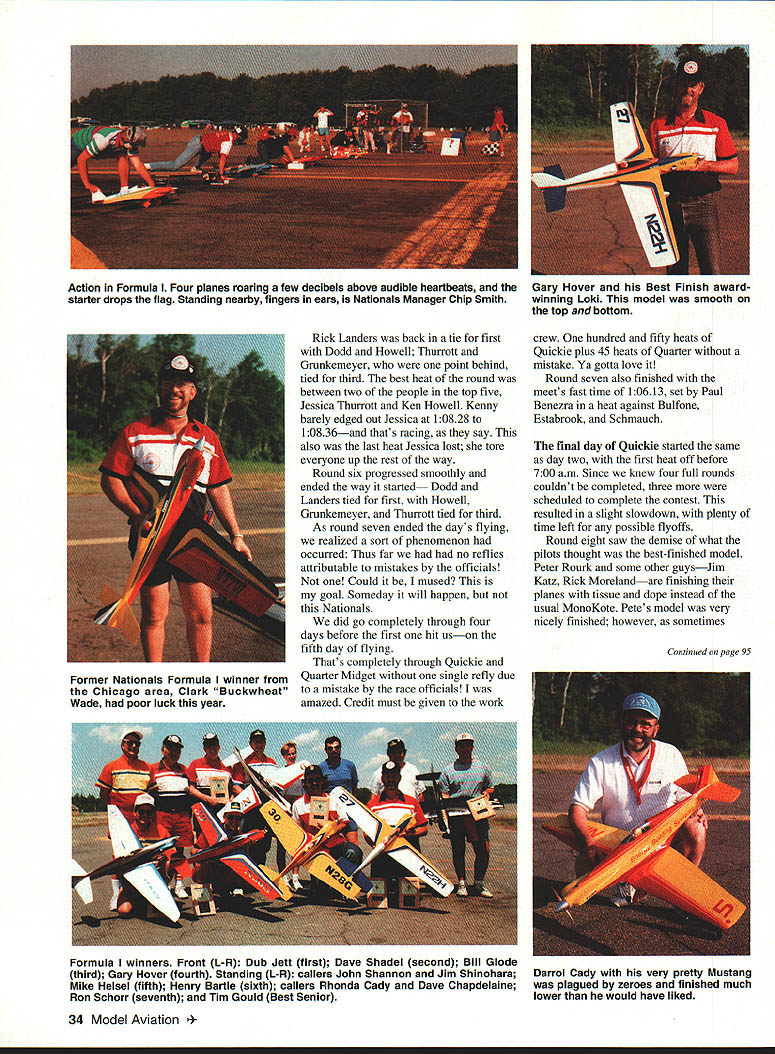
In the end, the judges reduced the field to three planes, from which I selected the finalist. This year the award went to Gary Hover's very nice Loki. Though it wasn't fancy in paint design, Gary's model was rubbed top and bottom and in my opinion had the best finish.
The other two finalists were fine models, but neither had a smooth finish on the bottom to match Hover's. Now, at this point you must understand something else.
By coincidence, the planes winning Best Finish at the Nationals have a poor record for longevity. Other than Dave Layman's Polecat, many have bitten the dust very early into racing. So some people don't particularly like winning this award. In fact, when I announced the winner at the morning pilots' meeting, Hover immediately went looking for an exorcist.
All for naught, though, as the plane lasted the entire meet. There was a pool at $10 a round, the winner being whoever selected the round in which the plane met its demise. I understand Gary's wife, Linda, even bought in. Gary was awarded the entire pool at the end of the race.
If this seems slightly macabre to you, please understand that these guys are serious and do not like breaking airplanes, but they also race long enough to realize that it sometimes happens. If you are unwilling to accept this fact, then you don't belong in pylon racing. Kinda like a guy who goes to a Ukie combat meet with one plane.
We had a pilots' meeting at 8:00 a.m. and started flying just after 8:30, losing only an hour and a half. This was not a problem, because we stopped each day at noon for Pattern events; however, Pattern was to be finished on Thursday, giving us plenty of time to complete Formula I on Friday.
There were 30 entries, with a 4 x 8 matrix. Since four times eight is 32, this resulted in two three-plane heats and the remainder four-plane heats.
Local guy Jerry Krasser, with his classy caller Rick Landers, and Bill Hauth made up the dreaded first heat. Maybe this is why everyone hates the first heat: Krasser and Hauth did not finish, so Landers coasted to an easy first and four points.
Heat two contained Arnie Wile, Dave Layman, and Bill Glode. Layman won, so on we went. The first round moved rather smoothly because everyone was ready, but after that things slowed down. Depending on where you were in the matrix—the fourth row, for example—many of the fliers were being called for the ready box as they were walking off the line.
Round one finished with Mike Helsel on top by virtue of the round's best time of 1:09.23. Following Helsel in order of finish were Dub Jett, Rich Tocci, Jessica Thurrott, Dave Layman, Ron Schorr, Rich Verano, and Rick Landers.
Rich Tocci and Dave Shadel had the best race of the round, with Tocci edging our perennial winner Dave at 1:12.26 to 1:12.88. Those not having any luck were Bill Hauth, Jerry Krasser, Gary Hover, and Paul Benezra, who didn't finish for various reasons; Darrol Cady, Arnie Wile, Dave Chapdelaine, who double-cut; and Dave Doyle, who had a radio problem and crashed his plane.
Round two buzzed along with only a few minor mishaps and concluded with Mike Helsel still on top with his fast time, followed by Jett, Tocci, Layman, and Verano. The rest of the pack were one or more points down. Helsel had gotten a zero because of a flameout, dropping him to a far-distant 19th!
Round three would be the last of the day, since we were using approximately one hour per round. This would put us in the 11:30 a.m. range. The Pattern event had to conclude that afternoon, and we agreed the pilots who had their time needed so we could have all of Friday to ourselves.
The round concluded with Rich Tocci triumphant with a perfect score of 12 points. Helsel, Jett, and Thurrott all dropped a point. Bill Hager moved into the top five with some solid racing and the day's fast time of 1:09.04.
Friday morning broke with balmy weather and absolutely no wind on the course. We moved right into round four exactly at 7:00 a.m., and the heats moved at a steady rate.
The round concluded with Tocci still alone on top, followed by Thurrott and Jett one point back and Helsel and Schorr three points back. It appeared we would be able to maintain our one hour per round. Some quick arithmetic told me we could fly straight to 1:00 p.m., making up the time lost on Thursday, and conclude the meet at the end of round nine.
This seemed agreeable to the fliers, because no one wanted an endurance race. Nine rounds was the goal and was announced accordingly.
Round five produced some changes. Leader Tocci lost two points to Bartle and Thurrott, dropping to a third-place finish. Jett lost to Shadel, who set a new fast time. This meant a three-way tie for first—Tocci, Jett, and Thurrott.
Jett led with the best time of the three. Shadel's time of 1:07.95 would hold up as the best of the meet. With the many changes occurring in the round, David moved up to 10th place.
The next three rounds ended with Jett victorious but Helsel and Glode steadily moving up. Hover was tied with Shadel for fourth and fifth places.
The last round got off at noon. Jett won his last heat and was declared the Nationals winner, untied! However, the remaining positions changed dramatically as Hover lost to Jett and Helsel zeroed. Shadel's win moved him into a tie with Glode, which was settled with a flyoff. Hover's second-place finish dropped him into fourth, and Helsel's zero dropped him into fifth.
Formula I final standings:
- Dub Jett
- Dave Shadel
- Bill Glode
- Gary Hover
- Mike Helsel
- Henry Bartle
- Ron Schorr
- Rich Tocci
- Dave Layman
- Jessica Thurrott
- Don McStay
- Craig Korsen
- Bill Hauth
- Norm Johnson
- Lloyd Burnham
- Dave Doyle
- Neil Watson
- Bill Hager
- Pete Reed
- Rich Verano
- Tim Gould (Senior)
- Clark Wade
- Dave Chapdelaine
- Jerry Krasser
- Paul Benezra
- Jim Young
- Darrol Cady
- John Landers
- Bob Brogdon
- Arnie Wile
Suddenly it was over. After seven days of pylon racing, we were finished—and tired. Tensions were strained and drained. Quite frankly, a few mistakes were made by our workers; however, no one is a machine. We are only people, and I'm proud of the way they performed. We met some new people this year who I'm confident will be back for more—and that is good for racing.
Without workers willing to sit in the hot sun all day, there wouldn't be any pylon racing, and the fliers know it. Although tensions are usually high when competing at the Nationals, the fliers are also to be commended for acting in a gentlemanly/ladylike manner, because no complaints were heard.
You people all done good, and my hat's off to ya! Workers, too!
The last chore was to pass out the trophies to those deserving.
The Fast Time trophy went to Dave Shadel, who made a great comeback from 19th place. Not too shabby, big guy!
The Best Finish award went, as mentioned, to Gary Hover for his excellent Loki. Dub Jett received the Nationals Open Champion trophy, plus another award that I took pleasure in being a part of—a good dunking with a bucket of ice water over his head.
Why did I like being involved in this prank? Because he did it to me in Australia. All I can say is, "Dub, paybacks are hell!" Good-bye until next year.
Transcribed from original scans by AI. Minor OCR errors may remain.

