
Radio Control Nationals: Soaring
Terry Edmonds
Togetherness
The 1992 Nationals was the first time that all radio-control events — including soaring — were held at the same site. This was accomplished by splitting frequencies and time-sharing.
Pros and cons:
- Pros: it was easy to visit other events and soaring felt more a part of the overall Nationals.
- Cons: fewer frequencies were available for soaring, and events were spread over a longer time span. A competitor entering all soaring events needed to be on site for eight days.
The soaring site was at the far north end of Westover, separated from the power site by a grove of pine trees. Models from different events occasionally overflew each other's airspace.
Entry numbers for soaring were down — roughly half of some recent years — possibly caused by limited frequencies and by some modelers' reluctance to change equipment. For the first time the Nationals faced a rival contest: a full slate of events at the LSF Nationals in July in Indiana. Some regular Midwestern competitors were absent from the Nationals.
Soaring was also an FAI-listed event this year, with a team from Guatemala competing. The Guatemalan team was sponsored by TACA International Airlines; a national selection program sent the top three winners with free airline tickets and other expenses. You could even hear countdowns in Spanish in the landing circles. The Guatemalan presence was especially meaningful to me because I learned to fly RC with Dr. Julio Quevedo, Sr., Julio Quevedo's father.
RC Sport Scale Soaring
RC Sport Scale Soaring kicked off Monday, June 22, with static judging. Five models entered. Flying took place the next morning between 7:00 a.m. and 12:00 noon in a time slot shared with hand-launching; coordination required assigned sailplane RC frequencies.
Field conditions were less than ideal for scale: the surface was rough and the grass was not short. Scale officials mowed an adequate takeoff area. Despite the rough surface, no one had trouble with ROGs (rise-off-ground). The landing area was not mowed, so contestants were given allowances on the landing maneuver and were permitted to remove any wheel doors without penalty. Contestants took it in stride, joking that it was like landing a full-scale plane in a field of tall weeds.
Weather varied from cold and cloudy to rainy. Winds were light early but picked up to 15–20 mph later in the morning. Models capable of handling wind did well, but pilots sometimes lacked enough altitude to complete their maneuver schedules because they spent so much time flying upwind for proper maneuver placement.
Notable entries:
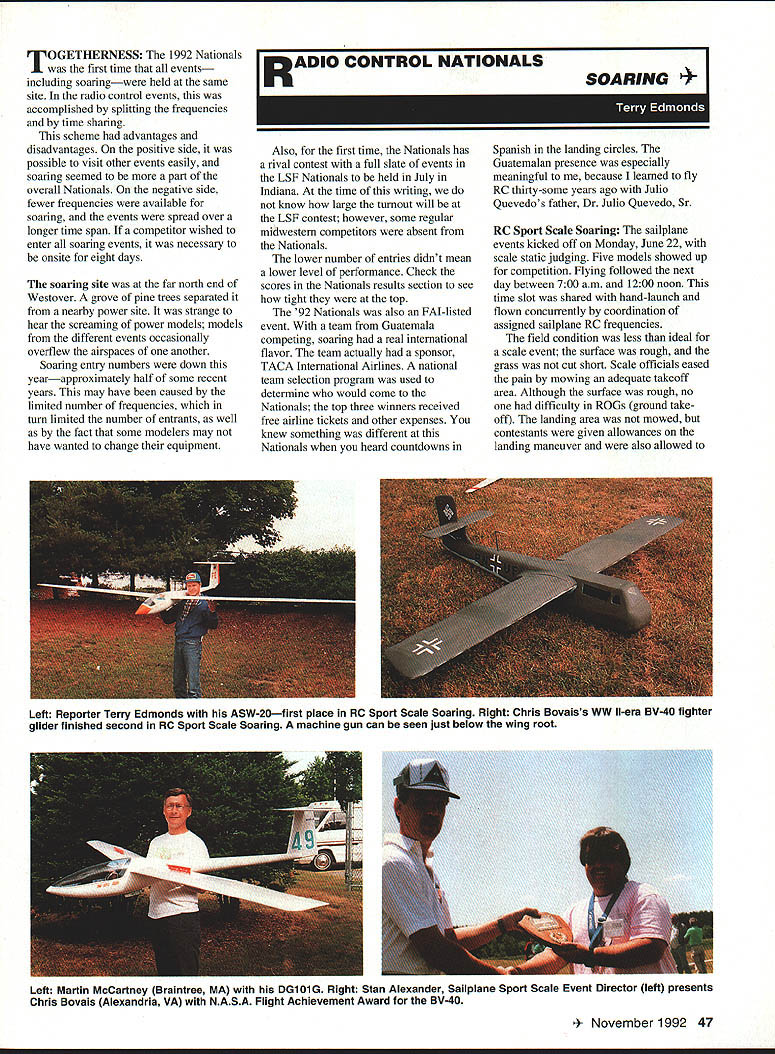
- Chris Bovais — a unique German Blohm & Voss BV-40 fighter glider. Chris scratch-built a 30%-scale, 94 in. wingspan model weighing 13 lb, foam covered with obeche (including the fuselage). Documentation was scarce; he obtained some from the Smithsonian. The design has a high sink rate and lends itself to aggressive maneuvers; Chris flew loops, rolls, split-esses, etc. He received the second-highest static and flying scores, finishing second overall, and earned the National Association of Scale Aeromodelers (N.A.S.A.) Flight Achievement Award.
- Terry Edmonds (reporter) — won the event with a 1/4-scale ASW-20, the third Nationals win in a row for that sailplane. The all-fiberglass model (finished in automotive acrylic lacquer) received the highest static and flying scores.
- Martin McCartney — entered a DG101G (Viking Models fuselage, built-up flying surfaces). A slightly rough first landing damaged his retracts and forced him to fly the remainder with gear up, resulting in a scoring penalty.
The rules allow competitors to change their maneuver routines between rounds; several contestants did so to try to improve scores. The new RC Sport Scale Soaring rules (now in their third year) have broadened the range of competitive glider designs — the BV-40 would not have been competitive under the old rules, and Chris said the new rules inspired his build.
Hand-Launched Sailplane
Hand-Launched Sailplane was scheduled for two half-days (Tuesday and Wednesday mornings). The task: six attempts for five official flights in a ten-minute slot, with a two-minute max. Fourteen competitors attended.
Tuesday morning required frequency sharing with Scale Sailplane, allowing only two hand-launch rounds before noon. Wednesday morning began with steady rain; officials postponed flying. Entrants were given permission to practice indoors in the base hangar — a first for many, and some free-flight hand-launched gliders actually achieved better times than the RC entries.
When the rain stopped in the early afternoon, Pete Carr arranged to move the event off base to the Pioneer Valley Radio Control Club (PVRCC) field in Connecticut. The PVRCC sod-farm site was ideal, and three more rounds were flown in improving weather.
Top finishers:
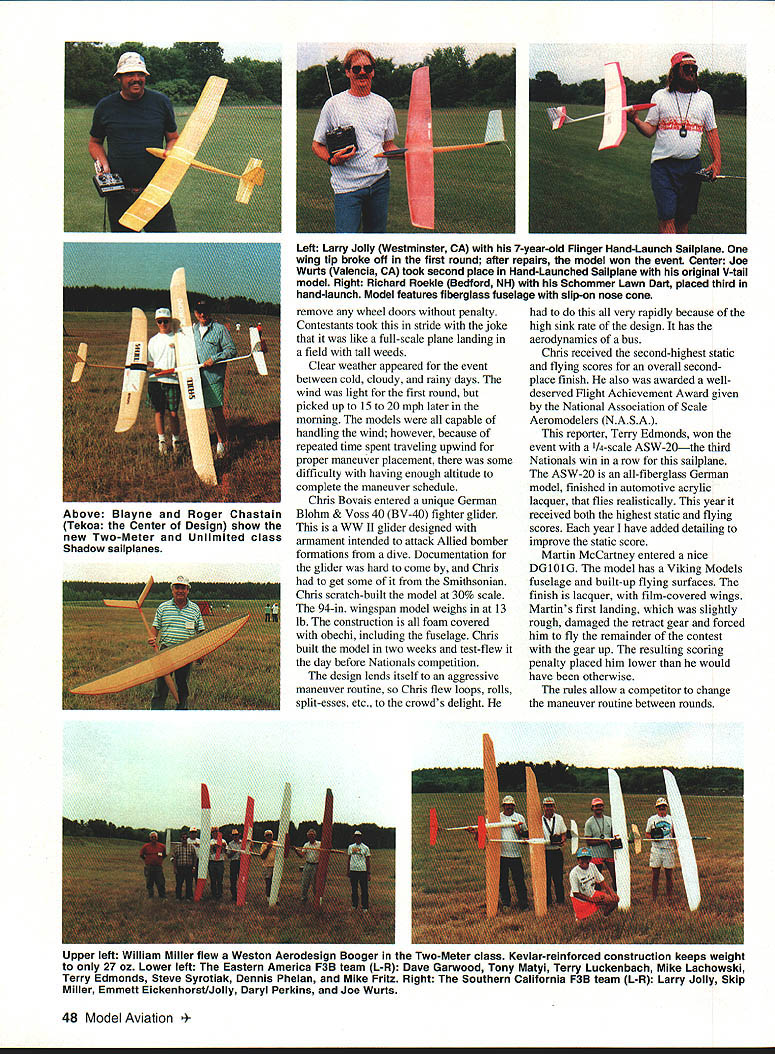
- Larry Jolly — won with a normalized perfect score. He flew a stock 60-in. Flinger (12 oz.) with Futaba S33 servos. His strategy: use the first launch to test the air, work a thermal bubble, return upwind to find the next bubble, have the timer count down for a two-minute precision, catch the model and relaunch.
- Joe Wurts — second with an all-composite fiberglass-and-foam model (387 airfoil, Airtronics 501 servos, 13 oz.). He used a similar technique to achieve 9:01 minutes in a 10-minute slot.
- Richard Roekle — third with a glass-fuselage, balsa-overlay 7032-wing model (12.7 oz., Kyosho KS10 servos).
F3B
This year’s F3B contest was probably the best-ever Nationals F3B, primarily because the entire Friday was devoted to it. With 12 entries, three complete rounds (duration, distance, speed) were completed. Weather was excellent: clear skies and light winds.
Notable competitors included:
- Joe Wurts — current F3B World Champion
- The entire 1991 U.S.A. F3B team
- Skip Miller — 1977 F3B World Champion
- Dale Nutter — member of the only U.S.A. team to win an F3B World Team title
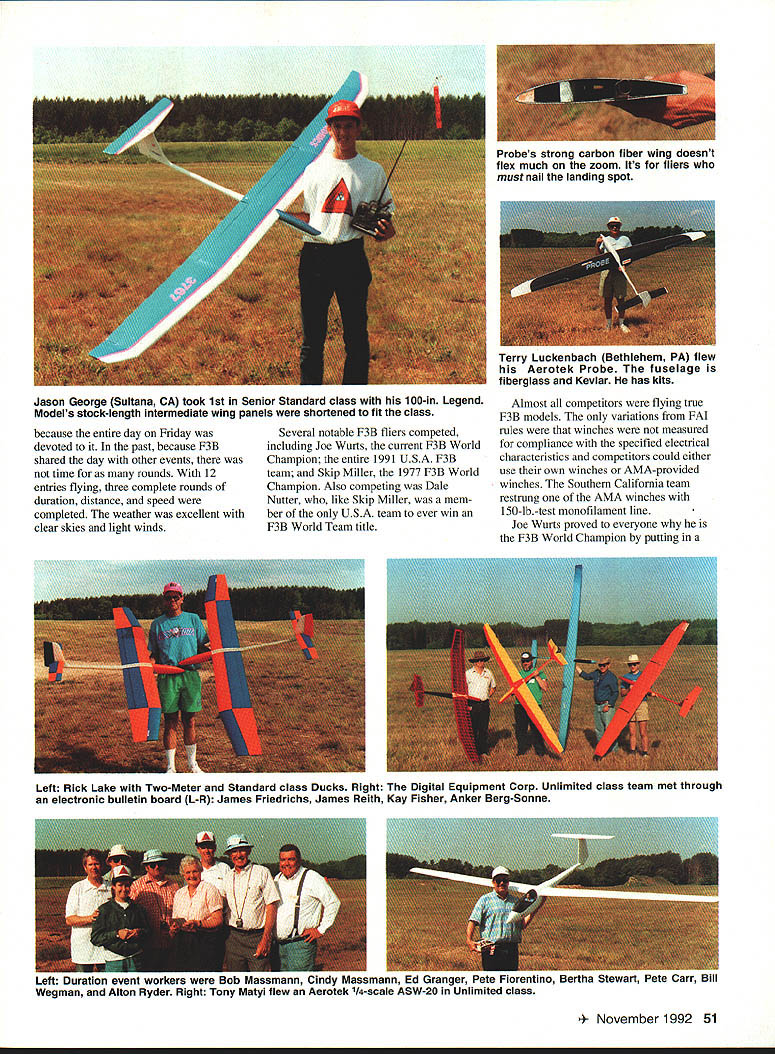
Joe Wurts posted a perfect 9,000 score. He flew an F3B Eagle (his former World Champs backup) with an RG15 airfoil, blue-foam unidirectional carbon-fiber/fiberglass vacuum-bagged wings, a stock fuselage, a Muller 4-mm carbon fiber joiner, and an Airtronics Infinity 1000 radio. The model weighs about 90 oz. and can carry up to four pounds of ballast; Joe flew speed with two pounds of ballast and distance/duration "dry."
Daryl Perkins placed second with an F3B Eagle built differently: 7003 hollow-core molded wings and hollow molded stabs (by Mark Allen). It weighs about 96 oz.; Daryl ballast ed an extra two to three pounds for speed. Larry Jolly flew a three-meter Muller Comet 89T and placed third. Notably, Joe, Daryl, and Larry finished in the same order they did at the 1991 World Champs.
Dennis Phelan successfully assembled a large Eastern America F3B team by advertising months ahead — the idea produced the largest regional F3B team at the Nationals.
Two-Meter
Saturday began with rain at the 7:00 a.m. pilots' meeting, but showers stopped by 8:00 a.m. Good lift developed early in round one. Excellent conditions prevailed until early in round three, when a thunderstorm halted the contest for a couple of hours. After the storm, conditions varied from sunshine to sprinkles, allowing only three rounds to be completed.
The task for 69 entries was seven-minute duration with an L6 (Graduated Runway) landing. Pete Carr changed the landing to "in or out" because of a manpower shortage. Tight scores resulted and three flyoffs were needed to decide trophy positions.
Results:
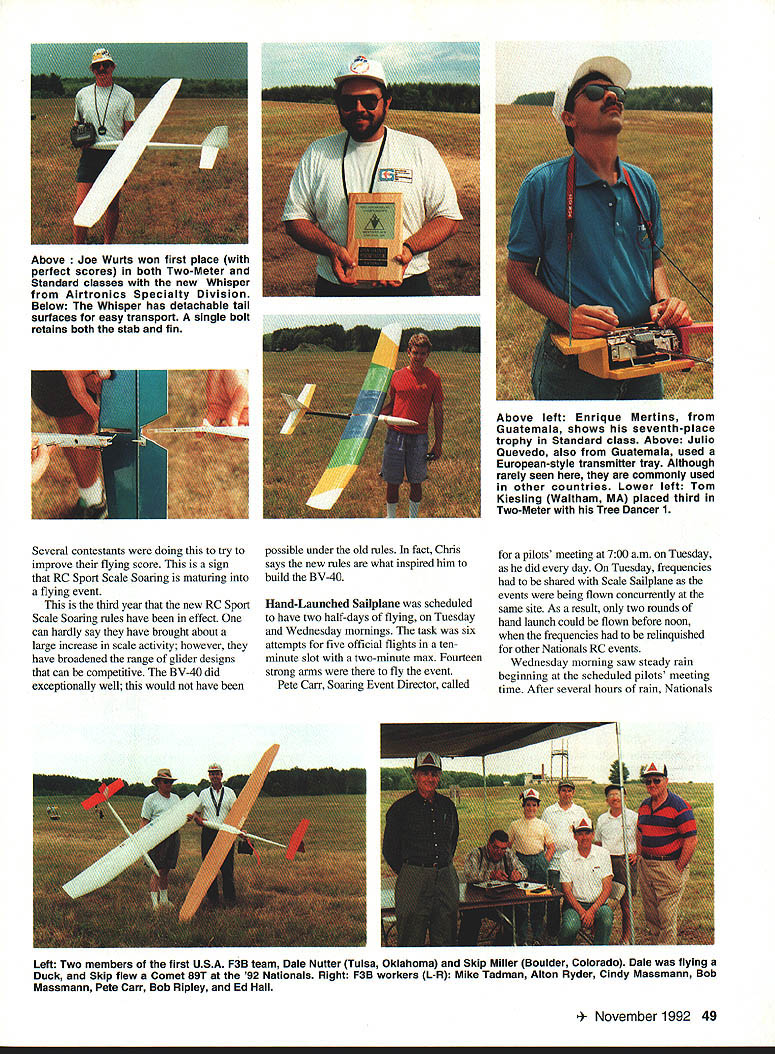
- Joe Wurts — winner, flying a Whisper (notable because Joe usually flies composites; this strong wood airplane receives hard launches like his composite ships).
- Ryan George — Junior Two-Meter winner, also flying a Whisper (he used a larger center wing panel later for Standard class).
- Flyoff for second: Larry Jolly vs. Tom Kiesling — Larry won (Larry flew an eight-year-old V-tail Icarus 205; Tom flew his original Tree Dancer II).
- Fourth-place flyoff: Ron Stanfield beat Dale Nutter.
- Tenth-place flyoff: Terry Edmonds beat Chris Ordzie.
- Blayne Chastain — won Senior class with a new Two-Meter Shadow.
Standard class
Sunday produced near-perfect soaring weather: light, variable winds, moderate temperatures, and abundant lift. With such conditions, near-perfect scores were needed to place.
Several hidden pitfalls affected competitors:
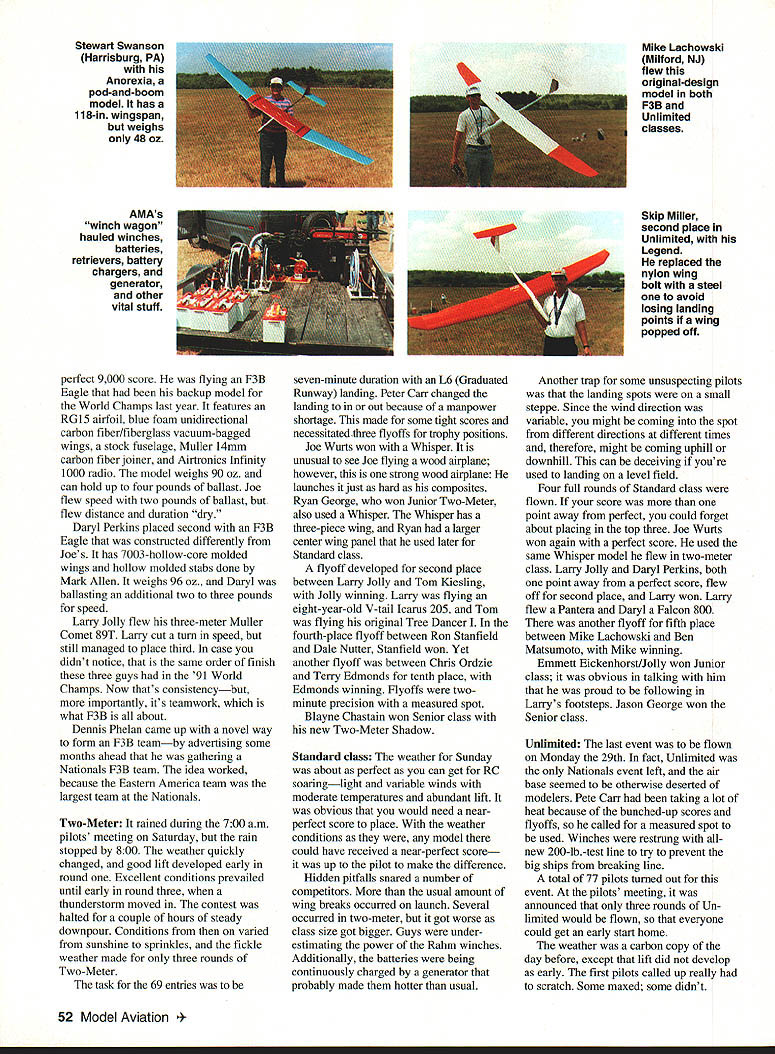
- An above-average number of wing cracks occurred on launch, worse as class size grew. Pilots were underestimating the power of the Rahm winches.
- Batteries were continuously charged by a generator that likely increased battery temperature.
- Landing spots were on a small slope; with variable winds pilots sometimes approached uphill or downhill, which can be deceiving if you expect a level field.
Four full rounds of Standard class were flown. If your score was more than one point off perfect, you likely could not place in the top three.
- Joe Wurts — won with a perfect score, flying the same Whisper used in Two-Meter.
- Flyoff for second: Larry Jolly beat Daryl Perkins (both were one point from perfect). Larry flew a Pantera; Daryl flew a Falcon 800.
- Flyoff for fifth: Mike Lachowski beat Ben Matsumoto.
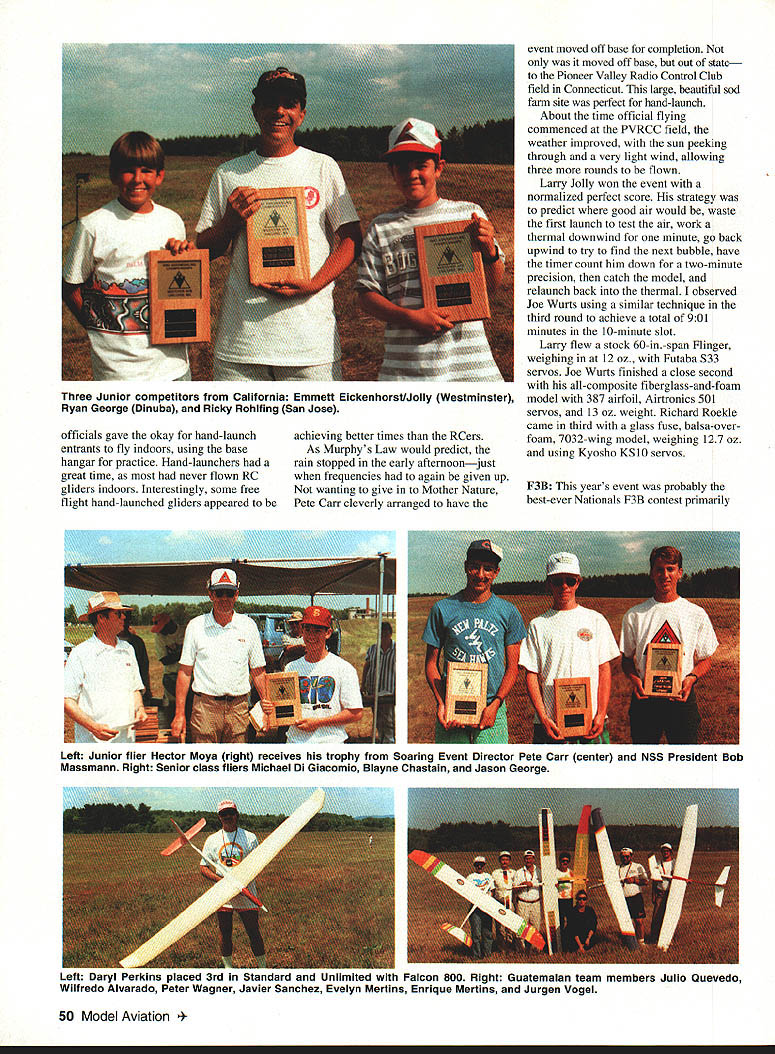
- Junior class: Emmett Eichenstocker (Joey) won Junior class.
- Senior class: Jason George won Senior.
Unlimited
Unlimited, the last event (Monday the 29th), drew 77 pilots. Pete Carr instituted a measured spot and winches were restrung with new 200-lb.-test line to help prevent breakage. Only three rounds were flown so competitors could get an early start home.
Weather mirrored the previous day, though lift developed later and early pilots had to scratch for lift. A flyoff decided the winner:
- Joe Wurts — won after a flyoff flight against Skip Miller.
- Flyoff for third: Daryl Perkins beat Mike Lachowski.
- Joe flew a vacuum-bagged Falcon 880 with flat tips; Skip Miller flew a stock Legend; Daryl Perkins flew a Falcon 800.
- Junior winner: Ryan George.
- Senior winner: Jason George.
Other notable entries and equipment:
- Terry Luckenbach — flew the Probe, a high-tech unlimited ship with a carbon-fiber/foam-cell sandwich E214 airfoil wing, hollow-core with no spar, made in top and bottom molds then joined. The wing joiner is an aircraft-grade aluminum tube; for ballasting it is replaced with a steel rod. Probes are available directly from Terry Luckenbach.
- Blayne Chastain — flew a 118-in. Shadow developed with his father, Roger. The design is a sparless obeche-sheeted foam core reinforced with carbon fiber and fiberglass; it is now being kitted. The kit uses a prefab, builder-friendly bagging technique and appears to be well made and reasonably priced.
Awards and team results:
- Joe Wurts made a clean sweep of all the duration events and won the Lee Renaud Overall Award and the Hi Johnson High Point Award.
- The Southern California team of Joe Wurts, Daryl Perkins, and Larry Jolly won the Dan Pruss Team Award.
Joe Wurts' achievements are unparalleled in RC soaring: being both F3B World Champion and Nationals Champion marks a unique and remarkable accomplishment. Hats off to Joe!
Transcribed from original scans by AI. Minor OCR errors may remain.

