
Radio Control: Old-Timer
Dee B. Mathews
FOR ENJOYMENT ONLY
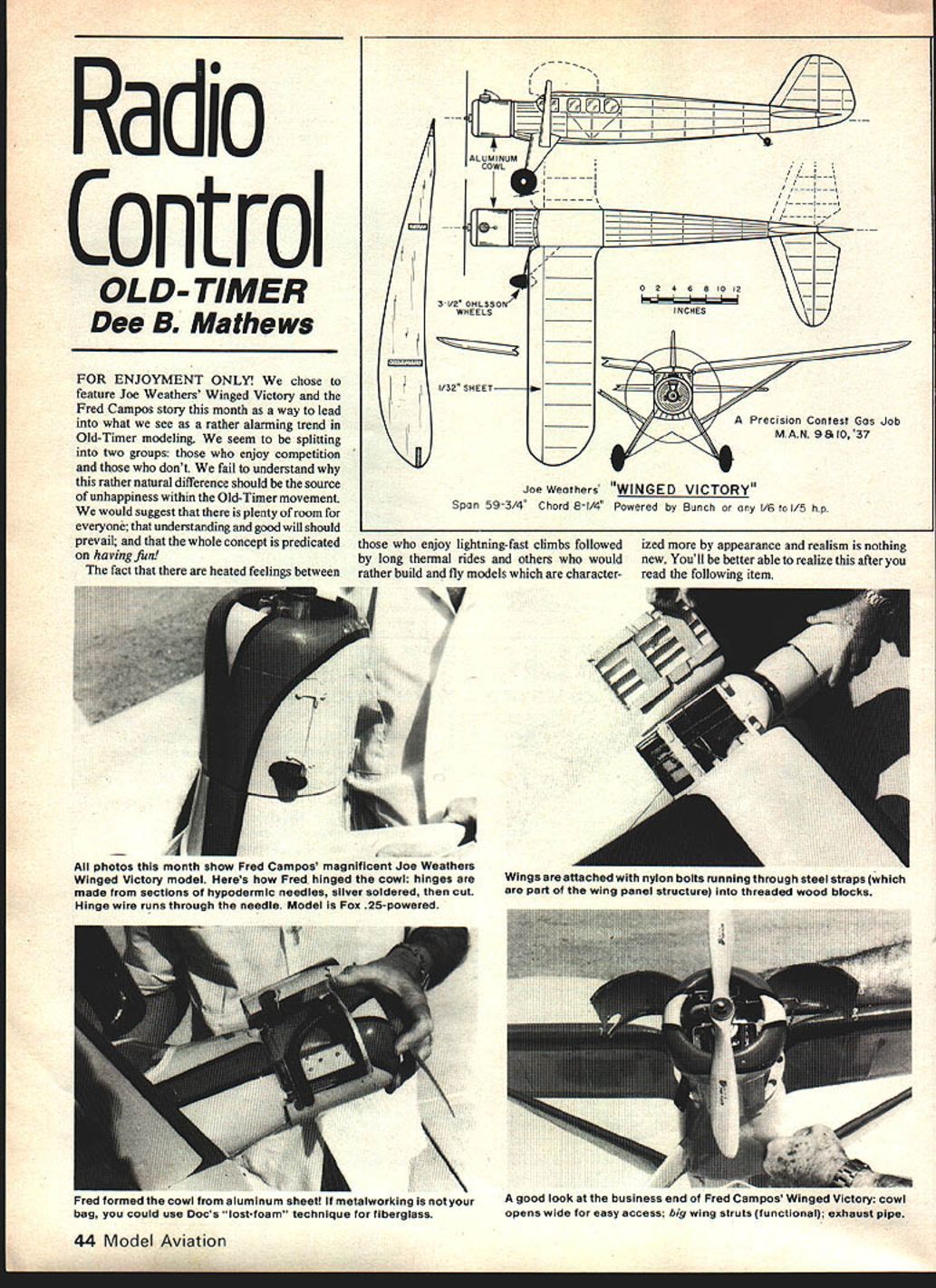
I chose to feature Joe Weathers' Winged Victory and Fred Campos' story this month because they lead into what I see as a rather alarming trend. Old-Timer modeling seems to be splitting into two groups — those who enjoy competition and those who don't. It's a natural difference and should not be a source of unhappiness within the Old-Timer movement. There's plenty of room for everyone; understanding and good will should prevail. The whole concept is predicated on having fun.
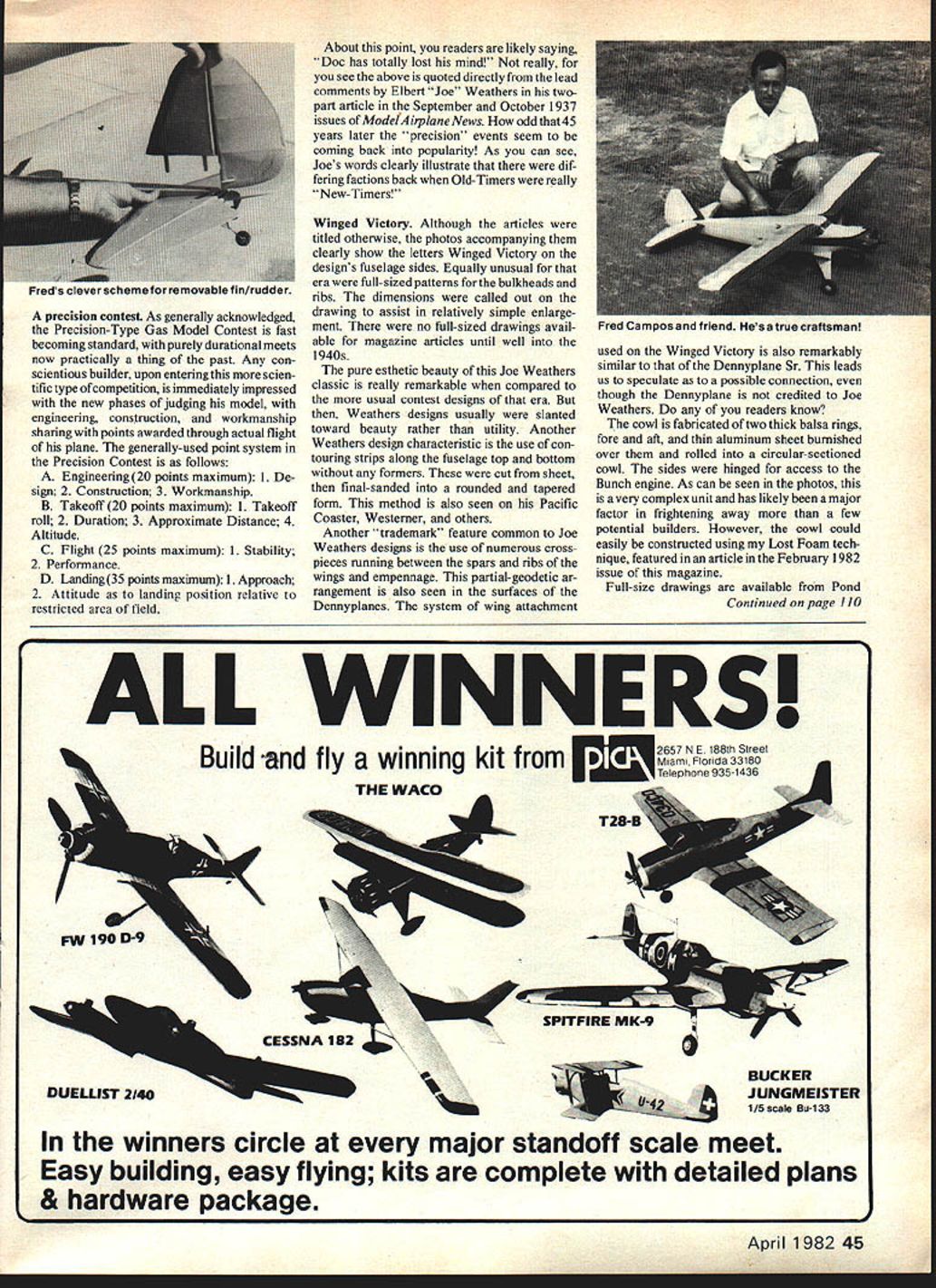
The photos this month show Fred Campos' magnificent Joe Weathers Winged Victory. The cowl hinges are made in sections from hypodermic needles silver-soldered and cut, with hinge wire running through the needle. The model is Fox .25-powered. Wings are attached with nylon bolts running through steel straps as part of the wing panel structure and threaded wood blocks. The cowl was re-formed from aluminum sheet; Doc's Lost-Foam technique or fiberglass can also produce a good result. The cowl opens wide for easy access, big wing struts are functional, and the exhaust pipe is a precision item.
Precision Contest
As generally acknowledged, the Precision-Type Gas Model Contest is fast becoming standard; purely durational meets are now practically a thing of the past. Any conscientious builder entering a scientific-type competition is immediately impressed by the expanded judging: engineering, construction and workmanship share points with those awarded for actual flight. The point system commonly used in the Precision Contest is as follows:
A. Engineering — 20 points maximum
- Design
- Construction
- Workmanship
B. Takeoff — 20 points maximum
- Takeoff roll
- Duration
- Approximate distance
- Altitude
C. Flight — 25 points maximum
- Stability
- Performance
D. Landing — 35 points maximum
- Approach
- Attitude (landing position relative to restricted area of field)
This point system is quoted from the lead comments by Elbert "Joe" Weathers in his two-part article in the September and October 1937 issues of Model Airplane News. It's interesting and rather odd that, 45 years later, precision events seem to be coming back into popularity. Joe's words clearly illustrate that differing factions existed even when Old-Timers were "New-Timers."
Winged Victory
Although the original articles were titled otherwise, the photos accompanying them clearly show the letters Winged Victory on the fuselage sides. Equally unusual for that era were full-size patterns for the bulkheads and ribs, with dimensions called out on the drawing to assist in relatively simple enlargement. Full-size drawings were not common in magazine articles until well into the 1940s.
Key design and construction features:
- Aesthetic emphasis: Weathers' designs generally favor beauty over pure utility; the Winged Victory is a fine example.
- Contouring strips: Top and bottom fuselage contouring strips are used without formers. These were cut from sheet, then final-sanded into a rounded, tapered form (seen also on the Pacific Coaster and Westerner).
- Partial-geodetic wing structure: Numerous crosspieces run between spars and ribs in the wings and empennage, a trait also seen on the Dennyplanes.
- Wing attachment: The wing-attachment system is strikingly similar to that used on the Dennyplane Jr., suggesting a possible connection.
- Cowl construction: The cowl is fabricated from two thick balsa rings (fore and aft) with thin aluminum sheet burnished and rolled into a circular-section cowl. The sides are hinged for access to the Bunch engine. Although complex, the cowl can be built more simply using a Lost-Foam technique (see February 1982 issue).
Full-size drawings are available from Pond Plans Service.
Plans and availability
- Pond Plans Service, P.O. Box 3215, San Jose, CA 95156.
Although the Winged Victory likely could never be competitive in a SAM contest as presently structured, the design is certainly appealing to those interested in the "more scientific type of competition," as Joe called it.
Fred Campos — craftsman
Fred Campos is a native of Cuba who was very active in Free Flight in that country for many years. He was an executive with the American Fruit Co. when Fidel Castro's revolutionaries toppled the Batista government. For the safety of his family and himself he emigrated to the United States, arriving in Florida with little more than the clothes on their backs and a handful of dollars, leaving behind a home, his bank account, and many modeling treasures.
Fred later moved to Wichita and worked at a dry cleaners while learning English. His managerial skills and intelligence led him to Beech Aircraft, where he became Director of Latin American Sales. He has an extensive scrapbook of modeling activities from pre-Castro Cuba; the photos were smuggled out a few at a time by his family and are priceless.
As can be seen in the photos, Fred Campos is a master craftsman. He builds beauty and has an enthusiasm for model aircraft — particularly Old-Timers — that is infectious. We will not detail the entire construction of his Winged Victory here; the photos and drawings tell much of the story.
Construction notes
- Cowl alternatives: The complex original cowl can be replicated more simply using the Lost-Foam method (see February 1982 issue) or fiberglass. Many builders adapt such parts for easier construction while retaining the model's appearance.
- Hinges and details: Hinges made from cut hypodermic-needle sections with hinge wire inside are an example of precise, small-scale craftsmanship. Functional struts, exhaust detail, and roomy cowl access are hallmarks of a finely finished model.
Silk covering — good news
Over ten years ago the Japanese government prohibited manufacture of dyed silk because aniline dyes were polluting wastewater. Thanks to new manufacturing techniques, dyed silk is again available. Esaki of Japan is now shipping eight colors:
- Red
- Orange
- Royal blue
- Silver
- Light yellow
- Dark yellow
- Rose pink
- White
This silk is being distributed in the U.S. by Sig and is available through local dealers. (Editor's note: other U.S. distributors have also advertised the material.)
Transcribed from original scans by AI. Minor OCR errors may remain.

