
Radio Control: Old-Timer
Dee B. Mathews
THE "OTHER" SNOW WHITE
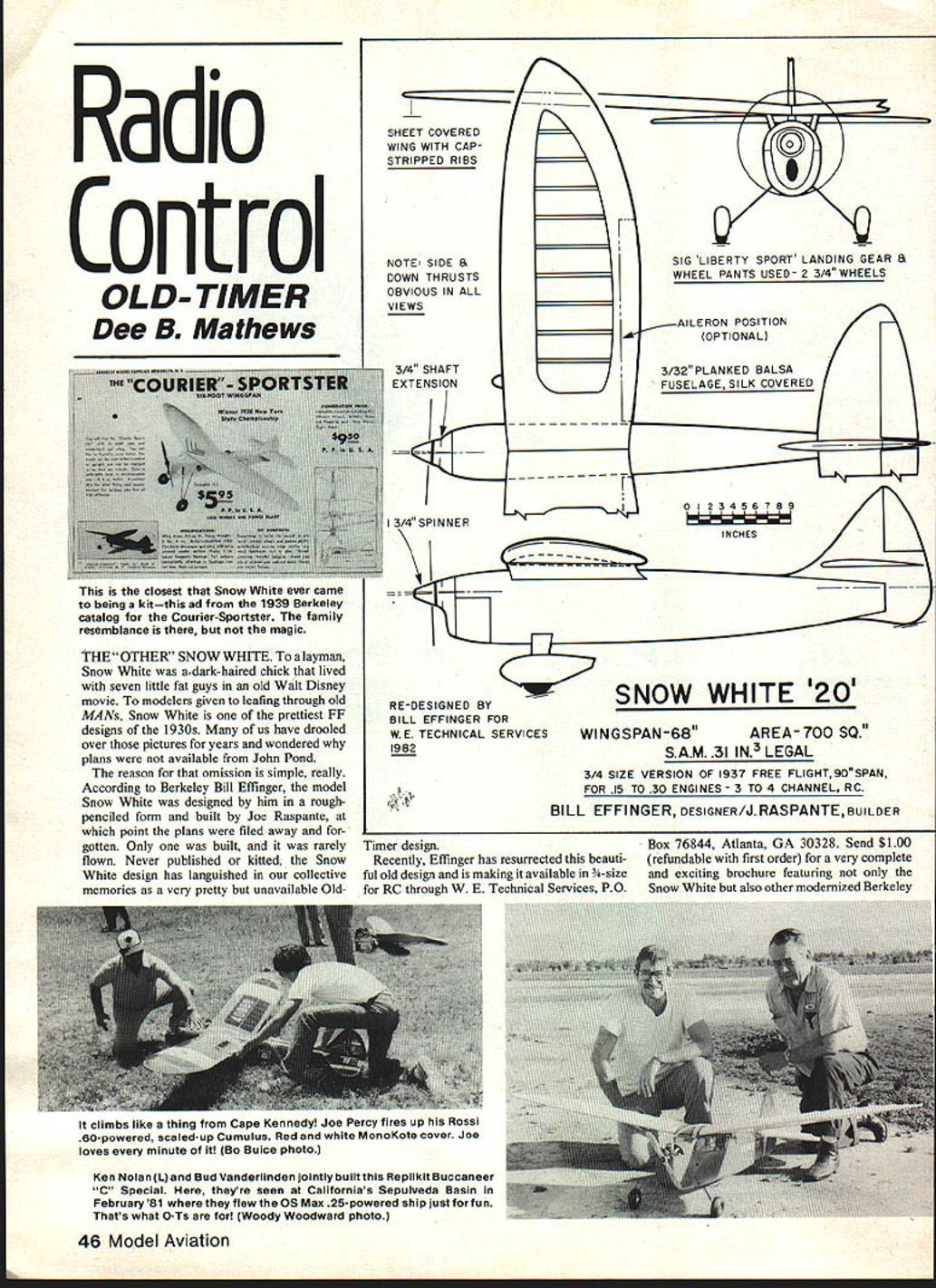
To a layman, Snow White was a dark-haired chick that lived with seven little fat guys in an old Walt Disney movie. To modelers given to leafing through old M.A.N.'s, Snow White is one of the prettiest free-flight designs of the 1930s. Many of us have drooled over those pictures for years and wondered why plans were not available from John Pond.
The reason for that omission is simple, really. According to Berkeley Bill Effinger, the model Snow White was designed by him in rough pencil form and built by Joe Raspante, at which point the plans were filed away and forgotten. Only one was built, and it was rarely flown. Never published or kitted, the Snow White design has languished in our collective memories as a very pretty but unavailable Old-Timer design.
Recently Effinger has resurrected this beautiful old design and is making it available in 3/4-size for RC through W. E. Technical Services, P.O. Box 76844, Atlanta, GA 30328. Send $1.00 (refundable with first order) for a very complete and exciting brochure featuring not only the Snow White but also other modernized Berkeley designs.
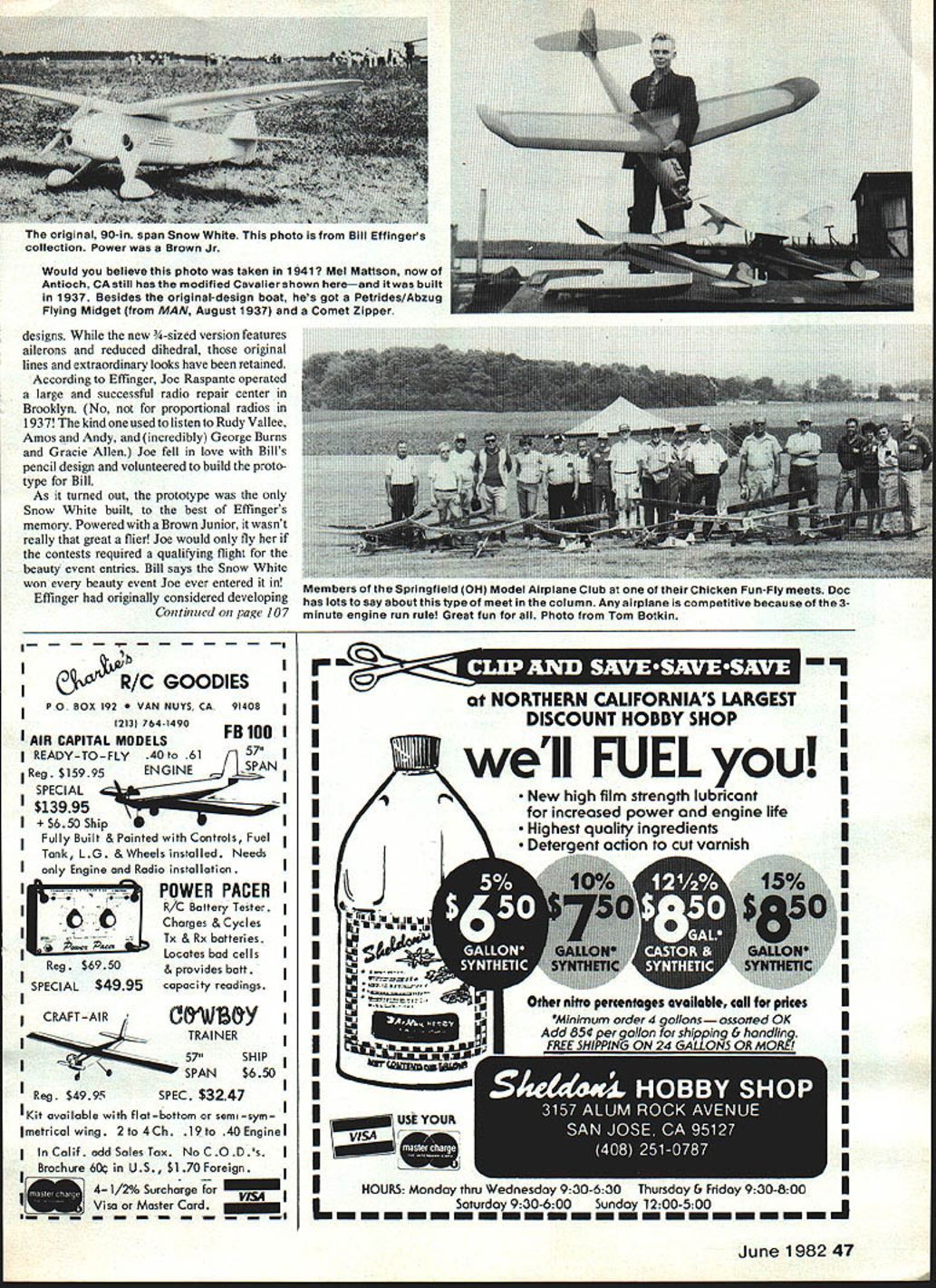
Would you believe this photo was taken in 1941? Mel Mattson, now of Antioch, CA, still has the modified Cavalier shown here — and it was built in 1937. Besides the original-design boat, he's got a Petrides/Abzug Flying Midget (from MAN, August 1937) and a Comet Zipper.
While the new 3/4-sized version features ailerons and reduced dihedral, those original lines and extraordinary looks have been retained.
According to Effinger, Joe Raspante operated a large and successful radio repair center in Brooklyn. (No, not for proportional radios in 1937! The kind one used to listen to Rudy Vallee, Amos and Andy, and — incredibly — George Burns and Gracie Allen.) Joe fell in love with Bill's pencil design and volunteered to build the prototype for Bill.
As it turned out, the prototype was the only Snow White built, to the best of Effinger's memory. Powered with a Brown Junior, it wasn't really that great a flier. Joe would only fly her if the contests required a qualifying flight for the beauty-event entries. Bill says the Snow White won every beauty event Joe ever entered it in.
Effinger had originally considered developing the design for kitting, but with the advent of the new limited-engine-run events and the declining interest in large models, the idea was not pursued. The Berkeley Courier Sportster was developed and kitted as a smaller, less complex model. Bill describes it as a "dog" but it did fly pretty well. Sales were disappointing, and the kit was dropped after a few years.
We chose to feature the Snow White this month as another example of the non-competition-type Old-Timer. It would be delightful to build and fly in the 90-inch original size, but it wouldn't have a prayer in competition with a Dallaire or similar. The 3/4-scale version should provide many of us with an opportunity to build and fly a Snow White after waiting all these years!
MEL MATTSON'S CAVALIER — 45 YEARS AND STILL FLYING
Now this really is incredible! Our two columns that featured the Berkeley Cavalier series elicited totally unexpected responses. Among those was one from Mel Mattson of Antioch, CA. Mel sent some photos of his Cavalier built from the first-run kits of the 1936 version.
Built in San Diego and first flown at Camp Kearny Mesa on February 21, 1937, the Cavalier is now 45 years old and still flying. Mel says it has taken color slides, movies, dropped soft drinks, beer, and champagne, as well as towing 300-foot banners.
The plane was in the fleet of the Night Hawks, the first model club in San Diego. Other members of that club included Bob Holland (engine man and several times National Champ) and Elbert "Joe" Weathers (Westemer, Mystery Man, Tubby, etc.). Mel says he still has his IGMAA pin. (The initials stand for International Gas Modelers Assoc. of America, a predecessor of our AMA.)
As can be detected from the photo, several modifications have been made over the years, but the basic shell remains Cavalier. While 45 years of continuous service may not be the record for model aircraft longevity, it certainly must place Mel Mattson's Cavalier in the top ten.
AIRBORNE MAGAZINE (AUSTRALIA) AND RC-ASSIST DOWN UNDER
An excellent model magazine is being printed in Australia called Airborne. Its pages include a monthly column titled "For Old-Timers" and "Timer's Sake," by Max Starick. The plans list from the magazine includes several Old-Timers, both rubber-powered and gas, including several delightful Frog kit designs and the popular Simplex by Paul Plecan. Subscriptions are available at 11 Cornwall Close, Gladstone Park, Victoria, Australia, 3043.
RC-assist Old-Timer is just beginning to catch on in the Southern Hemisphere. The activity has thus far been pretty much an informal affair. However, a set of rules has now been published, and the competitive juices are beginning to flow. Although, in our opinion, their rules are going to present a batch of problems, time will distill them into something more workable, and the events will undoubtedly become equally popular "down under."
SOME QUOTES
Jim Adams, editor of SAM Speaks, speaks out in the September/October issue:
"We see and hear from many guys who have just rediscovered the joy of Old-Timers. Locating that first old engine, putting together sticks for their first gas model in 35 years, rediscovering silk-and-dope. The pleasant discovery that the passing years have given them more patience and more understanding of the mysteries of flight.
"Letters from individuals in out-of-the-way places, flying by themselves or in little groups and clubs, tell how much fun it is to get together and enjoy watching each other fly those strange old, docile birds we call Old-Timers.
"Could it be that all this rule making is completely missing the point of how to increase the fun? The light vote count on the ballot just completed (less than 20% of the SAM members participated) would indicate that a very large contingent of SAM members don't care what is done to the rules. It could be that our desire to create a perfect set of rules for the competitive fliers is missing the needs of the majority of the members."
A letter from Tom Botkin of Urbana, OH:
"Many lovers of the Old-Timer models find the 'more power per ounce the better' style of flying really turns them off when it comes to any type of competition. We are just plain uninterested by the hot-climbing, screaming-engined Old-Timer that should be an otherwise majestic, slow-flying old bird."
SOME THOUGHTS
Competition in its various forms is the heart of the democratic system. The desire to excel at a given task and to receive the resultant rewards is, in reality, the "great motivator" behind every success story in our society. The effort-reward factor is prevalent in all our activities—whether business or pleasure. Truly, competition makes the world go around.
The current state of the art in our hobby is the direct result of the impetus provided by competition, both on the contest scene and in the manufacturing and selling of hobby-related products. Without competition, we might well still be using rubber-driven escapements purchased at terribly high prices.
For many active modelers, competition meets a need. It provides an outlet for creative drive and is a wholesome and definitely rewarding activity.
However, for many modelers the competitive pressures of their everyday world preclude their desire to project those same pressures into their hobby. These modelers use their hobby as an escape from workaday competitive pressure. To them, constructing and flying model aircraft is a "mini-vacation." The hours spent building, reading about, or flying model aircraft are an opportunity to put aside the "real" world—a time to relax and enjoy, a few moments in which they can indulge themselves in pleasure and happiness. Modeling activities are, for them, a time to recover and recharge—not a time of high-tension drama, but a time of joy.
This writer observes a growing groundswell of interest in low-pressure, fun-fly type activities around the U.S. While the large contest setting continues to attract (and we presume satisfy) the more competition-oriented modelers, an increasing number of "social" contests are appearing. Some local groups are leaning more to the type of events that produce a preponderance of laughter rather than "gotcha." An example of that approach is pointed out in the Springfield (OH) Model Airplane Club (SMAC) "Chicken" events.
THE CHICKEN FUN-FLY (SMAC)
For the last several years, SMAC has been experimenting with a fun-style contest that has really caught on and brought many new faces into the Old-Timer activities in Ohio. They have devised an event that allows Old-Timers of all sizes and with all types of power plants to compete on an even basis against each other in a slow-flying, relaxing, low-key manner.
Rules and format (SMAC "Chicken" Fun-Fly):
- Any plane is allowed three minutes for engine run to climb to its thermaling height. This long climb time removes any advantage from high-revving, screaming engines.
- After the flier reaches the desired altitude and shuts down the engine, he hands the transmitter to the timer, who then starts the stopwatch.
- The plane is allowed to free-fly until the contestant feels it is drifting too far downwind or otherwise checks out and takes back the transmitter, at which point the watch is stopped.
- SMAC sets a seven-minute maximum and three rounds per contestant to avoid excessively long flights and to free the frequency for others.
Scoring:
- 1 point per second of free flight.
- 120 points deducted for landing off the field.
- 30 bonus points for landing inside a 25-foot circle.
- Three flights are totaled.
This event puts as much emphasis on good trimming and piloting skills as possible, with virtually no reason to go for a high-powered screamer. The old ignition-engine bird should be just as competitive as the screamer. In our opinion, this concept sounds like really great fun and one that could well come close to combining free-flight skills with the assistance of radio.
Our thanks to Tom Botkin for sharing this with us. If other groups are playing with this type of approach, we would be most interested in hearing from them.
For further information on the "Chicken" event, send a large self-addressed envelope to: Tom Botkin, 945 Woodale Drive, Urbana, OH 43078.
A COMMON THREAD
This month we have attempted to illustrate the wide diversity of Old-Timer RC-assist with photos and text. We are trying to make a point. Simply stated: building and flying these old birds is for fun! That common denominator should unite us, not be the source of schism and discontent.
Let us not lose sight of the joy we can derive from the fun someone else is experiencing. Let us avoid making judgments based on our own preference, but rather use those based on the brotherhood that is peculiar to happy people. Your joy is my joy, and mine yours: we are brothers!
Dee B. Mathews 506 South Walnut, Greensburg, KS 67054.
Transcribed from original scans by AI. Minor OCR errors may remain.

