
Radio Control OLD-TIMER
Dee B. Mathews
Resurgence
One of the more satisfying aspects of my activities as the RC Old-Timers Contributing Editor has been to see many long-forgotten model designs reappear in the hands of O-T enthusiasts and prove themselves to be superior fliers. Many of these planes have a great deal of elegance—especially when they're in flight. Once someone rediscovers one of these ancient goodies, builds it, and flies it in a few SAM contests (and, especially if they win with it), we see more and more of them appear at the flying fields. I can only hope that my efforts in this direction have enabled others to find greater enjoyment in this fine hobby.
Our Old-Timer of the month in February 1980 was Joe Percy's version of the Marquardt Riser Rider. At that time the design was rarely seen in SAM contests—now, of course, it has established itself as an excellent choice.
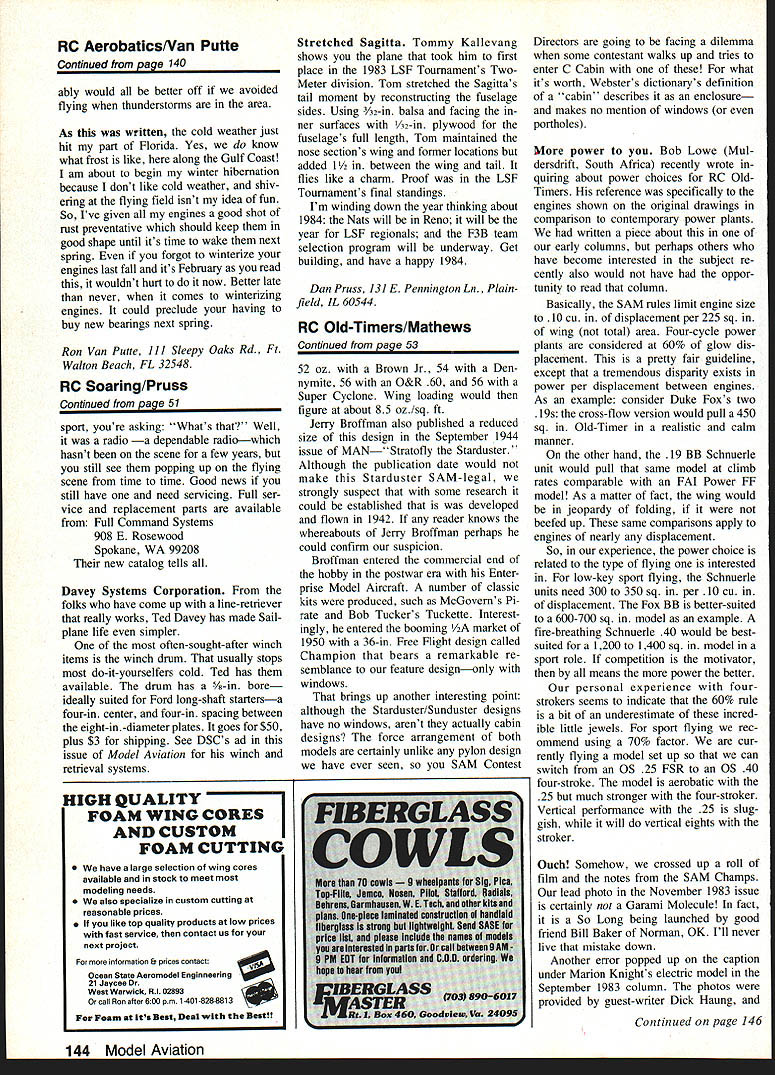
Another "sleeper" has been the Roger Hammer Flamingo, our Old-Timer of the Month for July 1979. Rob Williams demonstrated to one and all at the 1983 SAM Champs that this design is not just another pretty face but a superb competition machine. Williams placed second in Texaco—and in the first competition he'd ever entered!
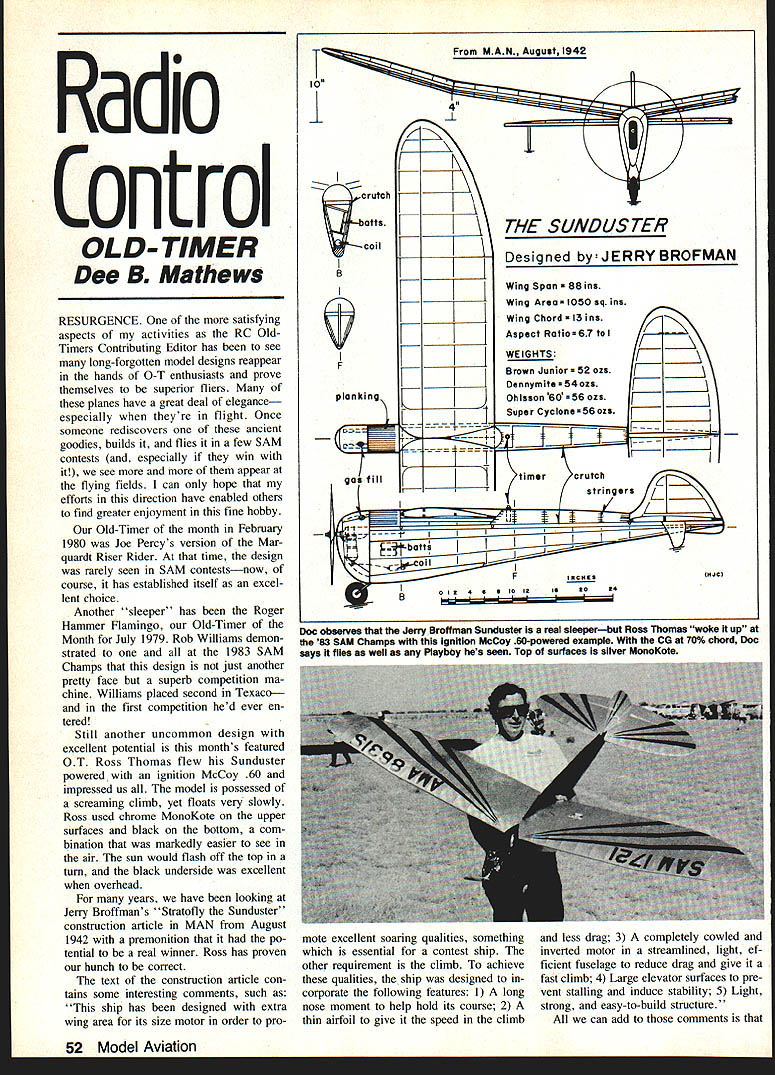
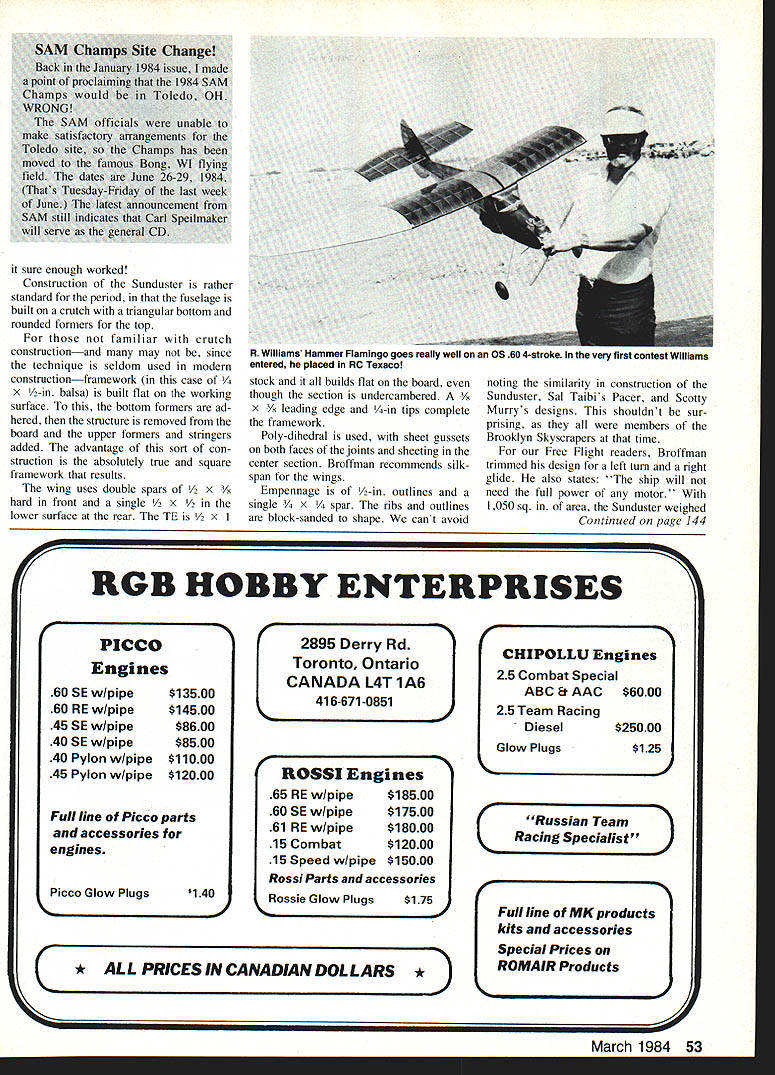
Still another uncommon design with excellent potential is this month's featured O.T. Ross Thomas flew his Sunduster powered with an ignition McCoy .60 and impressed us all. The model is possessed of a screaming climb, yet floats very slowly. Ross used chrome MonoKote on the upper surfaces and black on the bottom, a combination that was markedly easier to see in the air. The sun would flash off the top in a turn, and the black underside was excellent when overhead.
For many years, we have been looking at Jerry Broffman's "Stratofly the Sunduster" construction article in MAN from August 1942 with a premonition that it had the potential to be a real winner. Ross has proven our hunch to be correct.
The text of the construction article contains some interesting comments, such as:
- "This ship has been designed with extra wing area for its size motor in order to promote excellent soaring qualities, something which is essential for a contest ship.
- The other requirement is the climb. To achieve these qualities, the ship was designed to incorporate the following features:
- a long nose moment to help hold its course;
- a thin airfoil to give it the speed in the climb and less drag;
- a completely cowled and inverted motor in a streamlined, light, efficient fuselage to reduce drag and give it a fast climb;
- large elevator surfaces to prevent stalling and induce stability;
- light, strong, and easy-to-build structure."
All we can add to those comments is that it sure enough worked!
Construction
Construction of the Sunduster is rather standard for the period, in that the fuselage is built on a crutch with a triangular bottom and rounded formers for the top.
For those not familiar with crutch construction—and many may not be, since the technique is seldom used in modern construction—framework (in this case of 1/4 x 1/2-in. balsa) is built flat on the working surface. To this, the bottom formers are adhered, then the structure is removed from the board and the upper formers and stringers added. The advantage of this sort of construction is the absolutely true and square framework that results.
The wing uses double spars of 1/2 x 3/8-in. hard in front and a single 1/8 x 1/4-in. in the lower surface at the rear. The TE is 1/8 x 1/4-in. stock and it all builds flat on the board, even though the section is undercambered. A 3/8-in. leading edge and 1/4-in. tips complete the framework.
Poly-dihedral is used, with sheet gussets on both faces of the joints and sheeting in the center section. Broffman recommends silkspan for the wings.
Empennage is 1/8-in. outlines and a single 3/16 x 1/4-in. spar. The ribs and outlines are block-sanded to shape. We can't avoid noting the similarity in construction of the Sunduster, Sal Taibi's Pacer, and Scotty Murry's designs. This shouldn't be surprising, as they all were members of the Brooklyn Skyscrapers at that time.
Performance and Specifications
For our Free Flight readers, Broffman trimmed his design for a left turn and a right glide. He also states the ship "will not need the full power of any motor." With 1,050 sq. in. of area, the Sunduster weighed 52 oz. with a Brown Jr., 54 oz. with a Dennymite, 56 oz. with an O&R .60, and 56 oz. with a Super Cyclone. Wing loading would then figure at about 8.5 oz./sq. ft.
Starduster and Broffman's Later Work
Jerry Broffman also published a reduced size of this design in the September 1944 issue of MAN—“Stratofly the Starduster.” Although the publication date would not make this Starduster SAM-legal, we strongly suspect that with some research it could be established that it was developed and flown in 1942. If any reader knows the whereabouts of Jerry Broffman perhaps he could confirm our suspicion.
Broffman entered the commercial end of the hobby into the postwar era with his Enterprise Model Aircraft. A number of classic kits were produced, such as McGovern’s Pirate and Bob Tucker’s Tuckette. Interestingly, he entered the booming 1/2A market of 1950 with a 36-in. Free Flight design called Champion that bears a remarkable resemblance to our feature design—only with windows.
That brings up another interesting point: although the Starduster/Sunduster designs have no windows, aren’t they actually cabin designs? The fuselage arrangement of both models is certainly unlike any pylon design we have ever seen, so you SAM Contest Directors are going to be facing a dilemma when some contestant walks up and tries to enter C Cabin with one of these! For what it’s worth, Webster’s dictionary’s definition of a “cabin” describes it as an enclosure—and makes no mention of windows (or even portholes).
Power Choices — Guidance and Experience
More power to you. Bob Lowe (Muldersdrift, South Africa) recently wrote inquiring about power choices for RC Old-Timers. His reference was specifically to the engines shown on the original drawings in comparison to contemporary power plants. We had written a piece about this in one of our early columns, but perhaps others who have become interested in the subject recently also could not have had the opportunity to read that column.
Basically, the SAM rules limit engine size to 10 cu. in. in displacement per 225 sq. in. of wing (not total) area. Four-cycle power plants are considered at 60% of glow displacement. This is a pretty fair guideline, except that a tremendous disparity exists in power per displacement between engines. As an example: consider Duke Fox’s two .19s: the cross-flow versions would pull a 450 sq. in. Old-Timer in a realistic and calm manner.
On the other hand, the .19 BB Schnuerle unit would pull that same model at climb rates comparable with an FAI Power FF model! As a matter of fact, the wing would be in jeopardy of folding if it were not beefed up. These same comparisons apply to engines of nearly any displacement.
So, in our experience, the power choice is related to the type of flying one is interested in.
- For low-key sport flying, the Schnuerle units need 300 to 350 sq. in. per .10 cu. in. of displacement.
- The Fox .18 is better-suited to a 600–700 sq. in. model as an example.
- A four-stroke Schnuerle .40 would be best-suited for a 1,200 to 1,400 sq. in. model in a sport role.
- If competition is the motivator, then by all means the more power the better.
Our personal experience with four-strokers seems to indicate that the 60% rule is a bit of an underestimate of these incredible little jewels. For sport flying we recommend using a 70% factor. We are currently flying a model set up so that we can switch from an OS .25 FSR to an OS .40 four-stroke. The model is aerobatic with the .40 but much stronger with the four-stroke. Vertical performance with the .25 is sluggish, while it will do vertical eights with the stroker.
Corrections and Errata
Ouch! Somehow, we crossed up a roll of film and the notes from the SAM Champs. Our lead photo in the November 1983 issue is certainly not a Grami Molecule! In fact, it is So Long being launched by good friend Bill Baker of Norman, OK. I’ll never be able to thank my friend enough.
Another error popped up on the caption under Marion Knight’s electric model in the November 1983 column. The photos were provided by guest-writer Dick Huang, and we misinterpreted his information—the model is not a Laurie Experiment, but a Zaic design from the Yearbook. Frank tells us that Marion's may well be the first one ever built, since he only drew it up as a teaser!
Finally, we captioned the Bill Winter Citizen photo in the March 1983 column as the Citizen, powered with a Mills 1.3 diesel. Bill says it was an E.D. (Well, it looked like a Mills!)
Those are the errors we are aware of. Lord knows what else we've done! One thing about it: those of us who write sometimes wonder if anyone is reading our work. Man, make a mistake and you quickly learn you're being read!
Toys and Tools
We've been using one of Bob Davis' clever little hand drills and wouldn't be without it. The thing has the bits inside a screw-capped chamber, which sure helps keep track of them. It is a particularly handy device for drilling holes inside confined spaces. Our pet use is making holes for the servo screws. Very useful tool!
Joe Utasi (Jomar) has a speed-controller for electric-powered units with a very useful feature or two. Most prominent is an over-ride that can be used to actuate relays. On the low end, one of the relays can be used to short across the motor windings through a 1-ohm resistor to act as a brake, which will stop the prop. This is for those using folding props. The Jomar SC-2 unit is well-made and is a very useful device.
Those wide-bladed Y & O props that so many ignition runners seem to prefer are available from Y & O Props, P.O. Box 983, Walnut Grove, CA 95680, or phone 916-776-1371. These also work well on the new four-strokers.
Got an oddball, mister?
We always need photos of unusual Old-Timer subjects. We can now use good-quality color prints and slides, so send us a picture or two of your Flying Aces Dragon Fly or Peerless Black Hawk, etc.
Dee B. Mathews 506 South Walnut Greensburg, KS 67054
Transcribed from original scans by AI. Minor OCR errors may remain.

