
Radio Control: Old-Timer
Dee B. Mathews
Introduction
Three facts have been running around in my head lately:
- The West Coast SAM Champs will award all low-wing planes a 50% increase in flight times, up to the limit for a max.
- Bill Winter beat Doc to the punch in featuring Sadler's low-wing Pacemaker design.
- A thermal has no idea where a model's wing is located.
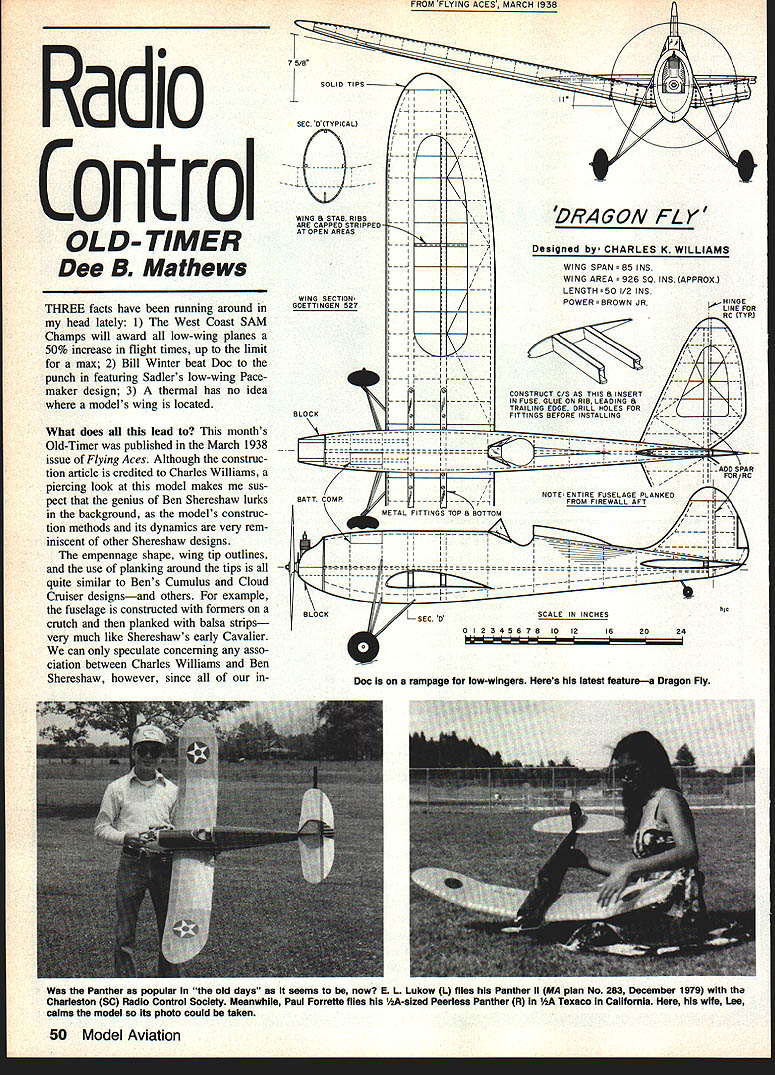
What does all this lead to? This month's Old-Timer was published in the March 1938 issue of Flying Aces. Although the construction article is credited to Charles Williams, a piercing look at this model makes me suspect the genius of Ben Shereshaw lurks in the background, as the model's construction methods and dynamics are very reminiscent of other Shereshaw designs.
The empennage shape, wing tip outlines, and the use of planking around the tips are all quite similar to Ben's Cumulus and Cloud Cruiser designs — and others. For example, the fuselage is constructed with formers on a crutch and then planked with balsa strips — very much like Shereshaw's early Cavalier. We can only speculate concerning any association between Charles Williams and Ben Shereshaw; since all of our inquiries remain unanswered I shall therefore leave the connection a mystery and let familiar Shereshaw designs draw their own conclusions.
The Dragon Fly (Old-Timer)
Flying Aces states the following about the model: "Combining scale model appearance and excellent flying characteristics, the 85-in.-spanned Dragon Fly cheerily belies the theory that a heavily-loaded gas model will not perform well." The Dragon Fly, a strongly built low-wing monoplane, has a very high rate of climb, smooth glide and is very stable during flight. What could the modeler want?
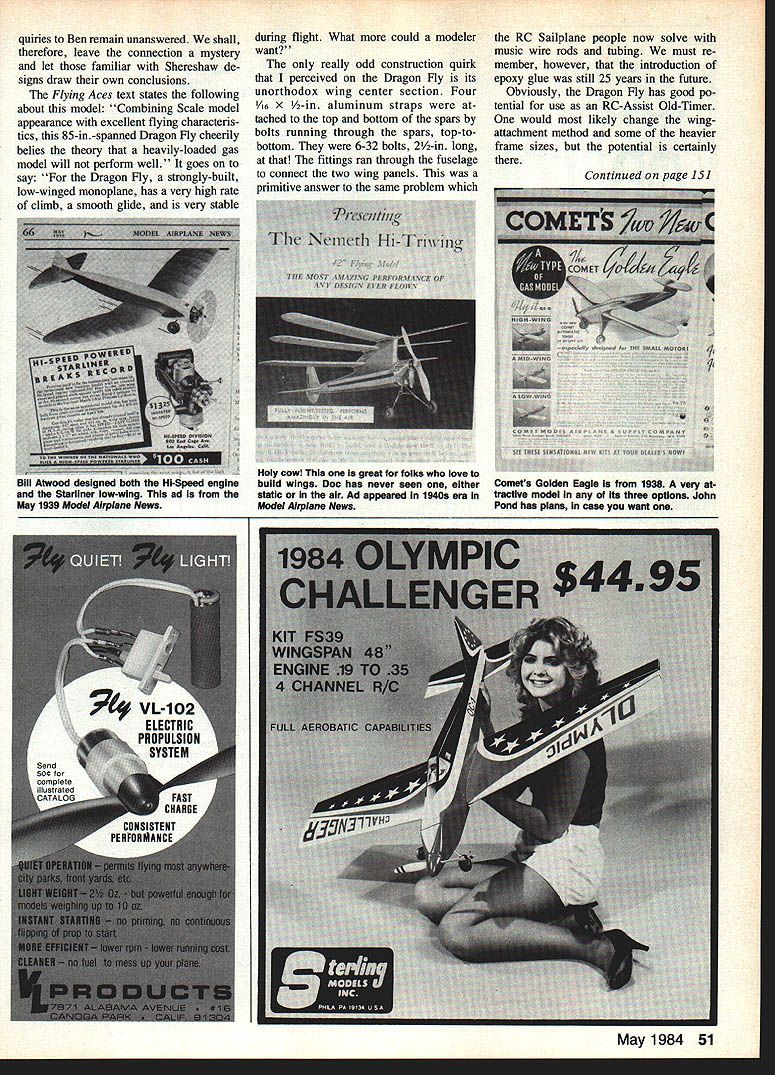
One really odd construction quirk perceived in the Dragon Fly is its unorthodox wing center section. Four 1/16 x 1/2-in. aluminum straps attached to top and bottom spars, with bolts running through the spars top-to-bottom — 6-32 bolts 2-1/2 in. long — fittings ran through the fuselage to connect the two wing panels. A primitive answer to the same problem RC sailplane people now solve with music-wire rods and tubing. Must remember, however, the introduction of epoxy glue was still 25 years in the future.
Obviously the Dragon Fly has good potential for use as RC-assist. Old-Timer would likely change the wing-attachment method for some heavier-frame sizes; potential certainly exists. No primary-article text for "Radio Control: Old-Timer" appears on this scanned page beyond the continuation notice; the page contains photos, captions, and advertisements.
The natural hinge lines of the rudder and elevator would be fine. A 1/8-inch-chord balance point would be a good starting place with a Goettingen 527 airfoil, and something in excess of the original's 1/5- to 1/6-horsepower power plant would be nice.
We chose to present the Dragon Fly as an example of low-wing designs which could be highly competitive with or without a .50's flight-time bonus. I, frankly, have never seen an example of the Dragon Fly in flight and find that puzzling. So, who'll be the first to order plan No. 263 from John Pond (P.O. Box 3215, San Jose, CA 95156) and send me a photo?
Other Low-Wing Designs
More low wings. Paul Forrette (Ben Lomond, CA) has been winning 1/2A Texaco rather regularly with his Peerless Panther, thereby proving to many that the old wives' tales about nasty habits with low wings are unfounded. He is hard at work on a slightly enlarged version and has been getting excellent results.
Comet's Golden Eagle is a seldom-seen design in any of its three options for wing location. A photo of the ad from the April 1938 Model Airplane News shows all three versions (high-, mid- and low-wing) and is reproduced on John Pond plan No. 7C3. This 45-in.-span design would present some challenges in construction and RC installation, but it would certainly be something to get you out of the Playboy rut!
Bill Atwood's Starliner is still another seldom-seen design — yet one with lots of charm and potential. The old ad in the May 1939 Model Airplane News proves the point: "With an inverted Hi-Speed engine, the Starliner captured first place in the Low-Wing event and placed second in the Speed 'Small Model' event." I saw the Starliner at Pomona, Calif.; it is one of those sensational models that still turns heads. The Starliner has been built from coast to coast in competition for the $50 Starliner prize contest on April 8th.
Of course, Bill Atwood was the designer of both the Hi-Speed engine and the model, and he was a master at Free Flight; this makes me believe that the Starliner is loaded with potential. The span of 54 in. and the wing area of 445 sq. in. makes it perfectly SAM-legal for a .19 cu. in. engine (that's based on the SAM rule of 225 sq. in. for each 10 cu. in. of displacement).
Nemith Hi-Triwing
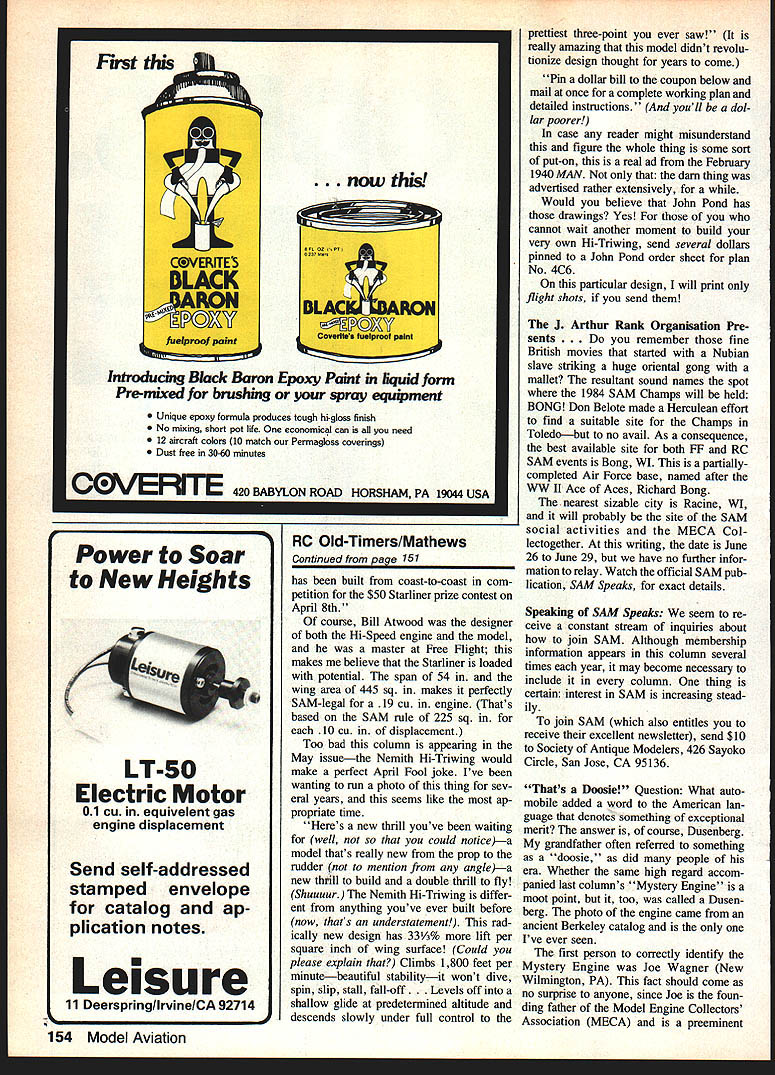
Too bad this column is appearing in May issue — the Nemith Hi-Triwing would make a perfect April Fool joke. I've been wanting to run a photo of this thing for several years, and this seems like the most appropriate time.
"Here's a new thrill you've been waiting for (well, not so that you could notice)—a model that's really new from the prop to the rudder (not to mention from any angle)—a new thrill to build and double thrill to fly! (Shuurr...) The Nemith Hi-Triwing is different from anything you've ever built before (now, that's an understatement!). This radically new design has 33 1/3% more lift per square inch of wing surface! (Could you please explain that?) Climbs 1,800 feet per minute—beautiful stability—it won't dive, spin, slip, stall, fall-off... Levels off into a shallow glide at predetermined altitude and descends slowly under full control to the prettiest three-point you ever saw!" It is really amazing that this model didn't revolutionize design thought for years to come.
"Pin a dollar bill to the coupon below and mail at once for a complete working plan and detailed instructions." (And you'll be a dollar poorer!)
In case any reader might misunderstand this and figure the whole thing is some sort of put-on, this is a real ad from the February 1940 Model Airplane News. Not only that: the darn thing was advertised rather extensively, for a while.
Would you believe that John Pond has those drawings? Yes! For those of you who cannot wait another moment to build your very own Hi-Triwing, send several dollars pinned to a John Pond order sheet for plan No. 4C6.
On this particular design, I will print only flight shots, if you send them!
SAM Champs — Bong, WI
The J. Arthur Rank Organisation Presents... Can you remember those fine British movies that started with a Nubian slave striking a huge oriental gong with a mallet? The resultant sound names the spot where the 1984 SAM Champs will be held: BONG!
Don Belote made a Herculean effort to find a suitable site for the Champs in Toledo — but to no avail. As a consequence, the best available site for both Free Flight (FF) and RC SAM events is Bong, WI. This is a partially completed Air Force base, named after the WWII Ace of Aces, Richard Bong.
The nearest sizable city is Racine, WI, and it will probably be the site of the SAM social activities at the MECA Collectogether. At this writing, the date is June 26 to June 29, but we have no further information to relay. Watch the official SAM publication, SAM Speaks, for exact details.
Joining SAM
Speaking of SAM Speaks: we seem to receive a constant stream of inquiries about how to join SAM. Although membership information appears in this column several times each year, it may become necessary to include it in every column. One thing is certain: interest in SAM is increasing steadily.
To join SAM (which also entitles you to receive their excellent newsletter), send $10 to Society of Antique Modelers, 426 Sayoko Circle, San Jose, CA 95136.
"That's a Doosie!" — Mystery Engine
Question: What automobile added a word to the American language that denotes something of exceptional merit? The answer is, of course, Duesenberg. My grandfather often referred to something as a "doosie", as did many people of his era.
Whether the same high regard accrues to the photo of the engine is another matter. The photo of the engine came from an ancient Berkeley catalog and is the only one I've ever seen.
The first person to correctly identify the Mystery Engine was Joe Wagner (New Wilmington, PA). This fact should come as no surprise to anyone, since Joe is the founding father of the Model Engine Collectors Association (MECA), and is a preeminent expert on old model engines. To the others who also replied: some of your stories will make interesting copy for one of my later columns. Thanks to all for writing.
Joe Wagner and Fun Flyers
Speaking of Joe Wagner, he is remembered fondly by many of us for his utterly delightful Veco Dakota and Sioux free-flight models of the late Forties and early Fifties. Both FF designs provided more fun per dollar than anything before or since. He also was the designer of many of Veco's control-line designs, such as the Warrior. Joe Wagner's name also appears on many published designs directed at low-pressure, fly-for-the-fun-of-it activities. Frankly, his name is almost synonymous with that sort of flying.
Joe is now forming a society directed at noncompetitive building and flying—particularly those models which can be flown safely in school yards and athletic fields (the sort of flying many of us enjoy so very much). His Fun Flyers society will publish a book with basic techniques for beginners, a quarterly magazine, and sponsor kits and local "fun-fly-ins."
Fun Flyers, as conceived by Joe, is not an attempt to draw away members from the AMA; rather, it will be a loosely knit society of those interested in building, flying, and promoting simple-to-build and fun-to-fly models of all types. As a matter of fact, this organization could be a breath of spring for the so-called "junior problem."
Bill Northrop wrote some stinging comments about the future of our hobby in his editorial in the February 1984 issue of Model Builder. He asked where on earth the kids of today can even find the equivalent of the models you and I built as kids. It is our observation that Fun Flyers just might hold the answer to Bill's question.
For more information about Fun Flyers, contact Joe Wagner, P.O. Box 95, Volant, PA 16156.
Dee B. Mathews 506 South Walnut Greensburg, KS 67054
Transcribed from original scans by AI. Minor OCR errors may remain.

