
Radio Control
OLD-TIMER
Dee B. Mathews
We are reaching the point of needing new subjects for the Old-Timer of the Month! If any reader has photos of any suitable model that we have not previously used (or any photos, period, for that matter), we would appreciate them.
Therefore, this month we thought we'd feature the engine–prop–rpm table as published in Model Craftsman, August and September 1946. While the prop sizes given for these ignition engines may not be optimal for a particular model, they certainly provide a starting point for those of us whose memories have faded or who are running some of these antique sparkers for the first time.
The "hot fuel" mentioned is not high-nitro but probably just an alcohol-based mix such as Francisco Labs' "Blue Blazer." As a youngster I was always puzzled by those old Francisco ads that had the photo of the fellow in the white coat and "Adolph Menjou" mustache. The only men I knew in those days who wore white coats were either physicians or butchers.
Table 2 — OLD-TIMER ENGINE DATA
Engine / Displacement / Prop / RPM / Thrust (lbs.)
Class A
- Arden 099 BB — .099 / 9-4 / 7400 / 1.125
- Arden 199 BB — .199 / 10-6 / 7000 / 1.625
- Atom — .097 / 9-4 / 7350 / 1.00
- Bantam — .199 / 10-6 / 6150 / 1.563
- Marvin — .14 / 9-4 / 5000 / 0.875
Class B
- Bullet — .275 / 12-6 / 5400 / 1.875
- Melcraft — .287 / 10-6 / 5500 / 1.875
- Forster 29 — .297 / 11-6 / 7000 / 2.375
- Ohlsson 23 — .232 / 10-6 / 6500 / 1.875
- Delong 30 — .299 / 11-6 / 7550 / 2.500
- Merlin 23 — .23 / 10-6 / 7000 / 1.750
- Phantom P.30 — .30 / 11-6 / 6800 / 2.500
- Hurricane — .245 / 11-6 / 6500 / 1.875
- Rogers — .292 / 11-6 / 4500 / 1.625
Class C
- Barker — .60 / 14-6 / 6700 / 4.675
- Champion — .60 / 14-6 / 8000 / 5.375
- Cannon — .358 / 13-6 / 4350 / 2.875
- Dennymite — .571 / 13-6 / 6400 / 4.375
- Rocket — .46 / 13-8 / 4500 / 3.375
- Vivell — .35 / 13-6 / 6450 / 2.875
- Wensen — .362 / 13-6 / 4800 / 2.625
- Madewell — .49 / 13-6 / 5500 / 3.750
- Fleetwind — .60 / 13-6 / 7300 / 5.000
- Pacemaker — .594 / 14-6 / 7800 / 5.250
- OK 60 — .604 / 14-6 / 6500 / 4.500
- Ohlsson 60 — .617 / 14-6 / 7450 / 5.125
- Super Cyclone (Twin Ign) — .647 / 14-6 / 7900 / 5.313
- Kencraft — .604 / 14-6 / 7800 / 5.3125
- Hornet — .604 / 14-6 / 7800 / 5.25*
- McCoy — .604 / 14-6 / 7800 / 5.25*
*Hot racing fuel blend. All others: three parts white gas to one part SAE 70 oil.
Data from Model Craftsman, August and September issues, 1946.
Cabin Playboys
Several readers have written to ask just where the plans for the cabin version of the Playboy can be found. The modified fuselage is illustrated in dashed outline on the Playboy Senior (plan No. 3E1) available from John Pond Plans, P.O. Box 3215, San Jose, CA 95156.
Although the Playboy Jr. drawings do not illustrate the cabin version, the Cleveland Viking (see Flying Models, June 1979) is a close approximation suitable for smaller powerplants.
SAM rules
The Society of Antique Modelers' 1982 rule book is now in the hands of the membership. While most of the RC rule changes are procedural (involving engine run length and so forth), some changes concerning power plants are also involved. Diesels manufactured prior to 1950 are considered to be antique ignition engines, while conversions such as the Davis units are classified as glow converted to ignition. Four-cycle engines are considered as 60% of two-cycle displacement, and Schnuerle-ported engines are allowed runs 5 sec. shorter than the cross-flow-scavenged engines.
For what it is worth, our experience with diesel conversions would lead us to speculate that the 35-sec. motor run allowed a Schnuerle-ported Davis conversion will make them potent contenders indeed. Time will tell, of course, but this rule as we interpret it may cause some unanticipated problems. A Davis-headed K&B 3.5cc with its added 20 sec. of motor run will surely gain a ton more altitude than the glow version.
RC Old-Timers / Mathews — Continued from page 47
Finally, spark ignition is defined as cam-operated points using coil, plug, etc. to ignite the fuel. This apparently eliminates the C.H.S. and Fabritronics sensor units from competition.
Dues are due! Annual SAM memberships are $10.00 and should be sent to SAM, 4269 Sayoko Circle, San Jose, CA 95136. If you are not a member — you should be; if you are — be sure to renew. Why the address change? After 10 years of yeoman service, Secretary-Treasurer Tim Banaski is going to be allowed some time to build a model or two. John Pond has stepped down as president and will replace Tim.
John plans (pun intended) to computerize the membership rolls so that readouts on such things as location relative to districts can be provided. This in itself is a great idea; we receive many inquiries regarding other SAM members in a given region.
Snow White and the Dwarves. Bill Effinger is now shipping plans for Snow White 20 as featured in our June 1982 column. The drawings are extraordinary in their completeness and detail, as are all the others in his line. Of equal interest are the Super Buccaneer 20 (66-in. span, 650 sq. in.) and Super Buccaneer 88 (a modernized, up-date of the planked-fuselage classic). Also available are excellent plans for several scale models in various sizes from a 1/4-scale Waco SRE to a 1/4-scale SE-5A. For further information, send $1.00 to W. E. Technical Services, P.O. Box 76884, Atlanta, GA 30328. These plans bear Doc's Seal of Good Modeling.
Old buddy Bill Cronk of Abilene, TX has challenged Ef's memory that the original Snow White was powered with a Brown Jr., as we reported. Bill and his dad spent many enjoyable times in Joe Raspante's workshop-garage, and he distinctly recalls a Forster .99 in the model.
Bill also recounts watching the Joe Lewis–Billy Conn fight on a pioneering, experimental TV unit Joe had developed. The neighborhood was seated on lawn chairs in the back yard, and the screen was placed in a garage window with the set's innards scattered all over the workshop! This would have been in 1945 or so, and the transmission had to be from one of New York's earliest stations, as very few existed in those days.
What makes this remembrance of interest to Old-Timers is that Raspante's child was riding the Snow White fuselage around like a toy. The model would have been at least eight years old at that time. Even more remarkable, we have learned that the model was recently partially disassembled and a set of drawings developed from the original structure, meaning that the model is still around! More on that when we can give exact information. (Editor's Note: An article about this appears in the August 1982 issue of Model Builder magazine. RMcM.)
We never learn. Mel Mattson has sent us a bunch of very interesting newspaper clippings (not reproducible, sadly). One from the San Diego Daily of March 29, 1937: "I set the timer for a 20-sec. test flight, but evidently forgot to release the lever. The plane flew for 10 minutes or more before the motor cut, and the model landed behind the Marine base buildings." Elsewhere in the same paper is an appeal for the model's return. Apparently it was, as the article continues, "Joe Weathers' Winged Victory has his name and address in the cabin!"
Also, a photo is shown with Sherwood Older beside his Elf-powered Miss San Diego (another Weathers design), Joe and his Winged Victory, and Mel Mattson with an original 9-ft. Brown-powered Cub.
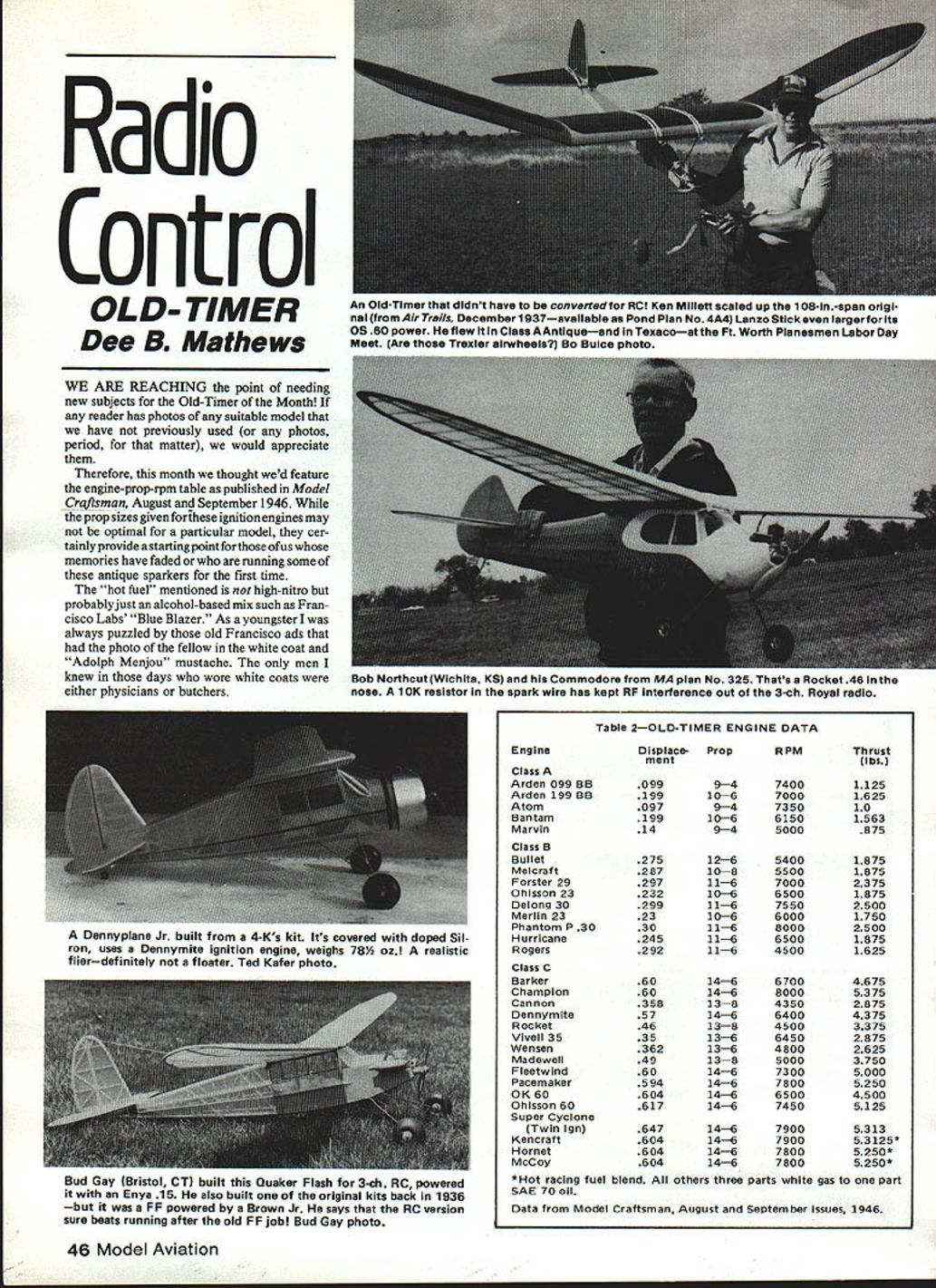
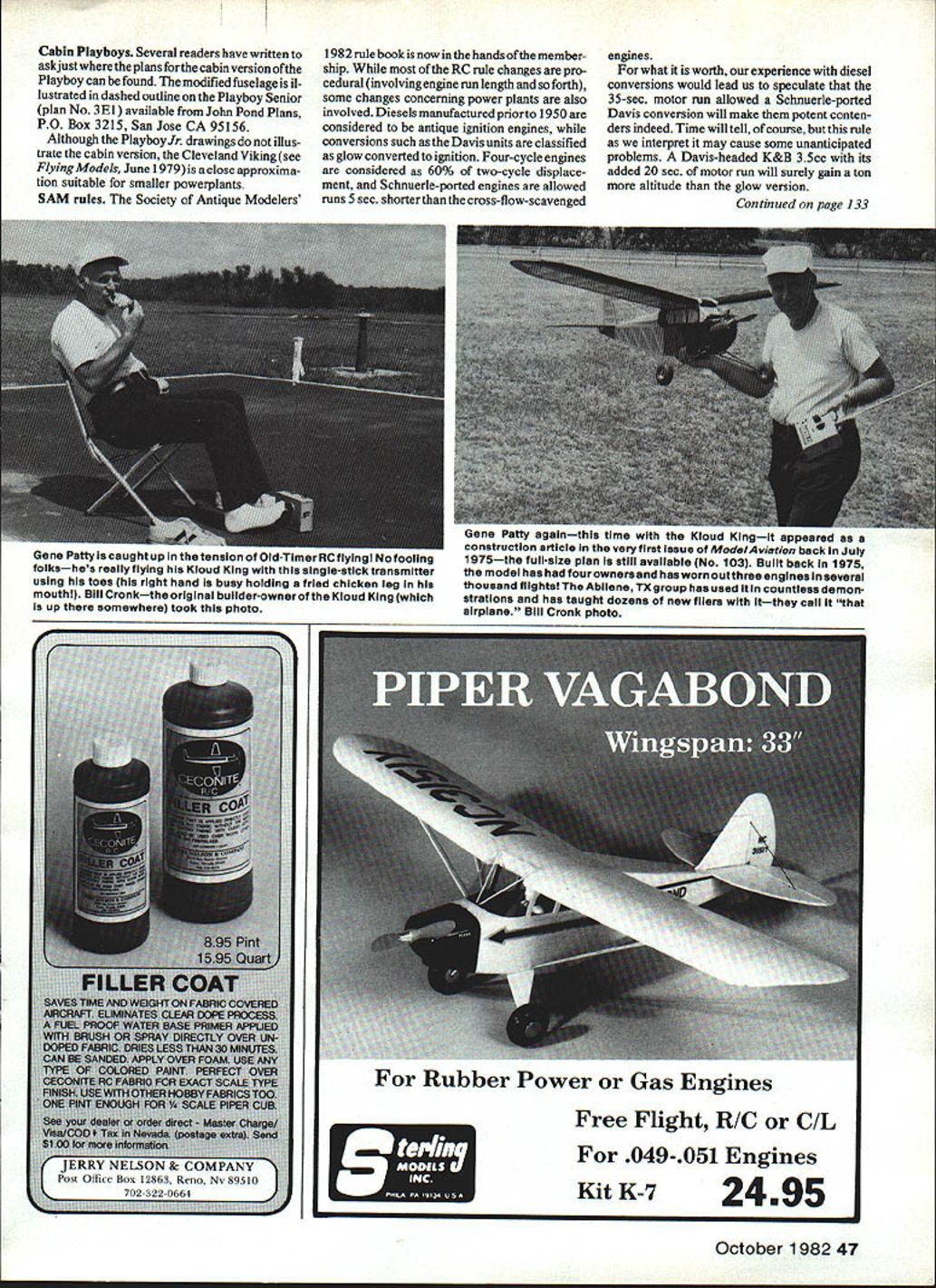
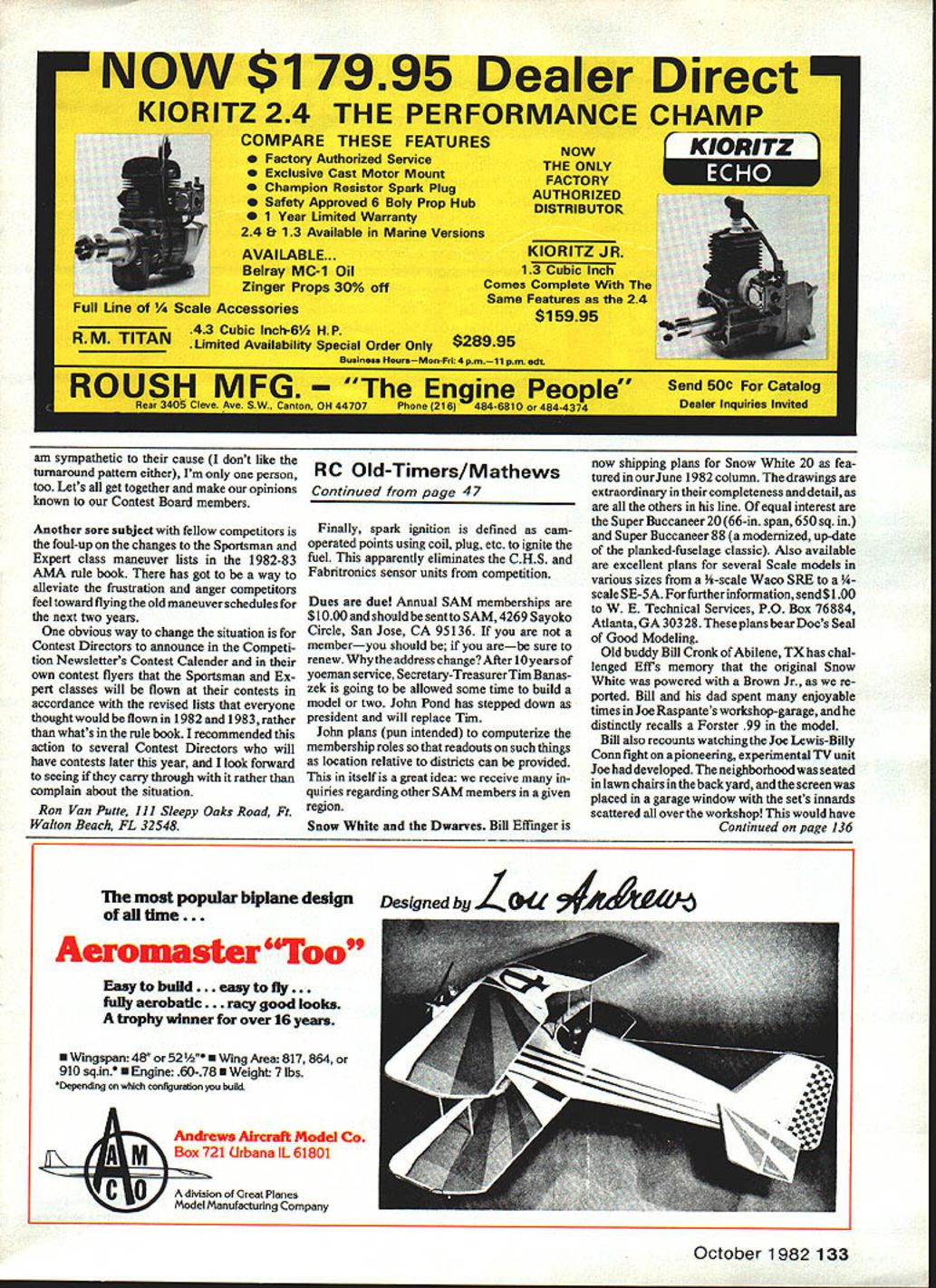
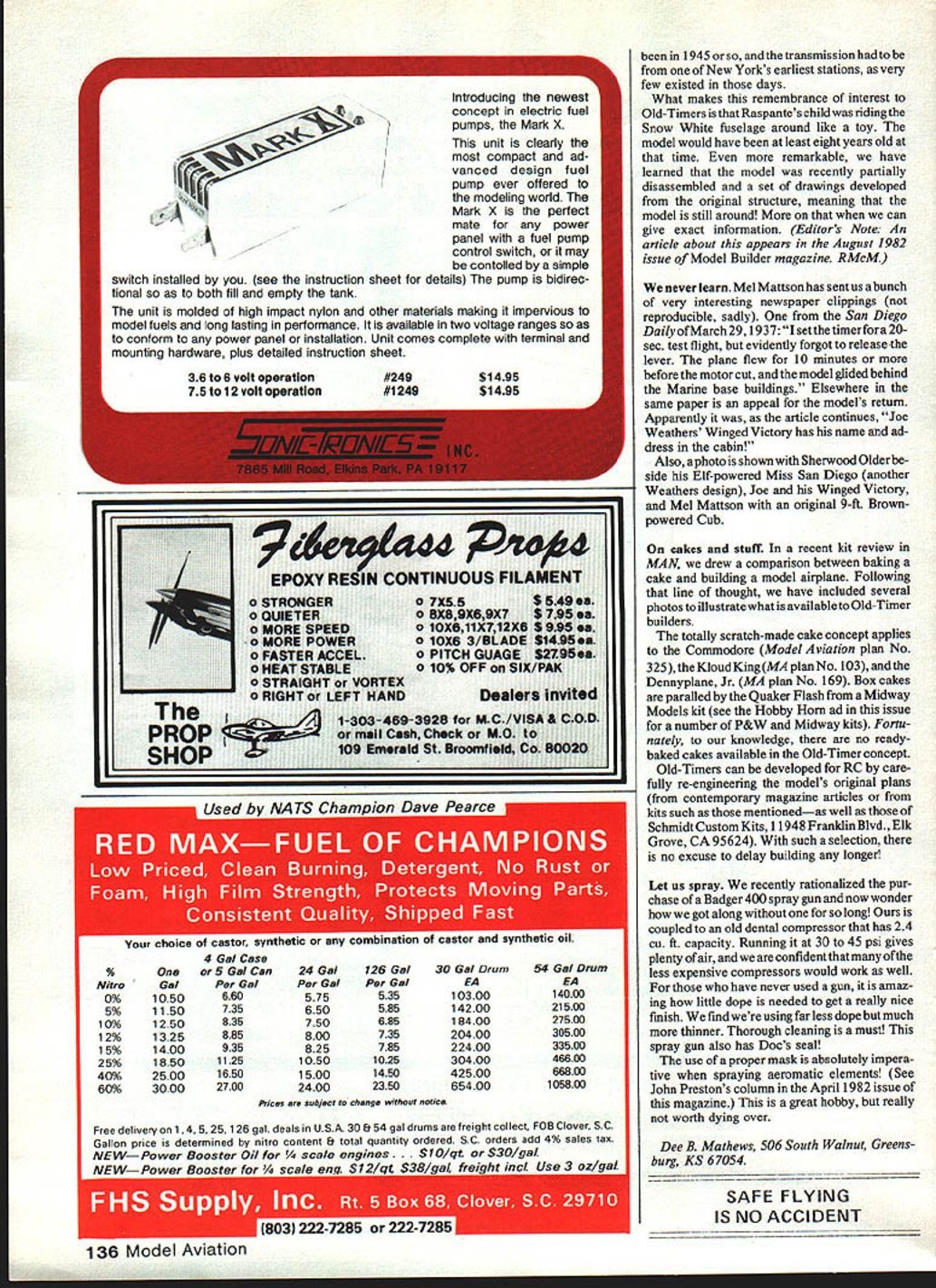
On cakes and stuff. In a recent kit review in MAN, we drew a comparison between baking a cake and building a model airplane. Following that line of thought, we have included several photos to illustrate what is available to Old-Timer builders.
The totally scratch-made cake concept applies to the Commodore (Model Aviation plan No. 325), the Kloud King (MA plan No. 103), and the Dennyplane, Jr. (MA plan No. 169). Box cakes are paralleled by the Quaker Flash from a Midway Models kit (see the Hobby Hors d'oeuvre in this issue for a number of P&W and Midway kits). Fortunately, to our knowledge, there are no ready-baked cakes available in the Old-Timer concept.
Old-Timers can be developed for RC by carefully re-engineering the model's original plans from contemporary magazine articles or from kits such as those mentioned — as well as those of Schmidt Custom Kits, 11948 Franklin Blvd., Elk Grove, CA 95624. With such a selection, there is no excuse to delay building any longer!
Let us spray. We recently rationalized the purchase of a Badger 400 spray gun and now wonder how we got along without one for so long! Ours is coupled to an old dental compressor that has a 2.4 cu. ft. capacity. Running it at 30 to 45 psi gives plenty of air, and we are confident that many of the less expensive compressors would work as well.
For those who have never used a gun, it is amazing how little dope is needed to get a really nice finish. We find we're using far less dope but much more thinner. Thorough cleaning is a must! This spray gun has Doc's seal.
The use of a proper mask is absolutely imperative when spraying aromatic elements! (See John Preston's column in the April 1982 issue of this magazine.) This is a great hobby, but really not worth dying over.
Dee B. Mathews 506 South Walnut Greensburg, KS 67054
Transcribed from original scans by AI. Minor OCR errors may remain.

