
Radio Control: Old-Timer
Dee B. Mathews
Back in the Bad Old Days
Let's take a time-frame jump from the pre-war era into the immediate post-war years to look at R/C flying as it was in 1950. Visiting with younger modelers, we are frequently stunned by the presumption that R/C models and equipment have always been as they are now. Most have only a vague appreciation of the incredible changes the hobby has undergone over the past three decades.
The crude, homemade single-channel radios of DeSoto, Lanzo, the Good brothers, and other pioneers in the 1930s and 1940s were developed through grueling hours of trial and (mostly) error. These early experiments were the work of men who were as much electronics genius as modeler. Equipment operated on the ham bands and was well beyond the abilities of most hobbyists. No fully assembled commercial equipment was available.
Little had changed by 1950, although the Good brothers' design and several others were now available commercially. Rubber-driven escapements, gas tubes, mechanical relays, and heavy dry-cell batteries were still accepted standards.
The Equipment and Its Problems
- Receivers were constantly out of tune; as battery voltage dropped, units had to be retuned with the aid of an ammeter. Most used movable iron-core slugs for tuning.
- Practically impossible to fly twice in a row without a helper carrying the transmitter (or moving the ground-based transmitter) while the operator fiddled with slugs to get a maximum rise or drop on the meter.
- Voltage change opened or closed a relay, passing current to the magnet of the escapement, thereby activating its pawl and moving the rudder.
- Transistors were only in research labs; Ni-Cd batteries were extremely expensive and rare; semiconductors and microchips were unheard of. Advances in circuitry were limited by available components.
- One early lightweight receiver came from a hearing-aid manufacturer.
- Relays suffered from engine vibration, point arcing, and gap changes from loss of spring tension.
- Escapements were notoriously sensitive to the number of winds in the rubber strip: too many winds and the pawls wouldn't catch (causing wild rudder movements); too few winds and linkages could bind to one side.
- Battery "packs" typically consisted of a 30 or 45 volt bias battery plus flashlight cells for tube filaments and another set to energize the escapement. The batteries alone often weighed more than a modern flight pack — and that was for rudder-only control.
- Receivers were commonly suspended from the cabin corners with rubber bands in a hammock-like arrangement to isolate the relay from engine vibration.
Control and Flying Technique
Control, if you could call it that, consisted of full left rudder when the transmitter button was pushed, then neutral, then full right rudder the next time the button was hit. Pilots had to remember the previous command at all times. To continue a left or right turn, one had to blip past the opposite rudder throw — a push-blip-push rhythm.
My own experience in that era: a successful 90° turn was an achievement; a left followed by a right turn was extraordinary; and actually landing the model on the original field was a source of ecstasy.
Designers like Bill Winter, who were getting consistent flights, were regarded as gurus. Bill was editor of MAN at that time and produced many superb single-channel designs. My first successful flight was with his Windy Joe design (from MAN) using an English E.D. R/C system and an O.K. Cub .14 for power. The Windy Joe was essentially an Old-Timer free-flight design with radio added to interrupt its flight path.
One telling anecdote: in an editorial back then Bill related a flying session at which his pushbutton failed. Rather than quit, he disconnected it from the transmitter cord and flew by touching the two wires together. We were all about that primitive ingenuity.
The R/C Champ of 1950 — Gene Foxworthy and the Hoosier Hot Shot
To illustrate how far the hobby has come, consider the National Contest Radio Control winner of 1950.
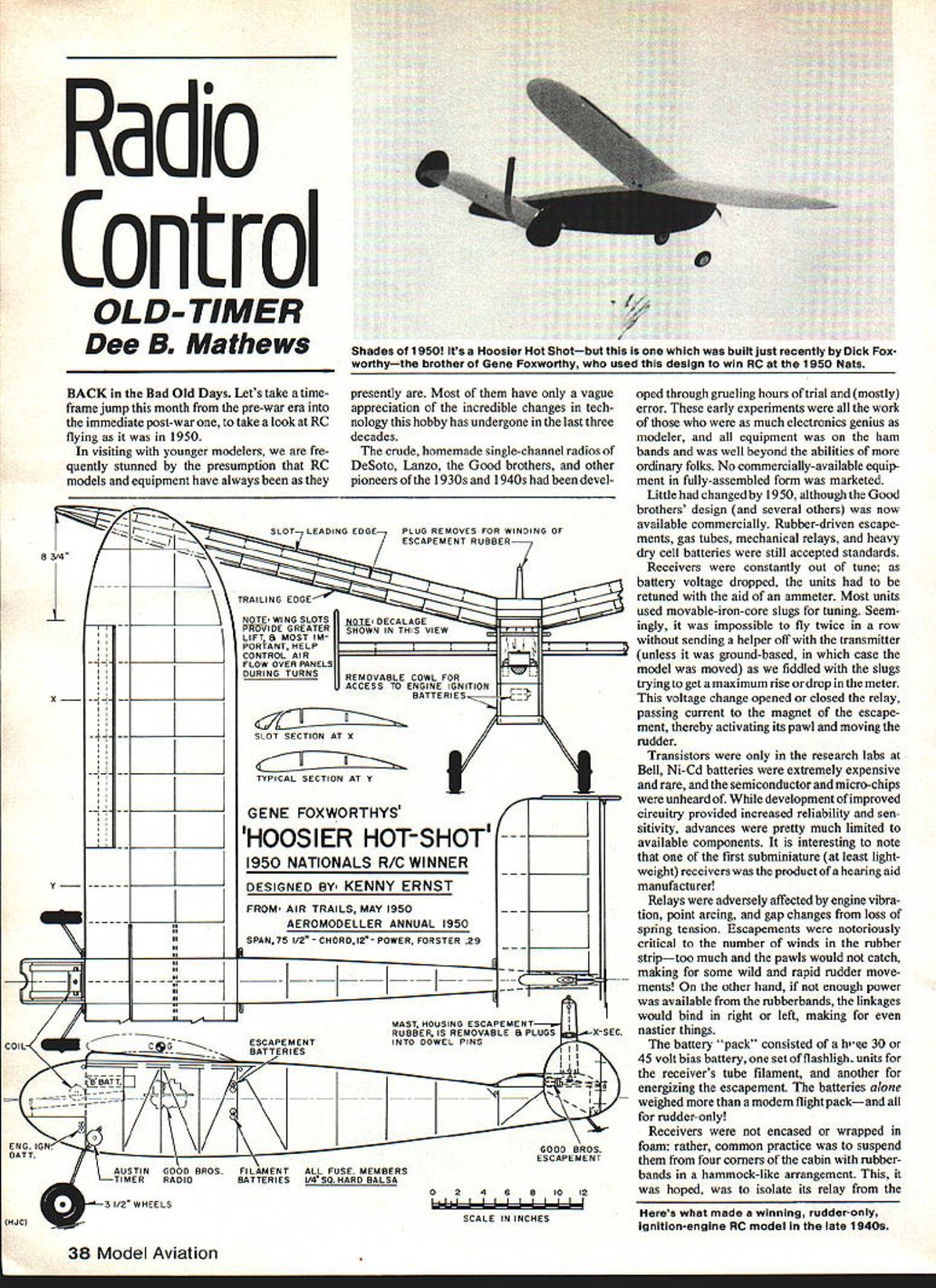
Gene Foxworthy, one of several brothers who operated an automobile engine rebuilding service in Indianapolis, IN, was a WWII Air Corps veteran who had flown many types of military aircraft and had been an active free-flighter in the prewar years. By 1946 Gene became deeply involved in developing radio-controlled models and fabricating his own equipment. His early gear was field-tested on a Kenny Ernst free-flight design that featured wing slots similar to those on the Berkeley Buccaneer Specials. The slots were intended to prevent tip stalling and spins; Ernst had found they cured looping in his free flights, though Gene proved you still could loop with rudder-only.
With help from Frank Volrath (Sal Taibi’s brother-in-law), Foxworthy refined his R/C gear and realized the need for a design better suited to radio control. Using lessons learned from Kenny Ernst, he designed and built the Hoosier Hot Shot (R/C) in 1948. That model placed second at the 1948 Nats and fourth in 1949.
The original powerplant was a Dennymite engine, which overheated so badly that Volrath developed a bolt-on heat sink for it. The Dennymite was eventually replaced with a Forster .29 turning an 11x4 Top Flite prop.
Two seasons of successful flying followed. Gene drew up the Hoosier Hot Shot for Air Trails and a construction article ran in May 1950. Ironically, the design won the National Championship a few months later.
The photos used with the article were of the second unit, but the drawings reflected changes used for the third unit — the Nationals winner. That third model was constructed just prior to the Dallas Nats of 1950 because the other two were destroyed, along with all of Gene’s R/C design equipment, in a disastrous garage fire in August 1949.
The Nationals-winning model used Citizens’ radio equipment that had been developed on contract for Vernon McNabb by IDEA, an electronics firm for whom Foxworthy worked. The Nats-winning model was later sold to McNabb and used as a flying test bed for many years.
Excerpts and Advice from the May 1950 Air Trails Article
Some quotes from the May 1950 Air Trails article illuminate the state of the art then:
- "The history of the average radio control model has been one spiral dive after another. We have all seen a first-class free-flight job spiral dive from a bad launch or gust of wind that disturbed its normal flight path; the movement of the rudder by radio is in effect the same...."
- On design choices: twin rudders were chosen to lower the center of lateral area (a prominent concept at the time) and to place the removable portion as far from the centerline as possible. The classic trimming problem was that with power on the plane would turn too much, while with power off it would turn too little. The Hot Shot's turning-radius difference, power on or off, would have to be measured in inches.
- On power: "Most beginners in Radio Control have a mistaken belief that it takes more power than is really needed." (That hasn't changed a particle in 32 years.)
- On reliability and maintenance: "When making the control system, it is essential that the fits and all connections be free but not sloppy.... We have found the advantage of larger B batteries to more than make up for the additional 4 to 6 ounces of weight. The 30E battery in our plane has made 125 flights in the last year. The pencells can generally hold out for 10 or 15 flights. It is, of course, a good idea to check them regularly and discard them when they go down below 1.2 volts."
- Practical test: "Test fly with the radio in place: you would only be fooling yourself if you fly it empty. After the model is trimmed for free flight, the radio equipment can be used."
- Final admonitions that remain applicable decades later:
- Don't overpower your plane.
- Don't overlook the radio manufacturer's instructions.
- Test the radio often — power on and power off.
- Don't forget to turn the switches on before launching.
Resurrection and Legacy
We are indebted to Don Jenkins of Indianapolis for researching the Hoosier Hot Shot and for tracking down the original (but badly faded) drawings, writing letters to Dick and Gene Foxworthy, and helping bring the story to light.
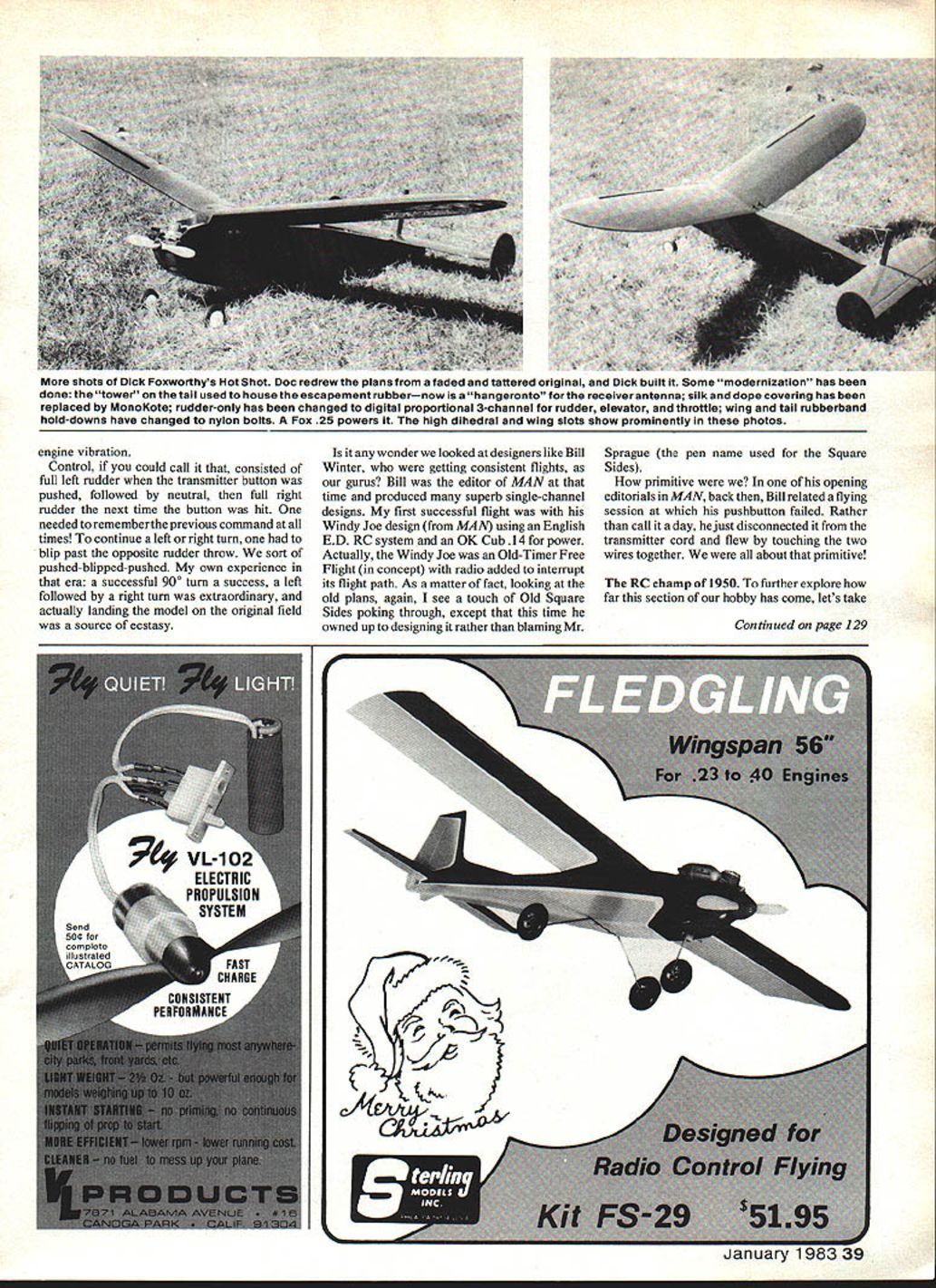
We resurrected those drawings into workable form and sent copies back to Indianapolis. Dick Foxworthy constructed two new models using contemporary engines and R/C gear but retaining the old escapement rubber tail for authenticity. One was photographed and the other was delivered to Gene, who now lives in West Virginia and was recuperating from bypass surgery. At last report, Gene was excited and hard at work on a number of R/C models after nearly 30 years of inactivity. Let us hope he recalls his four rules and follows them to the letter.
Contacts / Call for Old-Timers
Hal Cullins is trying to contact old-timers in Louisiana, Mississippi, east Texas, and adjoining areas. Contact: Hal Cullins, 3483 Coolidge St., Baker, LA 70714. He is a transplanted West Coaster and is looking for others interested in Old-Timers.
Transcribed from original scans by AI. Minor OCR errors may remain.

